- The paper introduces Burnyard, a user-space emulation platform combining syscall/API tracing and machine learning for efficient malware analysis.
- It achieves significant speedups over traditional sandboxes, reporting 1.44× to 14.78× improvements on Windows PE and Linux ELF samples.
- The architecture preserves privacy on commodity hardware by supporting diverse binary formats and delivering robust, family-level malware classification.
Context and Motivation
The increasing sophistication of modern malware—exemplified by polymorphism, obfuscation, and anti-analysis strategies—has exposed the limitations of mainstream dynamic analysis approaches, especially sandboxing via virtual machines. Traditional sandboxes are resource-intensive, susceptible to behavioral evasion, and may inadvertently leak submitted samples to cloud-based platforms (e.g., VirusTotal, MalwareBazaar). The rapid proliferation of AI-driven threats, such as PromptLock ransomware, underscores the need for robust, private, and efficient analysis solutions. Burnyard introduces a lightweight user-space binary emulation architecture, combining structured syscall/API event tracing with advanced classification pipelines, to address these challenges.
System Architecture
Burnyard comprises four modular components: (i) a binary tracer; (ii) a syscall/API hook framework; (iii) a machine learning classifier; and (iv) a web application orchestrating the workflow. The analysis pipeline initiates with binary submission—supporting PE, ELF, JS, BAT, PS1, and more—proceeds through metadata extraction, emulated execution with root filesystem stubbing, and records granular event traces encompassing syscalls, API calls, decoded arguments, and return values. The classification pipeline consumes these traces for malware family identification and generates natural language behavioral explanations via an SLM.
The emulation layer operates at the user-space instruction level, making deployment feasible on commodity hardware without network connectivity. This provides privacy guarantees unmet by cloud-based sandboxes and avoids infrastructure overhead associated with hypervisors and virtual machines.
Behavioral Feature Extraction and Classification
The syscall/API hook framework captures every observable runtime event, maintaining human-readable, chronologically ordered trace logs. The feature vector is structurally aligned with behavioral fingerprints characteristic of specific malware taxonomies: ransomware demonstrates extensive cryptographic/file operations; RATs exhibit persistent process injection and outbound C2 traffic; droppers are dominated by payload delivery APIs. This approach yields discriminative signals for machine learning classification, as evidenced by operational accuracy and misclassification patterns.
Burnyard's throughput was benchmarked against VirusTotal and Sophos Intelix using 100 samples across Windows PE and Linux ELF binaries. VirusTotal’s aggregate response times are driven by static analysis, whereas Intelix provisions dedicated sandboxes introducing substantial execution overhead.
Burnyard achieves the following results:
- Windows PE samples: 22.41 seconds, a 1.44× speedup over VirusTotal (32.36s) and an 8.16× speedup over Intelix (182.88s).
- Linux ELF samples: 5.47 seconds, a 2.97× speedup over VirusTotal (16.27s) and a 14.78× speedup over Intelix (80.85s).
All computations were performed locally on modest hardware (Intel i5, 16GB RAM), with optional GPU acceleration. This demonstrates highly efficient analysis without compromise of privacy or reliance on external infrastructure.
The classification pipeline was evaluated across 44 classes (43 malware families plus benign). Row-normalized confusion matrix analysis reveals strong per-class recall with diagonal dominance. Families with ample training data—Adware.Neoreklami, GCleaner, WannaCry, Socks5Systemz, CobaltStrike—exhibit high recall.
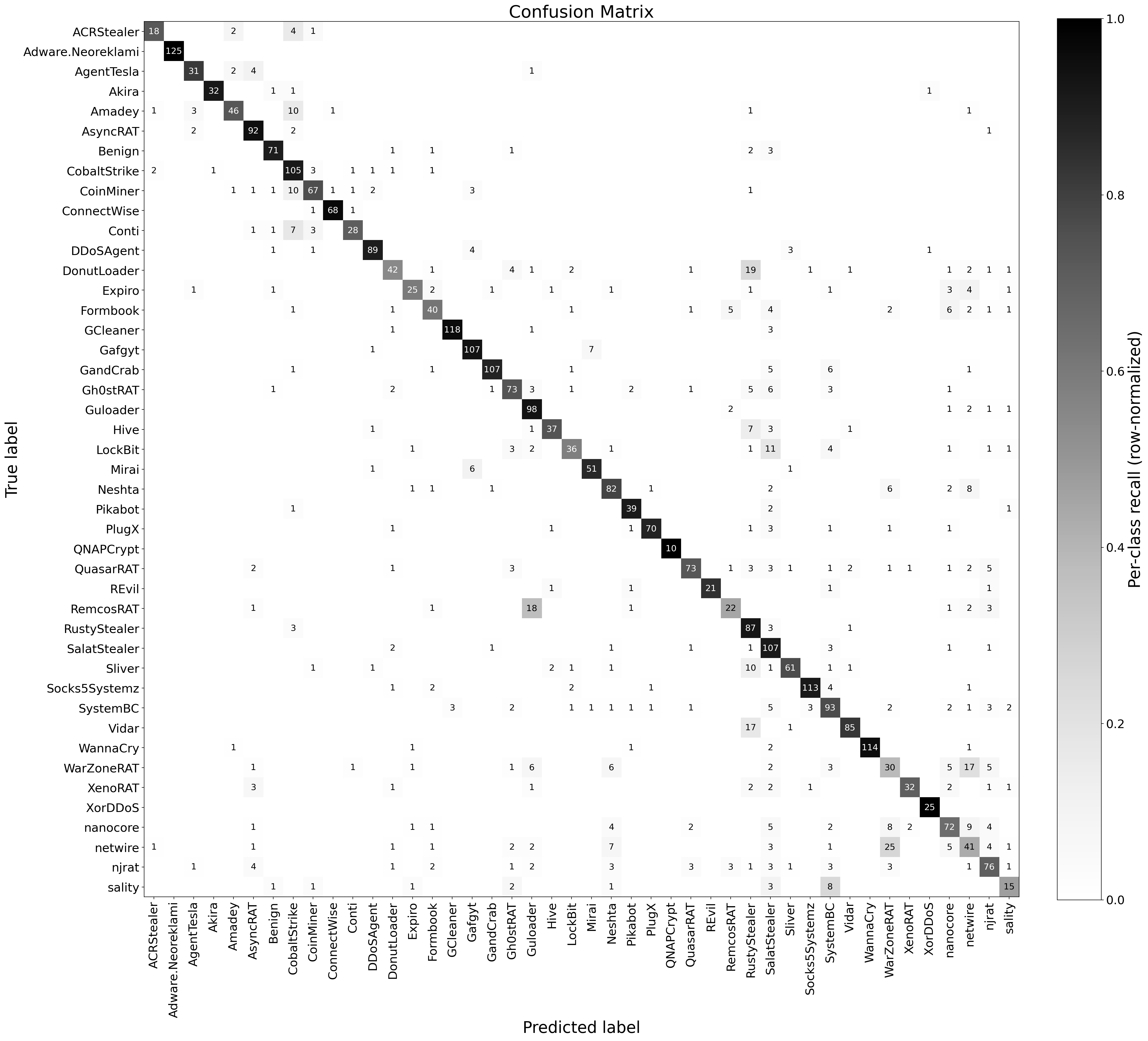
Figure 1: Confusion matrix across 44 classes, showing pronounced diagonal dominance and high per-class recall, supporting robust family-level discrimination.
Misclassifications are concentrated within semantically or behaviorally similar clusters:
- Ransomware: Mutual confusion between LockBit, Hive, Conti, Akira due to convergent cryptographic/file operation patterns.
- RATs: WarZoneRAT, njrat, nanocore, netwire exhibit partial cross-classification attributable to overlapping process injection and keylogging primitives.
- Stealers: ACRStealer, RustyStealer, SalatStealer, and Vidar are generally well-separated via browser credential and wallet enumeration APIs.
- Botnets/DDoS: Mirai and Gafgyt share network-centric traces but separation is achieved through propagation syscall patterns.
Classification ambiguity is structural, reflecting feature overlap and behavioral convergence within taxonomic families rather than random mislabeling.
Practical and Theoretical Implications
Burnyard’s architecture—centered on user-space emulation and privacy-preserving analysis—enables adoption in air-gapped and infrastructure-constrained environments. It offers an alternative to resource-expensive VM sandboxes, suitable for in-house and sensitive forensic workflows, and supports cross-platform binaries with minimal operational overhead. The event trace framework and transformer-based classification pipeline establish a systematic basis for extensible behavioral analysis.
Theoretical implications include the potential for emulation-driven trace features to supplant VM-based dynamic analysis for classification, with careful consideration of emulation completeness and API coverage. As malware families evolve, expanded hook coverage and incorporation of deep behavioral modeling (e.g., graph neural networks, sequence-to-sequence transformers) could augment discrimination and resilience against evasive samples.
Conclusion
Burnyard advances the state of malware analysis through efficient, privacy-preserving user-space binary emulation complemented by a granular syscall/API hook system and robust machine learning classification. The platform delivers substantially reduced analysis latency compared to prominent sandboxing and static analysis tools, without sacrificing recall or privacy. Misclassifications align with structural behavioral overlap, validating the feature engineering methodology. Future developments may leverage richer event representation and next-generation ML techniques, reinforcing Burnyard's utility in adversarial analysis landscapes.