- The paper identifies and characterizes even-denominator FQHSs at ν=3/4 and 5/4, establishing their emergence in the lowest Landau level.
- It employs tunable GaAs quantum wells with precise control over density and charge asymmetry to reveal transitions from one- to two-component states.
- Arrhenius analysis confirms energy gaps (e.g., 0.90 K at ν=3/4) supporting a bilayer composite fermion framework with implications for topological quantum computing.
Observation of Even-Denominator Fractional Quantum Hall States at ν=3/4 and $5/4$ in the Lowest Landau Level
Introduction
Fractional quantum Hall states (FQHSs) in two-dimensional electron systems (2DESs) subject to strong magnetic fields have traditionally manifested predominantly at odd-denominator filling factors in the lowest Landau level (LL), well-captured by composite fermion (CF) phenomenology. Even-denominator FQHSs, particularly prominent in excited LLs (e.g., ν=5/2, $7/2$), are associated with CF pairing and are widely regarded as candidate platforms for non-Abelian quasiparticles. Reports of even-denominator FQHSs in the lowest LL are rare and pose significant theoretical interest due to their unconventional stabilization mechanisms. This paper presents strong evidence for the existence of even-denominator FQHSs at ν=3/4 and $5/4$ in ultrahigh-mobility GaAs quantum wells (QWs) with precise tunability of density and charge distribution symmetry, elucidating the phase space for multi-component FQHSs and the role of competing energy scales in wide QWs.
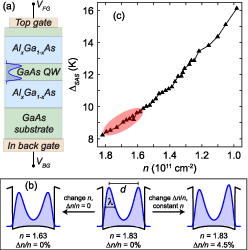
Figure 1: Device schematic, self-consistent charge distributions and potential profiles for a 72.5-nm-wide GaAs QW, and measured ΔSAS as a function of density (n).
The 2DES is realized in a 72.5-nm-wide GaAs QW with both front and back gate control, enabling independent manipulation of total density (n) and the symmetry of the bilayer charge distribution (Δn/n). The device schematic and quantum mechanical charge profiles reveal pronounced layer separation at high density, corresponding to decreased interlayer tunneling strength (ΔSAS), which is experimentally validated via Shubnikov–de Haas oscillations. The ability to tune these parameters allows direct exploration of intra- and interlayer Coulomb interactions and the stabilization of distinct multicomponent ground states.
Figure 1: Charge distribution evolution and energy separation ($5/4$0) as density and charge asymmetry are varied, defining the phase space for bilayer FQHSs.
Transport Signatures and Energy Gap Measurements
Longitudinal and Hall resistances reveal robust, incompressible FQHSs at even-denominator filling factors $5/4$1, $5/4$2, and $5/4$3 at the highest densities. These signatures, including vanishing $5/4$4 and quantized $5/4$5, are accompanied by clear even-numerator and odd-denominator FQHSs, with the emergence of unique bilayer states (e.g., at $5/4$6, $5/4$7) not seen in single-layer systems. Arrhenius analysis of $5/4$8 minima substantiates the energetic gaps: $5/4$9 K, ν=5/20 K, and ν=5/21 K, which are normalized to the Coulomb energy for comparative context. Notably, the ν=5/22 and ν=5/23 states, observed only in samples with mobility exceeding ν=5/24 cmν=5/25/Vs, exhibit gaps comparable to or exceeding those of ν=5/26.
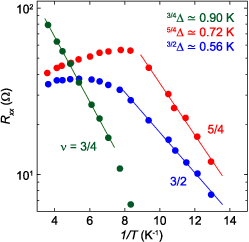
Figure 2: Arrhenius plots quantifying the energy gaps for the ν=5/27, ν=5/28, and ν=5/29 FQHSs.
Evolution and Transition of Ground States
At low density, the 2DES stabilizes 1C FQHSs; as density increases, a transition to 2C, bilayer FQHSs is observed. In particular, the $7/2$0 state transitions from a CF Fermi sea to a robust FQHS, coincident with the disappearance of Jain-sequence odd-denominator states (e.g., $7/2$1, $7/2$2) and the emergence of bilayer states (e.g., $7/2$3, $7/2$4, $7/2$5). This 1C to 2C transition is governed by the reduction in $7/2$6 and the modulation of inter/intralayer Coulomb interaction strengths. A similar transition and complex evolution are evident in the regime around $7/2$7 and $7/2$8, with signatures of both balanced and spontaneously imbalanced bilayer FQHSs. The emergent even-denominator FQHSs do not align with conventional single-layer CF physics at these local layer fillings, necessitating a multicomponent bilayer framework.
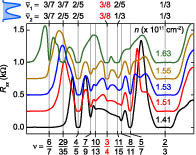
Figure 3: Density-driven evolution from compressible CF Fermi seas to incompressible FQHSs at $7/2$9.
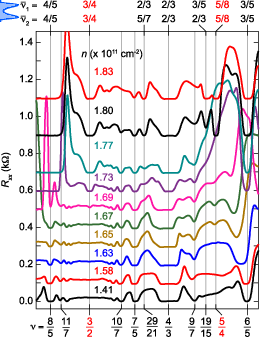
Figure 4: Ground state evolution around ν=3/40 and ν=3/41, displaying transitions between different FQHS regimes as density increases.
Multicomponent Bilayer Framework and Scarola-Jain States
The ground states at ν=3/42 and ν=3/43 are naturally described by generalized bilayer composite fermion frameworks, particularly the Scarola-Jain states, extending the Halperin ν=3/44 wavefunction to states with both interlayer and intralayer correlations. The ν=3/45 notation facilitates a systematic description: the ν=3/46 is a ν=3/47 state, while the observed ν=3/48 and ν=3/49 FQHSs correspond to $5/4$0 and its particle-hole conjugate. Numerical evidence and theoretical treatment confirm that these even-denominator states are layer-balanced, 2C, bilayer quantum liquids, stabilized by the intricate balance of tunneling, Coulomb interactions, and charge distribution symmetry.
Sensitivity to Charge Distribution Asymmetry
Fine control of $5/4$1 enables testing of the bilayer character by destabilizing layer-balanced states with small imposed asymmetry. The critical asymmetries for the disappearance of the even-denominator FQHSs are $5/4$2, $5/4$3, and $5/4$4 for the $5/4$5, $5/4$6, and $5/4$7 states, respectively. This extreme sensitivity unambiguously affirms their 2C bilayer origin. In contrast, imbalanced bilayer FQHSs at e.g., $5/4$8, $5/4$9 are typically strengthened by appropriate asymmetry, supporting their spontaneous charge transfer origin.
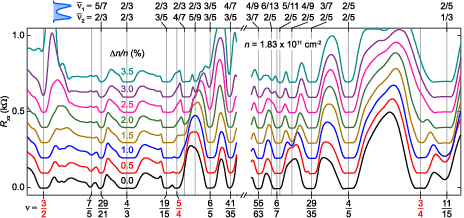
Figure 5: ΔSAS0 traces as charge distribution asymmetry (ΔSAS1) is tuned, revealing extreme susceptibility of even-denominator, layer-balanced FQHSs.
Implications, Theoretical Context, and Future Directions
The identification of robust even-denominator FQHSs at ΔSAS2 and ΔSAS3 in wide GaAs QWs fundamentally extends the family of observed bilayer quantum liquids in the lowest LL. These observations implicate the generalized Scarola-Jain framework as a reliable guide for multi-component FQHS stability beyond traditional Laughlin and CF paradigms. The strong energetic gaps and precise symmetry dependence may guide future engineering of bilayer platforms targeting even-denominator, possibly non-Abelian, phases relevant to topological quantum computing.
The nuanced evolution at ΔSAS4 may suggest the existence of competing 1C and 2C states depending on density and charge asymmetry, paralleling theoretical predictions for the fragile 1/4 FQHS and opening questions regarding the role of electric subband filling in bilayer QWs. Comparisons to graphene bilayer experiments highlight the interplay of tunneling, layer separation, and electron thickness in stabilizing exotic bilayer physics, requiring further exploration of unexplored phase space regions.
Conclusion
This work establishes the existence and energetic scale of even-denominator FQHSs at ΔSAS5 and ΔSAS6 in the lowest LL of ultrahigh-mobility GaAs QWs, providing strong evidence for the multicomponent, bilayer correlated nature of these states via transport measurements and symmetry susceptibility. The results substantiate the Scarola-Jain bilayer CF framework as a robust descriptor of bilayer FQHSs and elucidate the complex phase space navigated by competing energy and length scales. These findings inform future theoretical and experimental pursuits in engineered multicomponent FQHS platforms, with potential for harnessing exotic quantum statistics in mesoscopic and topological applications.

