- The paper introduces a wavelet-MPS framework that represents continuum quantum fields using Daubechies scaling functions.
- It leverages multiresolution analysis to achieve exponential error reduction in ground state energy density with systematic refinement.
- Benchmarking on the Lieb-Liniger model demonstrates accurate correlation functions and effective integration with established MPS algorithms.
Wavelet Matrix Product States for Quantum Fields: A Technical Essay
Introduction and Motivation
The paper "Wavelet Matrix Product States for Quantum Fields" (2606.23823) proposes a strictly variational and scalable framework for representing and optimizing quantum many-body ground states directly in the continuum using the tensor network formalism. Matrix Product States (MPS) have become a numerical workhorse for strongly correlated quantum systems on lattices. However, extension to continuum quantum field theories (QFT) presents significant obstacles, including the lack of a naturally adapted finite basis that preserves spatial locality, regularity required by the Hamiltonian, and a structure that allows efficient continuum refinement. Previous approaches—either through lattice discretization or adoption of specialized continuous MPS (CMPS) forms—have each faced limitations in systematic variational control or optimization algorithmic maturity.
This work resolves these issues by constructing “wavelet-MPS” (wMPS), wherein the local Hilbert spaces are built from Daubechies scaling functions, allowing the effective use of established MPS tools while retaining direct access to the continuum. The inherent multiresolution structure of these functions enables an iterative, numerically stable refinement routine that can systematically approximate the field ground state with precise error control. The approach is benchmarked on the integrable Lieb-Liniger model, with compelling quantitative results for energy and correlation functions and clear evidence for systematic improvement.
Construction of the Wavelet Matrix Product State Ansatz
The foundation of wMPS is a decomposition of the continuum QFT Hilbert space F(L2(R)) into a tensor product over local Fock spaces associated with Daubechies scaling functions at a fixed resolution r. These orthonormal, compactly supported, and sufficiently differentiable (for N≥6) functions provide a basis that preserves the locality necessary for efficient representation and MPO construction of the Hamiltonian. Three core properties motivate their choice:
- Locality: Ensured by compact support of Daubechies functions.
- Regularity: Necessary for finite kinetic energy in models such as the Lieb-Liniger, guaranteed by their differentiability for N≥6.
- Inclusion Property: Spaces at finer resolution strictly contain coarser ones, enabling systematic refinement without loss of variational control.
The generic state at resolution r is represented as an MPS over the local truncated Fock spaces, and the refinement process can extend the representation to arbitrarily fine scales.
Variational Optimization and Benchmark Results
The variational manifold is constructed by restricting to a finite number of bosonic excitations per mode (parameter d) and a fixed bond dimension (χ)—the standard approach for practical MPS computations. The exact representation of the Hamiltonian at a given resolution exploits the locality properties to yield an MPO with well-controlled but high bond dimension, determined by the order N of the scaling functions (702 for N=6 and 3306 for N=8). Optimization proceeds via standard methods (VUMPS, followed by gradient descent).
A central result is the scaling of the ground state energy density error as the resolution r0 increases: the relative error decays exponentially with r1, i.e., linearly with the lattice spacing, and saturates to the exact (CMPS) value as the scale becomes fine enough to be dominated by finite r2 effects.
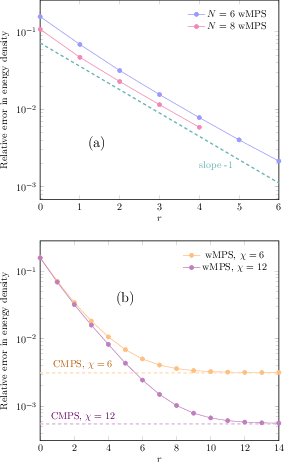
Figure 1: The relative error in the wMPS ground state energy density for the Lieb-Liniger model as a function of resolution r3, showing convergence to CMPS values and exponential scaling with r4.
Crucially, for fixed bond dimension, the energy density plateau aligns precisely with the best CMPS values for the same r5. This provides strong evidence that the wMPS at maximum refinement effectively reproduces the continuous MPS, yet with greater flexibility due to the compatibility with the existing tensor network toolbox.
Correlation Functions and Observables
Because the wMPS formalism does not rely on finite difference discretization, all observables (including multi-point and density-density correlators) can be computed at arbitrary real-space points. The construction ensures local operator expressions that are exact within the truncated subspace.
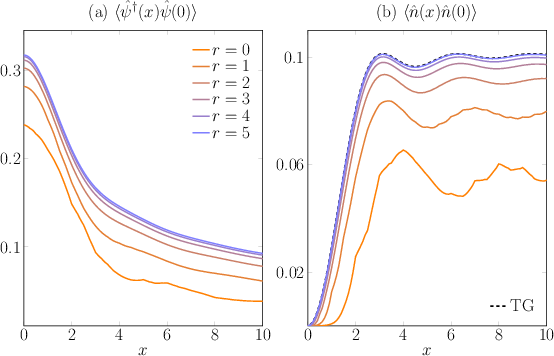
Figure 2: Two-point and density-density correlators computed in the wMPS ground state, illustrating the effect of increasing resolution near the Tonks-Girardeau limit and rapid convergence to the exact behavior.
Observables accurately reproduce the analytically known Tonks-Girardeau oscillations and behaviors, with finite-resolution artifacts decaying quickly. Notably, the minimized ground state at each resolution can display global shifts relative to exact solutions, reflecting its strictly variational nature.
Multiresolution Refinement Algorithm
The paper leverages the full structure of wavelet multiresolution analysis to implement a rigorous and efficient refinement protocol. Starting from a converged MPS at lower resolution, they perform a three-stage process:
- Quantum Circuit Mapping: The inverse wavelet transform (IWT) is expressed as a local brick-wall quantum circuit, which maps lower-resolution scaling functions and wavelet (vacuum) modes to finer-resolution modes.
- ITEBD Contraction: The circuit is contracted into the physical MPS via standard ITEBD routines, resulting in an MPS at the refined resolution (possibly with a larger unit cell and larger bond dimension).
- Translation-Invariant Projection: The MPS is projected back onto the translation-invariant manifold, restoring the symmetry of the ground state.
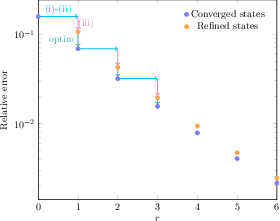
Figure 3: Energy densitiy comparison during refinement: IWT circuit application maintains the energy, and translation-invariant projection significantly lowers it, often approaching the fully optimized finer-resolution value.
Remarkably, the projection step frequently yields an energy density nearly indistinguishable from direct full optimization at fine scales, demonstrating the effectiveness of leveraging symmetry and inclusion in the basis. The numerical efficiency and stability of this method are sharply superior to direct optimization at high resolution, allowing extension up to r6 (r7 physical sites).
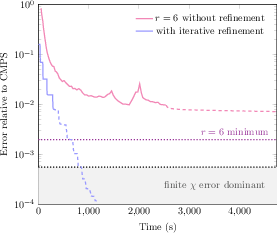
Figure 4: Performance of iterative refinement relative to direct optimization: refinement enables rapid convergence at high resolution, whereas direct optimization fails to reach the regime where finite bond dimension error dominates.
Theoretical and Practical Implications
The architecture introduced permits the application of virtually all advanced MPS-based algorithms to strongly correlated continuum problems. This includes ground state search, excited state computations, real-time dynamics, and the extension to open boundary conditions. The method is strictly variational at all stages, preserving energy bounds and enabling rigorous comparison of different state approximations.
The equivalence of fully refined wMPS with CMPS suggests that the technique can serve as a bridge between discrete tensor networks and continuous QFT representations, potentially allowing for import/export of solutions to higher-dimensional (e.g., PEPS/wPEPS) or even non-relativistic and relativistic cases, provided locality and regularity are maintained.
Another direction, as outlined, is the adoption of more general wavelet families (e.g., biorthogonal) or the design of basis functions optimized for fast convergence in energy and observable calculations. The generalization to higher spatial dimensions is formally straightforward, though the resulting MPO/PETO bond dimensions challenge current computational resources.
Conclusion
This work establishes wMPS as a natural, powerful, and variationally robust ansatz for continuum quantum fields based on Daubechies scaling functions. The method decisively overcomes the challenges of locality, regularity, and inclusion requisite for continuum ground state approximation, and demonstrates exponential error reduction with controlled multiresolution refinement. Compatibility with the MPS algorithmic ecosystem positions wMPS as a versatile tool for quantum field numerics, with broad implications for both non-relativistic and relativistic systems, and possible extension to higher dimensions.
The findings point toward several future research avenues, including systematic comparison with CMPS, basis function optimization, and practical realization of high-dimensional wavelet tensor networks. The formalism promises to expand the applicability of tensor network methods in quantum many-body and quantum field theory contexts.

