- The paper proposes a new formation channel where GW190814’s extreme mass ratio is explained by fragmentation in a neutrino-cooled collapsar disk.
- It employs post-Newtonian N-body simulations and population synthesis to validate how collapsar fragmentation produces low mass ratios and delayed mergers.
- The study predicts detectable electromagnetic precursors, such as the Type Ib SN2019npv, and suggests enhanced Hubble constant constraints using bright siren methods.
Collapsar-Disk Fragmentation as the Origin of GW190814
Overview
The paper offers a comprehensive analysis of GW190814—an observed gravitational wave merger event between a 23M⊙ black hole and a 2.6M⊙ compact object with an exceptionally low mass ratio (q≈0.11). This configuration is distinctly incompatible with all established binary formation channels. The authors propose an alternative scenario: GW190814 was generated by the delayed inspiral of a neutron star or low-mass black hole fragment produced via gravitational instability in a neutrino-cooled collapsar disk around a newly formed black hole. The scenario inherently predicts a temporal association with a stripped-envelope supernova and postulates the existence of electromagnetic precursors. The analysis identifies SN2019npv, a Type Ib supernova, as a plausible precursor occurring approximately 60 days prior within the GW190814 localization volume.
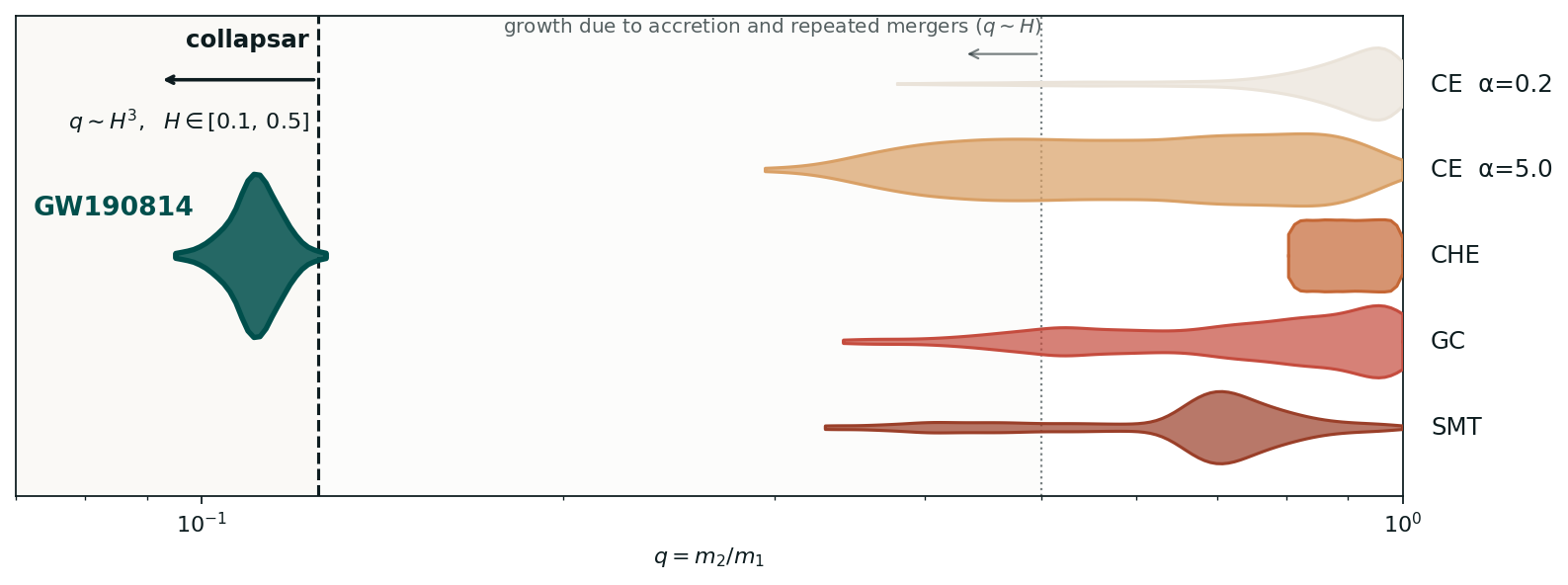
Figure 1: Mass ratio distribution for GW190814 compared to predictions from conventional formation channels; GW190814 lies distinctly within the collapsar-disk window.
All canonical formation pathways (common-envelope, chemically homogeneous evolution, globular cluster dynamics, and stable mass transfer) fail to explain GW190814’s mass ratio, secondary mass, and occurrence rate. Each channel preferentially produces more equal-mass binaries; mass transfer physics drives q toward unity, while dynamical interactions are strongly mass-equalizing due to mass segregation and exchange. Population synthesis studies and parametric mass models highlight that GW190814’s secondary mass and mass ratio are statistical outliers, not consistent with the underlying distribution of compact object mergers.
In contrast, fragmentation in thick (neutrino-cooled) collapsar disks naturally yields compact-object binaries with small q, as the fragment mass is set by disk scale height H (Mfrag∼H3m1). For GW190814, q=0.11 implies H∼0.1-$0.5$, matching theoretical expectations for such disks. The process does not require standard binary evolution, but rather the direct formation of a compact object in orbit around the central remnant, enabling the production of low-mass companions within the observed mass gap.
Delay Mechanism and Merger Dynamics
The scenario requires a delay between the supernova and the merger. Three-body interactions amongst multiple disk fragments result in dynamical scattering, promoting companions to eccentric, wide orbits prior to inspiral, and producing a distribution of merger delays ranging from hours to months. This is quantified via post-Newtonian 2.6M⊙0-body integrations for two 2.6M⊙1 fragments. The outer surviving companion (GW190814’s progenitor) typically receives a strong outward kick, increasing its semi-major axis to 2.6M⊙2 and producing month-scale merger delays, consistent with the observed 2.6M⊙360-day separation between SN2019npv and GW190814.
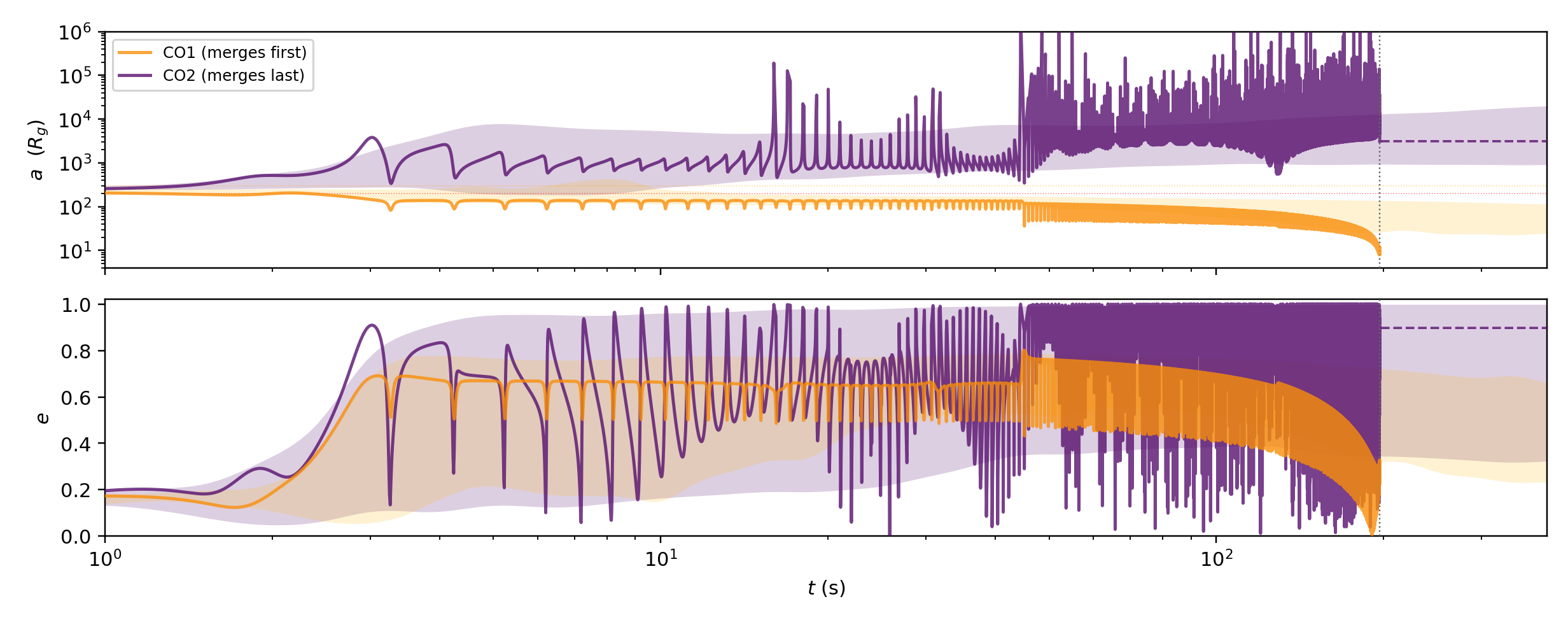
Figure 2: Orbital evolution of two disk fragments; three-body scattering produces divergent migration, with the outer companion (CO2) eventually merging after a significant delay.
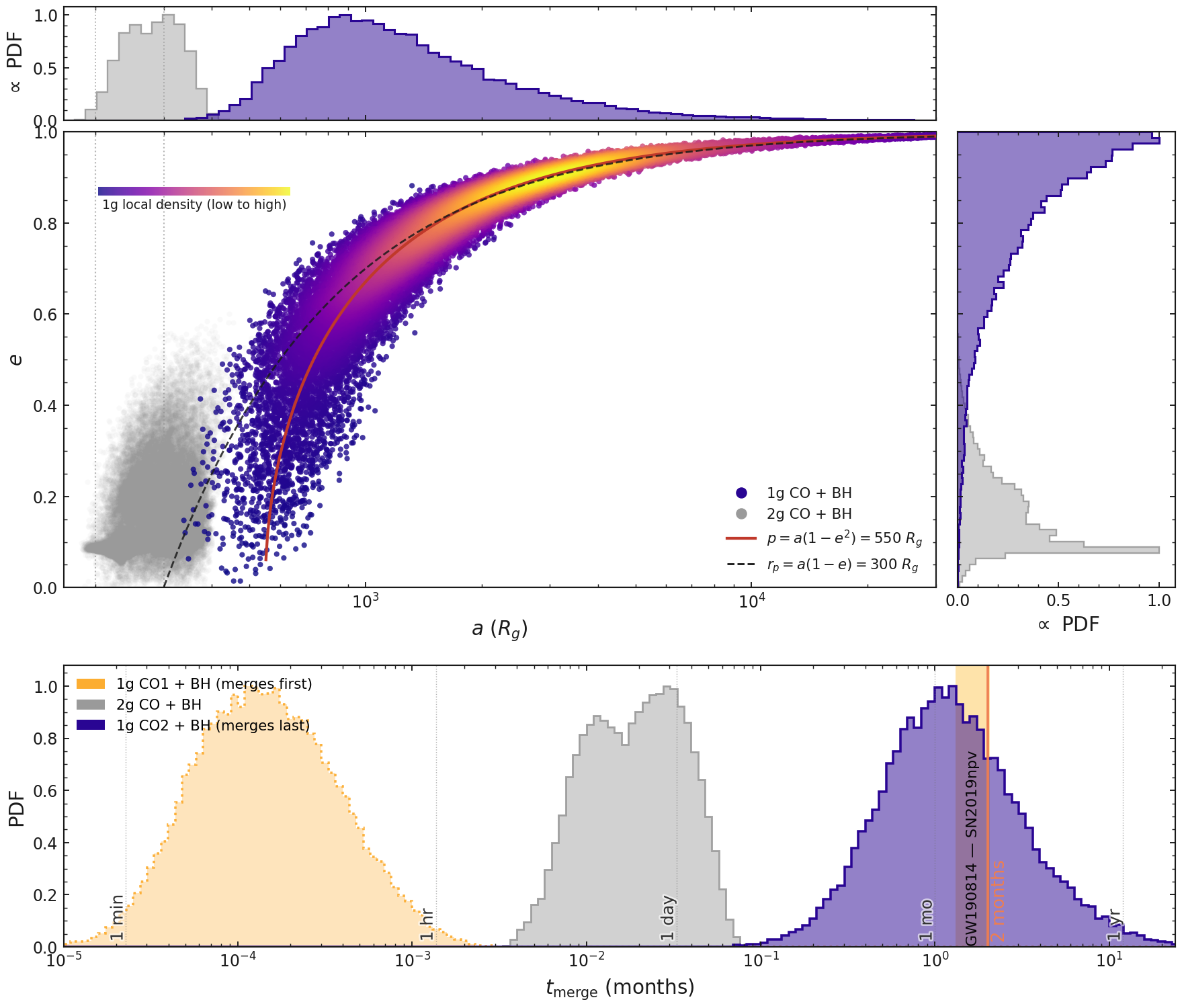
Figure 3: Post-scattering distributions; surviving companions occupy high-eccentricity, large semi-major axis orbits, resulting in delayed mergers and multimodal delay distributions.
Electromagnetic Precursors and Host Association
Collapsar-disk fragmentation implies a stripped-envelope supernova preceding the merger. Type Ib SN2019npv is identified as a candidate precursor, exploding roughly 60 days prior to GW190814 in the same localization volume. Statistical evaluation of the spatial and temporal overlap suggests a 2.6M⊙4 significance for physical association, providing strong but not definitive evidence. If confirmed, the host association enables GW190814 to be used as a "bright siren" to constrain cosmological parameters.
Cosmology with GW190814: Standard Siren Measurements
Treating SN2019npv as the host, the paper leverages GW190814 for Hubble constant (2.6M⊙5) estimation. The event is highly advantageous—higher redshift reduces peculiar velocity uncertainty, and its extreme mass ratio excites higher harmonics in the GW signal, intrinsically breaking the inclination–distance degeneracy.
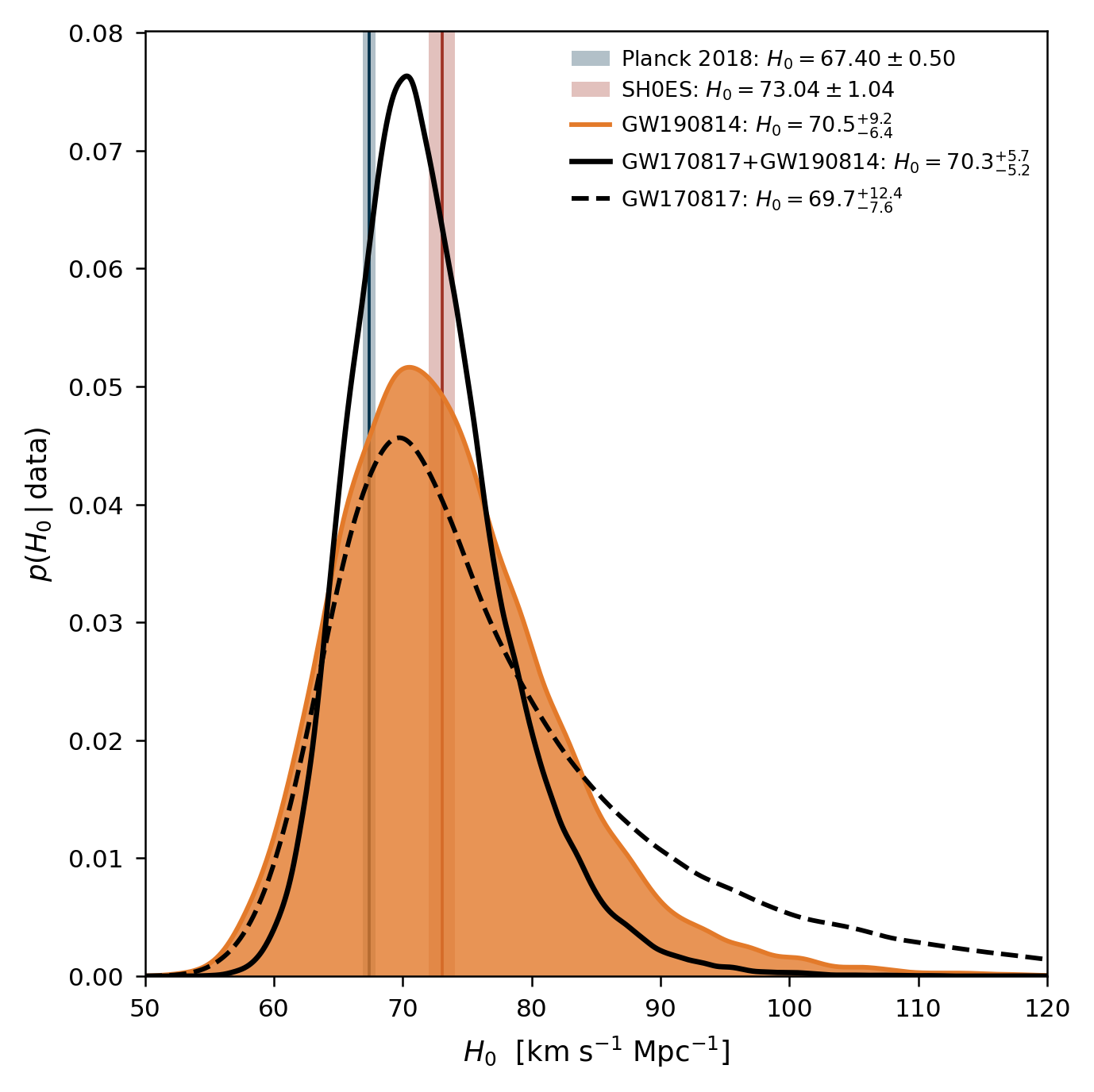
Figure 4: Posterior distributions for 2.6M⊙6; the GW190814 host-associated estimate offers a tighter, more symmetric constraint than GW170817.
From GW190814 alone, 2.6M⊙7, consistent with both Planck and SH0ES values and more precise than prior dark siren methods.
Astrophysical Transients: Embedded Merger Signatures
Delayed mergers occurring inside the ejecta of a preceding supernova are poised to generate distinctive electromagnetic transients. If the merger launches neutron-rich ejecta (i.e., a kilonova), radioactive heating may be reprocessed by the supernova envelope, resulting in late-time excesses, infrared signatures, or even luminous shock-powered optical flares akin to fast blue optical transients (FBOTs) if the merger ejecta collide with the slower supernova shell.
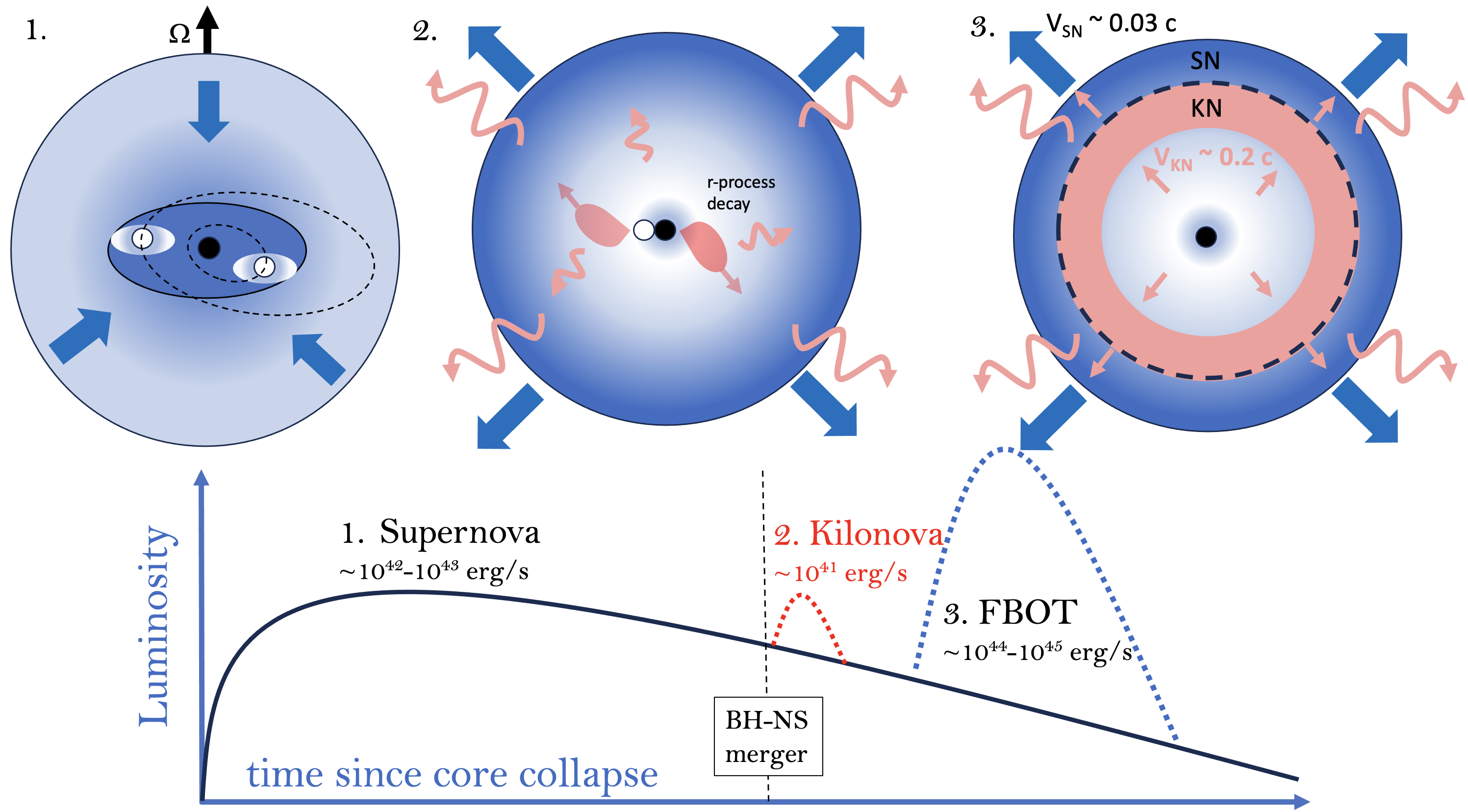
Figure 5: Schematic timeline: collapsar formation, disk fragmentation, delayed merger within supernova ejecta, subsequent electromagnetic transient production.
Channel Rates and Population Implications
Rate estimates based on the local LGRB population, corrected for beaming and central engine fraction, demonstrate that the collapsar channel can plausibly supply GW190814-like mergers at the observed rate (2.6M⊙8), unlike canonical formation mechanisms which are off by orders of magnitude.
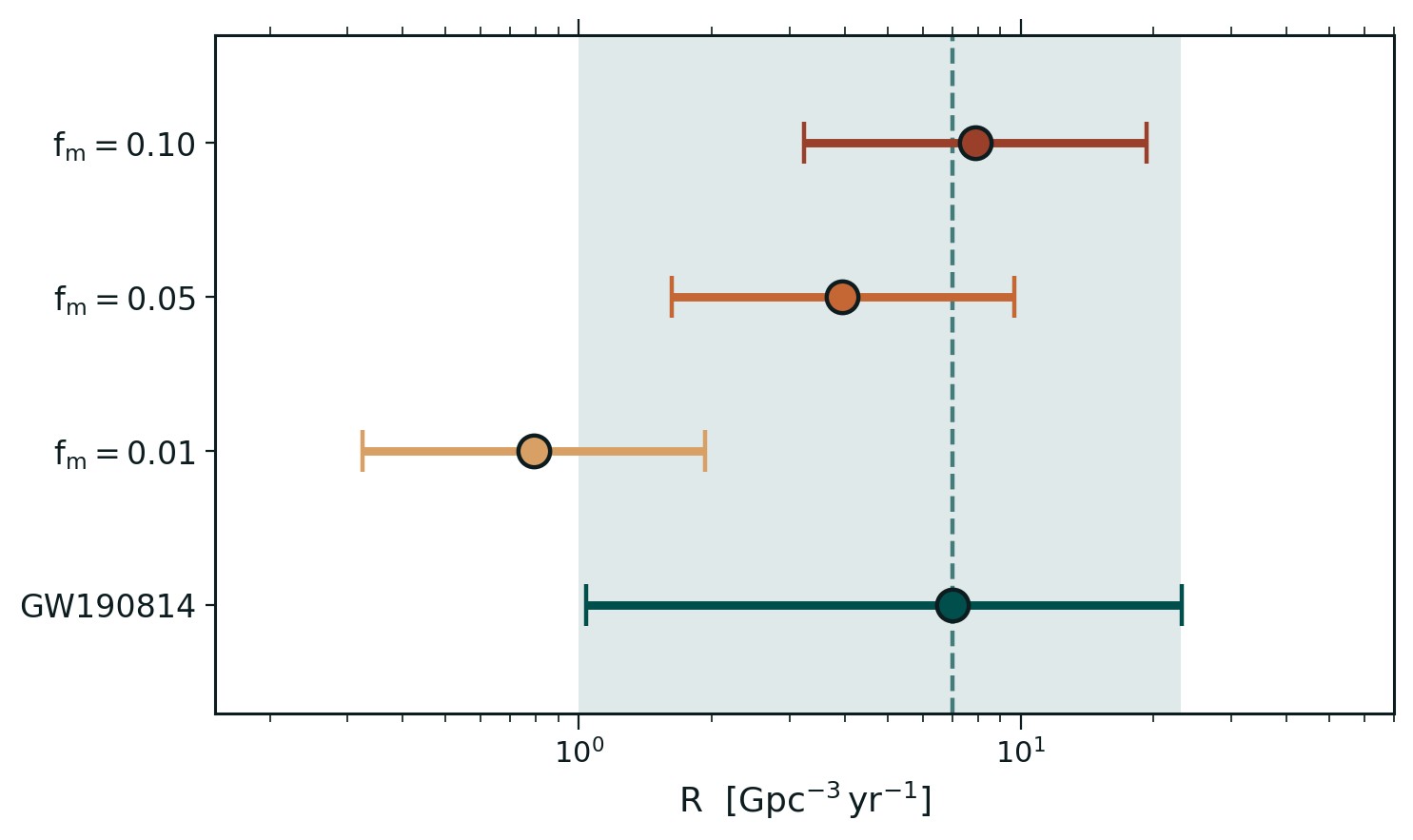
Figure 6: Predicted rates for GW190814-like events via collapsar disk fragmentation, showing overlap with measured LVK rates for plausible fraction values.
Future gravitational wave events exhibiting similar extreme mass ratios, mass-gap secondaries, pre-merger supernova associations, and low primary spins would strongly support the collapsar-disk origin. The scenario predicts a broad population continuum, including sub-solar mergers (e.g., candidates from ZTF), all inherently linked to core-collapse progenitors and fragmentation dynamics.
Conclusion
The collapsar-disk fragmentation framework provides a cohesive explanation for GW190814, unifying its mass ratio, secondary mass, rate, spin, and precursor supernova properties. The mechanism is robust against the deficiencies of established formation channels and is supported by theoretical and numerical evidence for fragment production in thick, neutrino-cooled disks. The scenario predicts delayed mergers, electromagnetic precursors, and unique post-merger transients, offering fertile ground for multi-messenger astrophysics and future cosmological measurements. Ongoing and upcoming surveys as well as future GW detector runs will be critical for further testing the channel and expanding the census of extreme-mass-ratio mergers.

