- The paper introduces a novel Fractal Neural Operator that uses a Prime-Weierstrass embedding to overcome spectral bias in chaotic attractor modeling.
- The methodology leverages prime-indexed cosine bases to capture high-frequency fractal features, extending the Lyapunov prediction horizon by 2.3x.
- Experimental results on the Lorenz-63 system demonstrate improved robustness and a 7.6% increase in prediction accuracy over baseline models.
The Fractal Neural Operator: Overcoming Spectral Bias in Chaotic Attractors via Prime-Harmonic Weierstrass Encodings
Introduction and Motivation
The prediction of chaotic dynamical systems such as Lorenz-63 remains fundamentally constrained by the exponential sensitivity to initial conditions, which is a consequence of the high-frequency, fractal structure of strange attractors. Mainstream neural architectures such as PINNs and Fourier Neural Operators, despite their notable performance on smooth and periodic PDEs, fail to capture the requisite microscopic ruggedness due to an intrinsic spectral bias toward low-frequency features. This smoothing effect critically limits prediction horizons in chaotic regimes. The examined work addresses this limitation through the introduction of a novel operator that structurally encodes high-frequency, non-resonant harmonic components informed by number-theoretic insights.
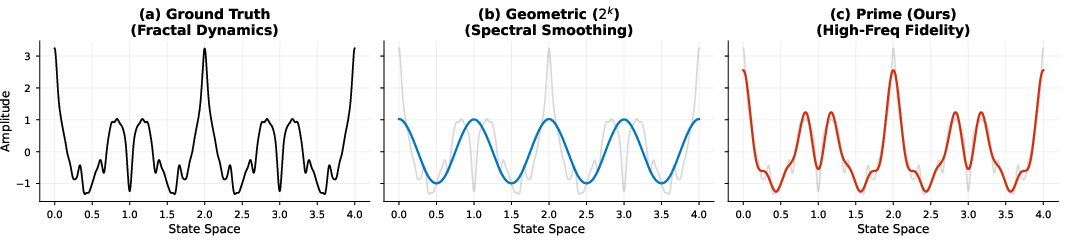
Figure 1: (a) Ground truth fractal function; (b) geometric encoding smooths high-frequency content, inducing spectral gaps; (c) prime-harmonic encoding captures fractal jaggedness essential for chaotic divergence prediction.
Fractal Neural Operator Architecture
The proposed Fractal Neural Operator (FNO) introduces a Prime-Weierstrass embedding that parameterizes input states using a sum of cosines at prime-indexed frequencies, each phase- and amplitude-modulated. The prime set's coprimality ensures non-resonant spectral coverage, thus avoiding artificial periodicity and resonance clustering that arise in geometric (e.g., dyadic) or trainable frequency allocations. The embedding aligns the neural feature space with the inherent aperiodicity and roughness of chaotic attractors.
FNO consists of three key components:
- Prime-Weierstrass Encoder: Lifts the state to a high-dimensional embedding constructed from non-resonant prime harmonics and pink-noise amplitude initialization.
- Evolution Kernel (GRU): Propagates the embedding forward in time; a GRU is selected for strict causality and continuous-time consistency.
- Decoder MLP: Maps the latent embedding back to the physical state space.
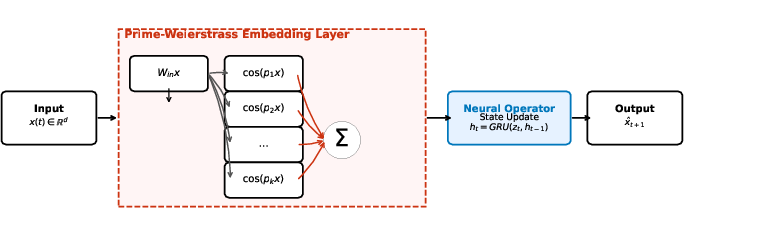
Figure 2: The FNO's pipeline: input lifting by the Prime-Weierstrass block, state evolution through a GRU kernel, and projection to state space; the coprime frequency set enforces aperiodicity and avoids resonance.
By construction, fixing frequency bases to the initial set of primes structurally regularizes the model, enforcing spectral diversity and aligning with the fractal manifold hypothesis of chaos.
Experimental Analysis
The model is benchmarked on the Lorenz-63 system, with experimental metrics focused on Lyapunov Horizon and power spectral density (PSD) of prediction errors. The Prime-Weierstrass-encoded FNO outperforms geometric and random Fourier baselines, increasing the prediction horizon to 347 Lyapunov times (mean), representing a 2.3x improvement over reservoir computing baselines and a 7.6% increase over the geometric operator. Furthermore, the variance in divergence timings is reduced by 14%, evidencing improved robustness.
Importantly, spectral analysis affirms that the prime-harmonic FNO preserves high-frequency components necessary for adherence to the fractal structure of the attractor. Ablation studies confirm that this improvement is uniquely attributable to the coprimality constraint; models with trainable or random frequencies collapse toward spectrally clustered or resonant bases, degrading their ability to sustain long-term chaotic prediction.
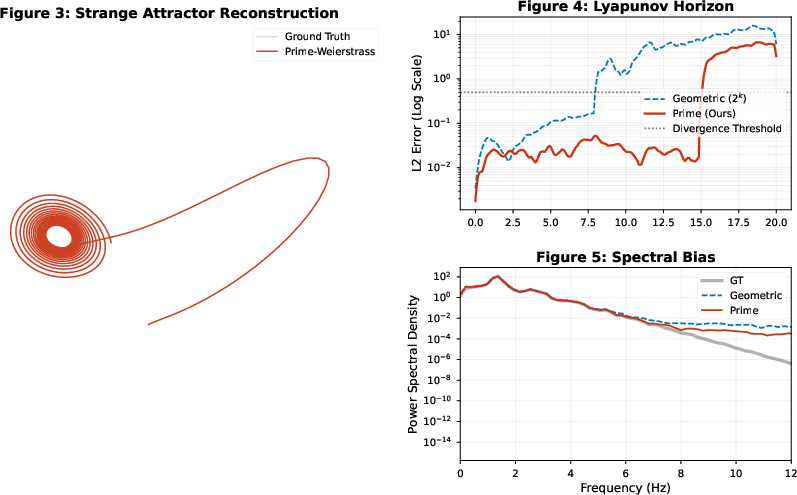
Figure 3: (Left) 3D Lorenz attractor reconstruction; the FNO (red) adheres tightly to the manifold. (Top right) Lyapunov error divergence: FNO extends accurate prediction. (Bottom right) PSD analysis: prime encoding maintains high-frequency fidelity versus baseline drop-off.
Theoretical and Practical Implications
The results substantiate that chaos is not irreducibly unpredictable by deep neural architectures; instead, the core impediment is a mismatch between the model's spectral basis and the fractal geometry of strange attractors. Embeddings that enforce aperiodicity and non-resonance via number-theoretic constructions enable neural operators to achieve longer prediction windows and robust, high-frequency tracking. This indicates that previous limitations in chaotic system modeling stem from architectural biases rather than any inherent limitation of deep learning itself.
Practically, this work advocates for "fractal-informed" operator design in domains where aperiodic, high-frequency details are critical, including turbulence modeling, plasma physics, and financial time series analysis. Architectures leveraging fixed coprime frequency bases could serve as new inductive priors for applications demanding sustained prediction horizons beyond traditional model limits.
Future Directions
Follow-up research avenues include:
- Application to high-dimensional spatiotemporal chaotic flows (e.g., Navier-Stokes turbulence).
- Scaling the principle to operator-learning architectures in more complex, irregular domains and non-autonomous systems.
- Joint optimization of amplitude and phase parameters under a fixed prime basis while exploring alternate coprime sets (e.g., twin primes, k-smooth numbers).
- Integration with differentiable solvers for hybrid equation–data-driven modeling in scientific machine learning.
Conclusion
This work introduces the Fractal Neural Operator as a structural solution to the spectral bias problem in modeling chaotic attractors. By embedding input states with a coprime, non-resonant frequency basis, the operator matches the fractal geometry of chaotic systems, enabling consistent high-frequency modeling and extended prediction horizons. The demonstrated extension of Lyapunov horizons and improved robustness highlights the importance of number-theoretic diversity in neural embedding design. This approach delineates a path toward neural architectures capable of reliable long-term prediction in domains previously considered refractory to deep learning due to chaotic instability.
(2606.23123)

