- The paper introduces a self-evolving agentic retrieval framework that models evidence refinement as an MDP, improving rare retinal disease diagnosis.
- It leverages a graph convolutional network and Group Relative Policy Optimization to enhance semantic homogeneity and label purity.
- Empirical results show significant improvements, including a 21% gain in rare-disease sensitivity with only minimal additional parameters.
Evo-RAD: Self-Evolving Agentic Retrieval for Rare Retinal Disease Diagnosis
Introduction
This work presents Evo-RAD, a self-evolving agentic retrieval framework, designed to address the challenges of rare retinal disease diagnosis using foundation vision–LLMs (VLMs). The primary motivation arises from the limitations of both parameter-efficient fine-tuning (PEFT) and conventional retrieval-augmented diagnosis (RAD) in the context of long-tailed clinical distributions. Specifically, rare diseases are underrepresented during pretraining, making their representations entangled with those of common diseases—leading to hubness-driven distractors and poor sensitivity for rare conditions. Evo-RAD reconceptualizes retrieval as a Markov Decision Process (MDP), employing a dynamic evidence evolution agent that iteratively refines the reference set through DELETE, INSERT, and TERMINATE actions, optimizing for semantic and diagnostic homogeneity with Group Relative Policy Optimization (GRPO).
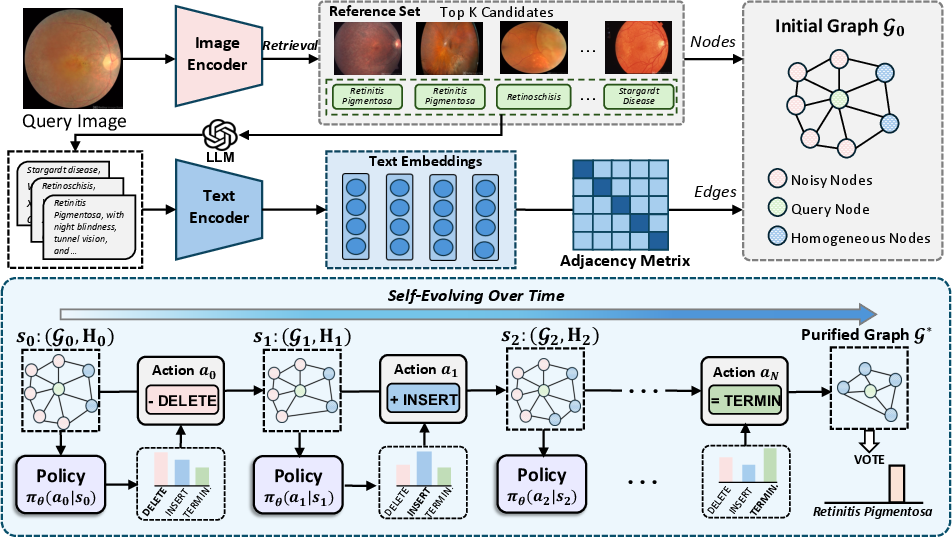
Figure 1: Overview of Evo-RAD. Retrieval is modeled as an MDP, where an agent evolves the reference set using discrete removal, addition, and stopping operations.
Modern VLMs such as FLAIR and RetiZero have demonstrated competitive results on public ophthalmic benchmarks, aligning retinal images with clinical semantics. However, their application to rare retinal disease diagnosis is hampered by severe representation bias, compounded by the hubness phenomenon inherent in high-dimensional spaces and long-tail distributions. Standard PEFT approaches (prompt tuning, adapters) often fail to generalize or overfit—particularly for minority classes with minimal data. Traditional RAD frameworks using static nearest-neighbor retrieval further exacerbate this bias, retrieving visually proximate but semantically incorrect evidence from prevalent diseases.
Evo-RAD aims to shift retrieval from passive matching to an active, reasoning-centric process, analogously modeling clinical diagnostic refinement. The retrieval process is cast as an MDP, allowing for sequential manipulation of the reference set, where each evolution is contextually informed by both visual and expanded semantic relations.
Methodology
Self-Evolving Agentic Retrieval as MDP
A query image q is embedded via a frozen retinal foundation model. The initial Top-K nearest neighbors, X0, are selected. The agent operates in a state space defined by graph-structured encodings of the active reference set, where node attributes include query affinity, initial retrieval rank, intra-set semantic density, and deviations from reference set statistics. A semantic adjacency matrix, constructed using LLM-based clinical tag expansion, encodes the relations among cases.
At each time step, the agent chooses one of:
- DELETE: Removes a reference deemed a distractor/hub, subject to a minimum cohort size.
- INSERT: Adds a new candidate, prioritized by query similarity (buffer-restricted).
- TERMINATE: Ends the evolution when the set is judged sufficiently coherent.
State transitions are deterministic; all operations update both the evidence set and the graph encoding.
Homogeneity-Aware Reward and Relational Policy Learning
A hierarchical reward structure is designed to maximize not only prediction accuracy but label purity (proportion of references sharing the ground-truth class) and intra-set semantic density. The reward for each action is positive-only, encouraging exploration without penalizing suboptimal insertions/deletions during early training—crucial for rare class discovery.
Trajectory-level rewards combine correct majority-voted diagnosis, relative purity gain, and semantic clustering within the active set. These are essential for driving the evidence evolution agent toward reference sets that facilitate rare disease identification.
Policy optimization is handled with GRPO, which does not require a learned value network. Group-normalized trajectory advantages are computed for stable and query-specific updates, thus countering reward sparsity and distribution skew common in long-tailed medical imaging tasks.
Graph Policy Network
The agent policy is parameterized as a two-layer Graph Convolutional Network (GCN) that aggregates both node-specific and graph-wide context for action scoring. The output action distribution blends local deletion competencies and global evidence evolution signals.
Evidence-Conditioned Prediction
Post-evolution, the final diagnosis is determined by majority vote over the current reference set labels, conditioned on the agent-evolved set.
Experimental Results
Extensive evaluation is performed on the Retina Image Bank (RIB), focusing on both Rare-20 (rare diseases only) and Retina-31 (rare + common diseases), with strict single-label splits to avoid co-morbidity interference. Evo-RAD is compared against baseline VLMs, static retrieval, and a suite of PEFT and retrieval-augmentation methods.
- Rare-20: Evo-RAD achieves 46.28% ACC, 40.99% macro-F1, and a rare-disease sensitivity of 42.43%, outperforming linear-probe and zero-shot VLMs (e.g., RetiZero at 13.05% sensitivity under linear probing).
- Retina-31: Evo-RAD attains 65.33% ACC, 51.45% macro-F1, and 49.53% sensitivity, surpassing static retrieval (RAC), PEFT baselines (CoOp, XCoOp), and parameter-heavy adapters—all while consuming only 116.4K trainable parameters.
Strong empirical claims include:
- Evo-RAD yields a +21.04% absolute improvement over best foundation model baselines for rare-disease sensitivity.
- Gains over advanced PEFT and retrieval-based methods exceed +3.56%.
A detailed ablation study validates the contributions of state representation, individual reward components, and initial retrieval set size.
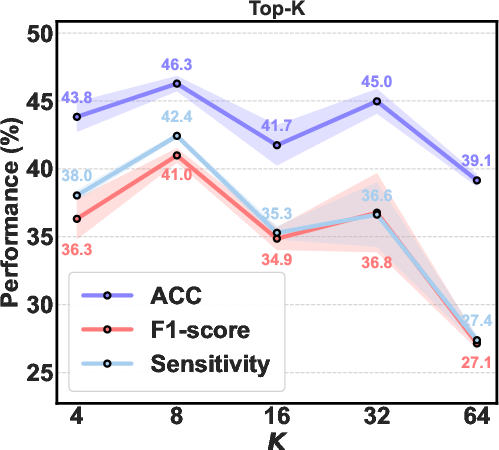
Figure 2: Impact of removing state features and reward components on accuracy and sensitivity. Removing mean deviations, base metrics, or purity/density rewards consistently degrades performance.
Practical and Theoretical Implications
Evo-RAD demonstrates that self-evolving, agent-based retrieval is superior to static or fixed retrieval augmentation in imbalanced medical settings—especially for rare-disease identification. By explicitly modeling evidence refinement as a decision process equipped with relational reasoning and reward shaping, the method counteracts hubness and semantic dominance from majority-class samples. The lightweight design and explicit final prediction conditioning on evolved evidence sets make Evo-RAD tractable for clinical deployment under realistic computational constraints.
The approach bridges reinforcement learning, graph-based relational reasoning, and retrieval-based AI for medical imaging, facilitating principled adaptation of foundation models to data distributions fundamentally mismatched with those encountered during pretraining.
Future Directions
Potential extensions include adaptation to multi-label and co-morbid scenarios and exploration of more complex evidence-evolution graphs, including incorporation of additional modalities and temporal data. Given the compatibility with any frozen encoder, Evo-RAD could be generalized across other medical specialties, rare event detection, and ultra-fine-grained classification domains.
Conclusion
Evo-RAD introduces a principled, agentic evolution of retrieval sets for rare disease diagnosis, leveraging discrete evidence refinement and homogeneity-based reward optimization. It consistently and substantially surpasses both PEFT and static retrieval methods, establishing new levels of rare-class sensitivity with minimal parameter overhead. Evidence evolution via agentic MDP formalism provides a robust framework for addressing the intrinsic challenges of long-tailed and imbalanced clinical AI.

