- The paper establishes theoretical conditions for maintaining Gaussian entangled states in high-harmonic generation using bright squeezed light.
- It employs analytical and numerical models to differentiate between nonlinear non-Gaussian dynamics and linear regimes that yield multimode Gaussian quantum correlations.
- The study demonstrates the utility of collective mode entanglement for quantum teleportation and offers criteria for exploiting entanglement in complex HHG processes.
Emergence of Gaussian Entanglement and Non-Gaussianity in High-Harmonic Generation Driven by Bright Squeezed Light
Introduction and Motivation
This paper presents an in-depth analysis of the quantum optical states generated in atomic high-harmonic generation (HHG) driven by bright squeezed vacuum (BSV) light, elucidating conditions under which the emitted harmonics exhibit Gaussian or non-Gaussian characteristics. The study addresses a fundamental question at the intersection of strong-field physics and quantum optics: how do quantum properties of non-classical driving fields—specifically bright squeezed states—translate through the highly nonlinear HHG process, and what are the resulting implications for generation and control of multimode entangled states in the extreme ultraviolet regime?
The motivation stems from recent demonstrations of non-classical light effects in strong-field phenomena. While standard HHG with coherent drivers typically produces radiation with classical or uncorrelated Gaussian statistics, BSV-driven HHG, enabled by advances in high-gain spontaneous parametric down-conversion, leads to qualitatively new regimes. The strong field fluctuations inherent to BSV sources are capable of imposing super-Poissonian statistics and non-trivial quantum correlations onto the harmonic emission, yielding rich structure in both the photon-number and phase-space distributions.
Theoretical Framework: Conditions for Gaussianity in HHG
The formal development is grounded in the calculation of the characteristic function of the quantum optical state produced via HHG, explicitly connecting the structure of the driving field, the atomic response, and the nature of the resulting harmonic field. The authors systematically delineate two key conditions for Gaussianity of the emitted state:
- Gaussianity of the Input State: The statistical amplitude c(α) describing the driver in the coherent state basis must itself be Gaussian.
- Affineness of the Quantum Response: The mapping α→χ(α), which relates the coherent amplitudes of the input to the HHG spectral amplitudes, must be affine (or at least approximately linear) in the relevant region of phase space.
These criteria ensure that the quantum state post-HHG remains Gaussian and therefore fully described by its first and second moments.
HHG Driven by Bright Squeezed Light: Analytical and Numerical Insights
Employing these conditions, the work provides a detailed scenario analysis:
- For monochromatic BSV driving, the nonlinear dependence of HHG spectra on the driving amplitude leads to strong non-Gaussianity: the mapping is highly nonlinear over the broad support of the BSV phase space, yielding harmonic states with significant super-Poissonian fluctuations and mixed, non-Gaussian Wigner distributions.
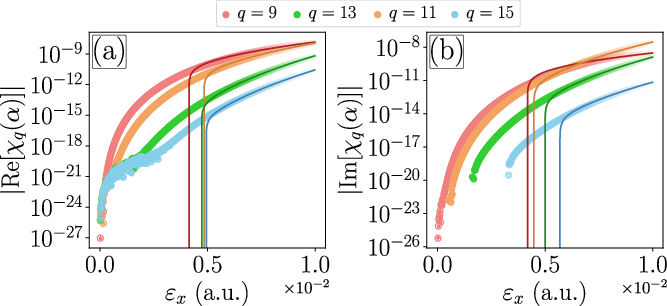
Figure 1: Dependence of the real and imaginary parts of the HHG spectral amplitudes for a BSV driver as a function of electric field strength, illustrating the nonlinear, non-affine mapping α↦χq(α) at high squeezing.
- In contrast, for bichromatic driving—a strong coherent field at ω and a perturbative BSV at 2ω—the process becomes approximately linear in the weak BSV amplitude. In this regime, the odd harmonics depend only on the coherent field, whereas even harmonics scale linearly with the quadrature of the BSV component. This configuration satisfies both Gaussianity conditions, leading to separable even/odd manifolds and enabling the emergence of genuinely multimode Gaussian entangled states among the even harmonics.
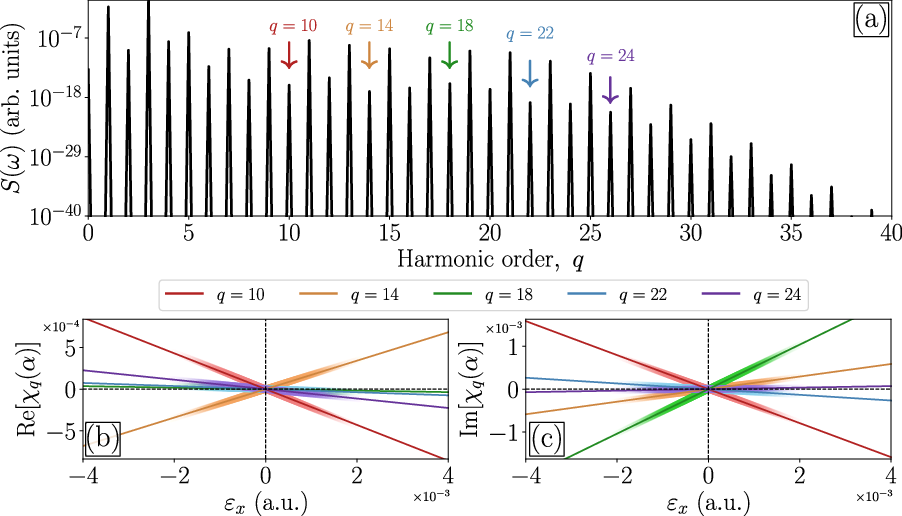
Figure 2: Bichromatic HHG: (a) Spectrum showing orders, (b,c) Real and imaginary parts of HHG spectral amplitude for even harmonics, exhibiting linear dependence on the BSV quadrature.
Analytical Model of the Harmonic State and Collective Mode Structure
To provide tractable analytical results, the authors introduce an effective one-quadrature model for the BSV driver, justified by the extreme squeezing anisotropy (r≫1), allowing reduction of the phase-space integral to the dominant anti-squeezed direction. The approximated harmonic state for the even channel can be represented as a collective excitation:
$\ket{\Tilde{\Phi}_{\text{even}}(t)} = \int_{-\infty}^{\infty} d\alpha\, \tilde{c}(\alpha) \hat{D}_\mathrm{coll}(\bar{\chi} \alpha) \ket{0}$
where D^coll(⋅) displaces an effective collective mode constructed from the even harmonics.
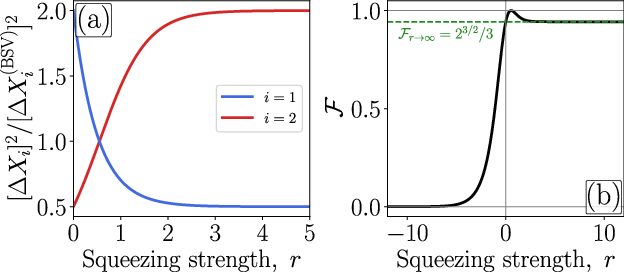
Figure 3: Comparison of the antisqueezed and squeezed quadrature variances (a) and fidelity (b) between the exact BSV state and the one-quadrature model as functions of squeezing parameter r.
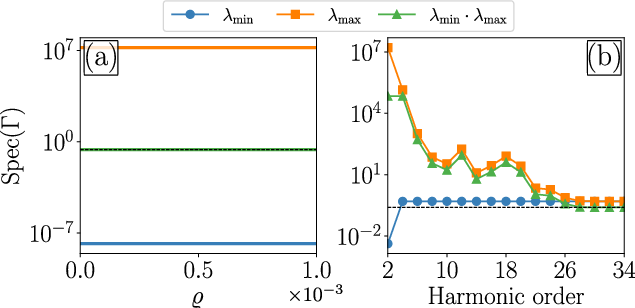
Figure 4: Eigenvalues of the covariance matrix for the collective excitation mode, confirming preservation of minimum uncertainty for the global Gaussian state.
The covariance structure and phase-space wavefunction are obtained analytically, and the preservation of the Gaussian character is shown explicitly for all quadratures. Individual harmonics, however, are mixed due to tracing over the global mode, with squeezing properties that are sharply suppressed on a per-mode basis except for the fundamental 2ω component.
Multipartite Entanglement and Operational Benchmarks
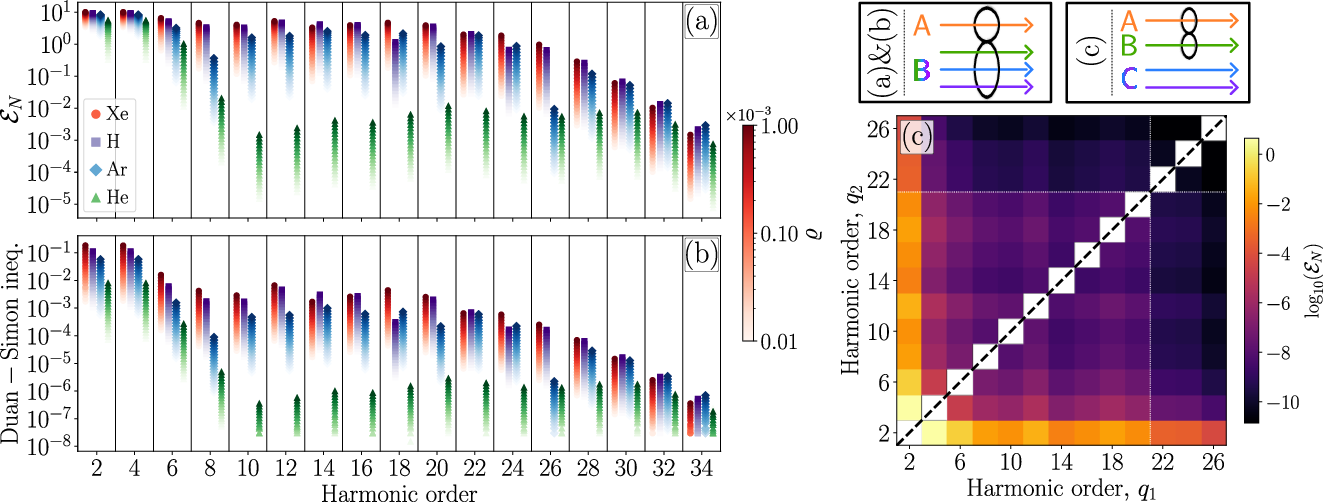
A full covariance matrix analysis quantifies the degree and structure of harmonic mode entanglement:
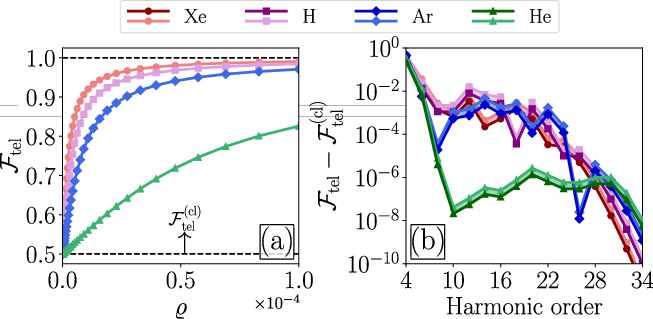
The resource character of this entanglement is benchmarked by considering its ability to enable quantum teleportation of continuous-variable states:
Breakdown of the Gaussian Regime and Onset of Non-Gaussianity
As the squeezing parameter or coupling strength increases and the BSV component becomes non-perturbative, the linear mapping approximation fails. The paper demonstrates that both even and odd harmonic Wigner functions lose their Gaussian character, developing multi-lobed or “non-classical” tails in phase space. The emergence of non-Gaussian mixed states coincides with the onset of strong nonlinear response in the HHG spectral amplitudes.
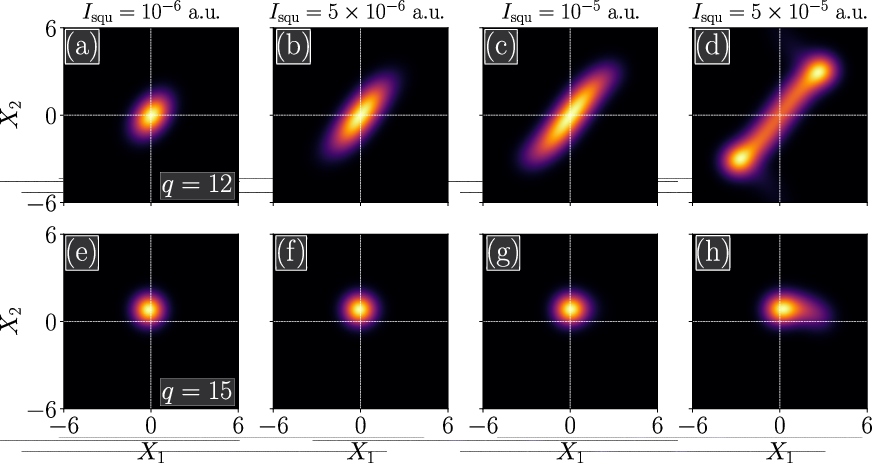
Figure 7: Wigner functions of (top) even and (bottom) odd harmonics for increasing squeezing: transition from Gaussian to strongly non-Gaussian phase-space structure at high squeezing.
Comparative and Supplementary Analyses
Comprehensive supplemental analyses are included:
- Comparison between exact BSV and model states via beam splitter-induced entanglement, quantifying model limitations.
- Sensitivity of covariance and entanglement properties to phase details of the squeezing.
- Optimization methods for experimental entanglement witnesses.
- Discussion of Cauchy-Schwarz inequalities in the present Gaussian context, showing saturation and limitations for entanglement certification.
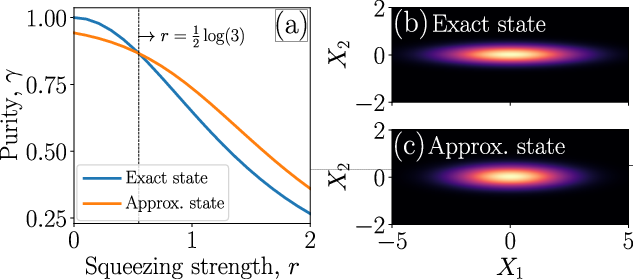
Figure 8: Purity comparison and Wigner functions for exact versus model squeezed states fed through a beam splitter.
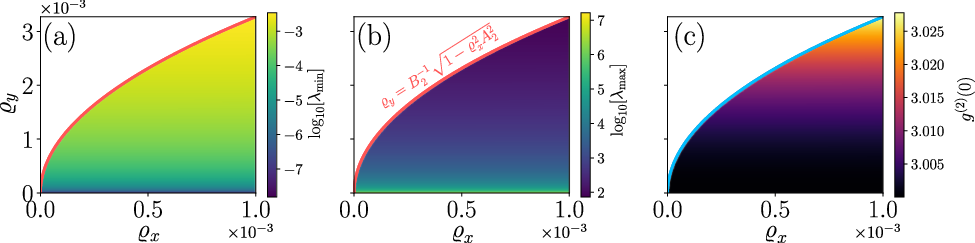
Figure 9: Covariance eigenvalues and autocorrelation of the HHG harmonic modes in two-dimensional parameter space, corroborating the Gaussian/non-Gaussian transition.
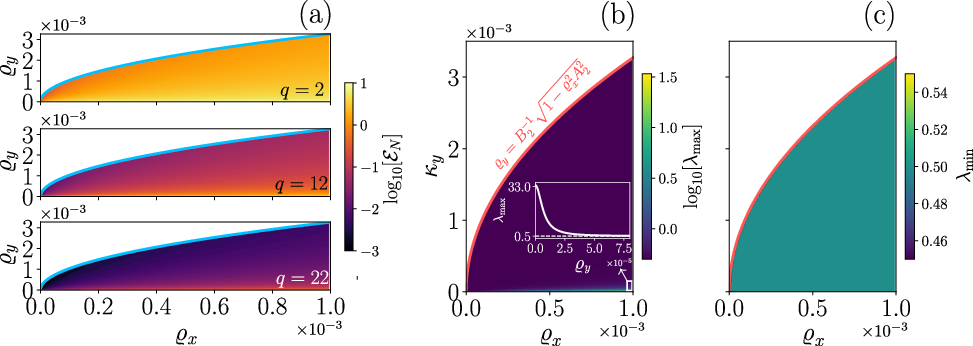
Figure 10: Analysis of two-mode covariance and entanglement properties for generalized bipartitions in the harmonic manifold.
Implications and Future Directions
The demonstrated ability to generate and characterize distributed multimode Gaussian entanglement via bichromatic HHG opens new avenues for quantum information protocols in the vacuum ultraviolet regime, where standard techniques are otherwise constrained by photon energy limitations. The analysis further highlights the regime of validity for Gaussian state approximations and the potential to drive beyond into non-Gaussian, highly mixed, and correlated photon statistics.
Key implications include:
- Operational Resource Availability: Only collective mode entanglement is practically exploitable for high-fidelity teleportation and related protocols due to the distributed nature of the quantum correlations.
- Experimental Accessibility: The development of entanglement witnesses based on reduced covariance information (e.g., Duan-Simon, semidefinite programming methods) can ease experimental requirements for certification.
- Non-Gaussian State Engineering: The breakdown regime may be harnessed to generate complex non-Gaussian states as resources for fault-tolerant and universal quantum computation in the continuous variable setting, where Gaussian operations alone are insufficient.
Future work may address extensions including propagation effects, phase matching, and collective emission in macroscopic media, as well as the interplay between material-specific and driver-induced correlations. The platform is also promising for probing quantum optics phenomena at attosecond and vacuum ultraviolet timescales.
Conclusion
This paper establishes clear theoretical conditions under which bichromatic HHG with BSV driving generates genuinely multimode Gaussian entangled states, develops analytical and operational benchmarks for their characterization, and delineates the nonlinear regime that marks the transition to non-Gaussian and highly non-classical light. These results lay the groundwork for using non-classical driver fields in strong-field physics as a versatile tool for quantum state engineering and quantum information science in extreme optical regimes.