- The paper demonstrates that grounded lexical acquisition is strongly influenced by perceptual coherence using controlled lexical mapping experiments.
- It employs a frozen DINOv2-small encoder and distinguishes naming from retrieval tasks to assess agents’ capacity for word learning.
- Consensus feedback enables rapid stabilization of label conventions without altering internal representations, setting clear limits for lexical induction.
Lexical Consensus: Grounded Lexical Acquisition in Artificial Agents
Introduction and Framework
"Lexical Consensus: Grounded Word Learning and Shared Meaning in Artificial Agents" (2606.22207) advances the empirical study of grounded lexical acquisition in artificial agents. The work proposes Lexical Consensus as an experimental protocol to rigorously evaluate whether agents can acquire, stabilize, and use novel words grounded in perceptual data, and what kinds of lexical mappings become learnable given a fixed visual substrate. The methodology eschews imitation- and benchmark-centric evaluation, instead operationalizing acquisition-based evaluation—assessing not only whether an agent produces the “right” outputs, but whether it can consistently construct, generalize, and share new lexical mappings from limited examples in a bidirectional, socially robust manner.
The framework is organized around four core layers: (1) a frozen perceptual encoder (DINOv2-small), (2) a learnable lexical mechanism, (3) an optional consensus protocol for multi-agent stabilization, and (4) a measurement layer encompassing naming, retrieval, information transfer, and representational alignment. Artificial lexical forms (Carrollian nonce words) are assigned to collections of visual classes with controlled degrees of perceptual coherence, allowing the study of acquisition gradients as concept definitions diverge from native dataset structure.
Structure of the Perceptual Substrate
A critical foundation of the protocol is the use of frozen, pretrained perceptual embeddings (from DINOv2). Analysis demonstrates moderate but nontrivial structure in the visual embedding space, with native categories exhibiting separation suitable for evaluating subsequent supervised lexical acquisition. This enables the separation of questions about perceptual capacity from those about word learning.
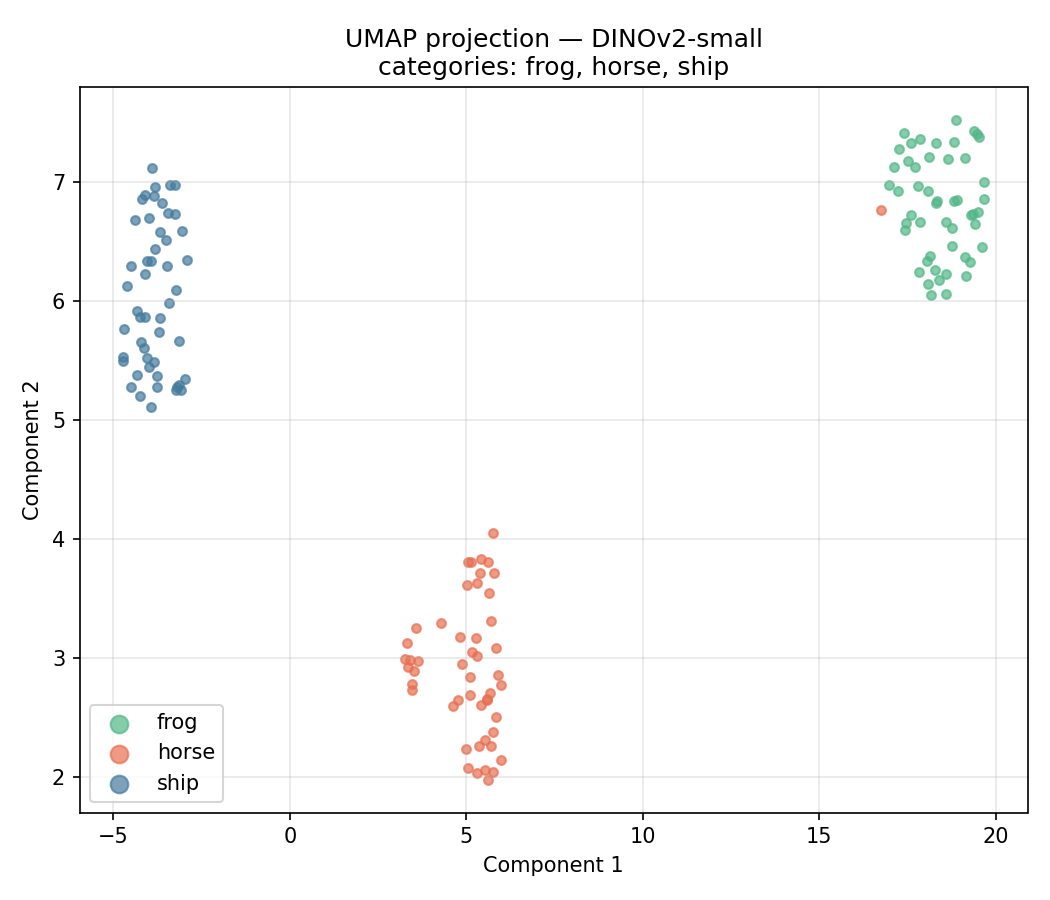
Figure 1: UMAP projection of the DINOv2-small frozen embedding space, demonstrating that meaningful visual structure precedes lexical learning.
Lexical Learning and the Perceptual-Coherence Gradient
Agents are trained to learn mappings from Carrollian labels to visual concepts with varied topologies: native categories (single dataset classes), near-disjunctive (perceptually/semiotically coherent unions), mid-disjunctive, and far-disjunctive (arbitrary, perceptually scattered unions). Learners operate with limited support (5–15 examples per word) and are evaluated both on naming (image-to-label) and retrieval (label-to-image) tasks.
The central empirical result is a robust monotonic perceptual-coherence gradient: naming accuracy is highest for native categories, slightly lower for near-disjunctive (coherent) unions, degrades for mid-range, and falls to near chance for far-disjunctive arbitrary concepts.
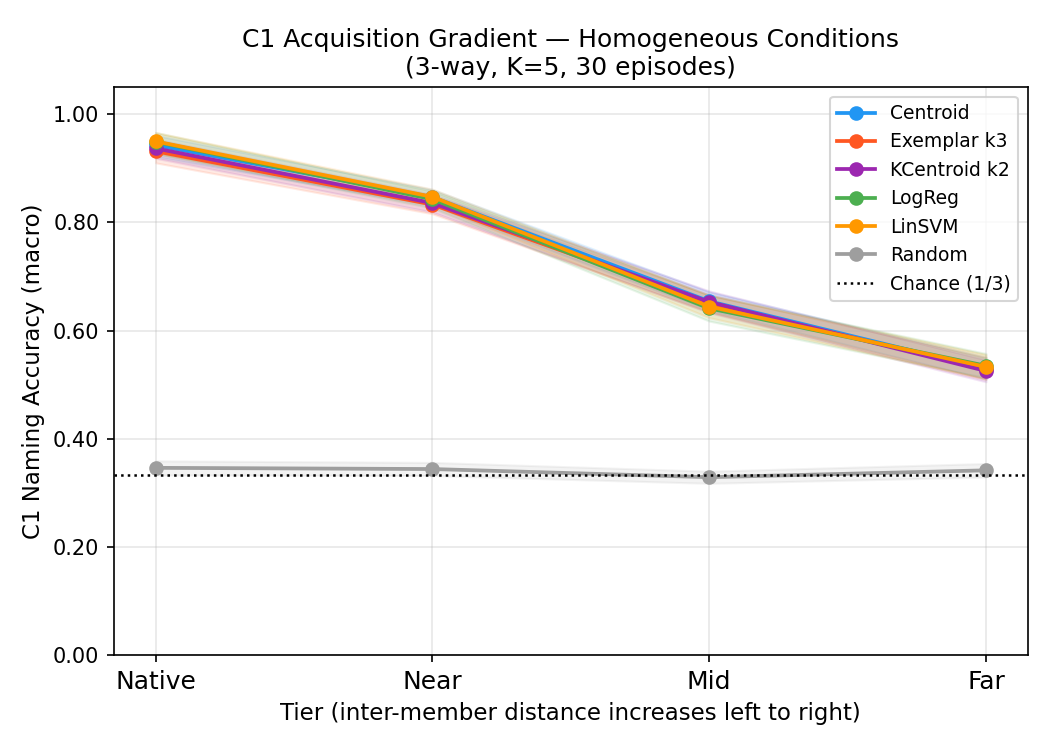
Figure 2: C1 naming accuracy across concept tiers; native > near-disjunctive > mid-disjunctive > far-disjunctive; all non-random learners exhibit the same ordering.
A pre-registered dissociation experiment using CIFAR-100 addresses the potential circularity of measuring and constructing concept difficulty with the same metric. By contrasting perceptual distance (DINOv2-based) and semantic distance (WordNet Wu-Palmer), it is shown—both via quadrant analysis and regression—that naming accuracy tracks perceptual, not semantic, distance (partial R2=0.245, p<10−7), with semantic similarity contributing essentially zero incremental explanatory power.
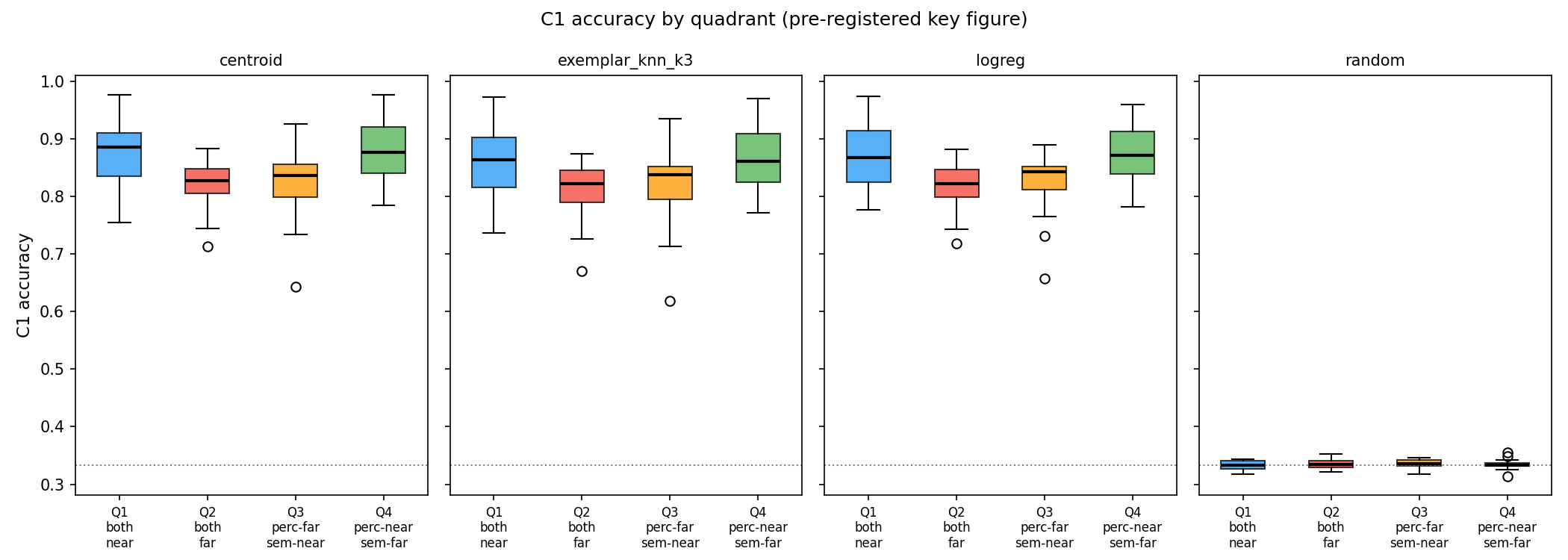
Figure 3: Naming accuracy by perceptual/semantic dissociation quadrants; learnability is robustly predicted by perceptual coherence even where semantic distance disagrees.
Bidirectionality and Retrieval as Memory Fidelity
Bidirectional evaluation (C1: image-to-label, C2: label-to-image) demonstrates that naming and retrieval tasks probe different capacities. For C2, exemplar mechanisms outperform centroids, especially for broad or multimodal concept boundaries, exposing a memory-fidelity dimension not captured by compressed prototypes. Linear discriminative baselines (e.g., SVM, logistic regression) can sometimes recover additional discriminative structure under “hard” retrieval pools.
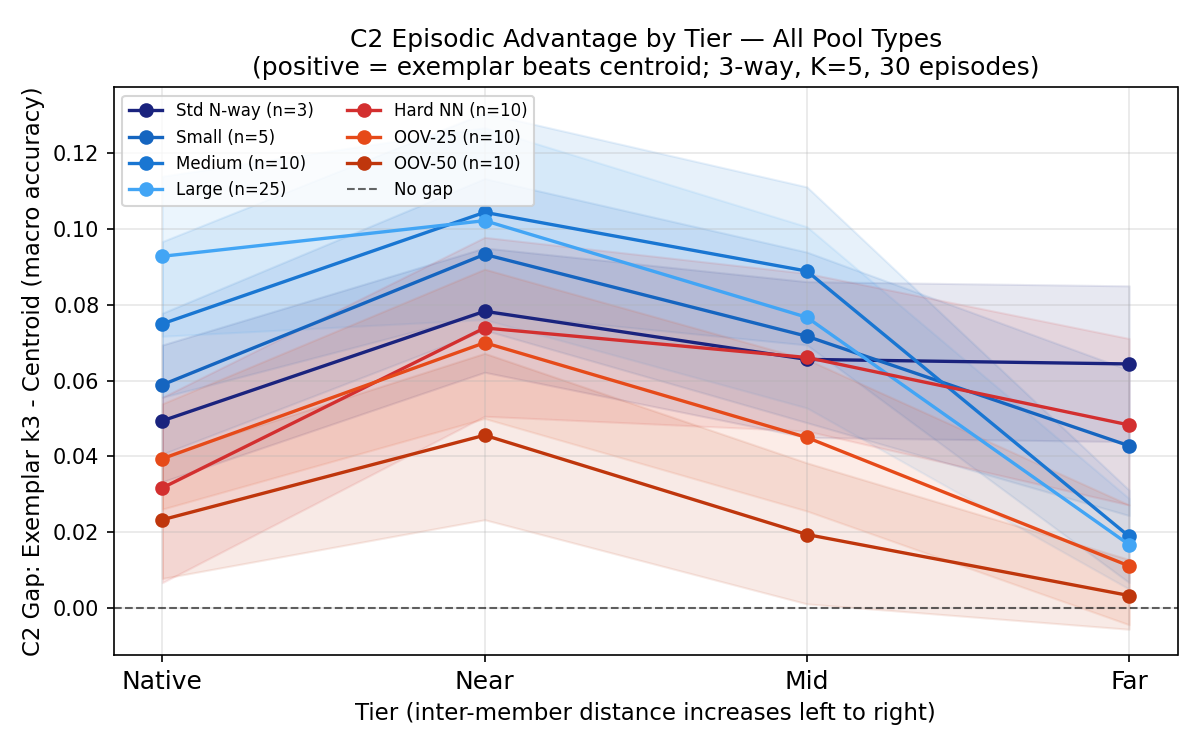
Figure 4: The gap in C2 retrieval accuracy between exemplar and centroid prototype increases with concept tier, peaking at intermediate disjunctiveness.
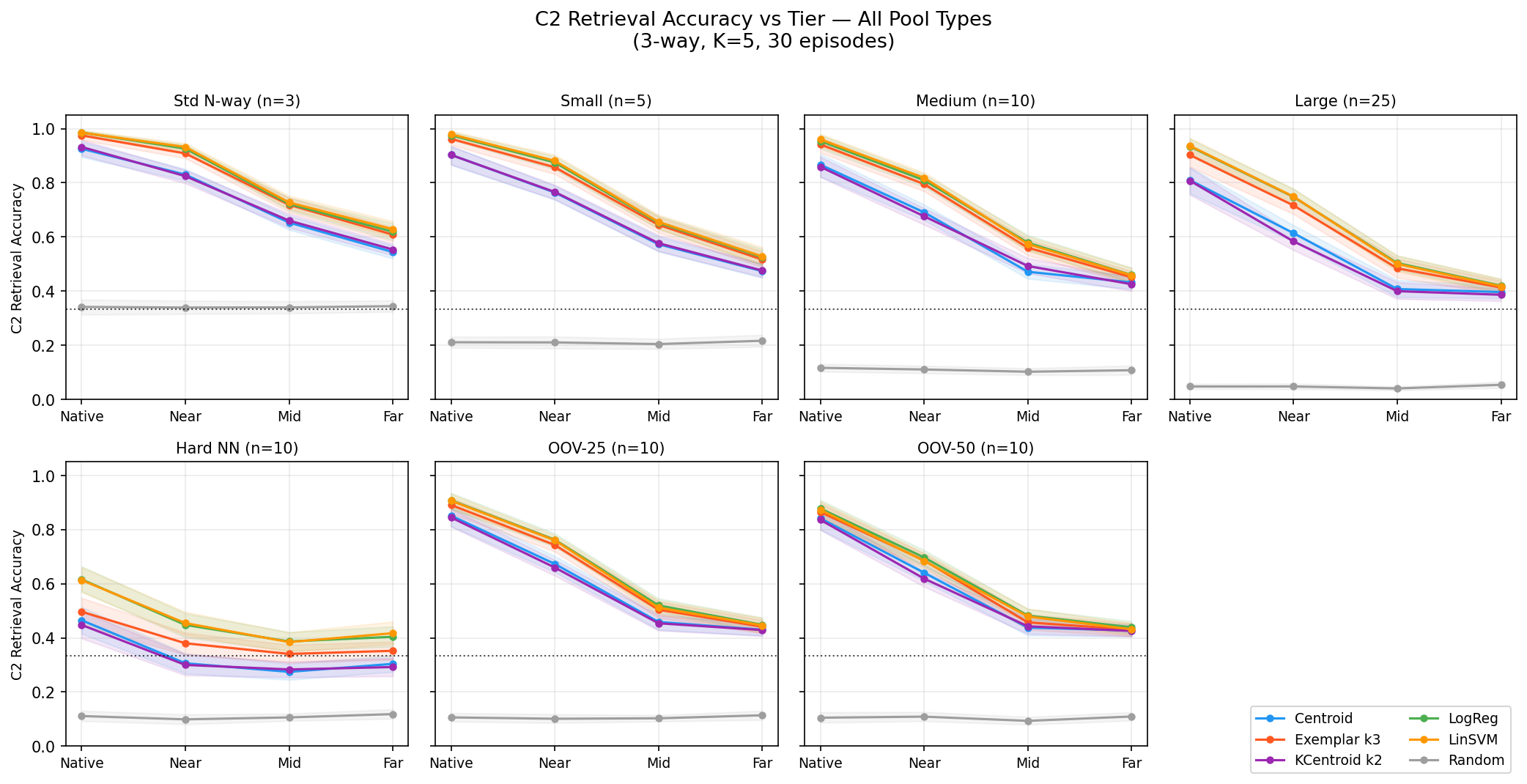
Figure 5: Retrieval accuracy across pool constructions and concept tiers: retrieval difficulty increases with distractor complexity.
Robustness: Falsification Controls and Stability
A series of controls—random labels, random embeddings, permuted bindings, OOV rejection, and repeated scramble baselines—demonstrate that positive results collapse under random or ungrounded conditions, confirming that effects are not artifactual. Agents robustly reject OOV examples (AUROC > 0.96), and performance remains high on more challenging native categories but degrades as geometric coherence is violated.
Multi-Agent Consensus and Representational Alignment
The consensus protocol demonstrates that agents trained on disjoint seeds can, with mild feedback, rapidly converge on stable and mutually intelligible lexical mappings. However, a strong no-feedback baseline finds high initial consensus due to the alignment induced by the shared perceptual substrate. Importantly, multiple analyses (alignment gain, mutable adapters, cluster divergence) show that consensus feedback does not substantially reshape internal representations—label agreement occurs over a fixed geometry rather than through representational realignment.
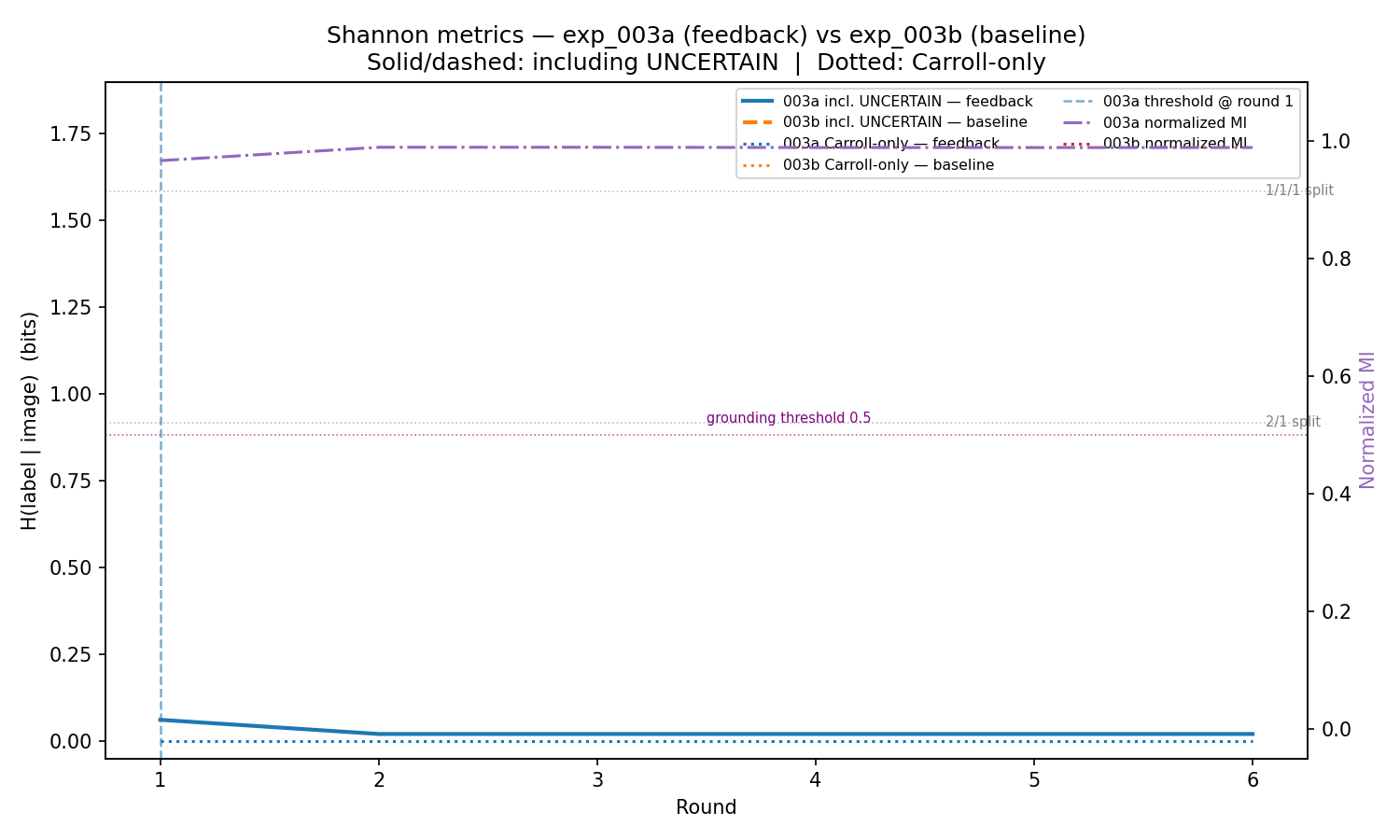
Figure 6: Entropy reduction in the population’s label distribution demonstrates rapid stabilization of lexical conventions.
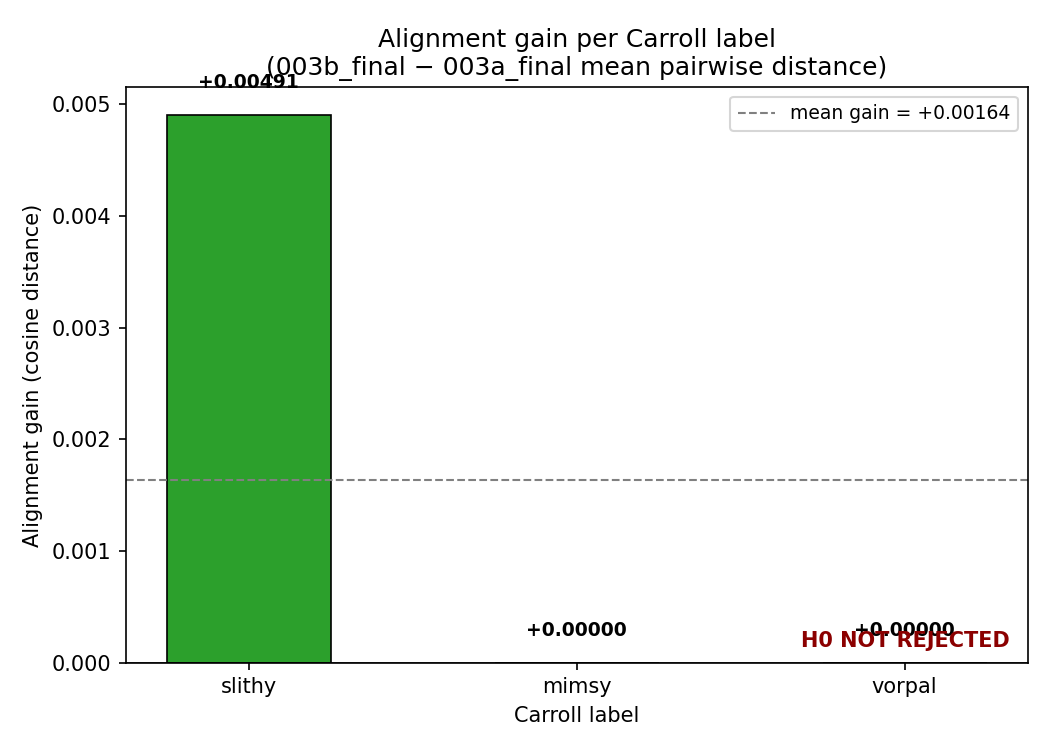
Figure 7: Alignment gain per label over rounds remains minimal, supporting the null result for representational change under consensus.
Implications and Theoretical Significance
The primary implication is the demonstration that grounded lexical learning in artificial agents is not arbitrary set learning; rather, acquisition is strongly constrained by perceptual coherence in the input substrate. This echoes findings in human early word learning and supports the use of controlled empirical protocols for evaluating grounded meaning in artificial systems.
Practically, the work illustrates a boundary for lexical induction in systems possessing fixed visual representations: perceptually coherent concepts are learnable and sharable, but cross-cutting or abstract unions do not become robustly grounded. The multi-agent results warn against conflating lexical agreement with deeper alignment—a critical distinction for evaluating emergent communication protocols.
Theoretically, this paradigm provides a fertile scaffold for future research scaling toward larger vocabularies, compositional mapping, adaptive perception, and more sophisticated, open-ended forms of language acquisition involving syntax, semantics, and embodied interaction.
Conclusion
Lexical Consensus delivers a falsifiable and highly controlled empirical protocol for measuring the capacity of artificial agents to acquire, stabilize, and share grounded lexical meaning. The strong monotonic gradient in learnability as a function of perceptual coherence is empirically established and shown to be grounded in agent-external geometry, not human linguistic similarity judgments. While coordination and bidirectionality are readily achievable over fixed encoders, representational restructuring via consensus is not observed with the present architecture, constituting an important negative result. This work motivates scaling the approach to richer concept spaces and adaptive perception and highlights the critical role of empirical falsification in the measurement of meaning in artificial agents.