Auditing Combinatorial Randomness from Finite Transcripts
Published 20 Jun 2026 in cs.IT, cs.CR, and stat.ME | (2606.22034v1)
Abstract: Public randomness is a security primitive whose deployed behavior is often observable only through a finite transcript. We study black-box auditing of k-subset draws from m labels under the exact uniform-without-replacement null. The outcome space has size (km), and unrestricted uniformity testing therefore requires Θ((km)/ε<sup>2) samples, establishing an information-theoretic limit on transcript-only certification. For structured faults, we construct generator-agnostic audits on the hypersimplex using marginal chi-square, pair maxima, serial overlap, anchored-box discrepancy, and low-dimensional H0/MST geometry, all calibrated under the exact combinatorial null. We also prove a finite-witness guarantee whose sample complexity depends logarithmically on the number of audited witnesses rather than on the full support size. Across observed and reference-source audits, no statistic remains significant after false-discovery correction (minimum BH q=0.279). GPU Monte Carlo experiments, using up to 300,000 null and 60,000 alternative replications per condition, show that marginal-preserving deviations can evade one-dimensional tests while remaining detectable through joint geometry. At n=1,956, a block-cluster alternative of strength 0.04 yields power 0.638 for pair maxima versus 0.051 for marginal chi-square; a band-repulsion alternative of strength 0.08 yields power 0.741 for anchored boxes versus 0.051. These results characterize which structured deviations finite public transcripts can detect and the sample sizes required for doing so.
The paper establishes an information-theoretic lower bound for auditing full joint uniformity in combinatorial draws from finite transcripts.
It develops generator-agnostic test statistics calibrated under the combinatorial null to detect joint structure anomalies that marginal tests miss.
Empirical results demonstrate that higher-order auditors achieve superior detection power, informing sample size thresholds for real-world randomness audits.
Rigorous Auditing of Combinatorial Randomness in Finite Transcripts
Problem Statement and Theoretical Barriers
The paper "Auditing Combinatorial Randomness from Finite Transcripts" (2606.22034) addresses the statistical and algorithmic challenges of auditing public randomness sources such as lotteries, beacons, and generator streams, where draws are combinatorial (e.g., k out of m labels without replacement) and only finite-length transcripts are available. The fundamental problem is certifying that these transcripts are consistent with uniform randomness, not only in marginals but in their full joint distribution---a critical requirement for ensuring trust in cryptographic or high-stakes public applications.
The authors formalize the auditability frontier set by an information-theoretic lower bound: for the space Ωm,k of size (km), any black-box test (auditor) for arbitrary joint uniformity requires Ω((km)/ε2) samples to reliably detect total variation ε separations, generalizing the well-known Paninski uniformity testing regime. For real-world settings such as EuroMillions (m=50,k=5,n=1,956), these bounds imply that strong guarantees of full joint uniformity are unachievable: no practical-length transcript supports information-theoretical auditability against all alternative distributions.
Structured Alternatives and Statistic Families
Given the impossibility of universal audits, the authors focus on practical tests targeting structured, low-dimensional alternatives reflecting real-world tampering or implementation faults. They construct generator-agnostic test statistics over the hypersimplex, calibrated under the exact combinatorial null, and design their audit battery to disentangle detection of marginal distortions from detection of higher-order joint dependencies.
The key statistics employed include:
Marginal chi-square: Sensitive to first-order (label-frequency) deviations.
Pair max-z: Sensitive to pairwise co-occurrence anomalies.
Serial overlap-z: Targets serial dependence between consecutive draws.
Anchored-box discrepancy: Exploits geometric structure in sorted tuples via anchored box tests.
H0/MST geometry: Applies minimum spanning tree edge spectrum geometry for high-dimensional joint structure.
All statistics are calibrated by exact Monte Carlo replication under the null to control type I error, leveraging GPU implementations for computational tractability at scale.
Irreducible Blind Spots of Marginal Audits
A principal contribution is the rigorous demonstration---both theoretical and empirical---that marginal tests are provably blind to many joint-alternative classes (block clustering, band repulsion) which modify global structure while preserving all single-coordinate marginals. The authors construct explicit alternative distributions with this property and show through large-scale GPU simulations that marginal chi-square maintains nominal size even as the joint structure is overtly non-uniform and easily detectable by higher-order auditors.
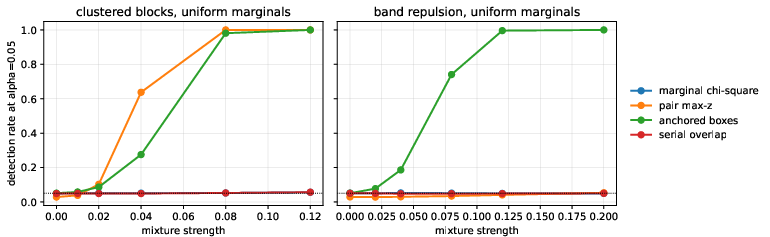
Figure 1: Marginal-preserving alternatives at n=1,956 for $5/50$ draws. The single-number marginal test remains at nominal size, while pair and geometric statistics detect joint structure.
Empirically, a block-cluster alternative (strength $0.04$) yields a detection power of m0 for pair max-z (at type I error m1), while marginal chi-square power is m2. For a band-repulsion alternative (strength m3), anchored-box discrepancy achieves power m4, again with marginal chi-square at m5. These results quantify the fundamental separation between marginal and joint structure testing in finite combinatorial transcripts.
Sample Complexity and Detectability Frontier
The study further characterizes the sample size thresholds required for high-power detection of structured alternatives. The authors show that, as m6 increases, power curves for tests targeting joint alternatives steeply interpolate from undetectability to near-perfect detection, depending on the alternative structure and format scale.
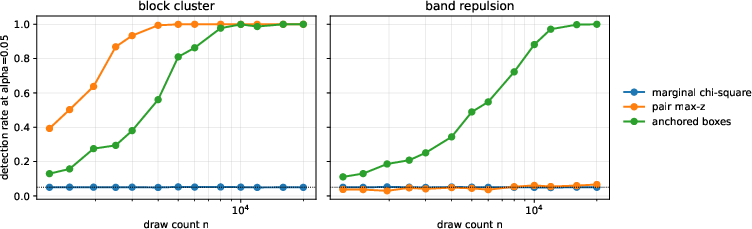
Figure 2: Sample-size frontier for marginal-preserving alternatives at strength m7 in m8 draws. The x-axis is logarithmic.
For block clustering in m9, pair max-z power increases from Ωm,k0 at Ωm,k1 to Ωm,k2 at Ωm,k3. Band-repulsion anchored-box power rises from Ωm,k4 at Ωm,k5 to Ωm,k6 at Ωm,k7. These transitions mark the operational regimes where transcript lengths become sufficient for reliable detection, guiding practical deployment of audit systems.
Robustness Across Lottery Formats
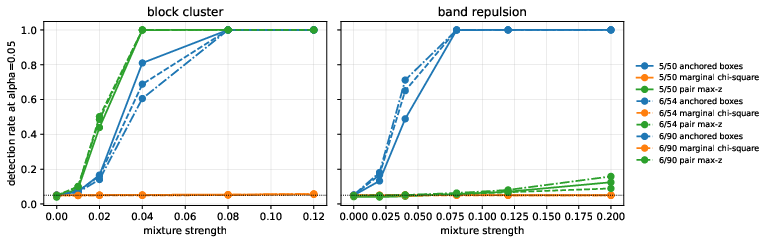
The format-dependence of detection is systematically analyzed by performing controlled experiments for Ωm,k8, Ωm,k9, and (km)0 formats, with support sizes spanning several orders of magnitude.
Figure 3: Format-scale comparison at (km)1. Solid lines are (km)2, dash-dotted lines are (km)3, and dashed lines are (km)4. Marginal-preserving alternatives keep marginal chi-square near nominal size across formats.
At (km)5 in (km)6, block clustering (strength (km)7) is detected by pair max-z with power (km)8 and by anchored boxes with power (km)9, while marginal chi-square remains at Ω((km)/ε2)0. Across all tested formats, the marginal test remains ineffective against joint-structure alternatives, while higher-order auditors retain considerable power, demonstrating the scalability and universality of the joint-detection approach.
Practical Implementation and Calibration
The study supplies both CPU and CUDA implementations, with GPU acceleration enabling tens of thousands of null and alternative replications per scenario. The statistical calibration meticulously accounts for dependencies among statistic families, utilizes conservative upper-tail rejection to handle discreteness, and applies Benjamini-Hochberg FDR adjustment for multiple-testing control. All observed and synthetic results are fully reproducible from the released code archive, including SHA-256 artifact manifests for complete provenance.
Implications and Theoretical Significance
The theoretical and experimental results delineate hard security tradeoffs in auditing public randomness from finite transcripts. The information-theoretic limits demonstrate that, barring structural a priori restrictions on adversaries or the alternative class, finite transcript audits cannot universally certify randomness at the joint level. However, concrete detection of meaningful classes of faults or tampering---especially those affecting joint structure---is achievable via geometric and combinatorial test batteries, provided the sample size is sufficient relative to the structured gap.
Practically, these findings inform the design of audit policies for lotteries, beacons, and cryptographic generators: marginal statistics alone are inadequate, and audit batteries should explicitly include pairwise and geometric tests tuned to relevant joint-structure alternatives. Sample size requirements and test power curves can be estimated in advance, enabling performance guarantees for real-world deployments.
Theoretically, the work draws a boundary between what is detectable in finite data and what is information-theoretically impossible, unifying perspectives from distribution testing, combinatorial probability, and computational geometry. The methodology suggests natural future developments in extending geometric and topological summaries (e.g., persistence methods via GPU pipelines) for further discriminating complex alternatives.
Conclusion
"Auditing Combinatorial Randomness from Finite Transcripts" establishes both lower bounds and constructive pathways for randomness auditing in practical, high-stakes combinatorial settings. By quantifying the inescapable blind spots of marginal tests and providing an extensible framework for joint-structure detection calibrated at the combinatorial null, the paper presents a precise roadmap for both practitioners and theorists tasked with securing and certifying public randomness sources.