- The paper shows that non-local grazing alters the Busse balloon topology, shifting stability boundaries and exposing direct desertification risks.
- It employs singular perturbation analysis and advanced PDE continuation to quantify fold conditions and pattern splits under distinct grazing regimes.
- The study challenges prevailing ecological assumptions by demonstrating that grazing-induced BB deformations can bypass intermediate pattern states, affecting ecosystem resilience.
Introduction and Motivation
The study addresses the impact of non-local grazing on spatial pattern formation in dryland vegetation, using an extended Klausmeier model. Periodic spatial patterns in semi-arid vegetation systems exhibit pronounced multistability, which is conventionally represented in the parameter-wavelength space by the so-called Busse balloon (BB). The BB delineates the regions in which periodic patterns of distinct wavelengths are simultaneously stable. Recent works have argued that the BB topology underpins the system's resilience to desertification and formation of alternative stable states. However, the role of ecological processes such as non-local grazing (i.e., forager mobility and nonlocal consumption response) in shaping or fragmenting BBs lacked systematic investigation. This paper fills that gap by extending singular perturbation theory to the Klausmeier model with non-local interaction terms and applying advanced numerical continuation techniques to track BB deformations and splittings under multiple grazing regimes (2606.21766).
The extended Klausmeier model considered describes the dynamics of surface water (w) and vegetation biomass (n) in a one-dimensional spatial domain with periodic boundary conditions,
∂t∂w=d∂x2∂2w+a−w−wn2, ∂t∂n=∂x2∂2n−gjnj−m0n+wn2,
where a is precipitation, d≫1 the water diffusion rate, m0 non-grazing mortality, and gjnj the grazing term. Non-locality manifests in gj, which depends on (potentially nonlinear) spatial averages of n and n2.
Four distinct grazing regimes capturing the forager distribution (proportional n0, disproportionate n1) and grazing pressure response (sustained/natural) are defined as:
- Proportional sustained: n2,
- Proportional natural: n3,
- Disproportionate sustained: n4,
- Disproportionate natural: n5.
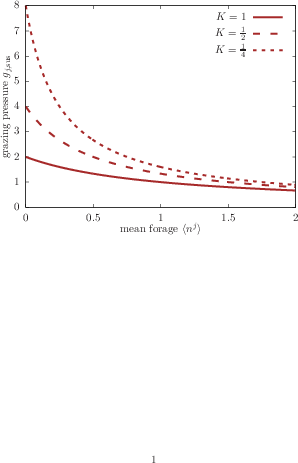
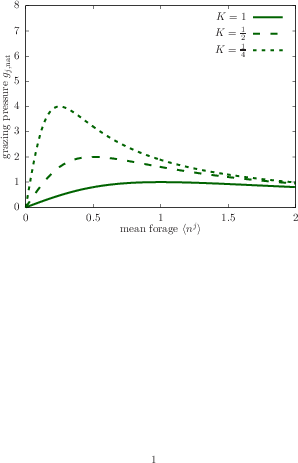
Figure 1: Sustained and natural grazing pressure as a function of mean forage n6, for n7 and n8, highlighting distinct non-monotonicity in the natural regime.
Busse Balloon: Structure, Multistability, and Genericity
The BB is constructed by tracking the coexistence/stability boundaries of periodic vegetation patterns as functions of precipitation n9 and pattern wavenumber ∂t∂w=d∂x2∂2w+a−w−wn2, ∂t∂n=∂x2∂2n−gjnj−m0n+wn2,0. The authors emphasize that observed real-world trends in wavenumber (e.g., remote sensing of pattern wavelengths along precipitation gradients) imply genuine multistability, thus substantiating the BB formalism.
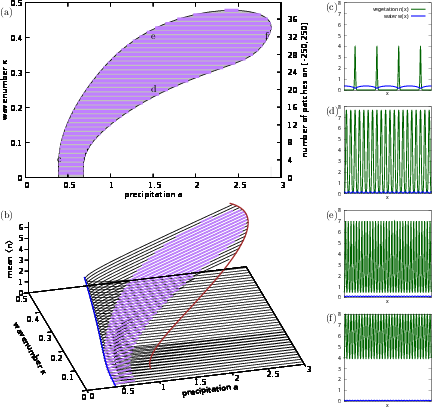
Figure 2: Busse balloon for the Klausmeier model without grazing, black curve: sideband instability limit, purple lines: admitted wavenumbers on bounded domain; multiwavelength coexistence is generic.
Singular Perturbation Analysis Near the Homoclinic (Pulse) Limit
For low precipitation and low wavenumber, solutions approach single-pulse (homoclinic) structures. The scale separation (∂t∂w=d∂x2∂2w+a−w−wn2, ∂t∂n=∂x2∂2n−gjnj−m0n+wn2,1) permits singular perturbation reduction, enabling explicit construction of pulse profiles and derivation of algebraic fold conditions delineating the extinction boundary of pulse patterns. These analytic fold approximations are directly compared to the fold loci computed via full PDE continuation, validating the approach, particularly for proportional regimes.
Numerical Continuation of BBs Under Non-local Grazing
Extensive PDE continuation explores how non-local grazing deforms or splits the BB across the four regimes and varying half-persistence ∂t∂w=d∂x2∂2w+a−w−wn2, ∂t∂n=∂x2∂2n−gjnj−m0n+wn2,2:
Proportional Sustained Grazing
As grazing persistence (low ∂t∂w=d∂x2∂2w+a−w−wn2, ∂t∂n=∂x2∂2n−gjnj−m0n+wn2,3) intensifies, the BB lifts away from the ∂t∂w=d∂x2∂2w+a−w−wn2, ∂t∂n=∂x2∂2n−gjnj−m0n+wn2,4 axis at low ∂t∂w=d∂x2∂2w+a−w−wn2, ∂t∂n=∂x2∂2n−gjnj−m0n+wn2,5, removing low-wavenumber stable patterns at low precipitation—a marked deviation from the canonical banana shape.
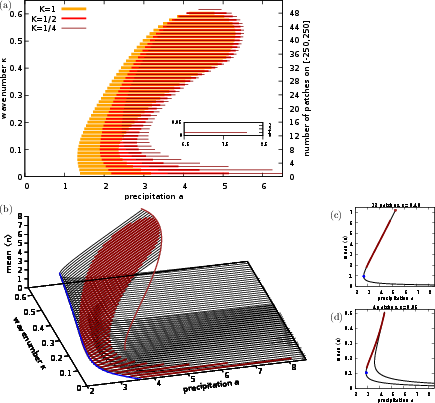
Figure 3: BBs for proportional sustained grazing; increasing grazing persistence (darker) shrinks stability at low ∂t∂w=d∂x2∂2w+a−w−wn2, ∂t∂n=∂x2∂2n−gjnj−m0n+wn2,6/∂t∂w=d∂x2∂2w+a−w−wn2, ∂t∂n=∂x2∂2n−gjnj−m0n+wn2,7, with high-fidelity agreement of the blue analytic fold curve.
Proportional Natural Grazing
Here, the BB not only tilts but exhibits "pinching": the upper boundary of stable patterns becomes concave, restricting available intermediate wavenumbers, especially at higher persistence.
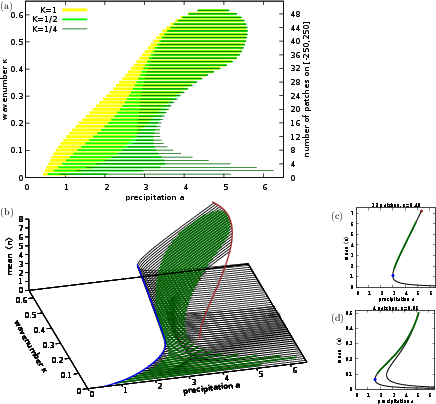
Figure 4: BB for proportional natural grazing; pinching reduces intermediate pattern availability, analytic fold (blue) remains accurate.
Disproportionate Sustained Grazing
In this regime, the BB notably splits as ∂t∂w=d∂x2∂2w+a−w−wn2, ∂t∂n=∂x2∂2n−gjnj−m0n+wn2,8 decreases: a gap appears with no stable patterns at intermediate ∂t∂w=d∂x2∂2w+a−w−wn2, ∂t∂n=∂x2∂2n−gjnj−m0n+wn2,9 and a0. This facilitates direct transitions from high-wavenumber pattern to bare desert ("tipping"), bypassing intermediary pattern states.
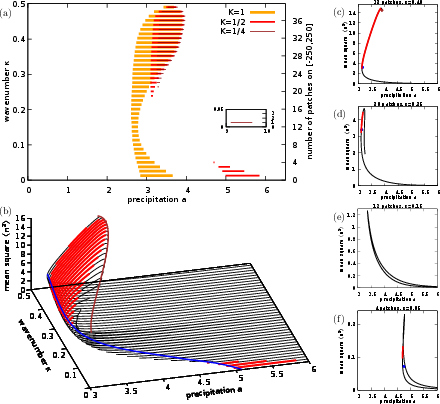
Figure 5: BBs for disproportionate sustained grazing, with splitting into disconnected domains at small a1; analytic fold loses accuracy where multipulse structure arises.
Disproportionate Natural Grazing
Again, splitting occurs for small a2, but the lower BB part now extends across substantial a3, maintaining coexisting pattern and homogeneous vegetation states over a wide parameter range.
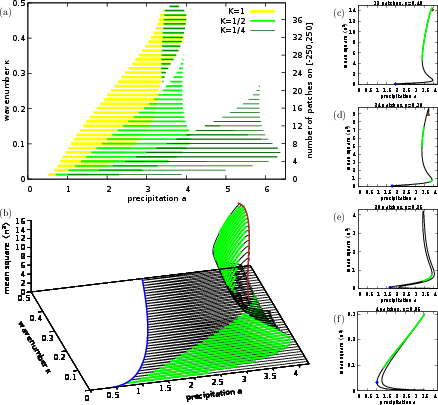
Figure 6: BBs for disproportionate natural grazing; splitting observed, but the lower stability region covers high precipitation with coexisting pattern/homogeneous states.
Implications and Theoretical Significance
A central claim of the paper is that the shape and topology of the Busse balloon are highly sensitive to the form of non-local interaction, even under the same environmental parameter manipulation. Sustained grazing generically causes the disappearance of large-wavelength patterns before smaller ones, invalidating the prevailing assumption (based on local mortality models) that pattern formation always enables "tipping evasion" via a cascade toward larger wavelengths (as, e.g., in Ni's conjecture).
Moreover, under strong non-locality/persistence, the BB can fragment, rendering regions of the parameter space where no spatial patterns can persist and thus direct desertification transitions become plausible even in the presence of a patterned phase at higher precipitation. This constitutes a marked contradiction to the narrative that spatial self-organization always enhances ecosystem resilience to environmental stress, by showing that forager mobility and response can induce new critical transition pathways.
Theoretically, the work generalizes singular perturbation analysis to non-local reaction-diffusion systems, demonstrating the utility of PDE bifurcation analysis software (pde2path) for full BB computation in high-dimensional spaces.
Conclusions
This study rigorously demonstrates that the multistability landscape (as encoded by the Busse balloon) of dryland vegetation models is fundamentally altered by ecological details of grazing—specifically, non-locality in mortality feedbacks. Key qualitative changes such as BB tilting, pinching, and splitting are directly tied to the combination of forager distribution and pressure-mean forage response. The findings have direct implications for predictive modeling of dryland resilience and guide the interpretation of pattern transitions in remote-sensing data.
By bridging analytic fold approximations, full numerical continuation, and ecological theory, this work disqualifies simplistic interpretations of spatial self-organization as universally resilience-enhancing, demanding reconsideration of management and restoration strategies under grazing pressure. Future developments should extend to two-dimensional domains, stochastic ecological forcing, and data-driven model selection using empirical Busse balloons.

