- The paper demonstrates that point defects, particularly vacancies, are energetically stabilized at vertical domain walls in wurtzite AlN, reducing local polarization.
- DFT calculations quantify defect-induced variations in switching barriers and bond distortions, offering insights into coercive field modulation.
- Electronic structure analysis reveals that defect states from nitrogen vacancies and substitutions modify the band gap and influence leakage pathways.
Point Defect–Domain Wall Interactions in Wurtzite AlN: Thermodynamic, Structural, and Electronic Consequences
Introduction
The paper "Interaction between point defects and vertical inversion domain walls in wurtzite AlN" (2606.21733) offers a systematic DFT-based investigation into the behavior and stability of point defects near vertical inversion DWs in wurtzite AlN. AlN and its alloys have emerged as significant ferroelectric materials with robust polarization, high band gaps, and compatibility with CMOS processes, enabling applications in FeRAM, RF devices, MEMS, and quantum information platforms. However, large coercive fields and ambiguous switching mechanisms limit broader adoption. Crucially, the role of domain walls and their interaction with point defects is underspecified, particularly regarding coercive field reduction and defect-driven switching phenomena.
Methodology and Model Construction
First-principles calculations were performed using the VASP code with PAW pseudopotentials and the PBEsol GGA functional. The study employs two supercell approaches—a bulk 4×4×3 and a 10×4×3 supercell with two vertical DWs, each extending two atomic layers perpendicular to [101ˉ0]. The vertical DW configuration is electrically neutral, simplifying defect–DW interaction analysis. The paper considers nine defect types: nitrogen and aluminum vacancies (VN, VAl), and seven substitutions at N/Al sites (O/CN, B/Si/Sc/Y/LaAl) in neutral or various charge states.
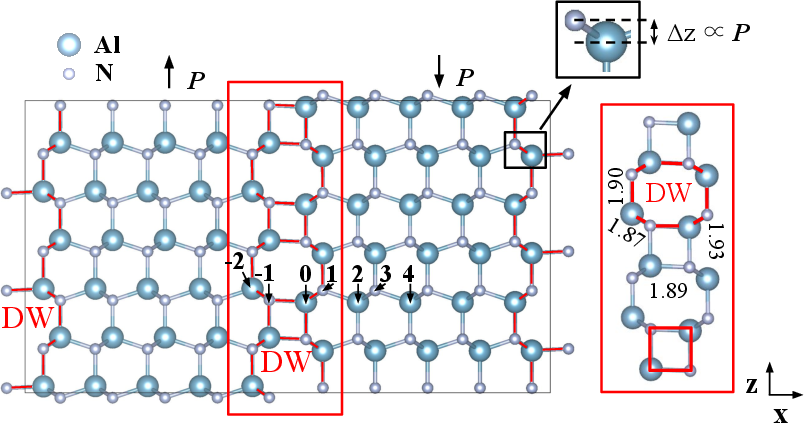
Figure 1: Atomic structure of the AlN supercell with two vertical domain walls highlighted, showing relevant (101ˉ0) layers and bond-length distortions.
The DW influences both local cation-anion rumpling and bond lengths; Al-N bonds are shortened in-plane and alternately lengthened out-of-plane, with local polarization reduction as indicated by the rumpling parameter Δz.
Defect Stability and Energetics at Domain Walls
Defect energetics were assessed as a function of distance from the DW. Except LaAl, all defects are energetically stabilized at or near the DW, most strongly for vacancies. The stabilization is interpreted through structural and polarization effects: DWs exhibit altered bond metrics and reduced polarization, so defects induce less energetic penalty when their polar weakening coincides with this local suppression.
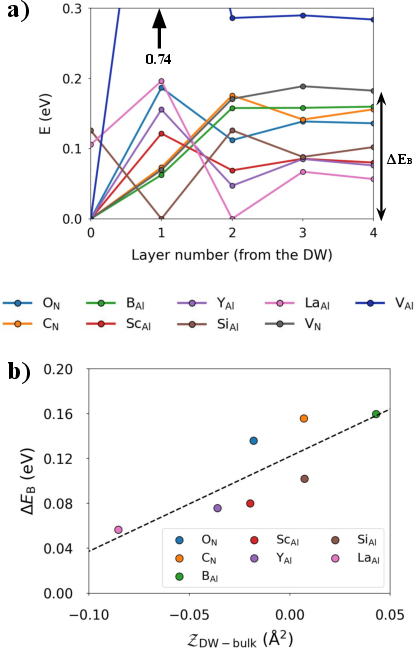
Figure 2: Relative energetics for point defect localization as a function of distance to the DW, showing stabilization near the wall.
A Landau-type model quantitatively relates the defect-induced energy gain 10×4×30 to the variation in cation-anion rumpling (proportional to polarization difference), yielding a strong linear correlation (10×4×31). Small substituent atoms (B, C, O) preferentially stabilize at the DW, while larger ions (Sc, Y) distribute more randomly.
Charge state further modulates defect stability: charged vacancies (e.g., V10×4×32, V10×4×33) exhibit greatly increased stabilization at the DW relative to their neutral forms (+130% – +167%), attributable to modification in local charge and ionic radius, bond lengths, and strain.
Impact of Defects on Domain Wall Displacement and Switching Kinetics
Switching energetics were calculated using NEB pathways for both coherent and chain-by-chain displacement mechanisms of the DW. Pristine DW displacement proceeds via sequential atomic column switching along [0001], with barriers 10×4×34 independent across chains, leading to seven metastable states and eight barriers.
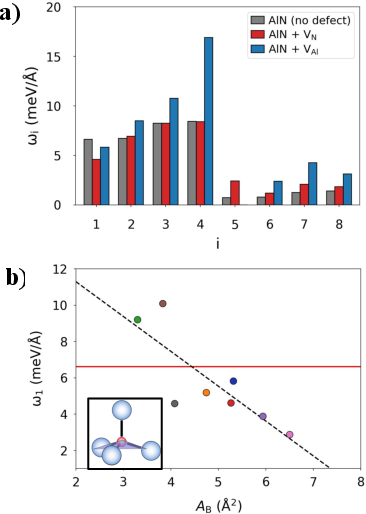
Figure 3: Energy barriers for polar column switching during DW displacement in pristine and defective AlN.
Introduction of V10×4×35 lowers the initial switching barrier by 10×4×36 meV/Å10×4×37 for the column containing the defect, but increases subsequent barriers, creating a pinning effect and randomizing local polarization. V10×4×38 causes a much stronger pinning, raising total displacement barrier by 51.54%. Substitutional defects display variable behavior: Si10×4×39 and B[101ˉ0]0 raise the barrier for switching the associated column significantly (+53% and +39%, respectively), while Sc[101ˉ0]1 tends to decrease the overall barrier under coherent displacement.
Defect-induced changes in the basal area [101ˉ0]2 (neighbor triangle area) were tightly correlated to switching barrier ([101ˉ0]3), implicating local structural hindrance. O[101ˉ0]4 defects provide particularly strong pinning, precluding metastable intermediate states during displacement—a severe impediment to DW mobility which is exacerbated in alloyed systems with high O affinity (e.g., Sc-doped AlN).
Electronic Structure Modification by Defects at Domain Walls
The investigation extends to electronic structure, especially gap modification and defect-induced states relevant to leakage and resistive switching. The DOS for a neutral V[101ˉ0]5 at the DW reveals spin-polarized defect states near the VBM/CBM, with a localized gap of [101ˉ0]6 meV present at the DW but closed in bulk, due to orbital symmetry changes.
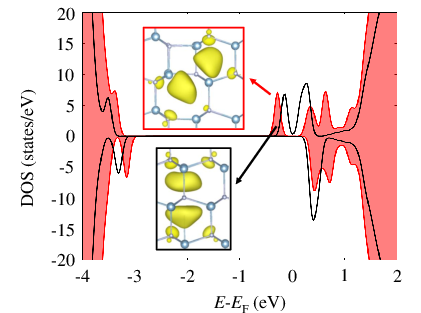
Figure 4: DOS for neutral V[101ˉ0]7 at the DW versus bulk, showing defect-induced states and gap modulation.
Other defects (C[101ˉ0]8, V[101ˉ0]9) introduce gap states near the VBM, while ON0 and SiN1 become metallized, resulting in electrons transferred to the CBM. Isoelectronic substitutions can slightly reduce the gap and modify band edge nature, sometimes introducing N2 states at CBM (Sc) without adding gap states.
These defect–DW electronic features are directly relevant to resistive switching, offering routes to filament formation and leakage by gap closure or shallow state introduction, of interest for neuromorphic and quantum device applications.
Practical and Theoretical Implications
The study robustly demonstrates that point defects are more stable at or near vertical DWs in AlN, with energetic stabilization tightly linked to cation-anion rumpling and polarization suppression. Strong numerical increases in stabilization energies for multi-charged vacancies are quantified.
Defects modulate DW mobility: certain defects facilitate the initiation of switching, especially VN3 and ScN4, while most—especially VN5, BN6, and ON7—significantly pin or hinder displacement. This may explain observed switching fatigue and high coercive fields in AlN-based ferroelectrics, and suggests defect engineering as a viable route for reducing N8 in device optimization.
Electronic conductivity induced by defects and DW interactions can be detrimental for ferroelectric device operation due to leakage, but is beneficial for resistive switching applications, including memristors and neuromorphic devices.
Theoretical implications extend to disorder-driven switching phenomena, collective defect effects, and understanding complex alloy systems where defect clusters and DWs interact nonlinearly.
Conclusion
This work provides a comprehensive DFT-based analysis of point defect–domain wall interactions in wurtzite AlN. Strong energetic, structural, and electronic coupling is revealed, with distinct outcomes for different defect types and charge states. The findings elucidate defect-driven pinning and switching pathways, address gap modulation and potential leakage, and offer routes for optimizing ferroelectric-nitride devices via defect and DW engineering. Future research should probe collective defect behaviors, disorder phenomena, and multi-defect complexes, especially as more complex alloys are developed for next-generation electronic and quantum devices.