- The paper introduces a parity-constrained PINN method that accurately recovers the Morse index and nullity of the critical catenoid.
- It reduces the Jacobi–Steklov eigenvalue problem to one-dimensional Robin boundary-value problems using rotational symmetry and Fourier modes.
- The study tracks spectral flow along operator homotopy and validates the rigidity of the catenoid, opening paths for non-standard domain analysis.
Mathematical Framework and Motivation
The Morse index of a free boundary minimal surface (FBMS) quantifies instability, counting directions in which the area can be decreased via normal variations. For FBMS in the unit ball B3, classical results establish that the Morse index is encoded in the combined spectrum of fixed-boundary eigenvalue problems and the Jacobi–Steklov Dirichlet-to-Neumann map. The critical catenoid is the prototypical minimal annulus in B3, with a rigorously established Morse index of $4$ and nullity of $2$, as proved in Tran's spectral characterization (2606.21725). This work aims to numerically recover these spectral invariants using Physics-Informed Neural Networks (PINNs), leveraging their applicability to settings where analytic solutions are unavailable.
Jacobi–Steklov Eigenvalue Reduction and Spectral Characterization
To compute the Morse index numerically, the authors exploit rotational symmetry to reduce the Jacobi–Steklov eigenvalue problem to a sequence of one-dimensional Robin boundary-value problems, parameterized by Fourier mode n. For each mode, the physical boundary and eigenvalue threshold are precisely determined by geometric constraints and the Steklov framework, with the threshold δ=1 stemming from the mean curvature of the ambient boundary. The full spectrum, crucial for index recovery, is known analytically for the catenoid, providing a rigorous benchmark.
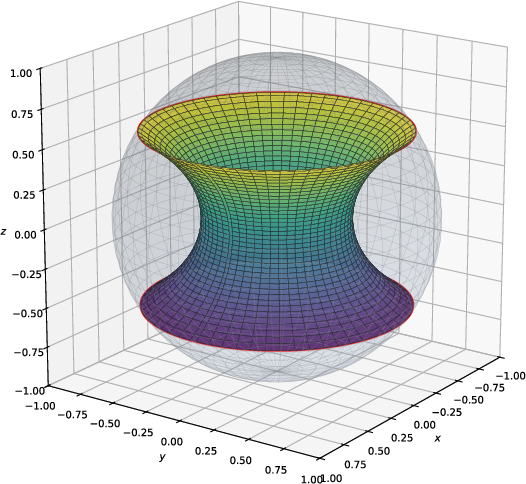
Figure 1: The critical catenoid embedded in B3 as the geometric setting for spectral analysis.
PINN Architecture and Parity Constraints
The PINN approach represents each eigenfunction as a neural network, explicitly enforcing mode parity via symmetrized network outputs (f(t)=N(t)±N(−t) for even/odd modes). The eigenvalue δ is treated as a trainable parameter in the boundary loss, rather than pre-specified. The loss function incorporates the PDE residual, Robin boundary residual, and normalization to avoid trivial solutions. This parity constraint is essential, as unconstrained networks typically converge to spurious mixed-parity states that fail to recover accurate eigenvalues.
Numerical Results: Index and Nullity Recovery
The PINN solver trained on the critical catenoid recovers the Jacobi–Steklov eigenvalues below the threshold to within 10−6 to B30 of analytic values. The fixed-boundary problem contributes one index via the Jacobi field, and PINN correctly finds the three B31 modes—one B32 odd and two B33 even modes. Summing these yields the Morse index B34 and nullity B35 exactly. Notably, PINN achieves low PDE residuals (B36), confirming accuracy for smooth, low-frequency eigenfunctions.
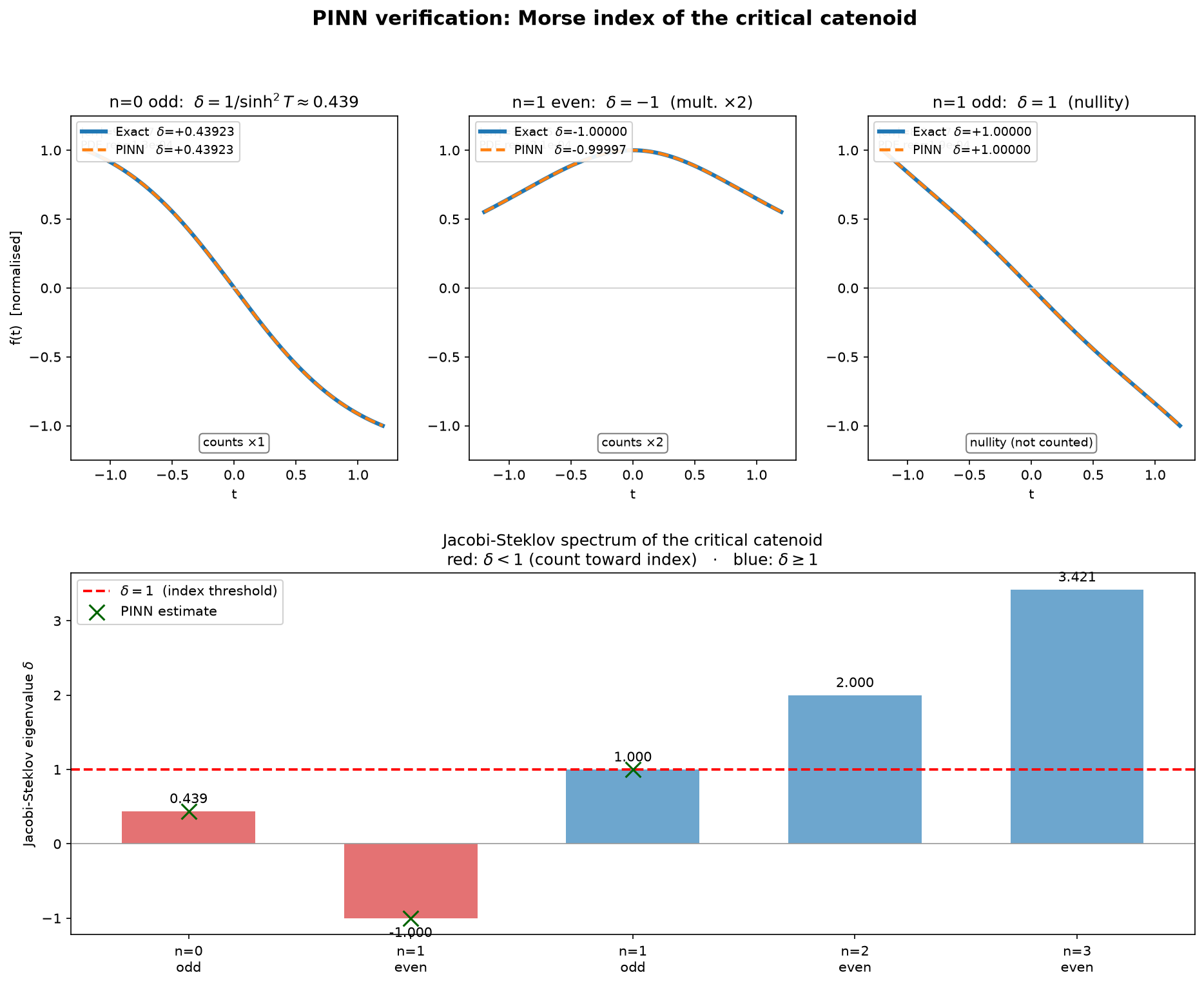
Figure 2: Top: analytic vs. PINN eigenfunctions for lowest Jacobi–Steklov modes; bottom: spectrum, with index and nullity annotated according to Theorem~\ref{thm:tran}.
The spectral gap is explicit: only three eigenvalues are strictly below the threshold, with no modes in B37, echoing classical spectral separation in minimal surface theory.
Spectral Flow along Operator Homotopy
The eigenvalue spectrum is tracked along a one-parameter homotopy interpolating between a flat reference operator (B38) and the critical catenoid Jacobi operator (B39). At each $4$0, Jacobi–Steklov eigenvalues are computed, and index jumps are identified as eigenvalues cross $4$1. The index varies non-monotonically: it rises to $4$2 before settling at the catenoid value $4$3, indicating that only at the catenoid endpoint are geometric and spectral constraints simultaneously satisfied.
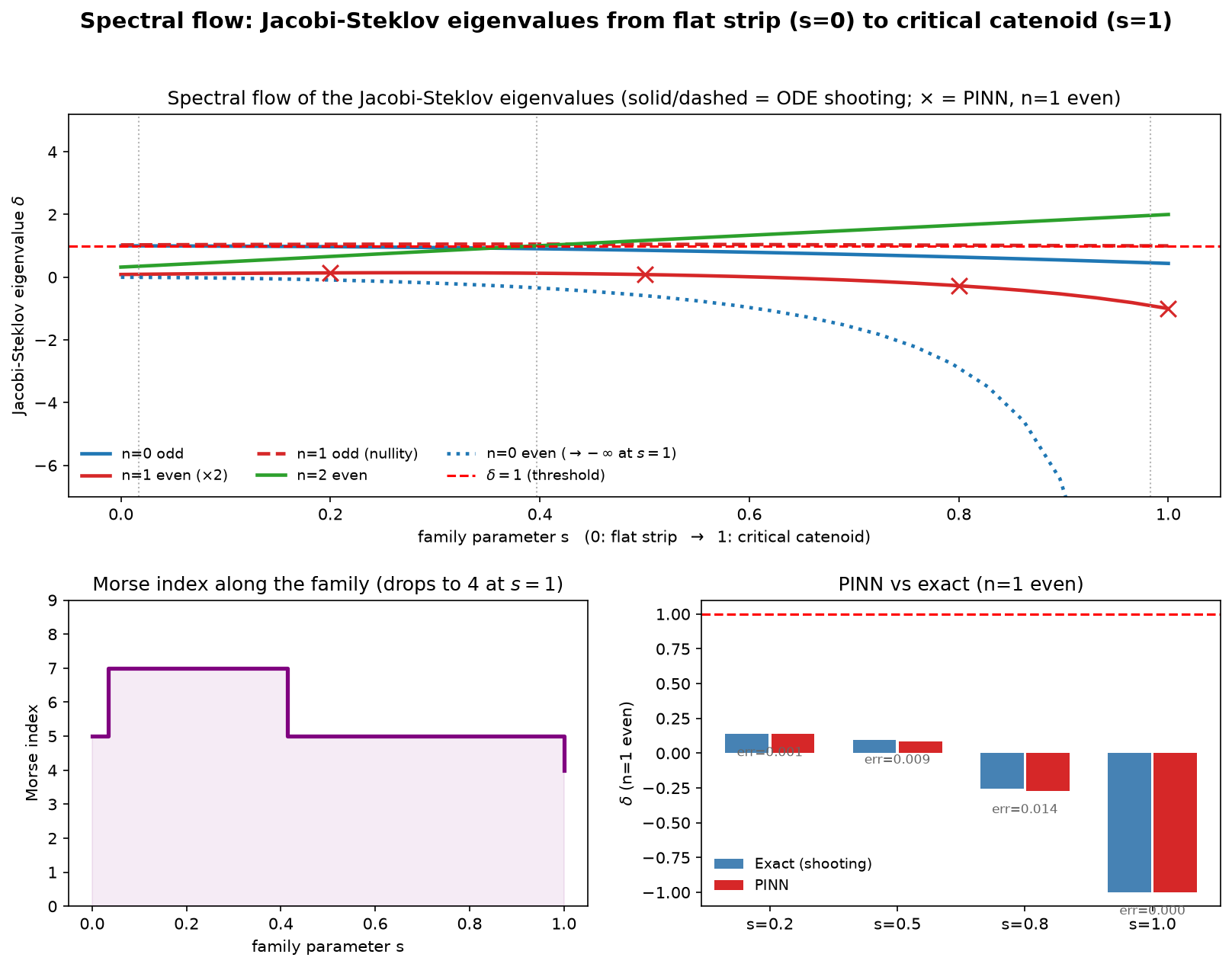
Figure 3: Spectral flow along operator homotopy, with eigenvalue crossings and index plateaus highlighted.
This flow counts the crossings and their Fourier types, providing an informative classification of the spectral events required to reach the catenoid's index.
Rigidity Analysis and Implications for Higher-Dimensional Settings
A formal rigidity result establishes that the catenoid is unique: the free-boundary condition, radius constraint, and minimality fix all parameters, precluding any genuine geometric deformation through FBMSs in $4$4. Varying the ambient radius is spectrally trivial, simply rescaling the threshold and spectrum without changing the index. The only nontrivial spectral flows arise in domains where curvature varies, such as ellipsoidal balls, for which neither analytic nor classical theory determines the Morse index. Here, PINN-based spectral pipelines—now validated—can provide genuinely geometric spectral flow and index computation.
Discussion and Theoretical/Practical Implications
The parity-constrained PINN scheme successfully calibrates against the critical catenoid, thus providing a robust numerical pipeline for spectral index computation where separation of variables is unavailable. This setup is poised to tackle the Jacobi–Steklov spectrum and Morse index for free boundary minimal surfaces in non-standard domains (e.g., ellipsoids), where analytic characterization fails due to non-constant boundary curvature. As such, future applications of PINN to two-dimensional spectral problems on parametrized geometric domains would enable the probing of open index problems and the tracking of genuinely geometric spectral flows.
On the theoretical side, this approach demonstrates the feasibility and reliability of PINN methods for spectral geometry on minimal surfaces, with spectral gap and index count numerical accuracy matching analytic benchmarks. Practically, it opens the door to robust index computation and spectral flow tracking in geometric configurations where classical methods, separation of variables, or spectral theory provide no closed formulas.
Conclusion
This paper validates a parity-constrained PINN pipeline for numerically recovering the Morse index and nullity of the critical catenoid in $4$5, matching analytic values to high accuracy. The spectral flow analysis along operator homotopy classifies index jumps and highlights the rigidity of the catenoid's geometric constraints. These results demonstrate both the necessity and future utility of neural spectral methods for investigating Morse index and spectral flow in genuinely geometric settings such as ellipsoidal balls, where analytic theory is absent.

