- The paper demonstrates that the hard-wall AdS/QCD model accurately computes deuteron gravitational form factors and generalized parton distributions.
- It employs a vector bulk field and Bessel-type solutions to derive normalized deuteron wavefunctions, extracting a gravitational radius of approximately 0.697 fm.
- The model’s consistency with experimental and lattice QCD data confirms its utility in probing the nonperturbative structure of nuclear matter.
Generalized Parton Distributions of a Deuteron in the AdS/QCD Hard-Wall Model
Introduction and Motivation
The study presents a comprehensive analysis of gravitational form factors (GFFs) and generalized parton distributions (GPDs) for the deuteron within the AdS/QCD hard-wall holographic model. The deuteron, as a spin-1 bound system, serves as an ideal testbed for probing the interplay between QCD dynamics and nuclear forces, specifically through the energy-momentum tensor (EMT). Beyond electromagnetic probes, GFFs accessed via EMT matrix elements provide direct insight into spatial distributions of mass, energy, and mechanical properties of hadronic systems. The work leverages the hard-wall AdS/QCD approach, which introduces an infrared cutoff in the AdS5 bulk, effectively modeling QCD confinement and enabling nonperturbative calculation of form factors and distributions.
Methodology: Holographic Model Construction
The analysis defines the deuteron in the AdS/QCD hard-wall model as a vector bulk field with twist 6 propagating in the five-dimensional AdS space. The infrared cutoff parameter z0 is fixed by matching the ground-state deuteron mass to its experimentally observed value. Profile functions for the deuteron are derived via the solution of a Bessel-type equation subject to specified boundary conditions, yielding normalized wavefunctions.
The gravitational sector is introduced as a perturbation to the metric, with the graviton bulk-to-boundary propagator encoding the response of the geometry to external EMT insertions. The propagator solution for spacelike momentum transfer facilitates direct evaluation of GFFs via integrals over the fifth dimension.
The EMT matrix element between deuteron states is parametrized by four invariant GFFs: A(Q2), C^(Q2), D(Q2), and F^(Q2), each derived holographically as integrals involving the deuteron profile and the graviton propagator. Of notable interest, the gravitational root-mean-square radius is extracted from the slope of A(Q2) at Q2=0, yielding rgrav≃0.697 fm—a value consistent with phenomenological fits to CLAS and ABHHM Collaboration data and lattice QCD estimates.
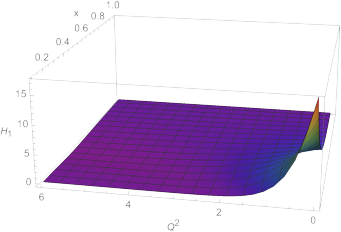
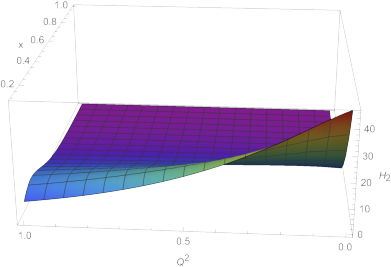
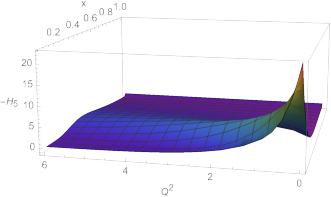
Figure 1: Plots of the ρ meson GPDs z00 as a function of z01 and z02 in the hard-wall model.
Graphical comparison demonstrates that the GFFs produced by the hard-wall model replicate both the qualitative dependencies and normalization conditions found in the soft-wall AdS/QCD model, affirming the robustness of the confinement implementation.
Generalized Parton Distributions: Structure and Comparisons
The framework derives five independent quark GPDs, z03, defined through light-front correlators and directly related to the GFFs via exact sum rules. Explicit integral representations are provided, unifying the spatial and momentum descriptions of the internal deuteron structure.
The shapes of the deuteron GPDs obtained from the hard-wall model exhibit close quantitative agreement with those extracted from electromagnetic form factors in soft-wall models and with corresponding z04 meson GPDs calculated using analogous procedures. Importantly, normalization checks confirm theoretical sum rules, e.g. the first moment of z05 accurately reproduces the maximal value for deuteron spin.
Implications, Applications, and Future Directions
The consistency of gravitational radius and GPD distributions with experimental, phenomenological, and lattice QCD results underscores the utility of the hard-wall AdS/QCD model for addressing the nonperturbative structure of nuclear states. Graph-based analysis reveals marked similarities with mesonic and electromagnetic GPD distributions, indicating the model's broad applicability.
The derived formulas admit straightforward extension to hybrid mesons and other spin-1 states, including z06, suggesting future analyses may access mechanical and spatial properties for a wider class of bound systems. There is prospective synergy with deep virtual Compton scattering and exclusive meson production experiments, facilitating further empirical validation.
Conclusion
This study rigorously demonstrates that the hard-wall AdS/QCD model provides accurate, nonperturbative estimates of deuteron gravitational form factors, radius, and GPD distributions, with numerical results in agreement with experimental and theoretical benchmarks. The formalism yields integral representations for GPDs that unify spatial and momentum structure, validating the holographic approach as a practical tool for nuclear QCD phenomenology. Extensions to other spin-1 states and hybrid mesons are feasible, potentially broadening the insights into nuclear and hadronic matter afforded by holographic models.

