- The paper demonstrates that hyperon inclusion systematically softens the EOS, reducing neutron star maximum mass by 0.05–0.10 M☉.
- It employs Bayesian inference integrating multi-messenger astrophysical and laboratory data to calibrate density-dependent and non-linear RMF models.
- The study finds that repulsive hyperon-hyperon φ-meson interactions enable compliance with 2 M☉ constraints while increasing the 1.4 M☉ radius by 0.5–0.8 km.
Systematic Bayesian Analysis of Hyperonic Equations of State in Neutron Stars
Introduction
The study systematically investigates the impact of hyperonic degrees of freedom on the equation of state (EOS) of neutron star (NS) matter using five relativistic mean-field (RMF) models, spanning both density-dependent (DDH) and non-linear (NL) formulations. A core aim is to resolve how the inclusion of the full baryon octet—especially hyperons—affects neutron star maximum masses, radii, and underlying nuclear matter properties, under rigorous constraints from recent multi-messenger observations, theoretical low- and high-density nuclear physics, and hypernuclear data. The analysis applies a robust Bayesian inference framework, allowing both astrophysical and laboratory constraints to transparently shape model posteriors.
Relativistic Mean-Field Models and Hyperonic Couplings
Five RMF model families are explored: DDB, DDBy, DDME, DDMEy (all DDH), and RMFNL (NL). DDH models utilize meson-nucleon couplings that scale with density, while NL models implement constant meson couplings supplemented with non-linear self- and mixed-interaction terms. In each model, the nucleonic sector is extended to include the entire baryon octet (Λ, Σ, Ξ), with hyperon-meson couplings constrained by SU(6) quark model relations for vector couplings and empirical hypernuclear potentials for scalar couplings.
The Bayesian treatment samples over scalar coupling ratios (xs, xsΣ, xsΞ) with broad, physically motivated priors. The vector isoscalar couplings (xωi,xϕi) are fixed by SU(6), and the isovector dependence is modulated in some models by the y parameter, which controls density dependence in the ϱ-meson channel. Hyperon-hyperon repulsion, mediated by the ϕ meson, is crucial for stiffening the EOS at high density and enabling massive NSs even when hyperonic softening is present.
Bayesian Inference and Multi-Observable Constraints
The inference workflow integrates:
- Laboratory nuclear matter properties at saturation (binding energy, incompressibility K0, symmetry energy Jsym),
- Sub-saturation energy density predictions from chiral EFT (for neutron matter),
- NS mass-radius data from NICER (J0030+0451, J0437–4715, J0740+6620),
- Tidal deformability measurements from GW170817,
- High-density pQCD constraints,
- Hypernuclear data for scalar optical potentials.
This multimodal likelihood ensures consistency of the EOS parameters with both terrestrial experiments and neutron-star observations.
Equation of State Softening and Macroscopic Stellar Properties
The introduction of hyperons leads to a systematic softening of the EOS at super-saturation densities, visible in a sharp reduction of sound speed cs2 at xsΣ0–xsΣ1 Figure 1.
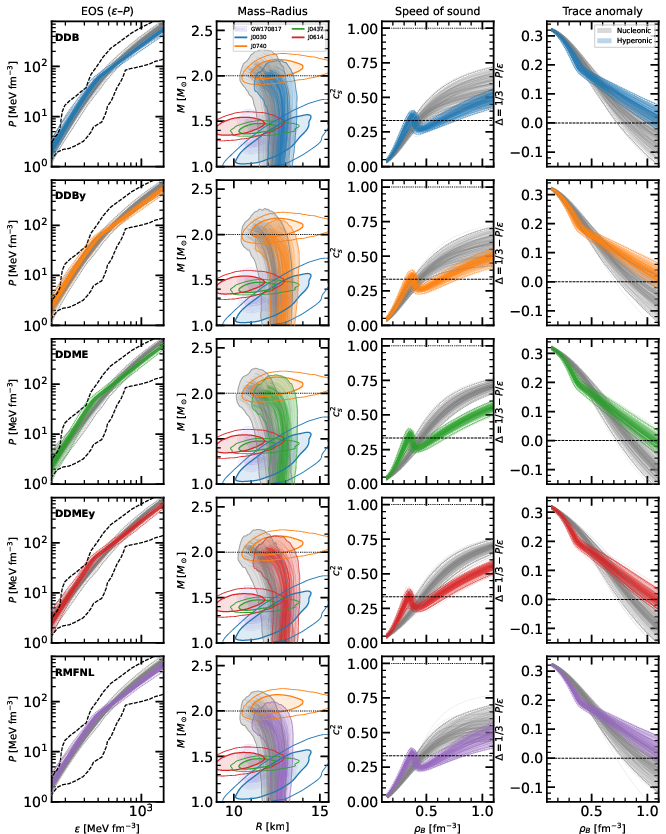
Figure 1: Posterior domains for EOS, mass-radius relation, and speed of sound for all model families, comparing nucleonic (gray) and hyperonic (colored) versions.
The hyperonic softening reduces the maximum NS mass by xsΣ2–xsΣ3 across all models (cf. Table 1 in the paper), but with the inclusion of repulsive hyperon-hyperon xsΣ4-meson interactions, all parameterizations remain compatible with the xsΣ5 observational constraint. A robust feature is an increase of the radius at xsΣ6 by xsΣ7–xsΣ8 km in hyperonic stars.
Particle Composition and Hyperonization
Hyperonization initiates at xsΣ9–xsΞ0, with the xsΞ1 hyperon always appearing first, followed closely by xsΞ2 and xsΞ3 (Figure 2, Figure 3).
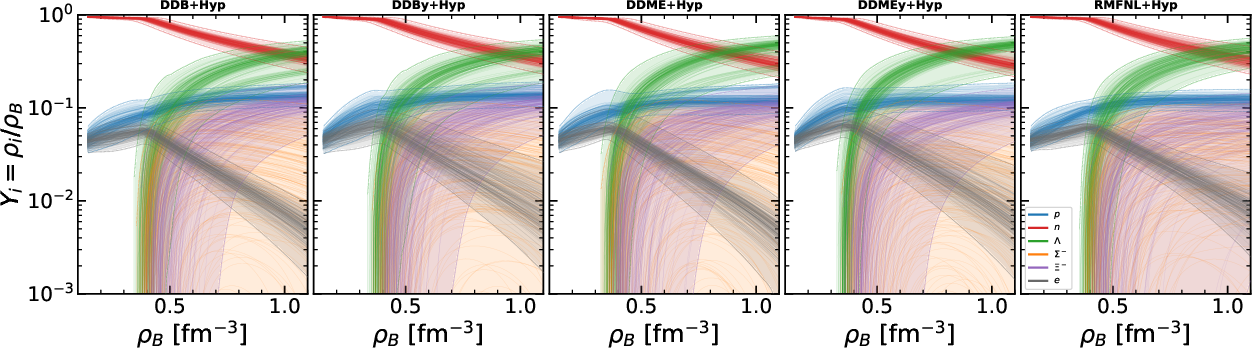
Figure 2: Particle fractions as a function of baryon density; the onset and growth of xsΞ4, xsΞ5, and xsΞ6 are evident.
Hyperon onset densities are tightly clustered between xsΞ7–xsΞ8 fmxsΞ9 for xωi,xϕi0, xωi,xϕi1–xωi,xϕi2 fmxωi,xϕi3 for xωi,xϕi4, and xωi,xϕi5–xωi,xϕi6 fmxωi,xϕi7 for xωi,xϕi8, with some model dependence Figure 3. Notably, in all hyperonic EOSs, the xωi,xϕi9 fraction exceeds that of protons at y0 fmy1.
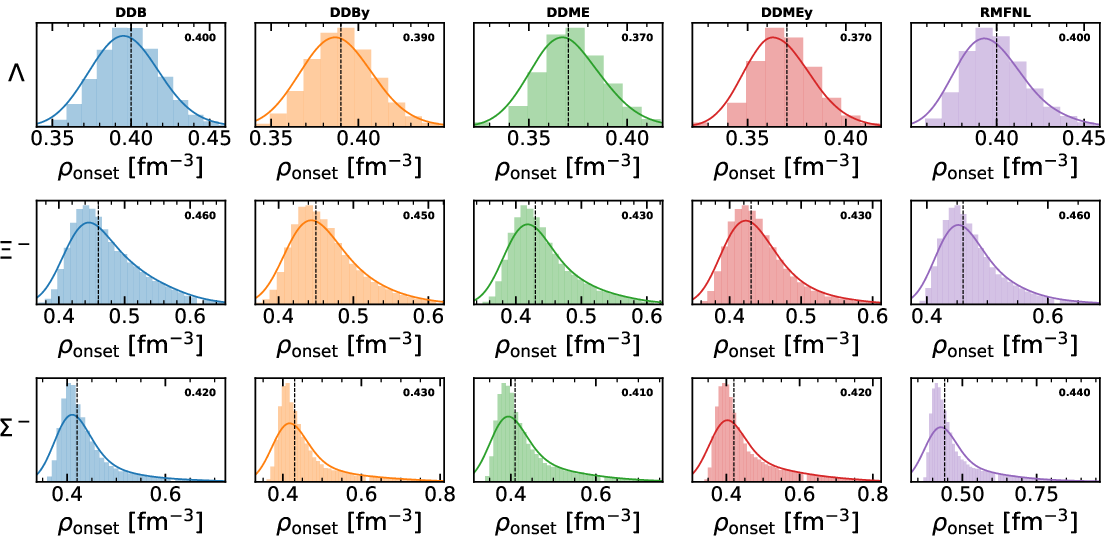
Figure 3: Posterior distributions of onset densities for y2, y3, and y4 hyperons in all models.
Impact on Proton Fraction and Isovector Physics
A central result is the sharp reduction and narrowing of the proton-fraction posterior in models with a flexible isovector channel (parameter y5) upon the inclusion of hyperons Figure 4.
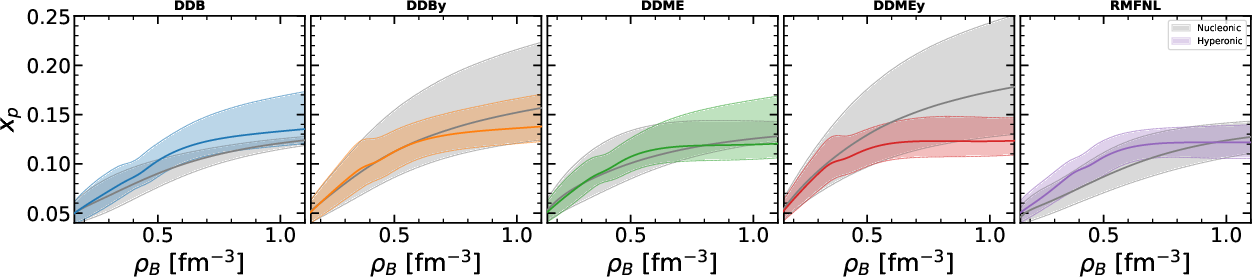
Figure 4: The proton fraction as a function of baryon density; hyperonic posteriors (colored) are substantially constrained compared to nucleonic cases (gray), especially in y6-models.
For models without y7, responding to the y8 constraint requires an EOS stiffening that increases high-density symmetry energy, and thus the proton fraction, offsetting (in part) the charge-compensation effects from hyperons.
A key claim is that once hyperons are present, the average proton fraction becomes essentially independent of the isovector-channel flexibility, being determined dominantly by the hyperon content.
Model Calibration with Hypernuclear Optical Potentials
The posterior optical potentials for hyperons in symmetric nuclear matter at saturation are consistent with empirical values: y9 to ϱ0 MeV, ϱ1 to ϱ2 MeV, ϱ3 to ϱ4 MeV Figure 5. This alignment validates both the selection of coupling priors and the ability of the RMF models to interpolate faithfully between laboratory and astrophysical environments.
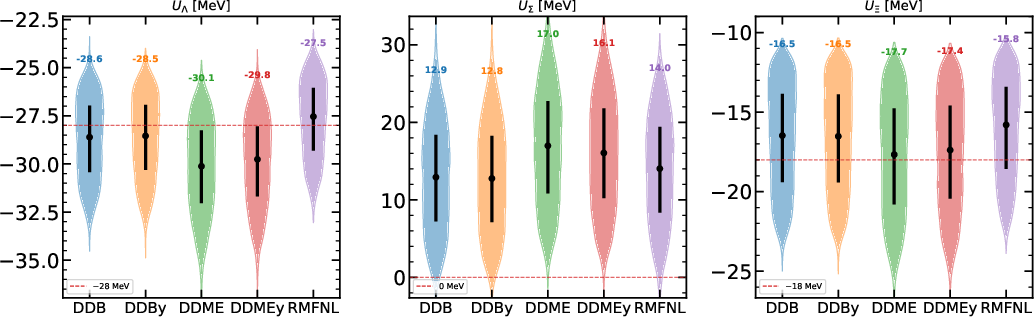
Figure 5: Posterior distributions for ϱ5, ϱ6, ϱ7 for all hyperonic RMF models.
Mass-Radius Topology and the Slope Diagnostic
The slope of the mass-radius curve (ϱ8) offers a diagnostic for the presence of non-nucleonic degrees of freedom Figure 6. In nucleonic EOSs, the radius typically decreases with increasing mass for ϱ9 (i.e., ϕ0), whereas in hyperonic models, ϕ1 even for low masses due to the requirement for a stiffer low-density EOS to counteract high-density softening.
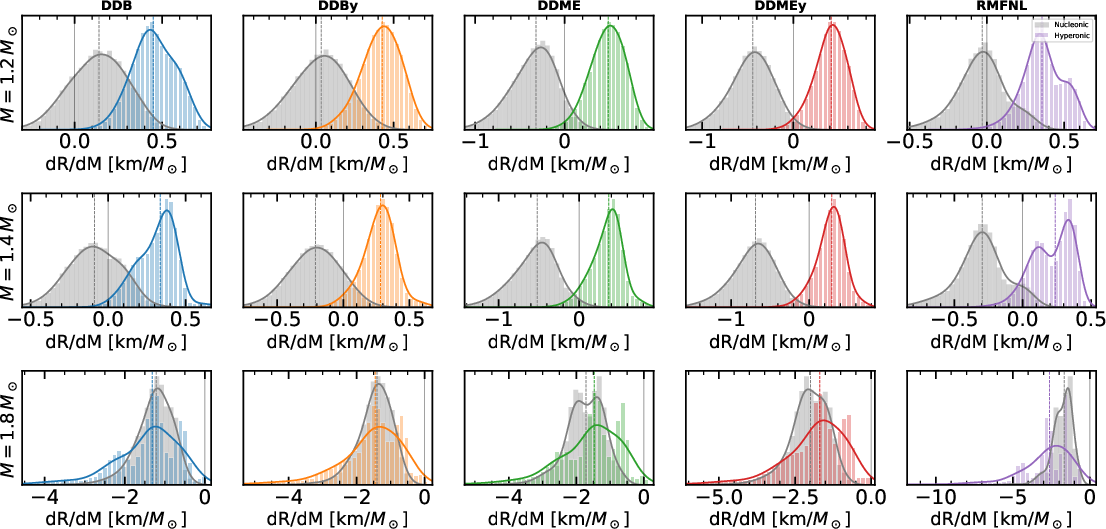
Figure 6: Posterior distributions of ϕ2 at fixed NS masses; the sign change to ϕ3 at low mass can distinguish hyperonic from nucleonic EOS.
Observation of a massive NS with a radius equal to or larger than a lighter star would indicate significant non-nucleonic content, serving as a discriminant for hyperonic or hybrid interiors.
Trends in Nuclear Matter Parameters
The nuclear incompressibility ϕ4 and symmetry energy curvature ϕ5 in hyperonic EOS samples are systematically larger and less negative than in nucleonic cases, as a direct consequence of the need to counteract the EOS softening from hyperonization (Table in the paper). Most other saturation parameters are insensitive to the inclusion of hyperons.
Theoretical and Practical Implications
The findings demonstrate that, with appropriately calibrated RMF interactions—specifically, models incorporating repulsive hyperon-hyperon dynamics—all theoretical and observational constraints on NS structure can be satisfied in the presence of hyperons. The results emphasize that hyperonization is likely encoded in subtle structural features (mass-radius topology, proton fraction evolution, onset densities) and cannot be excluded by ϕ6 or ϕ7 alone.
These trends suggest that statistical inference using future, more precise NS radii and tidal deformability (especially for high-mass stars), possibly augmented by direct determination of the mass-radius slope for multiple NS masses, could enable decisive evidence for or against the presence of hyperons in the core.
Conclusion
This study provides a comprehensive, constraint-driven assessment of the role of hyperons in neutron-star interiors using RMF density functionals. The inclusion of hyperon degrees of freedom, with empirically calibrated couplings and repulsive ϕ8-mediated interactions, naturally resolves the hyperon puzzle within current astrophysical constraints, while generating distinctive theoretical signatures—most notably in the behavior of the mass-radius relation and particle fractions. Future developments in observational accuracy and inference techniques are likely to transform the theoretical diagnosis of multi-baryonic composition in neutron stars.