- The paper introduces a QC-based methodology to quantify local MBS overlap and ground-state parity splitting, advancing topological qubit assessment.
- QC measurements reveal distinct peak splitting (δ) and height asymmetry (ν) that differentiate overlapping from well-localized Majorana states.
- Experiments on QD-based Kitaev chains validate the protocol, offering a path toward optimized and robust MBS-based qubits for quantum computing.
Assessing Majorana Bound States and Qubits via Quantum Capacitance
Introduction
The characterization and control of Majorana bound states (MBSs) are central to the development of topological quantum computing. Quantum capacitance (QC) has emerged as a sensitive, non-invasive probe capable of distinguishing fermion parity and, consequently, the quantum information encoded in MBS-based devices. In "Assessing Majorana states and qubits through quantum capacitance" (2606.21580), Dourado et al. develop a formalism and experimental scheme that exploits QC measurements via an auxiliary quantum dot (QD) to simultaneously quantify two principal figures of merit in MBS devices: the local MBS overlap and the ground-state parity splitting. This methodology applies broadly to engineered Kitaev chains and MBS-based qubits, providing a robust pathway for optimizing topological devices while preserving global fermion parity.
Quantum Capacitance Signatures of Majorana States
The primary technical advance is the use of QD-coupled QC measurements to distinguish well-localized from overlapping MBSs, and to directly measure their ground-state degeneracy splittings. The theoretical analysis begins with a minimal model comprising two MBSs coupled via a QD, the latter subject to gate-tuning and dispersive readout. The parity-conserving nature of the system enables calculation of the QC as the curvature of ground-state energy with respect to QD level detuning.
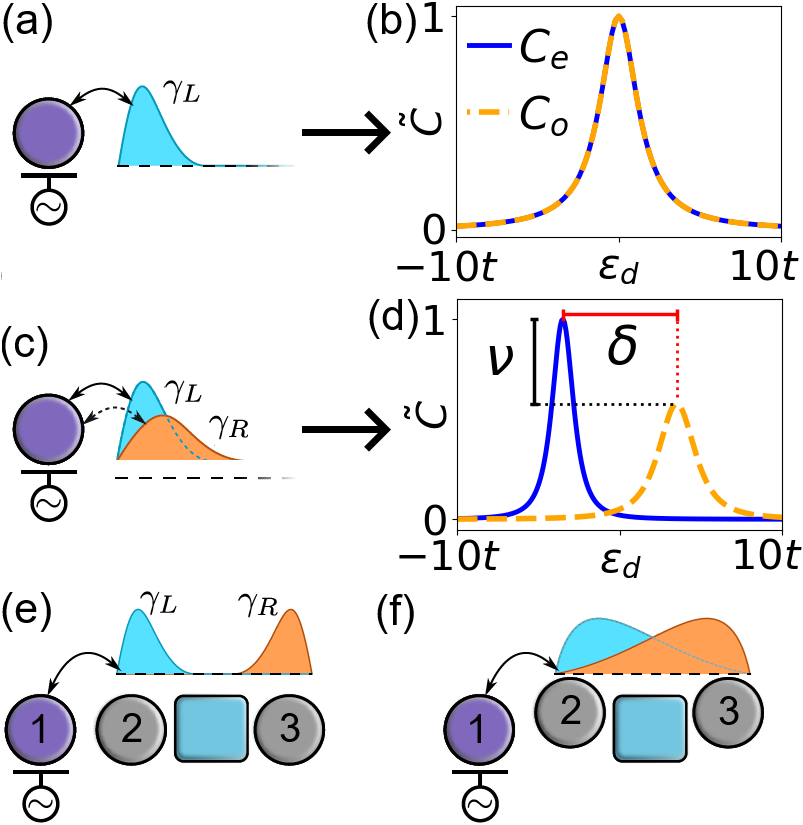
Figure 1: Zero-energy localized MBSs yield identical QC peaks for both parity sectors; overlapping MBSs result in split QC peaks with unequal amplitude, reflecting finite overlap and energy splitting.
For well-localized, non-overlapping MBSs, the QC measured in even and odd parity sectors is identical, and peak positions are degenerate with maximum amplitude determined by equal anomalous tunneling coherence factors. In contrast, local hybridization (finite u=v) or nonzero Majorana energy splitting shifts and unequally scales the QC peaks, leading to two robust observables: (i) the peak splitting δ, proportional to energy splitting, and (ii) the peak height difference ν, which directly encodes the local MBS overlap. These signatures are robust to power broadening and preserve the system’s fermion parity, a requirement for quantum information applications.
Majorana Polarization and Energy Splitting from QC
The parameter ν extracted from the ratio of maximal QC responses in each parity sector encodes the Majorana polarization (MP), a direct quantifier of the spatial overlap between MBSs. The analytic correspondence between QC response and MP,
∣Mi∣=1+(1−ν)22(1−ν),
permits in situ assessment of MBS quality at any QD-coupled site. The splitting δ between parity-selective QC peaks yields the ground-state energy splitting as δ=2εM, an essential metric for topological protection. These two figures of merit—MP and parity splitting—collectively capture the degree of non-locality and degeneracy in the Majorana system, properties unattainable via conventional transport-based probes.
Application to Quantum Dot-Based Kitaev Chains
The authors validate the QC methodology using a microscopic model of QD-based Kitaev chains—the experimental platform of choice for MBS realization. By systematically varying the chain parameters (on-site potentials, superconducting pairing, and hopping), the sweet spots of the system (maximal non-locality and zero energy splitting) are mapped directly to distinct QC signatures.
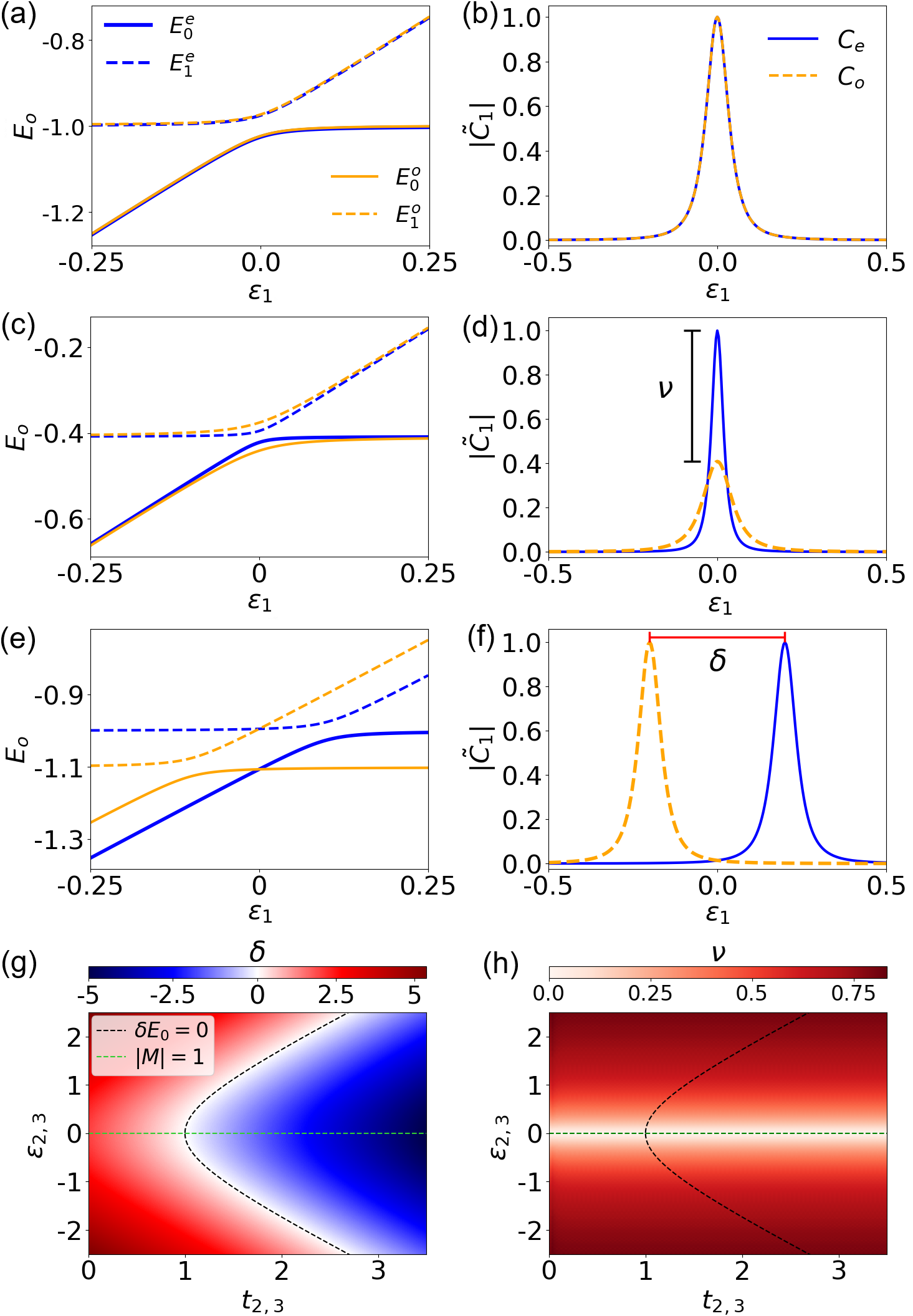
Figure 2: Symmetric QC peaks at the sweet spot signal well-localized, degenerate MBSs; deviation (overlap or splitting) manifests as peak height difference and/ or energy splitting in QC.
Specifically, at the sweet spot defined by ε2,3=0 and t2,3=Δ2,3, the QC peaks for both parity sectors are degenerate and maximal, corresponding to spatially separated MBSs. Departures from these conditions—either by shifting site energies or varying tunnel couplings—result in clearly resolved asymmetries: the QC response quantifies both the spatial overlap and the energy splitting. The calculated QC observables ν and δ0 track precisely with the theoretically computed Majorana polarization and ground-state splitting, demonstrating the power of QC for device optimization and benchmarking.
Assessing MBS-Based Qubits via Capacitance
The techniques are extensible to qubit architectures realized as two coupled Kitaev chains, each hosting a pair of spatially separated MBSs. By embedding auxiliary QDs at both ends and a tunable central QD to mediate coupling, one can experimentally map out the operational sweet spot of the qubit. QC measurements at the endpoints provide access to both the overlap (via δ1) and degeneracy (via δ2), for each wire segment.
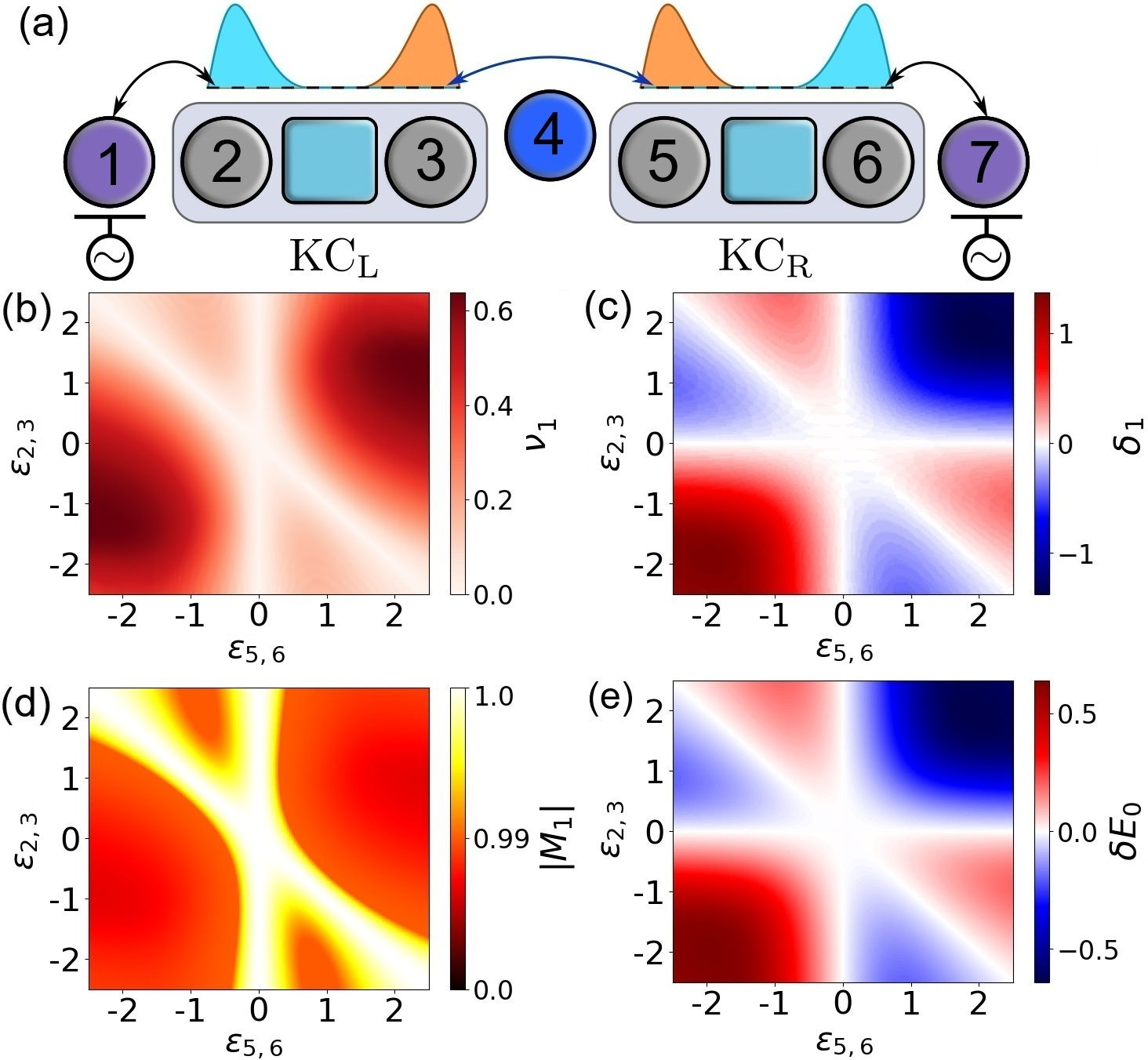
Figure 3: QC measurements at the ends of a double Kitaev chain device sharply identify sweet spots (minimized overlap and zero energy splitting) necessary for robust MBS-based qubits.
This experimental protocol enables performance assessment of both left- and right-localized MBSs and robust tuning of device parameters for degeneracy and spatial separation. In asymmetric or perturbed regimes (e.g., off-resonance central QD), accident degeneracies are broken, and QC observables correctly track the evolution of MP and splitting, even in the presence of realistic interactions or finite inter-chain coupling.
Implications and Outlook
The QC-based assessment protocol possesses both theoretical and experimental significance. From a methodological perspective, it offers a direct and parity-conserving probe of MBS devices, circumventing the limitations of spectroscopic or transport methods that may compromise quantum coherence. On the practical side, it establishes a foundation for active device tuning and benchmarking—optimal operation is directly linked to the degeneracy (minimal δ3) and non-locality (maximal δ4) accessible from QD-coupled QC measurements. This is critical for the realization and manipulation of non-Abelian states, for instance in future experiments targeting topological quantum computation or braiding protocols.
Future developments may further extend these ideas to complex multi-island topologies, driven by the increasing sophistication and integration of QD-based Kitaev chain arrays. The compatibility of QC readout with time-domain protocols and its robustness against quasiparticle poisoning will remain areas of high interest.
Conclusion
This work formulates and validates a systematic, device-agnostic protocol for quantifying both the spatial non-locality and parity splitting of MBSs using QC measurements via auxiliary QDs. The approach is shown to be effective in minimal and extended Kitaev chains, as well as in prototypical MBS-based qubits, underpinning its utility for both device optimization and fundamental studies of topological quantum matter. Direct extraction of Majorana polarization and parity splitting from experimentally accessible QC parameters offers a practical path toward scalable and protected quantum information devices.