- The paper presents a conflict-aware switching policy that addresses constraint conflicts in CBF-CLF-QP formulations to improve multi-goal navigation.
- It introduces a cosine similarity-based heuristic for detecting conflicts between safety (CBF) and progress (CLF) constraints, mitigating deadlocks.
- Experimental evaluations demonstrate reduced completion times and enhanced scalability compared to baseline strategies in various static and dynamic obstacle scenarios.
Conflict-Aware Switching for CBF-CLF-Based Multi-Goal Navigation
Overview and Motivation
This paper addresses the problem of constraint conflict in CBF-CLF-QP-based multi-goal navigation, especially in scenarios requiring safe reach-and-avoid behaviors for multiple agents and sequential goal-to-goal tasks. The authors rigorously highlight the incompatibility between safety (CBF) and nominal (CLF) objectives in standard quadratic program formulations, which notably results in slowdowns and deadlocks when these constraints conflict, particularly in dense, multi-goal environments. Existing methods are typically computationally expensive (e.g., model predictive control with forward propagation) or excessively conservative (e.g., complete deadlock elimination). The proposed approach centers on a conflict-aware switching policy that dynamically selects the least-conflicted nominal control objective based on a mathematically consistent heuristic measuring conflict between CBF and CLF gradients.
The paper lays out the standard control-affine system framework, describing the use of CBFs for safety and CLFs for goal progress, combined via quadratic programming. For multi-objective scenarios—where simultaneous satisfaction of all CLFs is infeasible—the nominal objective is selected, and safety is enforced across all obstacles. Deadlock analysis is formalized using KKT conditions of the QP, establishing sufficient and necessary conditions for deadlock in terms of constraint gradients. Specifically, deadlock emerges where ∇V and ∇h are collinear, and constraint conflict is quantifiable as proximity between these gradients.
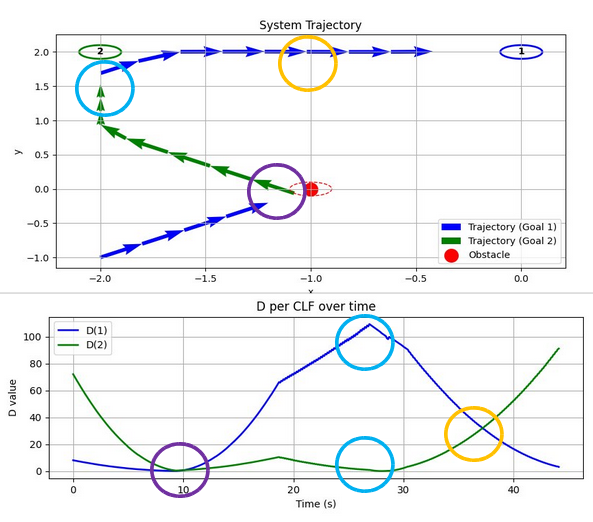
Figure 1: Inconsistent alignment-based heuristic; D fails to distinguish between head-on obstacle encounters and obstacle-free goal approaches, motivating the need for a consistent heuristic.
Conflict Heuristics and Consistent Switching Policy
The authors critically dissect prior attempts at alignment-based conflict metrics, specifically the collinearity metric D, which is insensitive to directional information and thus inconsistent. This motivates the introduction of a consistent heuristic: cosine similarity between constraint gradients, which yields a total order for constraint conflict and is able to differentiate between maximal (ϕθ≈1) and minimal (ϕθ≈−1) conflict. The heuristic is locally scaled with a Gaussian function to ensure conflict detection is only activated near the safety boundary, preventing overly conservative switching. The switching policy selects the CLF goal with minimal scaled conflict, subject to dwell-time and switching threshold constraints to avoid Zeno behavior.
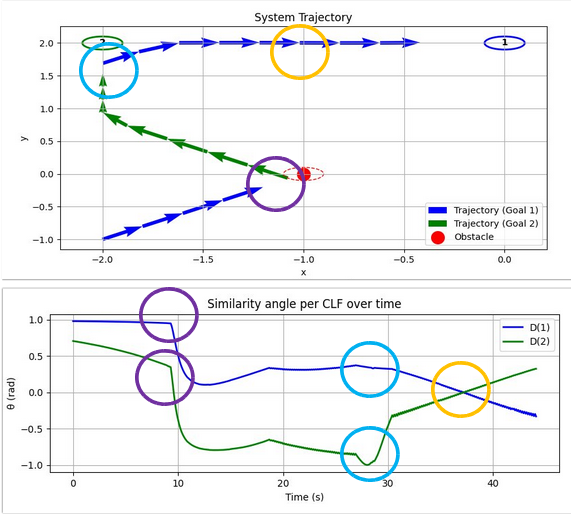
Figure 2: Consistent alignment-based heuristic, indicating conflict via cosine similarity; high values trigger switching to avoid slowdown and deadlock.
Experimental Evaluation
The methodology is empirically validated on several scenarios of increasing complexity:
- Stationary Obstacle: For a single 2D integrator agent navigating two goals, increasing obstacle size demonstrates that the baseline sequential policy's completion time increases with conflict, whereas the conflict-aware switching policy achieves lower completion times, especially as obstacle-induced conflict grows. The switching policy's activation neighborhood broadens with obstacle size, allowing earlier avoidance of slowdown.
- Patrolling Obstacle: For unicycle dynamics with moving obstacles, the switching agent dynamically redirects to less-conflicted goals while the baseline agent waits for the patrolling obstacle to clear, resulting in lower completion times for the switching strategy.
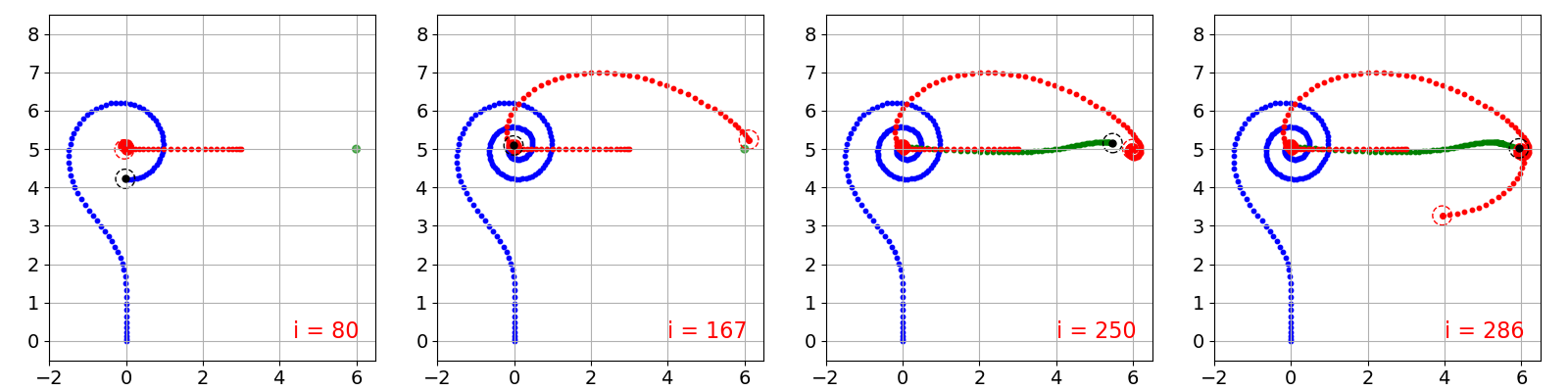
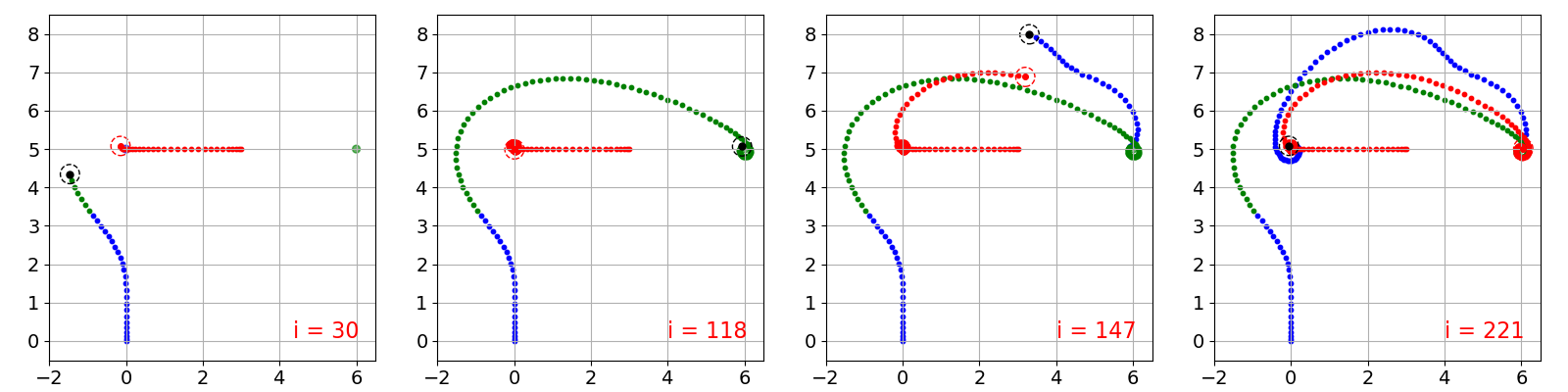
Figure 3: Patrolling scenario; switching policy enables dynamic redirection, improving completion time compared to baseline waiting behavior.
- Multi-Agent Multi-Goal Navigation: Extensive Monte Carlo experiments across scenarios with up to 19 agents and 14 goals demonstrate that conflict-aware switching yields superior scalability. Timeout percentages plateau for the switching policy but rise monotonically for the baseline. Average completion time is consistently lower for the switching policy, even accounting for randomized spatial configurations.
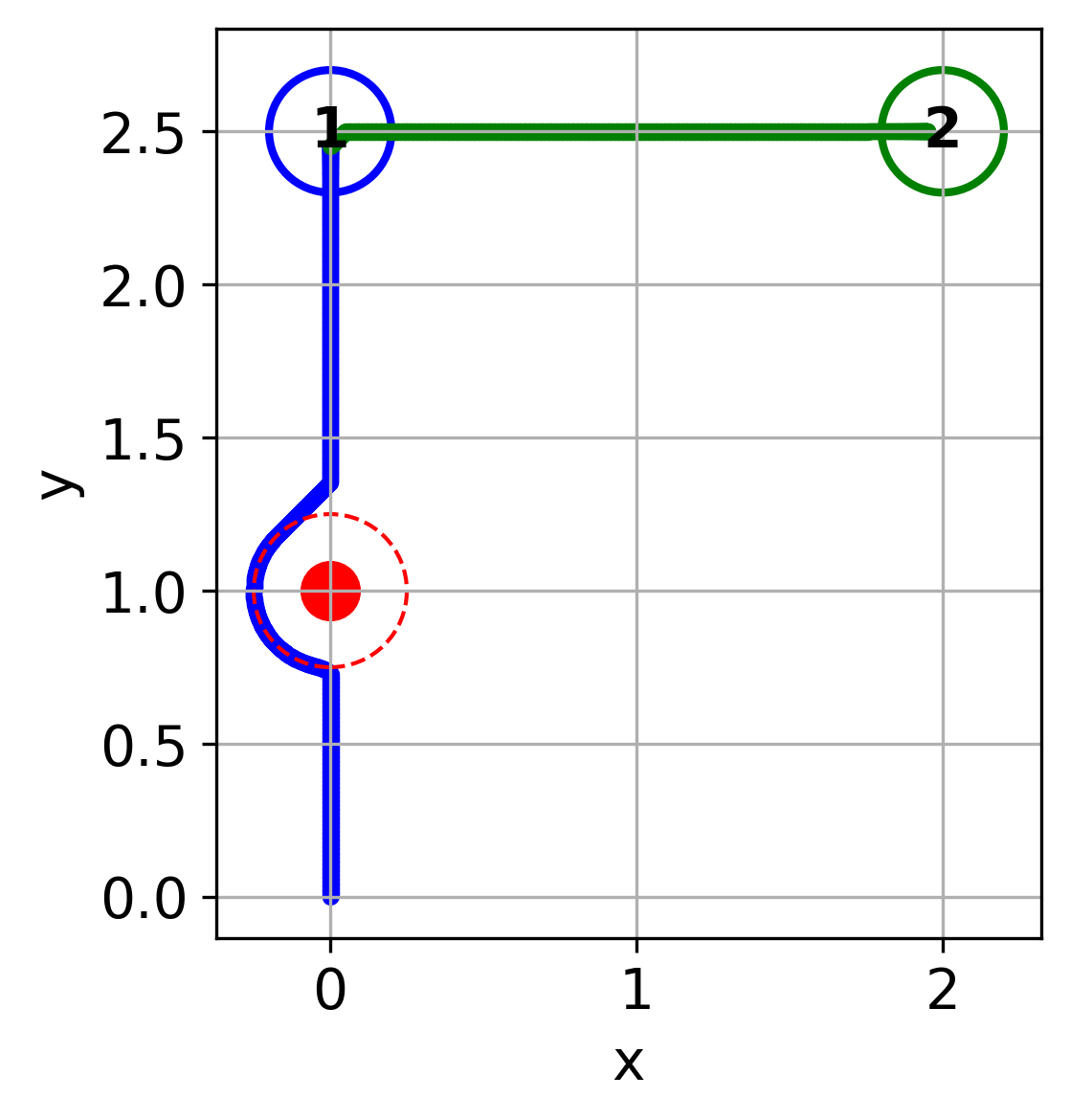
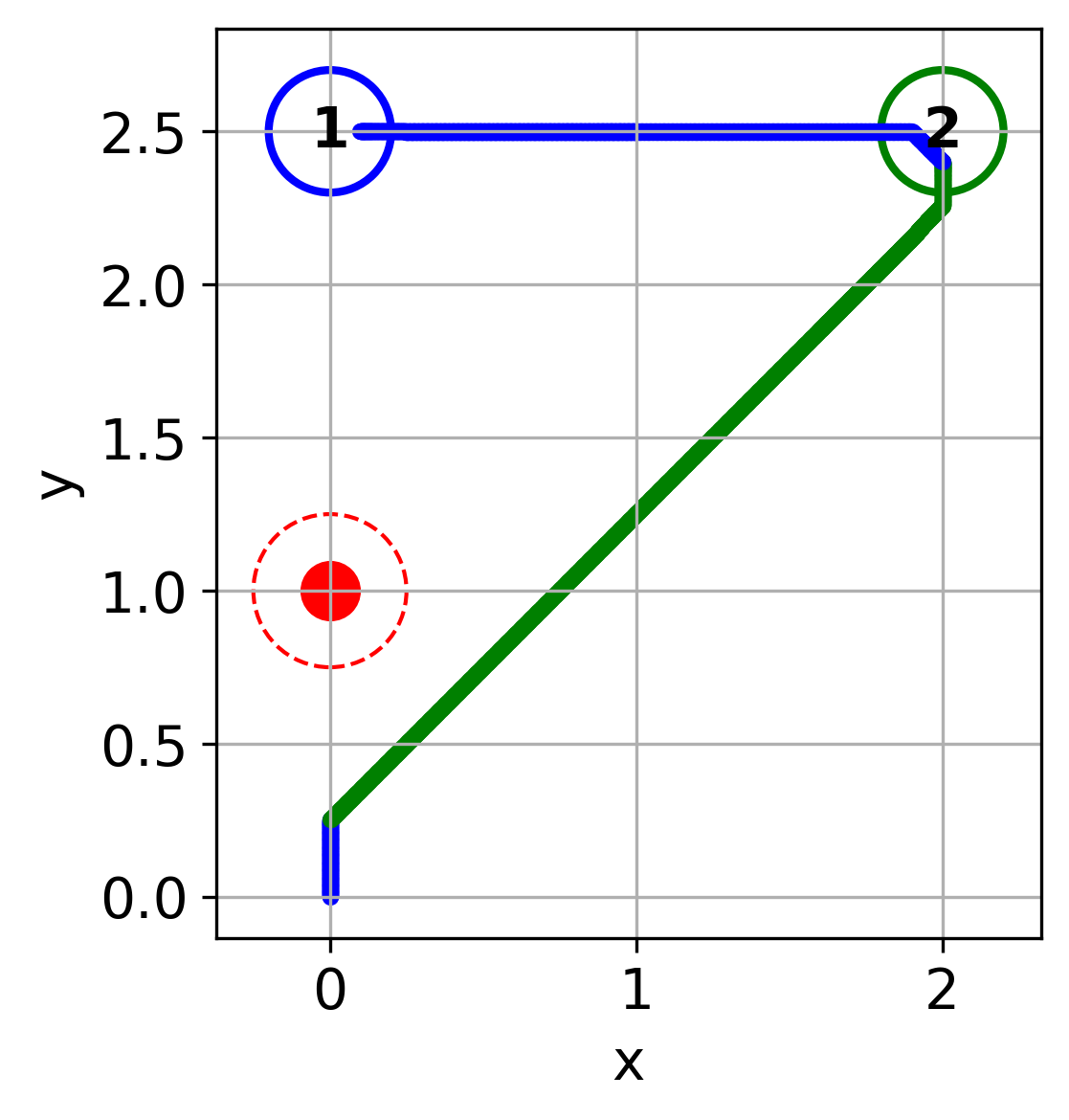
Figure 4: No switching; the agent is delayed by waiting for the patrolling obstacle, resulting in increased completion time.
Implications and Future Directions
The results strongly indicate that conflict-aware switching policies grounded in consistent alignment-based heuristics improve both completion time and mission success rates in multi-goal reach-and-avoid problems under CBF-CLF-QPs. The compatibility with high-order control constraints, scalability across increasing agent/goal counts, and avoidance of excessive conservativeness constitute significant practical and theoretic advancements for deployment in robotic navigation, warehouse logistics, and safety-critical multi-agent systems.
Potential future research directions include:
- Integration of learning-based approaches for adaptive conflict heuristics.
- Extension to dynamic environments with non-stationary and non-convex obstacles.
- Theoretical guarantees for switching optimality in heterogeneous nominal objective prioritization.
- Real-world deployment in multi-robot warehousing and urban navigation with additional constraints.
Conclusion
The paper establishes rigorous theoretical and empirical foundations for conflict-aware switching in CBF-CLF-QP-based multi-goal navigation. By formulating consistent heuristics and providing optimal policies for switching to least-conflicted nominal objectives, the authors demonstrate significant improvements over baseline sequential strategies, particularly in high-conflict, multi-agent environments. The contributions advance practical applicability and theoretical understanding of safe and efficient navigation under complex constraint interactions.

