- The paper introduces a necessary and sufficient condition for a function to be α-convex in the unit disk.
- It extends classical Fekete–Szegő inequalities by providing sharp coefficient estimates that interpolate between starlike and convex functions.
- It establishes precise subclass inclusions and sharp Schwarzian norm bounds, offering new insights in geometric function theory.
Characterization and Extremal Properties of α-Convex Functions
Introduction
The paper "A Characterization of α-Convex Functions with Sharp Coefficient and Schwarzian Estimates" (2606.21574) undertakes a thorough investigation of the analytic, geometric, and extremal properties of the class Mα of α-convex functions. This class, parameterized by α∈R, interpolates between starlike (α=0) and convex (α=1) univalent functions in the unit disk. The authors present an extension of the classical characterization theorems to the α-convex setting, derive sharp coefficient estimates (notably a sharp Fekete–Szegő-type inequality), establish precise subclass inclusions, and analyze the Schwarzian norm, including formulating a conjecture for the extremal value in the case α=1/n.
Definition and Main Characterization of Mα
A function α0 analytic in the unit disk α1 is α2-convex if
α3
where α4 is the α5-convexity operator:
α6
This encompasses the classical cases: α7 (starlike) and α8 (convex). The main result in the paper is a necessary and sufficient condition generalizing work by Chuaqui, Duren, and Osgood:
α9
for all Mα0. The proof leverages subordination to the Carathéodory class, Schwarz lemma, and sharp rearrangement inequalities.
Subclass Inclusions and Sharp Order Results
The authors derive explicit and sharp values for the minimal parameters Mα1 such that Mα2 (convex functions of order Mα3) and reciprocally, for given Mα4, determine the maximal Mα5 for which Mα6. They show that for Mα7:
Mα8
and, for Mα9, α0 for
α1
with α2 as in (1) of the paper.
Sharp Fekete–Szegő Inequality
A significant technical contribution is the extension of the Fekete–Szegő inequality to α3. For α4 in α5:
α6
which interpolates between the precise bounds for starlike and convex functions. The extremality and equality are attained for functions induced by a special starlike function in the integral representation, confirming sharpness.
Order and Schwarzian Norm for α7
The order invariant α8 for α9 is estimated by
α∈R0
For the Schwarzian norm, the authors provide a piecewise sharp upper bound α∈R1, with detailed phase transition points:
α∈R2
where α∈R3 depends on the Gamma function and describes a transition between starlike and convex distortion.
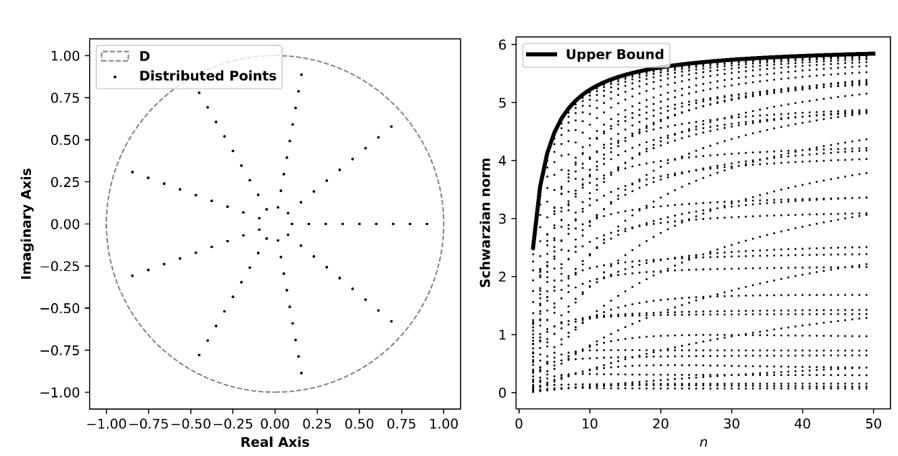
Figure 1: (Left) Sampling points in α∈R4. (Right) Numerical evaluation of α∈R5 for the α∈R6-Koebe function, illustrating sharpness of the conjectured Schwarzian norm formula.
Schwarzian Norm and the α∈R7-Koebe Function
A central conjecture based on numerical evidence for the case α∈R8 (with α∈R9 the α=00-Koebe function) is stated:
α=01
with agreement to numerical computation for α=02 up to at least α=03. The derivation is based on expressing the Schwarzian for functions of the form
α=04
and exploiting their explicit Taylor series and the arithmetic of the incomplete beta function.
Implications and Outlook
The precise analytic characterization of α=05 and the extremal results for its invariants contribute significant clarity to the structure of affine-invariant and non-affine-invariant univalent function classes. The results have direct implications for geometric function theory, particularly in understanding geometric distortion, boundary regularity, and the limits of extremal function problems among generalizations of classical families.
From a theoretical perspective, the approaches and methods introduced can be extended to other interpolatory or parameterized families, and the explicit connection with starlike representations opens a path for further development in general domain function theory and connections with functional subordination. The conjectural result for the Schwarzian norm suggests the potential for universal formulas in similar parameterized families, a direction ripe for further verification and generalization.
Conclusion
This work provides a comprehensive and technically sharp account of the structure and extremal properties of α=06-convex functions, with new characterizations, precise coefficient and norm bounds, and explicit subclass relations. The conjecture for the Schwarzian norm in the α=07 case is well-supported numerically and awaits a full general proof. The framework and methodology developed are likely to impact the analysis of related interpolation classes and contribute to the understanding of the geometric function theory landscape.