- The paper demonstrates a detailed mapping of momentum-dependent energy shifts and decay properties of moving Fermi polarons using Raman acceleration and RF spectroscopy.
- It reveals a sharp momentum-driven polaron-to-molecule transition near p_F, with contrasting behaviors in attractive and repulsive branches that match T-matrix theory predictions.
- The methodology provides actionable insights for probing non-equilibrium many-body dynamics and tailoring impurity physics in ultracold atomic systems.
Microscopic Properties of the Moving Fermi Polaron
Introduction and Context
This paper presents a detailed study of the Fermi polaron—a fundamental quasiparticle formed by a mobile impurity interacting with a degenerate Fermi sea—focusing specifically on its finite-momentum properties. While the zero-momentum regime of the Fermi polaron is well established, both experimentally and theoretically, little was known about the full momentum-dependent dispersion and decoherence mechanisms at finite p. The authors address this gap by employing a novel Raman acceleration technique and high-precision radio-frequency (RF) spectroscopy to systematically probe the polaron's energy shifts and spectral linewidths across a wide range of impurity momenta. Findings are compared with a diagrammatic T-matrix theory, and both attractive and repulsive polaronic branches are examined.
Theoretical Foundation: Dispersion and Effective Mass
The polaron's dispersion at low momentum is described by a simple parabolic form with a constant effective mass, m↓∗, which is typically enhanced relative to the bare impurity mass due to medium-induced dressing. In reduced units, the regime of parabolic behavior is limited to p/pF≲1, with pF set by the background Fermi sea. Finite-momentum effects lead to a breakdown of the effective-mass picture when p approaches pF or exceeds it, as two-body processes dominate, dressing is suppressed, and the polaron approaches the behavior of a bare impurity.
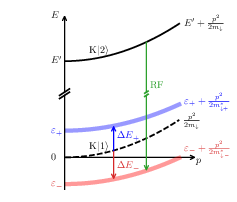
Figure 1: Energies of impurity states in the low-momentum regime, showing the parabolic dispersion associated with constant effective mass and the interaction-induced energy shifts for attractive and repulsive branches.
A crucial contrast is revealed between attractive and repulsive branches: for attractive interactions, the energy shift initially increases in magnitude with small momentum before exhibiting a non-monotonic, downward trend, whereas for the repulsive branch, the shift decreases monotonically. The diagrammatic T-matrix theory accurately captures this full crossover between low- and high-momentum regimes.
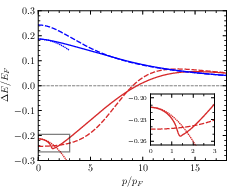
Figure 2: Momentum-dependent energy shift for the attractive (red) and repulsive (blue) polaronic branches according to various theoretical models, highlighting the crossover from parabolic to non-parabolic dispersion.
Experimental Methods: Raman Acceleration and RF Spectroscopy
The experimental system consists of 41K impurities in an optically trapped Fermi sea of 6Li, with interaction strength tunable via a Feshbach resonance. The authors developed a Raman acceleration protocol, allowing for quasi-continuous momentum transfer to the impurity atoms while maintaining negligible perturbation to the background Fermi sea. Momentum kicks up to T0 (with T1) are achieved, spanning deeply into the high-momentum regime.
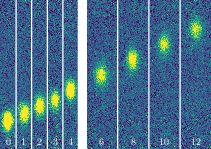
Figure 3: Controlled photon momentum transfer to K impurity atoms, enabling precise tuning of the impurity momentum up to many times T2.
Impurity energy shifts and spectral line broadenings are then measured via RF injection spectroscopy by driving transitions between a non-interacting reference state and a strongly interacting polaron state. This protocol enables direct extraction of the quasiparticle energy and decoherence effects as a function of the impurity momentum.
Results: Energy Shifts and Spectral Broadening
Momentum-Dependent Energy Shifts
Experimental data reveal a non-monotonic energy shift T3 for the attractive polaron: the magnitude initially increases with T4, reaches a minimum in the vicinity of T5, and then reverses direction as T6 increases further. For the repulsive polaron, the energy shift exhibits a smooth, monotonic decrease with increasing momentum.
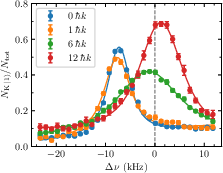
Figure 4: Effect of photon momentum transfer on the RF spectral peak for the attractive polaron, demonstrating non-monotonic energy shift behavior.
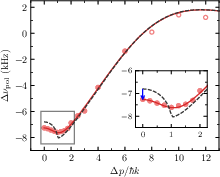
Figure 5: Extracted polaron peak shift as a function of impurity momentum, showing characteristic non-monotonicity for the attractive branch.
These results quantitatively match predictions from the T7-matrix theory, with universal scaling in reduced units observed across independent datasets.
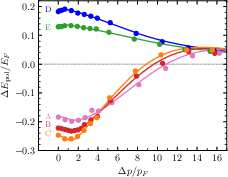
Figure 6: Universal representation of measured and theoretical momentum-dependent energy shifts for both attractive and repulsive polarons.
Spectral Linewidths
The linewidth of the polaron spectral peak provides information about quasiparticle decay. For the attractive branch, the linewidth is small at T8 but increases rapidly at intermediate T9, reaching a maximum before decreasing at higher m↓∗0. This pronounced growth in linewidth coincides with the polaron entering the molecule-hole continuum, where it ceases to be a well-defined ground state and mixes with molecular excitations. For the repulsive polaron, linewidths remain significantly smaller throughout, consistent with the absence of such continuum coupling.
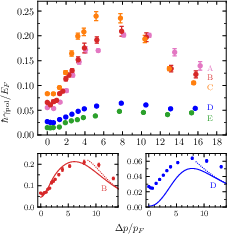
Figure 7: Momentum-dependent linewidths for attractive and repulsive polarons, with the attractive branch exhibiting strong growth at intermediate momenta due to decay into the molecule-hole continuum.
The high-momentum asymptote is well modeled by two-body scattering theory and exhibits universal behavior determined by the effective range of the Feshbach resonance.
Motion-Induced Polaron-Molecule Transition
One of the central findings is the observation of a sharp, motion-induced polaron-to-molecule transition for the attractive branch. As the impurity's momentum exceeds a threshold near m↓∗1, the polaron energy enters the molecule-hole continuum, leading to enhanced decay and a qualitative change in both the energy dispersion and effective mass tensor. The m↓∗2-matrix calculations naturally account for this transition via the Thouless pole condition and reveal a distinct change in the nature of the lowest-lying excitation of the system.
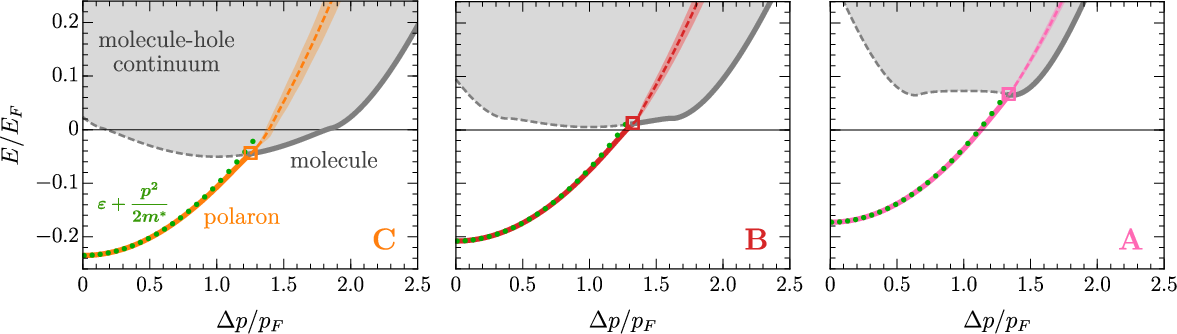
Figure 8: Full energy spectrum as a function of impurity momentum, showing the crossing of the attractive polaron with the molecule-hole continuum.
The onset and effects of this transition are further evidenced by pronounced kinks in the momentum-resolved energy shift and linewidth.
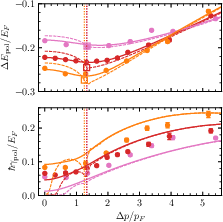
Figure 9: Fine structure of the attractive polaron’s energy shift and linewidth at low momentum, marking the polaron-molecule transition.
Effective-Mass Tensor and Universality
The effective mass tensor, including longitudinal and transverse components, is extracted from the dispersion. For the attractive polaron, both masses are enhanced near m↓∗3, but drop and become anomalously lighter than the bare mass once the polaron is no longer the ground state, reflecting the drastic change in quasiparticle character as it merges with the continuum.
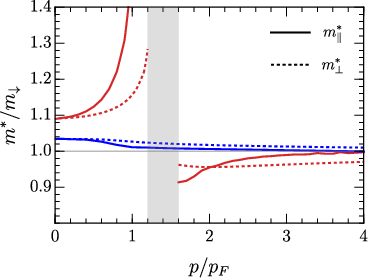
Figure 10: Longitudinal and transverse effective masses for attractive and repulsive polarons as functions of momentum, emphasizing nontrivial behavior across the transition.
Implications and Outlook
These results provide a comprehensive quantitative test of diagrammatic m↓∗4-matrix theory for Fermi polarons spanning low- to high-momentum regimes, verifying its accuracy for both energy and decay properties. The identification and control of the motion-induced polaron-molecule transition open new opportunities for exploring dynamical many-body physics and non-equilibrium phenomena in impurity systems.
Practically, the Raman acceleration and precise spectroscopic toolbox demonstrated here can be generalized to probe polaronic dispersion in a wide class of ultracold atomic mixtures, including extreme mass ratio systems, dipolar gases, or media with spin-orbit coupling, enabling tailored studies of Fermi- and Bose-polaron transport, decoherence, and emergent collective phenomena. The methodology is extensible to dynamical and time-resolved protocols, with implications for quantum simulation of nonequilibrium quasiparticle physics, Anderson orthogonality, and strongly correlated transport.
Conclusion
This work achieves a detailed mapping of the moving Fermi polaron's dispersion relation and spectral properties over a broad range of momenta, confirming the validity of many-body m↓∗5-matrix theory and uncovering distinctive contrasts between attractive and repulsive branches. The discovery of a momentum-driven polaron-to-molecule transition and associated spectral broadening illustrates the richness of finite-momentum impurity physics in Fermi gases. The experimental and theoretical frameworks developed provide a foundation for future investigations into quasiparticle dynamics, emergent transport, and novel quantum phases in ultracold atomic mixtures.