- The paper introduces a space horizon operator to extend μTGL, enabling explicit specification of bounded causal communication graph diameters in multi-agent systems.
- It develops an efficient offline monitoring algorithm that computes fixpoint evaluations integrating both time and spatial horizons.
- Experimental results demonstrate scalability and provide insights into connectivity dynamics and convergence in CBBA-driven multi-agent task allocation.
Monitoring Causal Communication Diameters with Spatio-Temporal Logic
Introduction and Context
Formal assurance of correctness in spatially distributed, multi-agent systems—particularly those with dynamic, time-varying communication topologies—demands expressive spatio-temporal logics and efficient monitoring algorithms. The paper "Monitoring Diameters of Causal Communication Graph with Spatio-Temporal Logic" (2606.21558) introduces a substantial extension of fixpoint-based spatio-temporal logic (specifically, μTGL) with a space horizon operator. This augmentation enables the specification and offline monitoring of properties such as bounded causal communication graph diameter and communication chain length, which are essential for robust and efficient distributed protocols (e.g., consensus and CBBA-based task allocation) operating on time-evolving networks.
Extension of Spatio-Temporal Logic: Space Horizon Operator
The foundation of this work is the μTGL logic, combining ideas from MITL and the modal μ-calculus. While μTGL can natively express various local and recursively-intertwined spatial-temporal properties, it lacks mechanisms to bound or reason about explicit communication chain lengths or costs—that is, properties fundamentally tied to the underlying network topology such as the diameter of the causal communication graph.
To address this lacuna, the authors introduce a space horizon operator s, dual to the existing time horizon operator Hh. It restricts the budget available for spatial propagation—enabling formulae such as “property φ holds via some path of total cost at most s.” This operator is compositional, works in concert with fixpoint operators, and suffices to encode spatial reachability and escape modalities (as generalized from STREL logic), but crucially, with the addition of full causal and temporal semantics.
This expressiveness is formalized and supported with syntactic and semantic definitions, including a three-valued semantics (⊥,?,⊤) to account for indeterminate truth assignments in incomplete observational settings, as necessitated by practical online/offline monitoring.
Semantics and Computation of the Extended Logic
The key technical challenge is to define and compute the semantics of formulae involving both space and time horizons, fixpoints, and the additional complexity introduced by causal (directed, time-evolving) communication graphs. The main points are:
- Formula evaluation at (t,h,s,a)—time μ0, time budget μ1, space budget μ2, and agent μ3—outputs its value in the three-valued set. Both time and space horizon modalities explicitly appear in formula evaluation.
- The space horizon operator interacts nontrivially with the spatial diamond modality and the fixpoint operator. Boundedness and proper convergence of fixpoints require substantial care—especially noting that the semantics at μ4 is not necessarily the supremum of finite μ5-horizon evaluations.
- The monitoring algorithm is defined for discrete (sampled, piecewise-constant) timed communication graph traces, using efficient data structures encoding the partial maps (over time, time horizon, and space horizon) of uncertain truth value assignments to agents.
One of the notable contributions is the proof that the fixpoint computation for formula evaluation, with both time and space horizons, is guaranteed to terminate with piecewise-constant trajectories. This termination guarantee is crucial for practical monitor deployment in large-scale systems.
Encoding and Monitoring Causal Diameter
The practical import of the space horizon operator is demonstrated by encoding properties such as:
- Causal graph diameter boundedness: μ6 asserts that every node can be causally reached via a chain of at most μ7 cost within a 10-step time horizon.
- Causal chain length monitoring: For more refined properties—e.g., whether all communication chains to an agent μ8 are bounded—formulae compare the unbounded versus bounded semantics of the reachability fixpoint, as outlined in the paper.
The approach enables direct offline monitoring of simulation traces, as illustrated by the experimental analysis of CBBA-driven multi-agent task allocation.
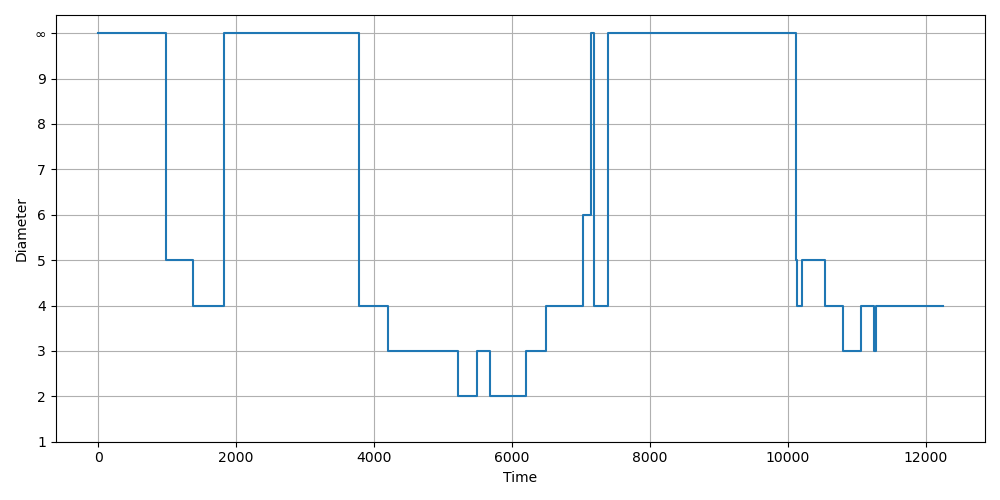
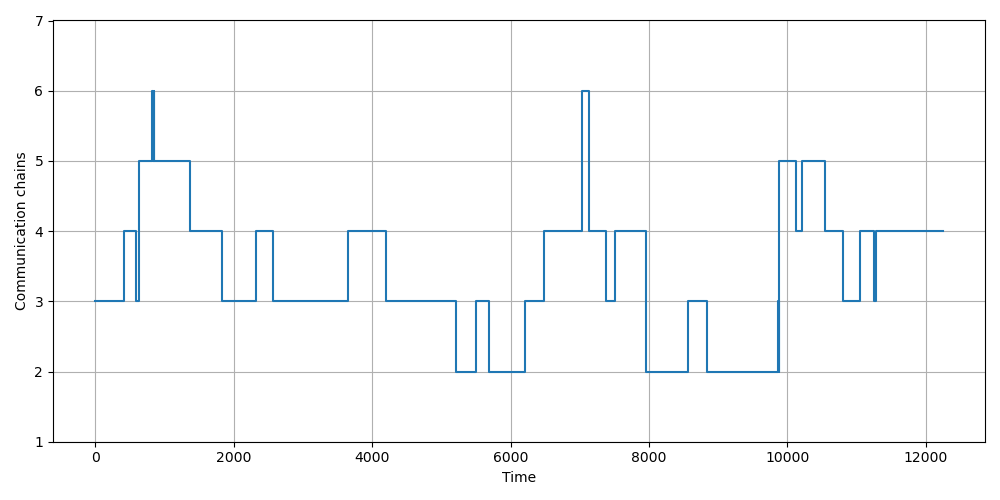
Figure 1: Bounds on the diameter (left) and the communication chains (right) of the causal communication graph over time.
Figure 1 demonstrates the monitor’s capability: the causal communication graph is rarely a clique (μ9), but periodically maintains full connectivity with minimum diameter μ0–μ1 over significant intervals.
Scalability is critical for practical application to real-world multi-agent systems. The authors implement their monitor in OCaml and evaluate it on traces generated by a standard open-source CBBA simulator. Quantitative results highlight the following:
- The monitor exhibits acceptable per-timestep runtimes up to moderate agent counts (e.g., 17ms per timestep for 30 agents, 142ms for 50 agents).
- The design allows scalability if monitoring is decentralized (per-agent scope), but centralized all-pairs monitoring naturally incurs higher computational burdens.
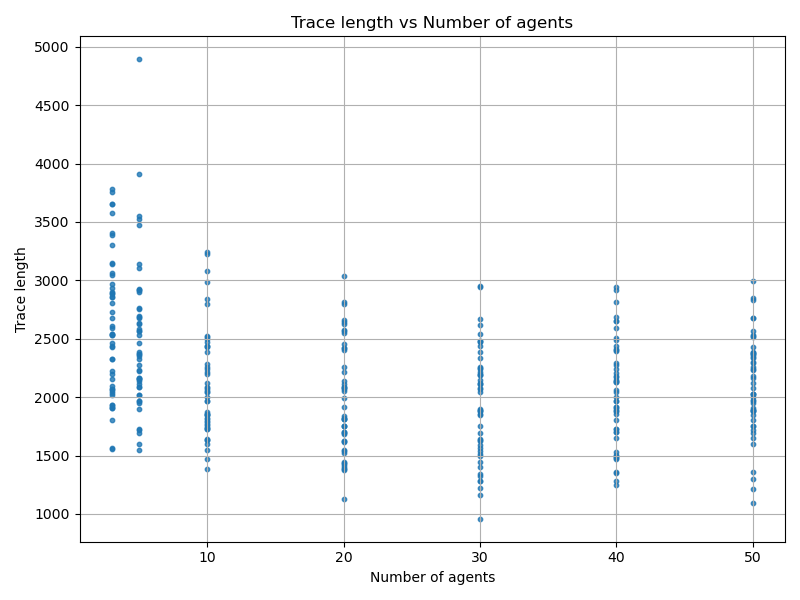
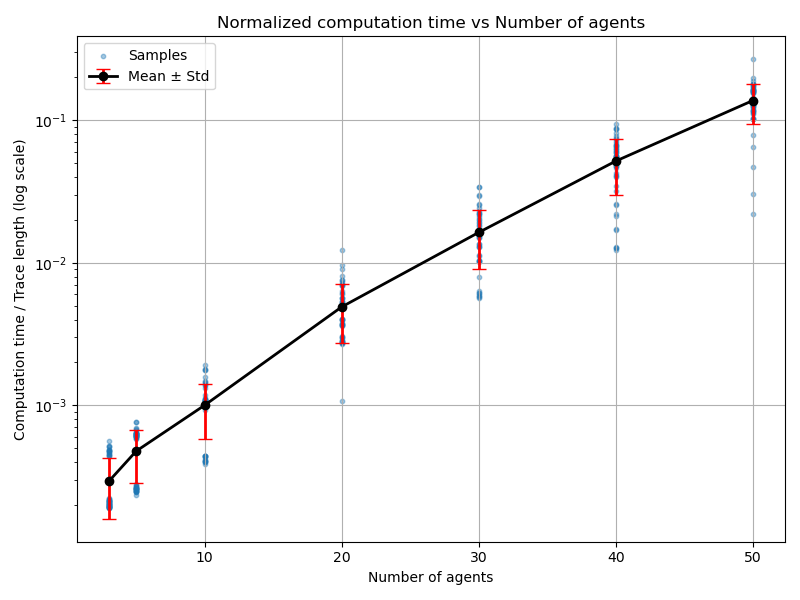
Figure 2: Length of traces and statistics on normalized times of computation as a function of agent count.
The results confirm the algorithm’s suitability for offline analysis and enable future online extensions contingent on systems’ physical sampling rates.
Theoretical and Practical Implications
Expressiveness: The formal addition of the space horizon strictly increases the expressiveness of μ2TGL, subsuming distinct modalities from multiple prior logics and supporting specification of temporally entangled, causally-aware spatial properties that could not be captured previously.
Monitoring Algorithms: The results provide a blueprint for extending runtime verification infrastructures for multi-agent and cyber-physical systems, particularly where decentralized communication and resilience against partial failure (e.g., Byzantine faults in consensus) are priorities.
Future Directions: Key avenues for future work include:
- Online monitoring under partial observability.
- Integration of the monitoring framework as a shield in control loops (e.g., for safe reinforcement learning).
- Extension to quantitative semantics for policy synthesis and system optimization.
Conclusion
The paper rigorously extends spatio-temporal logic to enable explicit causal diameter monitoring in time-varying multi-agent networks, fully characterizing the associated semantics and providing tractable algorithms for practical monitoring. The extension closes a significant expressiveness gap relative to previous logics and direct applicability to critical distributed coordination protocols. Anticipated further research includes online monitoring, integration in adaptive control loops, and formal synthesis leveraging the new semantic capabilities.