- The paper rigorously derives a universal hybrid quantum thermodynamic uncertainty relation that bounds dissipation and precision in N–S coherent conductors.
- It employs the Anantram–Datta scattering formalism to decompose total noise into Andreev, quasiparticle, and interference contributions across varying bias and gap.
- Numerical tests confirm that the derived hybrid TUR holds universally where classical and previous quantum bounds fail, guiding optimal device design.
Hybrid Quantum Thermodynamic Uncertainty Relation for N–S Coherent Conductors
Overview and Motivation
The paper "A thermodynamic uncertainty relation for (hybrid) N–S coherent conductors" (2606.21555) addresses the extension of thermodynamic uncertainty relations (TURs)—fundamental bounds linking current fluctuations and entropy production—into the context of hybrid quantum devices, specifically normal–superconductor (N–S) junctions. TURs, originally derived for classical Markovian systems, impose a dissipation–precision trade-off whose quantum generalization (QTUR) is nontrivial due to effects from quantum coherence and the presence of multiple transport channels.
Hybrid N–S systems present additional complexity: subgap transport is dominated by Andreev reflection, where charge is transferred via Cooper pairs, doubling the effective transfer charge, while transport above the gap involves both quasiparticle transmission and Andreev processes. Prior theoretical work yielded partial or perturbative bounds, but lacked a rigorous uncertainty relation applicable across arbitrary bias, temperature, and superconducting gap. This paper fills that gap by deriving, proving, and numerically validating a hybrid quantum TUR (HQTUR), providing a universal dissipation–precision constraint in hybrid quantum conductors.
Physical and Mathematical Model
The device is a coherent scatterer connected to a normal reservoir and a grounded superconductor with gap Δ, enabling the coexistence of Andreev reflection and quasiparticle transmission. The physical setup is summarized schematically, with the relevant transmission probabilities defining the respective transport channels.
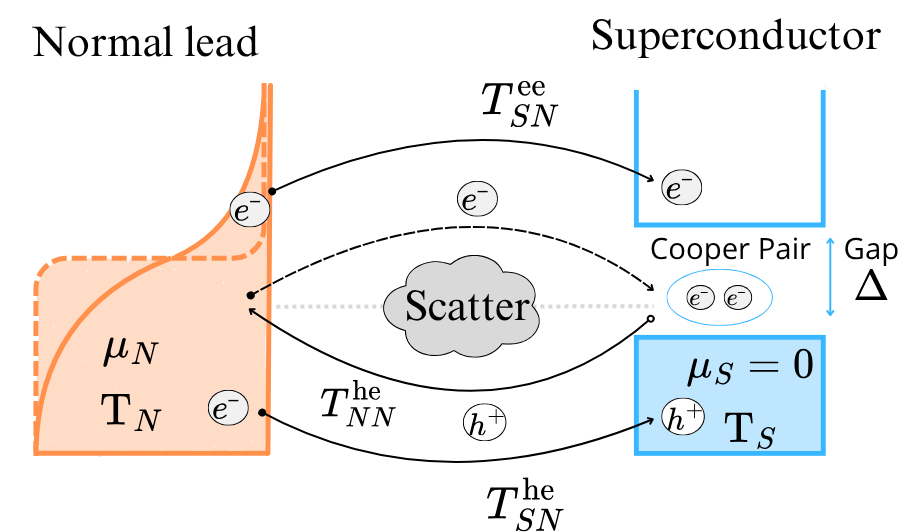
Figure 1: Schematic of the hybrid N–S device showing competing Andreev and quasiparticle transport channels.
The analysis employs the Anantram–Datta scattering formalism in the Nambu (electron–hole) basis. The charge current at the normal terminal is expressed via energy integrals over transmission probabilities, distinguishing Andreev (electron–hole conversion, probability TA) and quasiparticle transport (TQ). The entropy production rate follows the Clausius relation involving heat currents and the respective reservoir temperatures.
Noise Decomposition and Fundamental Bound
A key technical advance is the decomposition of zero-frequency charge noise S into three physically distinct contributions:
- Andreev noise (SA): Associated with processes that transfer $2e$ via Andreev reflection; always non-negative.
- Quasiparticle noise (SQ): Recovers the standard quantum conductor noise in the normal limit; also non-negative.
- Cross (interference) term (SCross): Originates from quantum interference between Andreev and quasiparticle channels; can be negative, and vanishes in pure limits.
These components are mapped versus applied bias and gap, revealing distinct parameter regimes where Andreev or quasiparticle noise dominates, and where the interference term becomes significant.
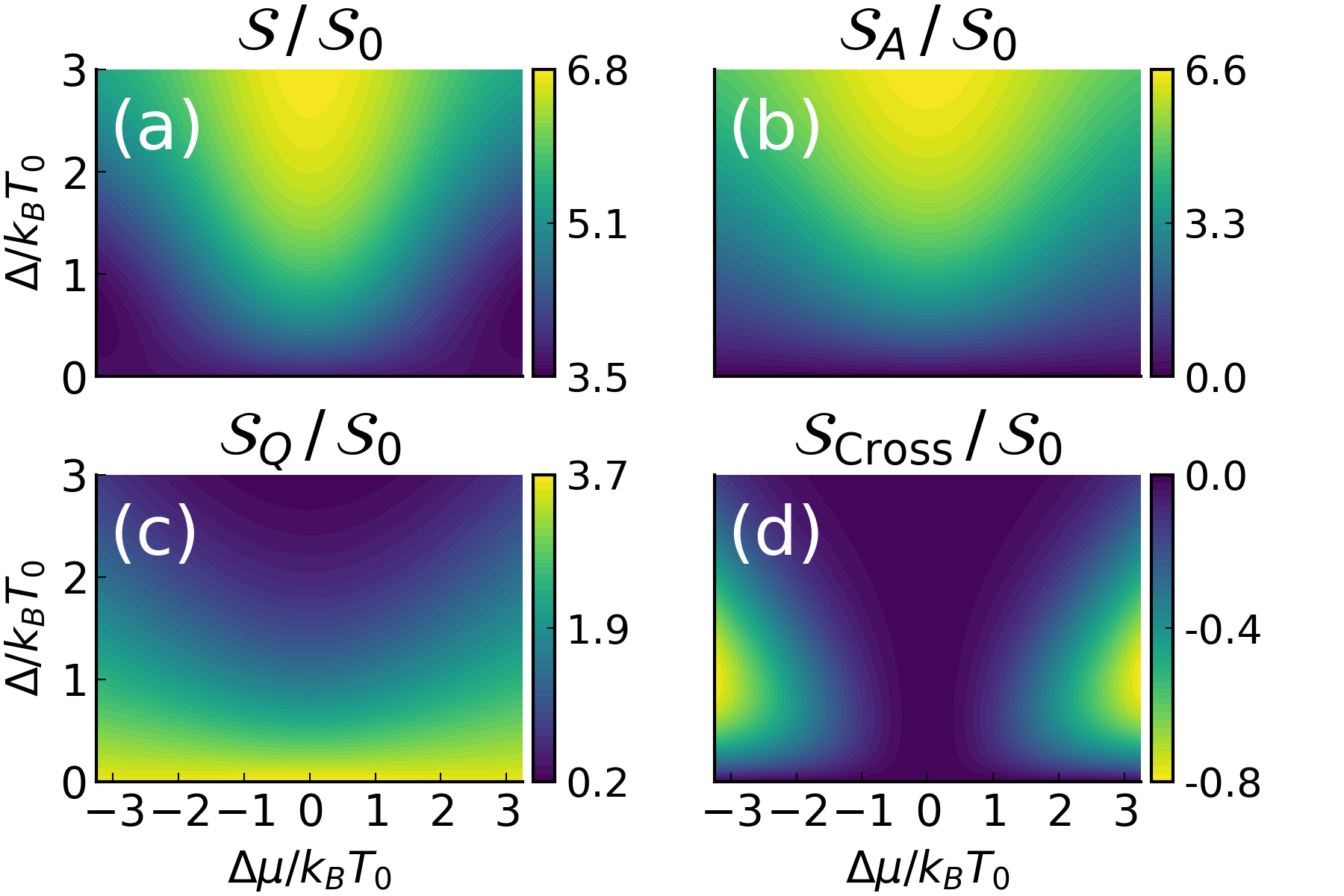
Figure 2: Color maps showing total noise, Andreev, quasiparticle, and interference contributions across bias and gap.
The total charge noise is further partitioned into thermal and shot-noise components, with both manifestly non-negative despite the non-positive definite interference contribution. Proper algebraic manipulations show that the nonequilibrium excess (shot) noise retains overall positivity—a crucial property for establishing the hybrid TUR.
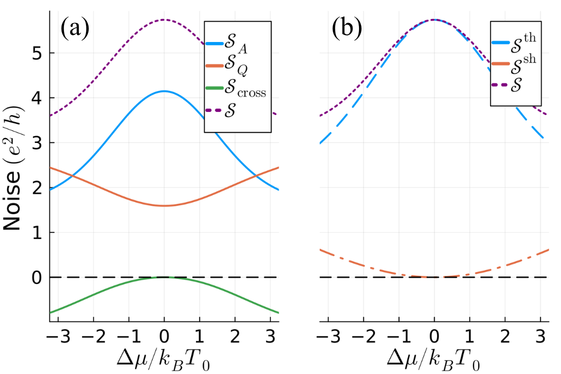
Figure 3: Noise decomposition by physical channel and by thermal/shot-noise components as function of bias.
Derivation and Verification of the Hybrid Quantum TUR
The central result is the rigorous derivation of the HQTUR:
σ≥ekB∣I∣arsinh(S2e∣I∣)
where σ is entropy production, TA0 is the charge current, TA1 is total noise, and TA2 is Boltzmann’s constant. This bound is obtained via convexity arguments and exploitation of transmission probability positivity, ensuring validity for arbitrary gap TA3 and bias.
Existing bounds (classical TUR, quantum TUR for normal conductors) are numerically tested and shown to be violated in regimes of strong Andreev–quasiparticle interference, while the HQTUR holds universally.
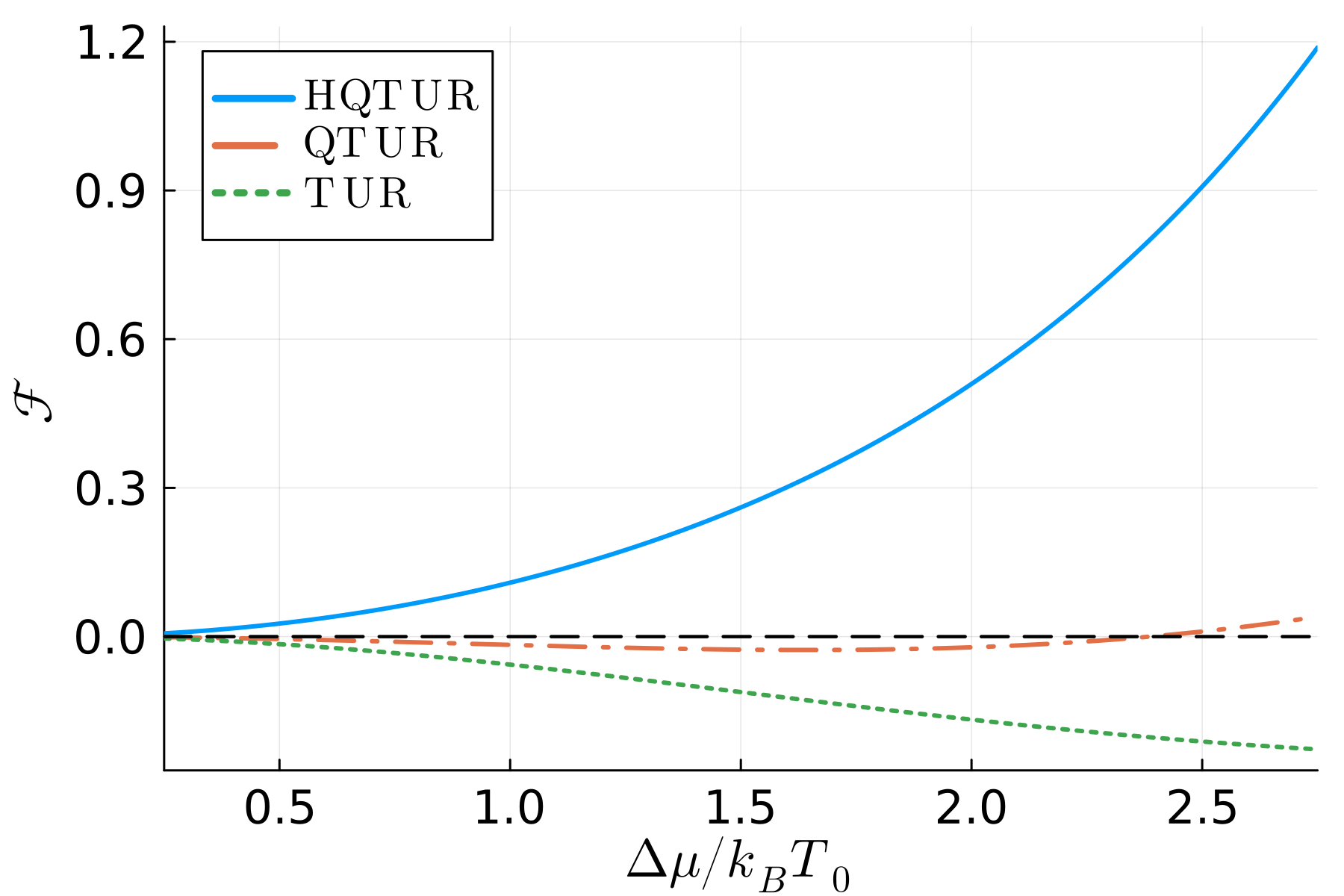
Figure 4: Numerical validation of TUR, QTUR, and HQTUR across bias window; only HQTUR remains unviolated.
Implications and Future Directions
Theoretically, the result establishes a natural and tight dissipation–precision constraint for quantum transport in hybrid normal–superconductor systems, extending the previous pure-Andreev and normal-conductor bounds. The positivity proof relies on scattering theory and is shown to be equivalent in nonequilibrium Green function formalism via the Fisher–Lee relation.
Practically, this constraint provides guidelines for optimizing hybrid N–S quantum devices, affecting designs for quantum information processing, superconducting electronics, and fundamental studies of quantum thermodynamics. The universal bound is robust to the presence of tunable quantum dot elements, arbitrary gap, and transmission channel mixing.
Future developments may address multi-terminal or interacting cases, extensions to time-dependent or driven systems, and experimental verification in mesoscopic superconducting structures.
Conclusion
This paper rigorously establishes the hybrid quantum thermodynamic uncertainty relation, providing a universal bound for precision–dissipation trade-off in hybrid normal–superconductor quantum conductors. The bound is validated algebraically and numerically, overcoming prior limitations of classical and quantum TURs in mixed transport regimes. The result solidifies the foundational understanding of nonequilibrium fluctuations in hybrid superconducting systems and informs the design and interpretation of quantum transport experiments.

