- The paper introduces Mem-GF, a novel approach that leverages user-specific Krylov subspaces to achieve memory-efficient graph filtering for scalable collaborative filtering.
- It employs Lanczos iterations and polynomial filter approximations to bypass full item similarity matrix storage, reducing memory usage by up to 5.74×.
- Experimental results demonstrate linear scaling in runtime and memory while delivering state-of-the-art recommendation accuracy without sacrificing filter expressiveness.
Memory-Efficient Graph Filtering for Scalable Collaborative Filtering: The Mem-GF Paradigm
Motivation and Problem Statement
The paper addresses a critical limitation of training-free graph filtering (GF)-based collaborative filtering (CF) methods: the memory bottleneck associated with storing the full item similarity graph. Despite their computational advantages and applicability to diverse recommendation scenarios, current polynomial GF-based approaches require a universal ∣I∣×∣I∣ matrix for graph filtering, incurring prohibitive RAM/VRAM costs at scale. This bottleneck impedes large-scale deployment of GF-based CF systems, especially for real-time inference, and often results in out-of-memory errors even on high-spec GPU hardware.
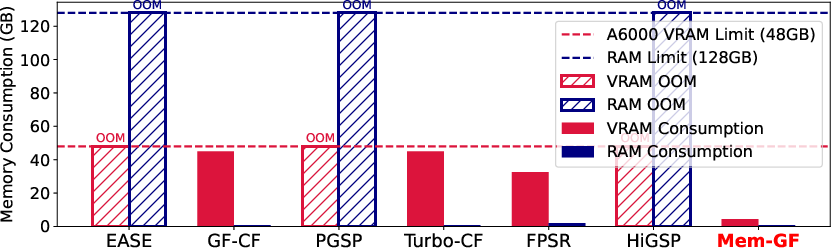
Figure 1: Memory usage (RAM/VRAM) comparison among six representative GF-based CF methods and Mem-GF on the Amazon-book dataset, highlighting severe OOM failures of classical methods.
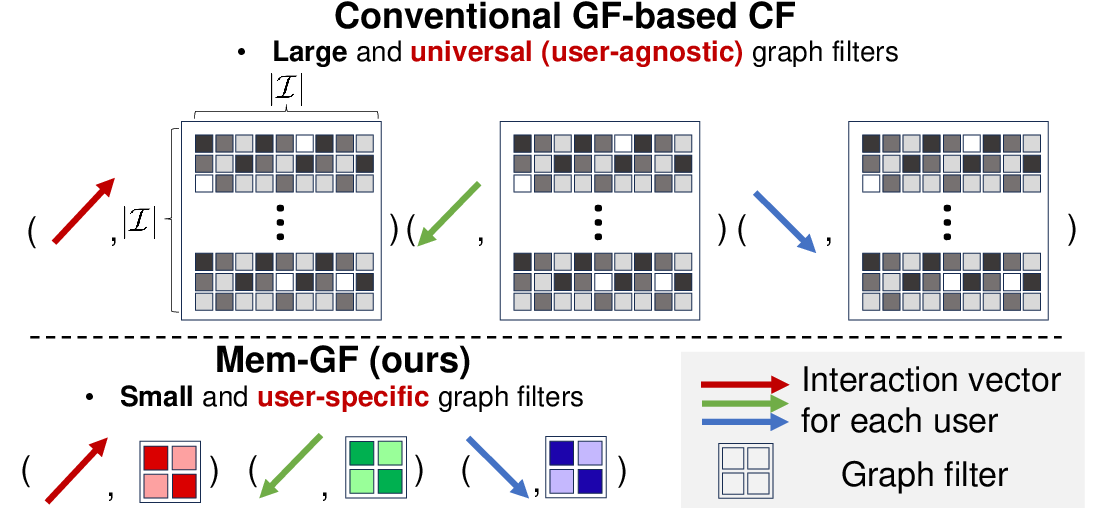
Figure 2: Space consumption scaling curves contrasting conventional GF-based CF designs with Mem-GF, showing quadratic growth for classical approaches and linear scaling for Mem-GF.
Mem-GF: Krylov Subspace-Based Filtering
Mem-GF proposes a fundamentally new approach by leveraging user-specific Krylov subspaces to approximate polynomial graph filters without explicitly constructing or storing the item similarity matrix. For each user's interaction vector, repeated matrix-vector products construct a compact basis capturing the relevant spectral properties. The filter is then applied in this Krylov-reduced space, ensuring polynomial filter expressiveness with dramatically lower memory requirements.
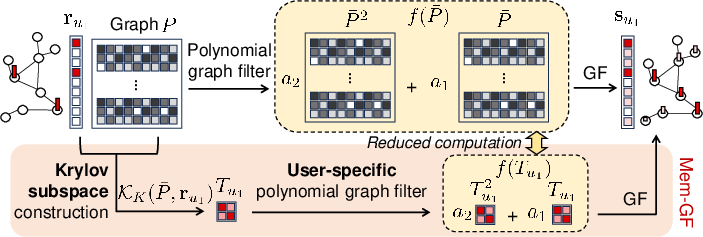
Figure 3: Schematic overview of Mem-GF: per-user Krylov subspace construction and compact polynomial filtering, fully circumventing explicit item similarity matrix formation.
Methodological Details
- Adjusted Interaction Matrix: Instead of direct Hadamard-power transforms on the item graph, Mem-GF adjusts the normalized interaction matrix, regularizing the original user-item signal.
- Lanczos Algorithm: Krylov subspaces are constructed via the Lanczos iteration, yielding a user-specific orthonormal basis and tridiagonal projection of the item similarity matrix.
- Polynomial Filtering: Arbitrary-order polynomial filters are efficiently computed in the Krylov space, allowing high-order designs previously unattainable due to memory constraints.
- Zero-Error Guarantee: If the Krylov basis dimension K>N (filter order), Mem-GF provides a lossless approximation under exact arithmetic, as formally proven in the paper.
Filter Design and Expressiveness
Mem-GF supports expressive polynomial graph filters of arbitrary order, including fifth-order approximations of Gaussian low-pass filters for spectral graph smoothing.
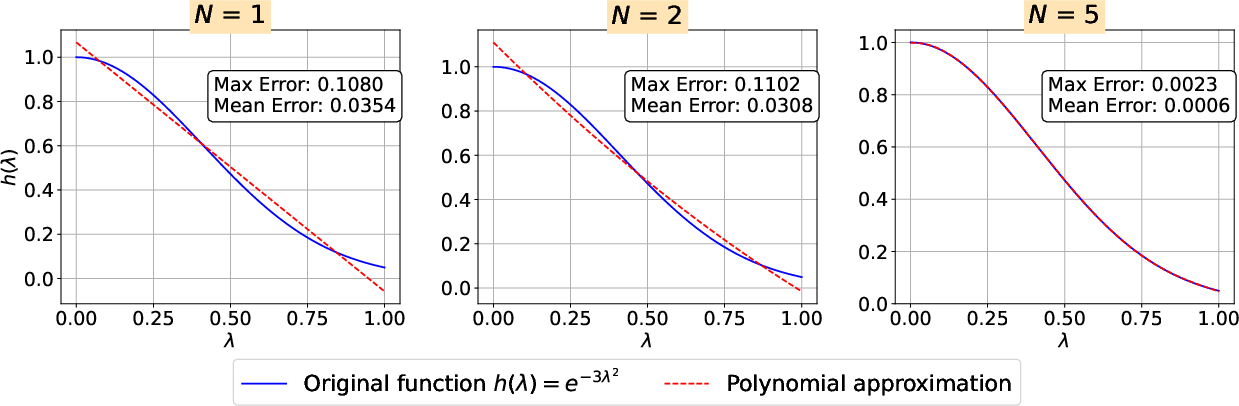
Figure 4: Comparison of the function h(λ)=e−γλ2 and its polynomial approximations for N=1,2,5, demonstrating decreased approximation error with increasing polynomial order.
This advances the field beyond the classical restriction to linear/ideal low-pass filters, enabling broader frequency response control and personalized filter selection per user.
Memory and Runtime Scaling
Theoretical complexity analysis and extensive experiments confirm that Mem-GF achieves linear space and runtime scaling in the number of items, users, and interactions. No full item-item matrix is ever formed; only the adjusted interaction matrix and compact Krylov structures are held in memory.
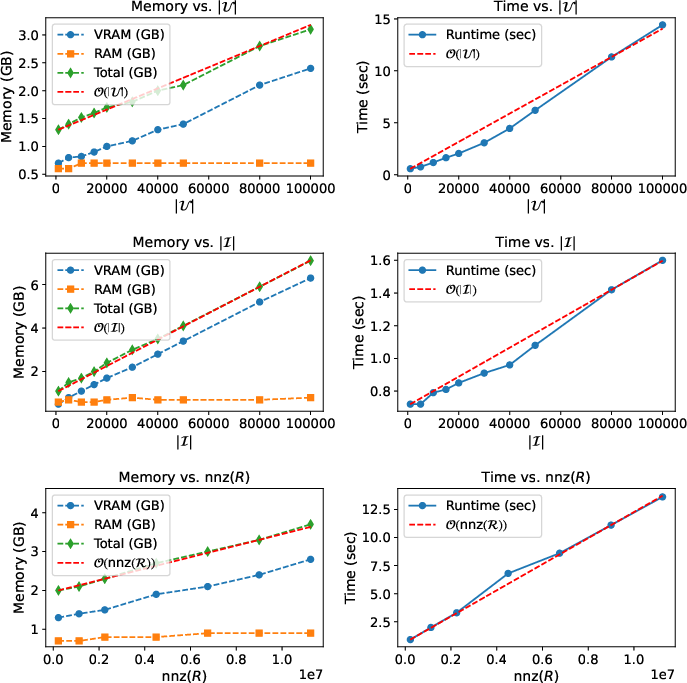
Figure 5: Empirical scaling of Mem-GF memory usage and runtime as the number of users, items, and interactions increase, confirming linear complexity.
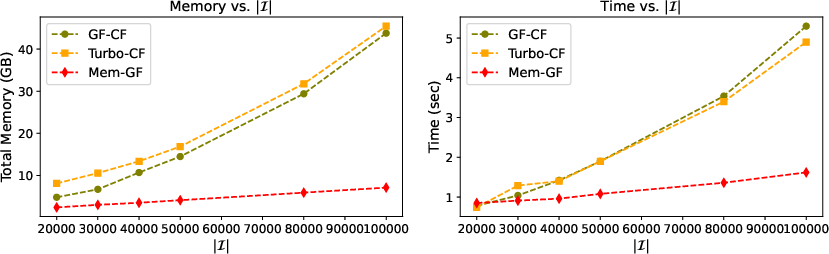
Figure 6: Total memory and runtime comparison among GF-based CF methods as a function of item set cardinality, with Mem-GF consistently outperforming classical competitors.
Key empirical results:
- Up to 5.74× lower memory usage and 4.38× preprocessing speedup versus best classical GF competitors.
- OOM errors eliminated for all datasets, including tens-of-millions scale MovieLens-20M.
- Even high-order (fifth) polynomial filters incur negligible additional overhead.
Recommendation Accuracy and Ablations
Mem-GF not only achieves substantial efficiency improvements but also consistently yields state-of-the-art recommendation accuracy, outperforming both GF-based and GCN-based methods across datasets.
Contradictory claim: Despite its focus on efficiency, Mem-GF achieves higher recommendation accuracy than competing GF and GCN methods, refuting the common tradeoff assumption between scalability and expressiveness.
Empirical ablation on Krylov basis dimension confirms the zero-error guarantee: for K>N, Mem-GF matches the baseline performance, while K≤N leads to degradation.
Hyperparameter Sensitivity
Mem-GF's accuracy exhibits mild sensitivity to two key hyperparameters: the normalization exponent γ and the adjustment parameter s. The optimal settings vary across datasets but cluster closely around typical values (K>N0, K>N1).
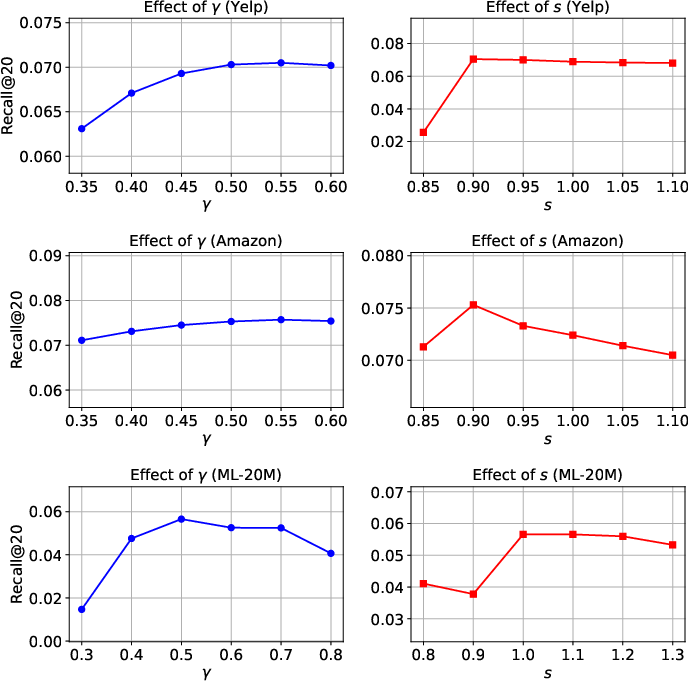
Figure 7: Sensitivity curves of Mem-GF accuracy as a function of K>N2 and K>N3, illustrating robust performance within typical parameter ranges.
Practical Implications and Limitations
Mem-GF is directly deployable in real-world recommender systems for candidate generation and scoring, as its core operations are naturally parallelizable and training-free. Its compact memory footprint enables scaling beyond prior limitations. Extensions to heterogeneous graphs, social networks, and cold-start scenarios may require further filter design. Extreme sparsity or noise in user signals remains a potential limitation, as Krylov subspaces may not adequately capture structure.
Conclusion
Mem-GF introduces user-adaptive, memory-efficient graph filtering for CF based on Krylov subspace principles, providing strong theoretical guarantees and empirical evidence for linear scaling, robust expressiveness, and accuracy. This paradigm eliminates the classical memory bottleneck, facilitates high-order filter design, and supports deployment in large-scale, real-time recommendation systems. Future developments may generalize Mem-GF to multi-modal, cross-domain, and distributed CF architectures, and further integrate with adaptive optimization for filter selection.