- The paper introduces SORT, a data-driven approach employing sparse orthogonal regression to capture nonlinear interactions across social, technological, and environmental systems.
- It calibrates the model on EU macro-level data from 2005 to 2025, effectively simulating structural feedbacks and conditional projections to 2045.
- The study highlights the importance of integrating cross-domain feedbacks to enhance policy scenario analysis and support sustainable transition strategies.
Introduction and Motivation
The paper "Exploratory Modelling of Multi-System Transformation Pathways from Real-World Data: A SINDy-Inspired Sparse Orthogonal Regression Technique" (2606.21530) presents a data-driven approach for reconstructing the medium-term dynamics of interacting social, technological, environmental, economic, and governance systems relevant to sustainability transitions. The study addresses critical limitations in prevailing transition modelling approaches, specifically the lack of explicit multi-domain feedback representation and the shortcomings of optimization-driven, subsystem-isolated, or purely linear models. The authors introduce the Sparse Orthogonal Regression Technique (SORT), an empirical framework for extracting parsimonious nonlinear dynamical relationships from harmonised macro-level European indicator data, inspired by the SINDy (Sparse Identification of Nonlinear Dynamical Systems) methodology.
Data-Driven Dynamical Systems Modelling
SORT offers a methodology that infers coupled low-dimensional dynamical system (DS) representations from real-world time series of key indicators. This avoids presupposing structural forms or comprehensive system equations, instead employing sparse regression over orthogonal basis expansions to select a subset of dominant cross-domain dependencies. The emergent structure endogenously captures feedbacks, path dependencies, and nonlinear effects observable in the data, aligning with the system dynamics tradition but explicitly grounded in empirical evidence rather than expert elicitation.
The model is calibrated over a 2005–2025 empirical window using macro-level EU data. It simulates structural interactions and conditional projections to 2045. Importantly, this approach is positioned as a support tool for policy and scenario exploration—emphasizing interpretability, minimality, and traceability over numerical point forecasting.
Modelling Scope and Variables
The indicator set spans ten state variables, each representing a key dimension of the European sustainability transition:
- Renewable energy share (V1)
- ETS-regulated emissions (V2)
- Resource productivity (V3)
- Digitalisation (V4)
- Green patent share (clean innovation, V5)
- Policy stringency (V6)
- Transition finance (V7)
- Social wellbeing (V8)
- Environmental stress (V9)
- System resilience (V10)
This choice reflects a provisioning systems perspective and recent MST (Multi-System Transition) theory, ensuring the inclusion of cross-cutting drivers, enabling conditions, ecological limits, and social outcomes.
Empirical Results: System Variables and Conditional Dynamics
The results consistently demonstrate that nonlinearity, feedback, and multi-system interaction substantially shape medium-term trajectories. Figures 1–10 compare the DS model fit and projection with simple linear extrapolation for individual state variables.
After calibrating on 2005–2025, the forward DS projections demonstrate departures from linearity precisely when structural feedbacks—positive or negative—become dominant.
Renewable Energy Share
The DS reconstruction reproduces the observed historical growth with high fidelity. Both DS and linear projections remain similar through 2045, validating the stable, inertia-driven expansion regime for renewables over the analysis window.
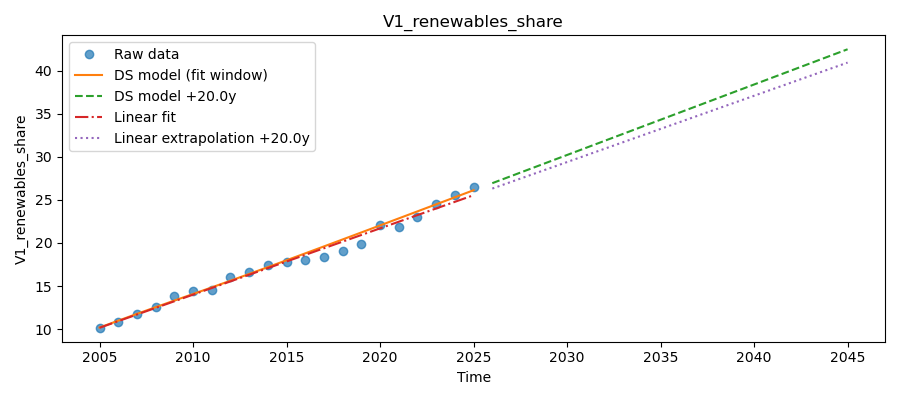
Figure 1: Empirical fit and +20-year projection for EU renewable energy share; DS and linear projections co-evolve.
ETS-Regulated Emissions
While both approaches capture the historical decline, the DS model projects notably more rapid emissions reduction than linear extrapolation—conditional on the activation of reinforcing multi-system feedbacks involving finance, productivity, and stress.
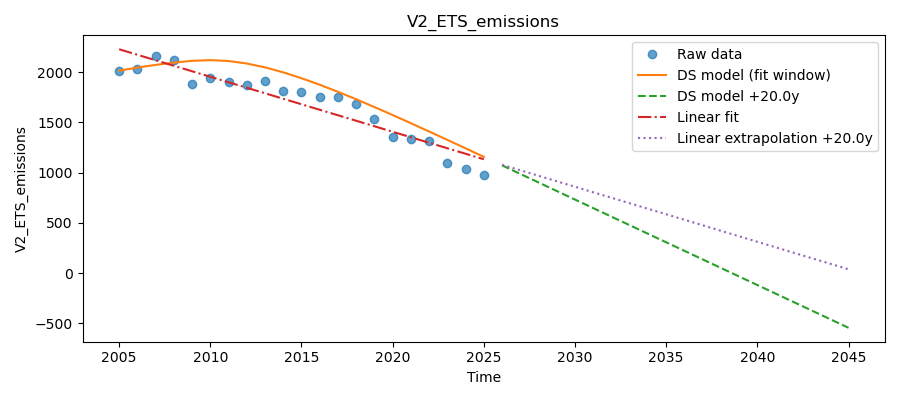
Figure 2: DS projection for regulated industrial emissions exhibits an accelerated decline under favorable cross-domain conditions.
Resource Productivity
The DS simulation delivers an upward convex trajectory—exceeding the linear trend—attributable to endogenous compounding of technological and process-driven improvements.
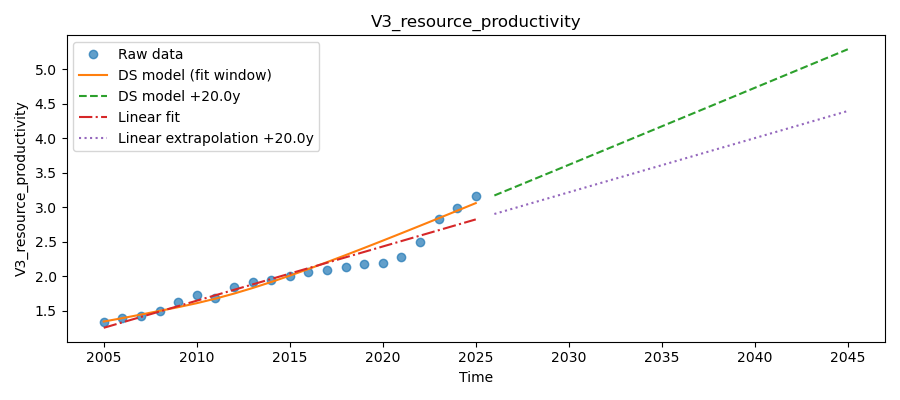
Figure 3: Resource productivity improvement accelerates in DS projection, consistent with compounding structural reinforcements.
Digitalisation
Digitalisation dynamics remain close to linear with marginal DS deceleration, illustrating that, for diffusion variables lacking substantial saturation or constraint effects over this horizon, aggregate structural feedbacks are weak.
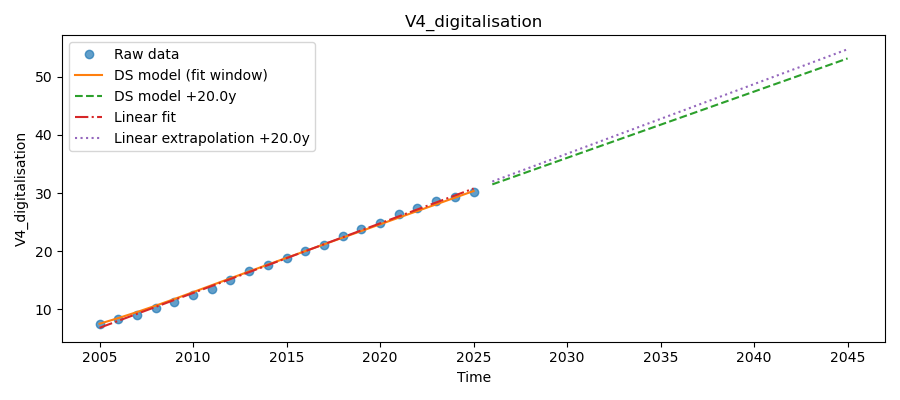
Figure 4: Business digitalisation dynamics follow a robust near-linear trend with weak DS nonlinearity.
Green Patent Share
Clean innovation, proxied by green patenting activity, follows a smoothed DS trajectory. The DS model filters out short-term shocks, such as the COVID-19 downturn, and reflects structural, rather than incidental, drivers.
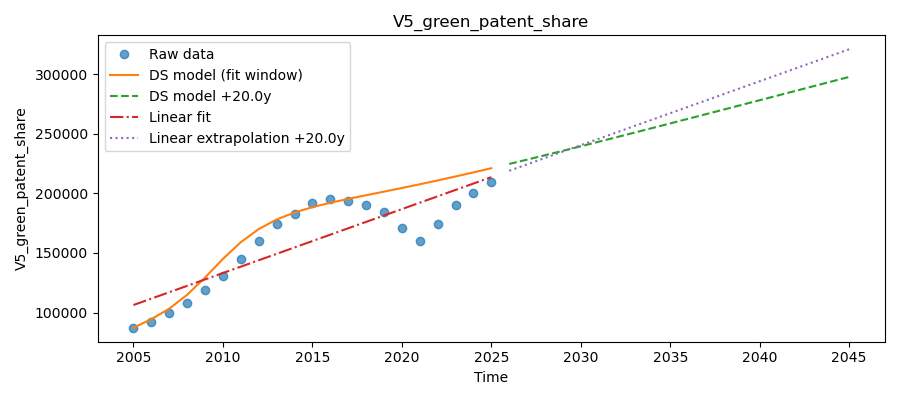
Figure 5: DS projection for clean innovation preserves medium-term growth unperturbed by transient data deviations.
Policy Stringency
The DS and linear models are virtually indistinguishable for policy stringency; this variable acts as a slow-moving, exogenously sequenced structural condition with limited endogenous feedbacks.
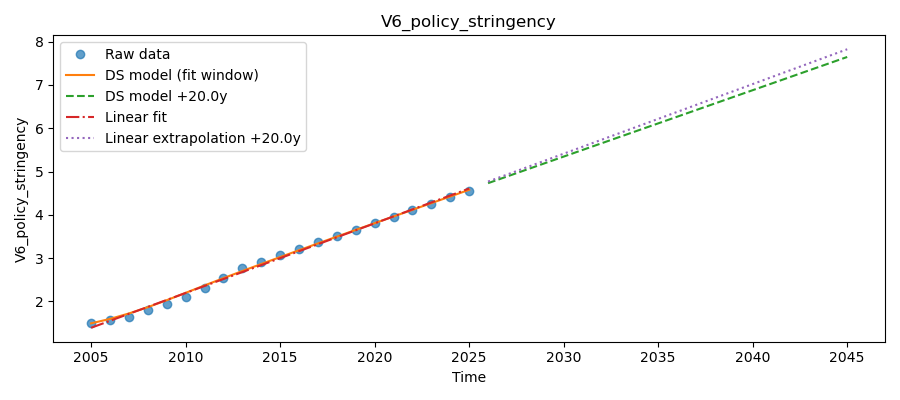
Figure 6: Policy stringency index varies linearly, signifying institutional inertia and gradualism.
Transition Finance
Transition finance projections diverge significantly: the DS model produces strongly convex acceleration, reflecting that financial mobilisation in support of transition is highly nonlinear—sensitive to prior coordination and institutional alignment.
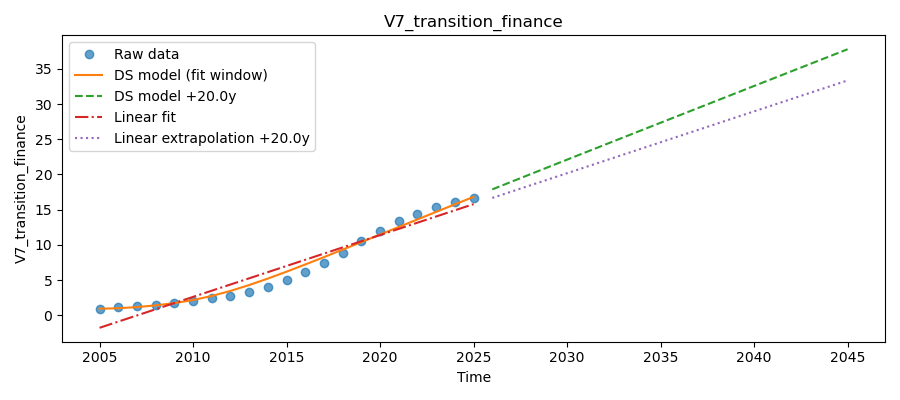
Figure 7: Transition finance demonstrates threshold-like acceleration captured by the DS model but missed by linear extrapolation.
Social Wellbeing
The DS model reproduces the medium-term impact of social and economic shocks and anticipates a conditional recovery, reinforcing the bounded, mutually reinforcing relationship between social capital and innovation.
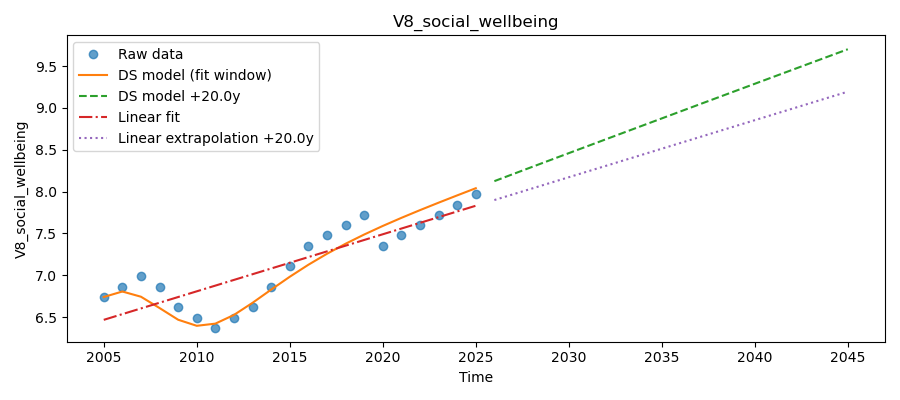
Figure 8: DS model encodes both the shock-responsiveness and post-crisis recovery of social wellbeing.
Environmental Stress
Environmental stress (WEI+) dynamics are inherently non-monotonic with pronounced historical variability. The DS model captures this, projecting plausible stabilisation and partial reversal, whereas linear extrapolation produces implausible monotonicity.
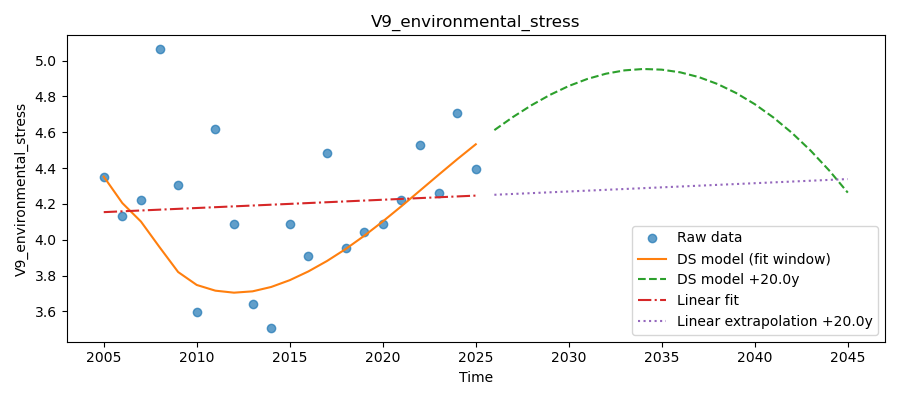
Figure 9: Environmental stress dynamics are inherently oscillatory/nonlinear; DS model projection stabilises in contrast to linear extrapolation.
System Resilience
Resilience, as proxied by financial integration, exhibits structurally persistent linearity. The variable primarily acts as a buffering modifier stabilizing the system, rather than a direct endogenous driver.
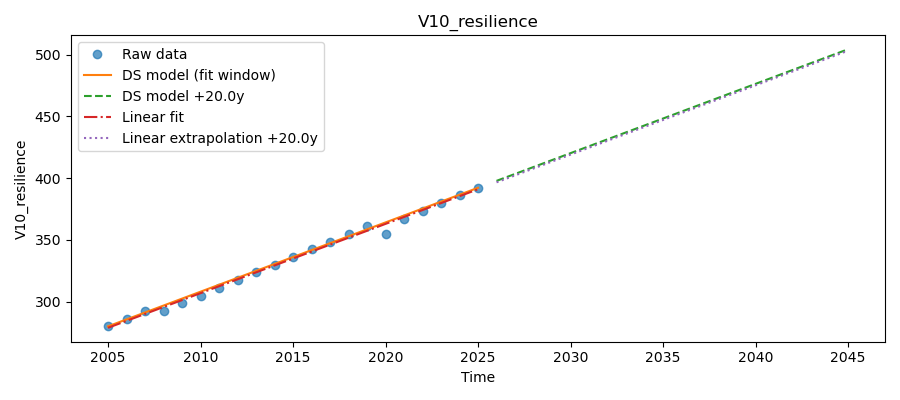
Figure 10: DS and linear projection for resilience are nearly identical, indicating low endogenous feedback strength.
Structural Feedbacks and Causal Loop Architecture
The inferred dynamical system is sparse, with only a limited set of dominant interactions. These can be structured as an influence diagram, highlighting three core subsystems:
- Social-Technological Feedback: Clean innovation and social wellbeing are mutually reinforcing, creating an enabling environment for technologically supported welfare gains.
- Environmental-Productive Constraint: Environmental stress acts as a principal constraint, negatively affecting both renewable energy deployment and productivity. This channel operationalises ecological limits as an endogenous damper within the transition system.
- Governance-Finance-Resilience Cluster: Policy stringency activates transition finance; finance primarily boosts innovation, and system resilience buffers environmental and social shocks.
(Figure 11)
Figure 11: Structural feedback architecture extracted via sparse orthogonal regression, highlighting mutually reinforcing, constraining, and conditioning domains.
Implications for Policy, Scenario Analysis, and Theory
The results reveal that accelerated decarbonisation, productivity gains, and social stability are conditional phenomena—emerging only when enabling and constraining feedbacks across domains are aligned. Linear extrapolation can misrepresent the true potential and risks inherent in transition pathways. Specifically:
- Policy stringency alone yields incremental progress but cannot substitute for cross-system reinforcement.
- Transition finance only produces acceleration if concurrently activated by credible policy and catalyzed by innovation/market readiness.
- Environmental stress not only reflects but shapes the feasible domain for technological and social advancement; neglecting this constraint produces misleading system optimism.
- Mutual reinforcement between innovation and social wellbeing highlights the non-reducible role of social legitimacy in sustaining transformation, emphasizing MST perspectives where social, institutional, and technological dimensions are jointly analyzed rather than isolated.
For scenario work, the model architecture extracted by SORT supports scenario-dependent outcomes as regimes shaped by shifts in feedback strength and systemic coupling—nonlinearly and path-dependently—rather than as straightforward extrapolations of sectoral trends. This justifies the structural focus in future MST and transition pathway research.
Conclusion
This study provides a formal demonstration of how sparse, empirically calibrated dynamical systems models can bridge multi-system transition theory with policy-applicable analytics. The SORT framework isolates conditional, feedback-driven dynamics that are obscured in purely linear or subsystem-focused models. The approach is portable to national and subnational contexts and supports participatory extension.
The results reinforce the theoretical imperative to foreground feedbacks, cross-system constraints, and mutually constitutive governance–finance–wellbeing–environment couplings in analysis, design, and governance of sustainability transitions.
Reference: "Exploratory Modelling of Multi-System Transformation Pathways from Real-World Data: A SINDy-Inspired Sparse Orthogonal Regression Technique" (2606.21530)

