- The paper develops a formal design framework for shaping filters in GFORE reset controllers that systematically suppresses higher-order harmonics.
- The paper demonstrates both analytical and experimental validations, showing up to 59% tracking error reduction and improved phase consistency.
- The paper provides explicit algebraic conditions for filter coefficients, enabling precise low-frequency harmonic attenuation while preserving desired phase lead.
Authoritative Essay on "Revisiting the generalized first-order reset element with shaping filters" (2606.21478)
Motivation and Context
Linear time-invariant (LTI) control systems are fundamentally limited in their capacity to trade off gain and phase in the frequency domain due to constraints such as the waterbed effect and Bode's gain-phase relationship. Reset controllers—nonlinear elements that periodically reset their state based on triggering conditions—have become prominent for surpassing these limitations and achieving improved closed-loop performance. However, classical reset elements (e.g., the generalized first-order reset element, GFORE) introduce higher-order harmonics via reset action, which can be detrimental for tracking precision, signal integrity, and prediction reliability, especially in precision motion systems.
This paper systematically revisits the GFORE augmented with shaping filters, developing a formal design framework to mitigate undesirable reset-induced higher-order harmonics (quantified via Higher-Order Sinusoidal Input Describing Functions, HOSIDFs). The approach introduces explicit algebraic coefficient constraints for shaping filters, enabling direct control over the low-frequency attenuation slope of HOSIDFs, thus strongly suppressing nonlinearities where reset action is not desired, while preserving phase lead near crossover frequencies.
Analytical Foundation: Reset Elements and HOSIDFs
The GFORE is modeled in state-space and triggered by a shaping-filtered signal, er(t), rather than the raw input. This distinction is crucial: nonlinearities in the reset signal can cause unreliable closed-loop behaviors due to excessive resets and loss of superposition. The paper builds on advanced frequency-domain analysis using not only the classical Sinusoidal Input Describing Function (SIDF), which captures the first harmonic, but also HOSIDFs that quantify nonlinear contributions at higher orders.
The mathematical analysis rigorously derives conditions under which the attenuation slope of the n-th order HOSIDF (in dB/dec) can be increased by shaping filter design. Explicit algebraic constraints on shaping filter coefficients are formulated, providing non-iterative, constructive synthesis rules. This enables systematic harmonic suppression without impacting the desired first-order phase properties.
Shaping Filter Design and Harmonic Suppression
The central analytic results demonstrate that the low-frequency slope, h0, of ∣Hn(ω)∣ for GFORE with a shaping filter of order p follows:
h0=40(p+1) dB/dec
given that the shaping filter coefficients satisfy p algebraic constraints per Theorem 1. This yields a powerful trade-off: increasing filter order yields dramatically stronger suppression of higher-order harmonics.
The practical workflow is provided, facilitating design of filters up to fourth order by selecting denominator coefficients (for stability and phase characteristics), then computing numerator coefficients to meet the slope constraints, with explicit avoidance of pole-zero cancellations.
Frequency-Domain and Time-Domain Validation
Detailed analysis validates the harmonic suppression via both frequency-domain HOSIDF plots and a superposition-law test. As illustrated below:
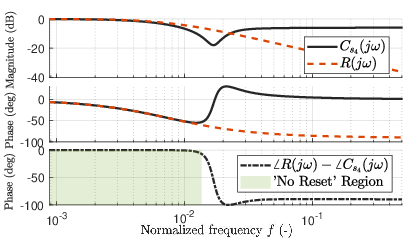
Figure 1: The designed fourth-order shaping filter for the reset controller CR2SF.
Designs with increasing filter order (p=0,1,2,3) clearly demonstrate h0 scaling (40, 80, 120, 160 dB/dec respectively) and rapidly diminishing magnitude of unwanted higher-order harmonics over low frequencies. Time-domain tests show improved adherence to superposition (the system's response to the sum of sinusoids approaches the sum of the individual responses), indicating near-linear behavior in regions outside active reset.
Industrial Experimental Validation
The methodology was deployed on an industrial wire bonder motion stage—the XYZ platform in semiconductor manufacturing—with experimental FRF analyses confirming negligible cross-coupling and model suitability for SISO controller synthesis. Several controllers were implemented:
- Baseline LTI controller (n0): optimally tuned PID and notch filters subject to robustness constraints.
- GFORE-based reset controllers without shaping filters (n1, n2): tuned for maximal integrator corner frequency, but limited by excessive higher-order nonlinearities.
- Shaped reset controller (n3): includes fourth-order shaping filter, aligns phase at frequency regions of excessive resets, eliminates spurious zero crossings, and suppresses nonlinearity.
Pseudo-sensitivity and HOSIDF metrics confirm that the shaped controller not only achieves best-in-class improvement in low-frequency tracking error (RMS error reduction up to n4 compared to linear benchmark), but also suppresses higher-order harmonics of the reset signal by more than n5 relative to the unshaped reset controller.
Implementation and Practical Impact
The controllers were implemented digitally via Tustin discretization, preserving phase characteristics. All designs maintained closed-loop stability, validated under established frequency-domain methods.
Carefully shaped reset controllers thus make reset-based phase compensation feasible in industrial settings, circumventing limitations of previous trial-and-error shaping approaches, controlling nonlinearity, and improving tracking precision.
Theoretical and Practical Implications
Theoretical implications are substantial: algebraic control of HOSIDF slope via filter design advances nonlinear control synthesis, ensuring reliable frequency-domain prediction in reset systems. Practically, the methods enable deployment in high-performance mechatronic systems, such as wafer stages and wire bonders, where precision and reliability are critical.
The explicit algebraic results and design workflow open avenues for automated tuning, more complex reset elements, and broader adoption in nonlinear frequency-domain controller design.
Conclusion
This paper delivers a rigorous, constructive framework for shaping-filter design in GFORE reset elements, controlling nonlinear harmonic content without compromising phase benefits. Analytical, time-domain, and experimental results demonstrate enhanced tracking, selective reset activation, and improved prediction reliability in an industrial precision motion application. The approach addresses a core limitation in nonlinear control synthesis, offering new directions for automated design and robust deployment of reset controllers in advanced mechatronic systems.