Atomistic Language Models Understand and Generate Materials
Abstract: Atomistic structure and natural language have long been modeled separately, with LLMs either calling atomistic models as tools or being fine-tuned on lossy textual encodings that discard atomistic information. We introduce Atomistic LLMs (ALMs) to pursue native multimodality, in which a single language backbone understands atomistic structures, generates materials from natural language, and optimizes crystal structures as instructed by text. By unifying a pretrained atomistic encoder, LLM, and denoising diffusion model through purely continuous projectors and staged training, ALMs achieve state-of-the-art results on crystal structure prediction and de novo generation. ALMs are enabled by a continuous bridge that maps LLM embeddings directly into the steering space of atomistic diffusion, and are assisted by Text-to-Crystal Feynman-Kac (T2C-FK), a particle-based sampler that scores partial denoising trajectories to enforce stoichiometric targets at inference time. To evaluate the ability of ALMs to optimize and generate materials from natural-language prompts and 3D atom-coordinate inputs, we introduce ALM Bench, the first benchmark for text-conditioned crystal generation and optimization. Code, training data, and model weights will be released soon.
Paper Prompts
Sign up for free to create and run prompts on this paper using GPT-5.
Top Community Prompts
Explain it Like I'm 14
Explaining “Atomistic LLMs Understand and Generate Materials”
Overview: What is this paper about?
This paper introduces Atomistic LLMs (ALMs), a new kind of AI that can both “read” materials at the level of atoms and “talk” about them in everyday language. Even better, it can follow text instructions (like “make this material denser” or “add this element”) and use them to change or create 3D crystal structures. In short, ALMs are like a bilingual expert that speaks both “atoms” and “words,” helping scientists understand and invent new materials faster.
Key objectives: What questions are the researchers asking?
The authors set out to answer three big questions:
- Can one model understand materials both as 3D atomic structures and as natural language, without losing important details?
- Can we steer a materials generator using plain-text instructions (for example, “increase the strength” or “make a new stable crystal with these elements”)?
- Can this unified model match or beat the best existing tools for predicting material properties, guessing crystal structures, and inventing new materials?
How it works: The approach in simple terms
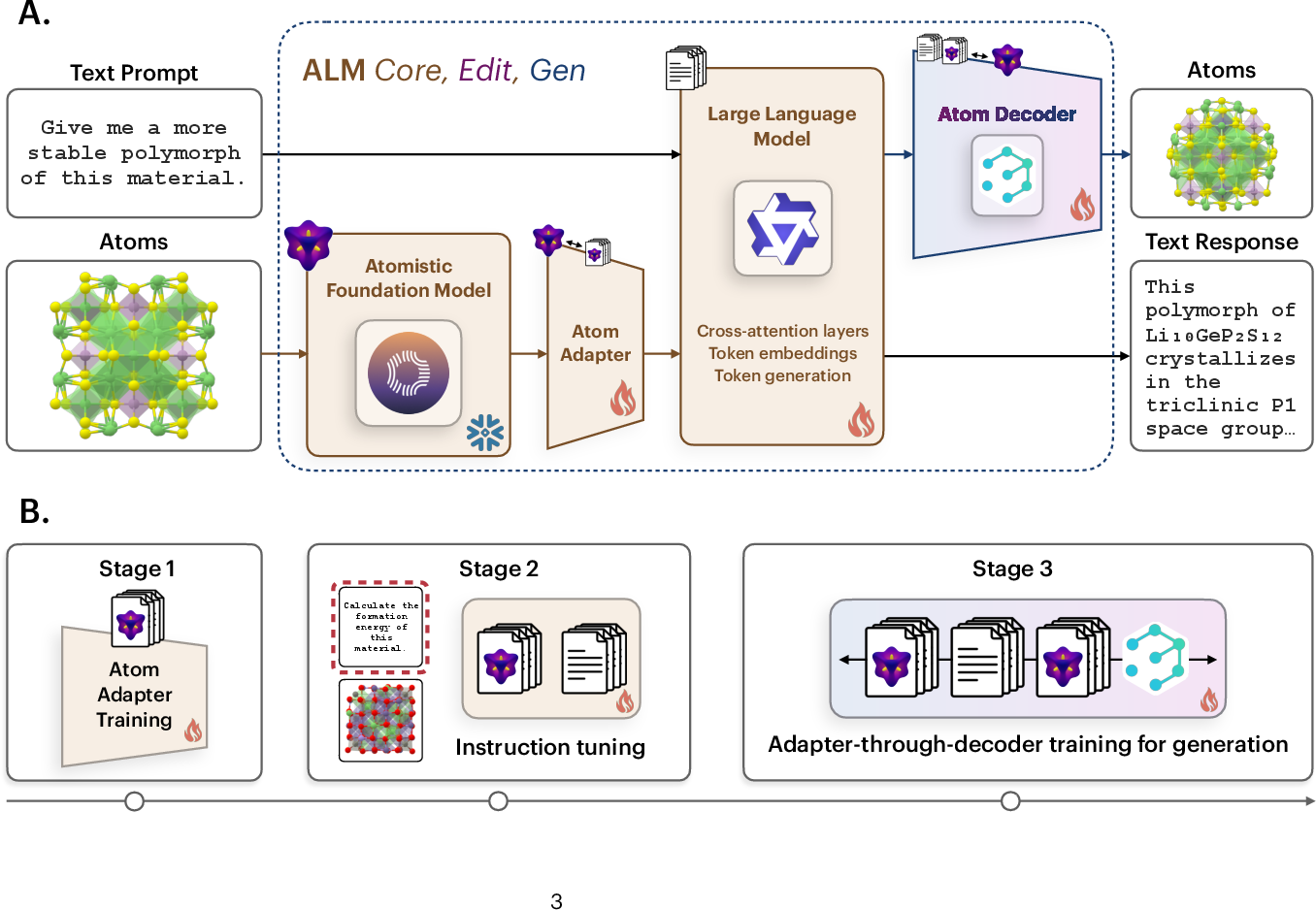
Think of the system as a team of three specialists connected by smooth, two-way translators:
- The “atom expert”: An atomistic encoder that reads the material’s “blueprint”—the atom types, their 3D positions, and the repeating cell that defines a crystal. (Imagine reading the exact coordinates of every LEGO brick in a build.)
- The “language expert”: A LLM that understands and generates natural language. (This expert can answer questions, follow instructions, and describe things in words.)
- The “builder”: A diffusion model that creates or tweaks 3D crystal structures. (Picture a sculptor starting from a block of noise and carefully revealing a detailed statue.)
Instead of forcing atoms into a clumsy string format (like trying to describe a complicated shape with a few words), ALMs keep everything in smooth, continuous “signals” so nothing important is lost. The three parts are tied together by continuous bridges—like high-quality translators—so atoms and words can influence each other directly.
The authors build three versions:
- ALM Core (understands): Reads crystals and answers questions about structure and properties.
- ALM Edit (edits): Takes a crystal and text instructions (like “increase this property”) and adjusts the structure accordingly.
- ALM Gen (generates): Makes entirely new crystals from text prompts.
They also add a helper tool called T2C-FK (Text-to-Crystal Feynman–Kac). Imagine sampling many possible versions of a crystal at once and gently nudging them toward having the exact elements and ratios requested—like making sure a recipe uses the right ingredients and amounts while the dish is still being cooked.
Finally, the authors introduce ALM Bench, a new “exam” with thousands of text-plus-crystal tasks to fairly test whether models can follow text instructions when designing or editing materials.
Main findings: What did the model achieve, and why does it matter?
Here are the key results, explained simply:
- One model for both talking and atoms:
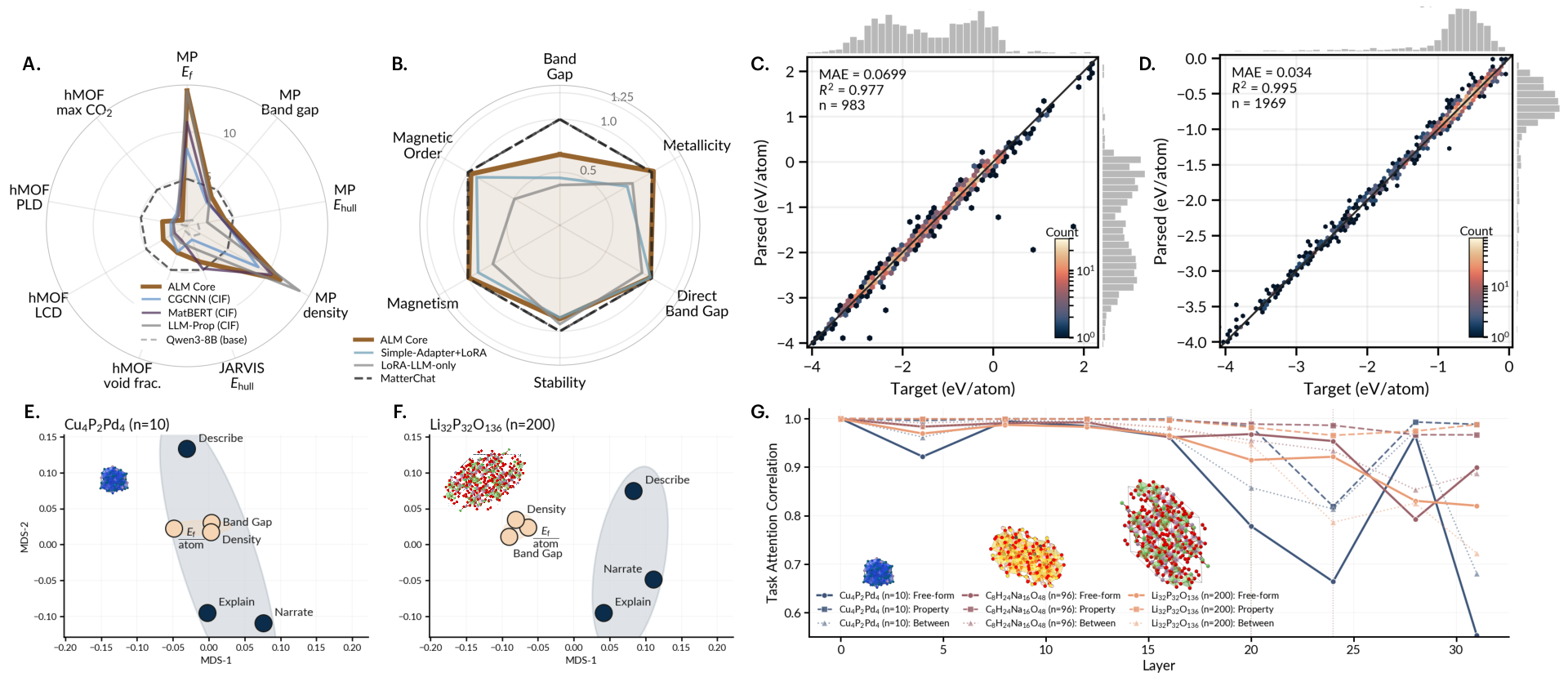
- ALM Core can read a material’s atoms and predict properties (like energy or density) as accurately as strong, specialized models that only work with atom graphs.
- Unlike many models, ALM keeps its general language skills. It still answers scientific questions and reasons well in text.
- Editing with text instructions works:
- ALM Edit can follow prompts like “increase formation energy,” “decrease volume,” or “dope this crystal with element X,” and then actually produce the edited 3D structure.
- On ALM Bench (the new test suite), ALM Edit clearly beats top general-purpose LLMs, which struggle to produce valid, realistic crystals from text alone.
- Best-in-class crystal structure prediction:
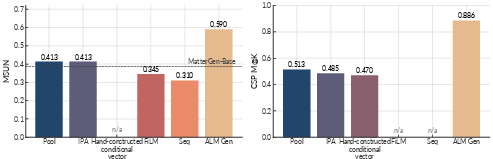
- When asked to reconstruct actual crystals from their compositions, ALM Edit reaches or surpasses state-of-the-art performance on tough benchmarks (MP-20 and MPTS-52). This means it’s very good at guessing how atoms arrange themselves in 3D space.
- Generating new stable crystals:
- ALM Gen creates many stable, unique, and novel crystals (often called “SUN” for Stable, Unique, Novel), outperforming previous language-based systems and even challenging strong atom-based generators.
- T2C-FK helps ALM Gen better match the exact element mix requested in a prompt, improving how well the creations follow the “recipe.”
- Scales like LLMs:
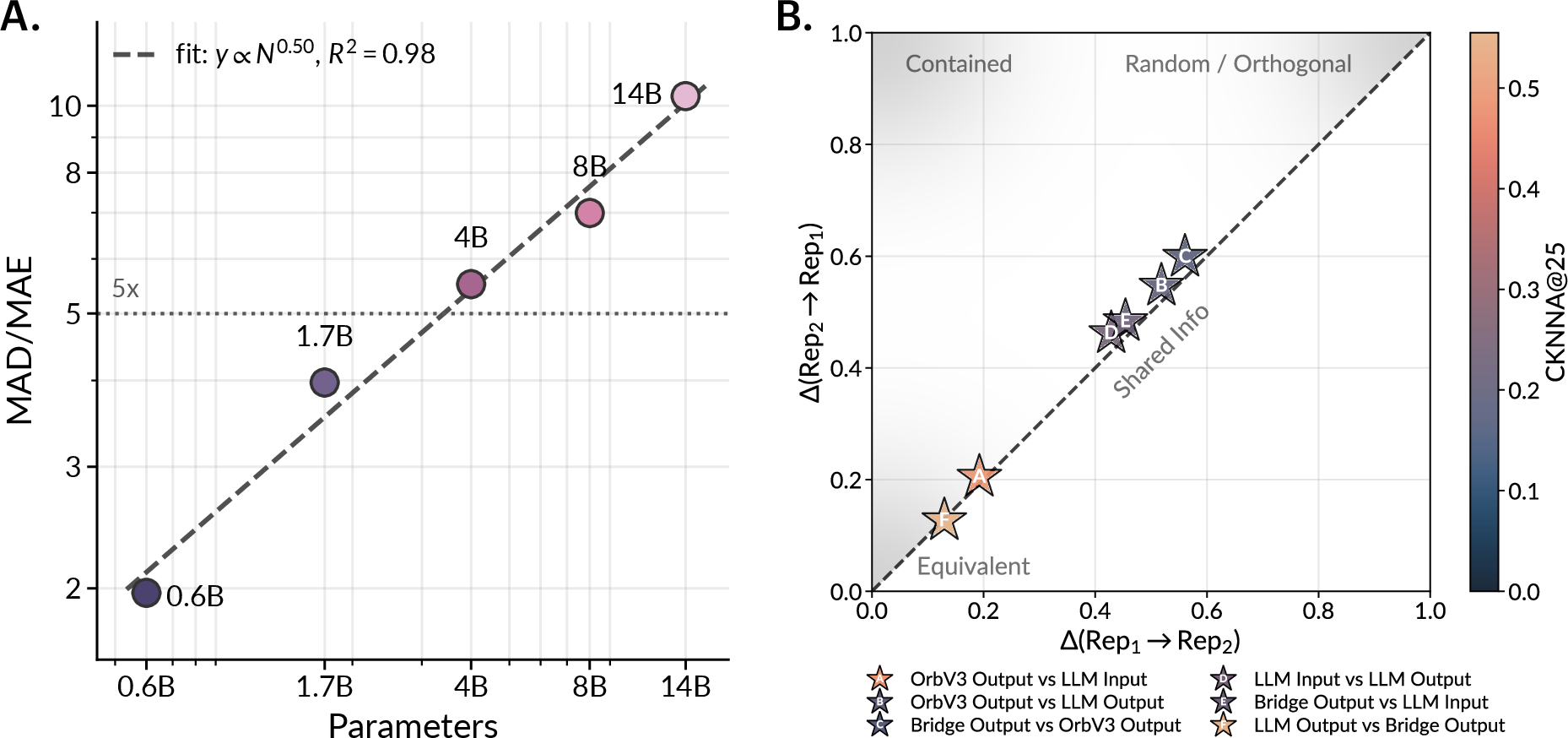
- As the language backbone gets bigger, property predictions get better, suggesting performance will continue to improve with scale and data.
Why this matters:
- Faster discovery: Being able to describe what you want in plain language—then get a 3D structure that fits—could speed up the search for better batteries, solar materials, catalysts, and more.
- Less loss of detail: Since the model doesn’t squash the atom data into rough text shortcuts, it keeps crucial geometry that determines real-world behavior.
Implications: What could this lead to?
This work shows a new path for materials discovery:
- Unified workflows: Scientists could ask for materials with certain properties in natural language and watch the model generate candidates to test—tightening the loop between idea and design.
- Better tools for complex systems: The continuous bridges may be especially useful for large, messy, or imperfect materials (like those with defects), where simple text formats don’t capture the important details.
- Broader impact: The same idea—bridging words and 3D atoms—could extend beyond crystals to other kinds of matter, such as molecules, alloys, or even amorphous materials.
In short, ALMs blend the strengths of language and atom-level modeling. They help us talk to materials—and have the materials “talk back”—so we can understand, improve, and invent them more quickly and reliably.
Knowledge Gaps
Below is a concise list of concrete knowledge gaps, limitations, and open questions left unresolved by the paper. These points are framed so that future researchers can act on them.
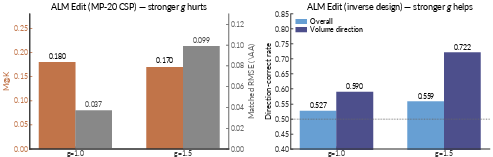
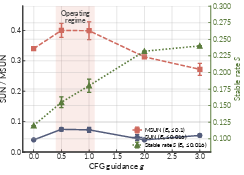
- Decoder conditioning gap: MatterGen cannot reliably enforce stoichiometry and atomic positions under classifier-free guidance (CFG), forcing the use of two decoders (Edit vs Gen). Can a single decoder support both strong and weak conditioning without sacrificing stability or instruction-following (e.g., via conditional flows, consistency models, constrained diffusion, or guidance via differentiable constraints)?
- Latent-bridge sensitivity: The producer–consumer bridge’s steering signal is sensitive to the teacher-forced atomistic token order and architecture choices (K, cross-attention, queries). What bridge designs yield stable, strong, and robust steering, and how do K, positional schemes, and attention mechanisms affect controllability and sample quality?
- Composition–decoder mismatch: ALM Edit relies on the LLM to emit a JSON composition that the decoder observes, but MatterGen ignores stoichiometric targets during denoising. Can composition be enforced natively (e.g., compositional masks, hard constraints) to reduce reliance on post-hoc fixes?
- Symmetry control: Training used space-group labels, but inference for CSP only uses composition. How well can ALMs target specific space groups via text, and can symmetry be enforced during generation (e.g., equivariant score networks or symmetry-constrained samplers)?
- T2C-FK reward design: T2C-FK currently focuses on stoichiometry (with a final Hungarian override). How should rewards be designed to enforce charge balance, oxidation states, space-group symmetry, minimum interatomic distances, and application-specific constraints, and how do these choices trade off with stability, uniqueness, and diversity?
- T2C-FK diversity trade-offs: Particle resampling improves constraint satisfaction but can reduce uniqueness (e.g., lower uniqueness with FK-stoich). How to preserve diversity (e.g., tempered resampling, ESS thresholds, rejuvenation moves) while maintaining constraint compliance?
- T2C-FK timing and schedules: Scoring is deferred until the atomic-number distribution leaves the high-noise regime. What is the optimal timing/scheduling for rewards and resampling frequency across denoising steps to maximize stability and constraint satisfaction?
- FK posterior-correction guarantees in practice: The theoretical correction is stated, but how accurate is it under high-dimensional, multimodal crystal posteriors, and how sensitive is it to MLIP or score-network miscalibration?
- Post-hoc Hungarian override risks: Snapping atom identities at the final step without adjusting coordinates/lattice may create nonphysical local bonding. Can joint constrained updates (e.g., small coordinated relaxations) reduce such artifacts?
- Energy evaluation fidelity: Many results (SUN rates, directional editing) depend on MLIP energies and MP hulls; limited DFT validation is provided. How do conclusions change under DFT relaxation and DFT-computed hulls, and what is the expected MLIP-to-DFT error propagation in ALM-guided discovery?
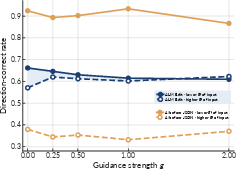
- Stability vs instruction-following Pareto: ALM Gen improves stability but weakens prompt adherence; ALM Edit does the inverse. Can we quantify and control this Pareto frontier per prompt (e.g., adjustable guidance schedules, multi-objective conditioning, energy–instruction dual guidance)?
- Generalization beyond inorganic crystals: The approach is not demonstrated on molecules, polymers, amorphous phases, defects, surfaces, or interfaces. What encoder/decoder changes and datasets are required to extend ALMs to non-crystalline and multi-scale systems?
- Large-system scalability: Performance on very large supercells, defect-rich systems, and multi-component alloys remains untested. How do memory, inference time, and steering strength scale with atom count, and do the learned latents remain informative?
- Catastrophic forgetting vs capacity: Some tasks underperform, partially attributed to low LoRA rank and encoder expressivity. What are the optimal adapter strategies (rank, placement, multi-adapter routing) to retain language skills while maximizing materials performance?
- End-to-end training: Encoders/decoders are mostly frozen; gradients do not fully propagate across all components. Does joint fine-tuning (with careful regularization) improve alignment and generation fidelity without harming language capability?
- Invariances and equivariance: The LLM consumes soft tokens from an equivariant encoder, but the overall stack is not provably symmetry-equivariant. How invariant are outputs to rigid motions, cell choices, and equivalent fractional representations, and can explicit equivariance be maintained end-to-end?
- CSP metric alignment: Current CSP metrics can over-penalize valid polymorphs (e.g., cell doublings, rotations). Can new metrics account for polymorph equivalence classes, energetic near-degeneracy, and symmetry equivalence to better reflect physical correctness?
- Doping tasks physicality: Doping evaluation measures structural/compositional match and strain but not charge balance, preferred sites, or defect energetics. Can the benchmark include oxidation-state checks, site-preference energies, and charge neutrality constraints?
- Prompt robustness: Robustness to ambiguous, adversarial, multilingual, or unit-inconsistent prompts is not characterized. How to calibrate and certify prompt-to-structure mappings and detect when instructions are infeasible or unsafe?
- Uncertainty quantification: The model provides no calibrated uncertainty on property predictions, edits, or generated structures. Can we quantify epistemic/aleatoric uncertainty and propagate it through the editing/generation pipeline for decision-making?
- Interpretability and controllability: Which latent directions map to specific structural changes (e.g., lattice expansion, motif substitution)? Can we disentangle and control interpretable factors (space group, density, bandgap proxies) via targeted latent manipulations?
- Multi-objective conditioning: Real applications require meeting multiple simultaneous constraints (e.g., stability, bandgap, density, symmetry). How to integrate numeric targets with natural language in a unified conditioning scheme and avoid reward hacking?
- Data overlap and leakage: Edit is pretrained on datasets also used for evaluation (MP-20, MPTS-52). Are there strict, structure-level deduplication protocols and leakage audits (including near-duplicate polymorphs) ensuring fair generalization claims?
- Benchmark subjectivity: ALM Bench uses an LLM judge (GPT-4o) for application consistency and textual criteria. How reliable are these judgments (inter-rater agreement, bias), and can human-curated or rule-based criteria reduce subjectivity?
- Synthesis realism: Stability against a hull is necessary but insufficient. How to evaluate synthesizability, kinetic accessibility, decomposition pathways, and processing conditions, and incorporate T, P, and process history into conditioning?
- Safety and compliance: The framework does not address generation of hazardous, toxic, or proliferation-sensitive materials. What safeguards, filters, and governance should be integrated into ALM-guided discovery workflows?
- Structured decoding constraints: The LLM’s composition JSON may be inconsistent or invalid. Can constrained decoding (finite-state machines, grammar-based decoding, oxidation-state-aware filters) eliminate invalid compositions at source?
- Guidance schedules: Only a fixed guidance scale (e.g., g=0.5) is reported. How do adaptive guidance schedules and timestep-dependent guidance affect SUN yield, novelty, and property controllability?
- Chain-of-thought for materials: “Thinking” was disabled due to lack of CoT data. Does materials-specific CoT (tool-augmented reasoning traces, RLHF/GRPO) improve instruction-following, CSP, and property-aware editing?
- Alternative latent discretization: Continuous latents were chosen; vector-quantized/tokenized latents are mentioned as an alternative. Under what regimes (model/data scale, noise tolerance) do codebook approaches improve controllability or compression without losing geometric fidelity?
- Calibration of latent alignment: Information imbalance shows alignment without collapse, but practical diagnostics for drift during training/inference are missing. Can online alignment monitors detect when modalities diverge and trigger corrective training?
- Relaxation pipelines: Pre-relaxation choices (method, thresholds) can materially change SUN metrics and structural RMSDs. What standardized relaxation protocols and cross-DFT validations are needed for fair, reproducible comparison?
- Domain coverage and OOD: Performance on chemistries poorly represented in training (e.g., 4f/5f elements, high oxidation states) is unknown. Can few-shot adapters or retrieval-augmented conditioning mitigate OOD degradation?
- Throughput and cost: T2C-FK’s SMC introduces compute overhead. What are the best trade-offs (particle count, resampling frequency) for large-scale screening, and how do costs compare to flow-based generators at similar quality levels?
Practical Applications
Immediate Applications
The paper’s methods enable several deployable workflows and tools today, especially when combined with existing simulation (DFT/MLIP) and lab software. Below are practical use cases by sector, with concrete tool/workflow ideas and key dependencies.
- Text-instructed crystal editing and property-directed optimization (energy, semiconductors, chemicals, advanced manufacturing)
- Use ALM Edit to “nudge” an existing crystal toward a target (e.g., higher bandgap, lower formation energy, higher density) or perform targeted doping/polymorph exploration from natural-language prompts.
- Tools/products: Prompt-to-Polymorph editor; “Doping Assistant” that proposes composition/structure edits; a VSCode/Jupyter extension that reads CIF/POSCAR and outputs edited crystals plus rationales.
- Workflow: Input structure + plain-English goal → ALM Edit generates candidate edits → MLIP/DFT relaxations and re-scoring → shortlist for experiment.
- Assumptions/dependencies: Access to ALM Edit weights; compute for batched generation and relaxation; reliability of MLIP pre-screening; downstream DFT validation remains essential.
- De novo candidate generation for high-throughput screening (energy, catalysis, PV, solid-state batteries, dielectrics)
- Use ALM Gen to generate large, diverse pools of candidates; apply T2C-FK at inference to enforce stoichiometry or element set constraints without retraining.
- Tools/products: Prompt-conditioned generator API; FK Steering Engine (plug-in for diffusion generators) that enforces composition, charge neutrality, or symmetry constraints at sampling time.
- Workflow: Text prompt describing target domain/properties → ALM Gen samples → T2C-FK refines stoichiometry → MLIP/DFT relax/score → deduplicate + novelty checks → triage for synthesis.
- Assumptions/dependencies: Ability to run MatterGen-scale samplers; reward design for FK (stoichiometry is ready; charge/symmetry needs reward definitions); stability/novelty verified against a trusted hull (e.g., MP, GNoME).
- Natural-language property prediction and structure-aware assistance (industry R&D, academia)
- Use ALM Core as a “Crystal Chat” assistant that ingests 3D structures and answers questions about properties, trade-offs, and likely applications; generates structured reports for ELNs/LIMS.
- Tools/products: ELN/LIMS plugin that annotates crystal entries with AI-generated summaries, predicted properties (with uncertainty bands), and suggested next experiments.
- Assumptions/dependencies: Proper calibration against domain datasets (e.g., LLM4Mat-Bench tasks); careful messaging on prediction uncertainty; guardrails for extrapolation beyond inorganic, crystalline domain.
- Inverse-design loops for target properties (semiconductors, photonics, thermoelectrics)
- Iteratively apply ALM Edit to a seed crystal with a property-direction instruction (e.g., “increase bandgap slightly”), validate via MLIP/DFT, and re-prompt until reaching spec.
- Tools/products: Closed-loop “Property Setter” that couples ALM Edit with automated relax/score and early-stopping criteria.
- Assumptions/dependencies: Robust scoring oracles (DFT, MLIPs) and convergence criteria; human-in-the-loop review for feasibility and synthesizability.
- Constraint-aware generation for safety/compliance and sustainability (manufacturing, EHS, supply chain)
- Use T2C-FK at inference to exclude toxic/heavy elements, enforce charge balance, or impose symmetry/packing constraints.
- Tools/products: “Green Filter” generator wrapper with pre-defined element blacklists/whitelists and charge-balance rewards.
- Assumptions/dependencies: Mapping from constraints to per-step rewards; maintaining generation yield under strong constraints.
- Critical material substitution via text-guided doping (energy storage, magnets, catalysis)
- Prompt ALM Edit to replace scarce/toxic elements (e.g., Co, REEs) with abundant alternatives while maintaining performance proxies.
- Tools/products: Substitution Explorer dashboard comparing predicted properties and synthesis notes for candidate substitutions.
- Assumptions/dependencies: Availability of accurate property proxies; DFT/experiment to confirm substitutions don’t degrade performance or stability.
- Data curation and knowledge extraction for materials databases (software, data providers, academia)
- Auto-generate structural narratives and predicted properties for new entries; flag anomalous entries; map text-only records to candidate structures.
- Tools/products: “Crystal Annotator” service for Materials Project-like platforms; batch CIF-to-text and text-to-candidate modules.
- Assumptions/dependencies: API-level integration; quality control pipelines; licensing for training/serving over proprietary datasets.
- Education and training in crystallography and materials design (education, workforce development)
- Interactive teaching assistant connecting symmetry, polymorphs, and properties; hands-on labs where students “talk to” structures and see AI-edited outcomes.
- Tools/products: Courseware notebooks; web sandbox that visualizes ALM edits and predicted property shifts.
- Assumptions/dependencies: Guardrails to prevent overinterpretation; curated educational datasets for safe demos.
- Benchmarking and evaluation standardization (academia, vendors, funding bodies)
- Adopt ALM Bench to compare text-conditioned generation/editing across labs and vendors with shared metrics and leaderboards.
- Tools/products: Public leaderboard and test harness; “challenge tasks” for property-direction editing and robust stoichiometry control.
- Assumptions/dependencies: Community buy-in; consistent evaluation protocols; periodic dataset refreshes.
- IP and prior-art triage for materials claims (legal/IP analytics, corporate R&D)
- Map textual patent claims to likely structures and compare against known databases to identify overlaps/gaps.
- Tools/products: Claim-to-Crystal mapper; similarity scoring toolkit combining structural and textual embeddings.
- Assumptions/dependencies: Legal-grade traceability; careful uncertainty communication; restricted to inorganic crystalline scope.
Long-Term Applications
As the models, data, and decoders scale—and as synthesis/oracle integration matures—richer, cross-domain applications become feasible.
- Self-driving materials labs with natural-language objectives (robotics, lab automation, energy/semiconductors)
- ALM proposes targets and edits; FK enforces constraints; autonomous platforms execute synthesis/characterization; the loop iterates with NL feedback.
- Tools/products: Orchestrator that couples ALM (design) + DFT/MLIP/XRD oracles (score) + robotic planners (execute); experiment-planning agents with text goals (“maximize ionic conductivity at room temperature”).
- Assumptions/dependencies: Reliable synthesis-planning for solids; robust instrument control; standardized NL-to-protocol translation; safety/ethics frameworks.
- Extension beyond crystalline inorganics to molecules, polymers, amorphous and defect-rich systems (healthcare/biomaterials, soft matter, coatings)
- Re-train with encoders/decoders suited to non-crystalline or multi-scale systems; design bioactive ceramics, bone-mimetic materials, polymer electrolytes.
- Tools/products: “Atomistic Language OS” spanning multiple encoders (e.g., UMA/PET-MAD) and decoders per domain.
- Assumptions/dependencies: Domain datasets with 3D structure/process labels; new inductive biases in encoders/decoders; cross-validation with experiments.
- Device and process co-design: text-to-device-level materials integration (semiconductors, photonics, batteries)
- Jointly optimize material + device stack (e.g., perovskite layer + transport layers) and process conditions via language instructions.
- Tools/products: CAD/EDA plug-ins that accept NL specs and return stack suggestions with process windows; “Text-to-Process” planners.
- Assumptions/dependencies: Differentiable links between structure–property–device performance; process-structure datasets; multi-physics oracles.
- Multi-objective, constraint-rich generation with learned reward models and RL (broad industry)
- Train reward models for synthesizability, cost, lifecycle carbon, and reliability; steer diffusion with FK-like samplers and RL fine-tuning.
- Tools/products: Reward Model Hub; policy-gradient pipelines for generator alignment to enterprise KPIs.
- Assumptions/dependencies: High-quality labels for synthesis success/cost; scalable RL with diffusion; maintaining diversity under stronger rewards.
- Strategic materials policy and national discovery programs (policy, public sector, finance)
- Use ALM-driven exploration to identify alternatives to critical minerals, forecast technology timelines, and guide funding portfolios.
- Tools/products: Decision-support dashboards integrating ALM outputs, supply risk, and cost models; scenario planners for substitution strategies.
- Assumptions/dependencies: Coupling to economic and supply-chain models; governance for AI-proposed materials; transparency/traceability.
- Clinical and biomedical materials design (healthcare/medtech)
- Design ceramic implants, coatings, and bioactive glasses with target modulus, toughness, and bioactivity profiles expressed in NL.
- Tools/products: Regulated co-pilot for biomaterial screening; integration with finite-element analysis and in vitro validation loops.
- Assumptions/dependencies: Domain retraining; biocompatibility and regulatory validation; coupling to mechanics and degradation oracles.
- Materials marketplace and provenance-aware IP exchange (software, legal/finance)
- Curate and license AI-generated candidates with provenance metadata (prompts, seeds, FK constraints), uncertainty, and evaluation lineage.
- Tools/products: “Materials App Store” with audit trails; smart contracts encoding usage rights and credit attribution.
- Assumptions/dependencies: Standards for provenance; legal frameworks for AI-generated IP; interoperability with data repositories.
- Safer-by-design governance and red-teaming (policy, corporate risk)
- Develop playbooks and monitoring to prevent unsafe or unsynthesizable suggestions; enforce guardrails in generation and deployment.
- Tools/products: Safety filters and governance kits; red-team benchmarks focused on hazardous compositions/processes.
- Assumptions/dependencies: Consensus on risk taxonomies; continuous updates as models scale.
- Efficient deployment via latent codebooks and edge adapters (software, embedded systems)
- Compress continuous bridges to discrete codebooks or distill to smaller backbones for on-prem/edge use.
- Tools/products: Quantized ALM variants; adapter layers for private data centers.
- Assumptions/dependencies: Acceptable accuracy trade-offs; secure model-update pipelines.
- Multi-agent reasoning with specialist oracles (software, research)
- Pair a planning LLM with ALM as a specialist in a tool-use loop (e.g., DFT, XRD simulators, synthesis planners), capturing chain-of-thought traces for further RL fine-tuning.
- Tools/products: Agentic orchestration frameworks; trace datasets for supervised and RL training.
- Assumptions/dependencies: Reliable tool APIs; data/compute budgets; privacy and IP protections for traces.
Cross-cutting assumptions and dependencies
- Model availability and licensing: The paper states “code, training data, and model weights will be released soon”; immediate adoption depends on actual release terms and model sizes (Qwen3-8B, MatterGen).
- Domain scope: Current training focuses on inorganic crystalline materials; generalization to molecules, polymers, amorphous, and large-defect systems requires retraining with suitable encoders/decoders and data.
- Oracles and validation: MLIP pre-screening accelerates loops but must be backed by DFT (and ultimately experiment). Reported “stability” often depends on hulls derived from specific datasets (e.g., MP-20), which may introduce bias/domain shift.
- Compute and MLOps: Diffusion sampling (with FK) and relaxation at scale require HPC/GPU resources and robust pipelines (ASE/pymatgen integration, job schedulers).
- Synthesizability and process knowledge: The models generate structures, not synthesis routes; integration with synthesis-planning and lab robotics is necessary for real-world impact.
- Safety, compliance, and ethics: Enforce constraints (element bans, charge balance) and guardrails; ensure transparency on uncertainty and provenance in enterprise use.
Glossary
- ALM Bench: A benchmark dataset and evaluation framework for text-conditioned crystal generation and optimization. "we introduce ALM Bench, the first benchmark for text-conditioned crystal generation and optimization."
- autoregressive backbone: A model architecture that generates outputs token-by-token, conditioning on previous tokens. "This new paradigm allows a single autoregressive backbone to characterize the structure, properties, and applications of a material"
- band gap: The energy difference between the valence and conduction bands that determines electronic properties of a solid. "band gaps that are hundreds of meV apart"
- bootstrap Sequential Monte Carlo sampler: A particle-based sampling method that resamples trajectories according to weights, used here to steer diffusion. "replaces MatterGen's single denoising trajectory with an -particle bootstrap Sequential Monte Carlo sampler"
- classifier-free guidance (CFG): A technique to steer diffusion models by interpolating conditional and unconditional scores. "MatterGen serves as the denoising diffusion model for ALMs due to its extensibility to different conditioning heads via classifier-free guidance"
- continuous projectors: Learned continuous mappings that align latent spaces across modalities without discretization. "unifying a pretrained atomistic encoder, LLM, and denoising diffusion model through purely continuous projectors and staged training"
- crystal structure prediction (CSP): The task of generating a crystal’s atomic arrangement from composition or other constraints. "state-of-the-art results on crystal structure prediction"
- denoising diffusion model: A generative model that synthesizes data by iteratively denoising from noise. "a denoising diffusion model that decodes the LLM's latent instructions into 3D crystal structures"
- energy above hull (E_hull): A thermodynamic stability metric measuring energy relative to the convex hull of competing phases. "JARVIS-DFT energy above hull"
- Feynman--Kac: A probabilistic formulation connecting stochastic processes and differential equations, used here for trajectory weighting. "Text-to-Crystal Feynman--Kac (T2C-FK)"
- fractional coordinates: Atom positions expressed relative to the unit cell basis vectors. "continuous fractional coordinates of each of the atoms in the material"
- GNN--LLM wall: The perceived performance gap where LLMs underperform graph neural networks on property prediction. "breaking the so-called ``GNN--LLM wall''"
- Hungarian algorithm (override): An assignment optimization used here to align predicted atoms to target element identities at the end of sampling. "a final Hungarian override snaps each atom to its assigned target element"
- inductive priors: Built-in architectural biases (e.g., symmetry, locality) that encode domain knowledge. "many having inductive priors like symmetry, locality, and stoichiometry baked into their architectures."
- information imbalance: A representational similarity metric quantifying differences in information content between embedding sets. "Information imbalance, a global representational similarity metric over sets of embeddings, quantifies the difference in information content between representations of each modality."
- JARVIS-DFT: A density functional theory dataset and benchmark from the JARVIS project. "JARVIS-DFT energy above hull"
- lattice parameters: The geometric parameters (cell vectors/angles) defining a crystal’s unit cell. "atomic coordinates, lattice parameters, and element types"
- LeMat-GenBench: A benchmark protocol for evaluating de novo crystal generation over broader chemistries. "using MP-20 or LeMat-GenBench hulls to determine stability"
- LoRA (Low-Rank Adaptation): A parameter-efficient fine-tuning technique that injects low-rank adapters into pretrained models. "The LLM is then instruction-tuned via LoRA"
- machine learning interatomic potential (MLIP): A learned potential energy model that maps atomic structures to energies/forces and rich embeddings. "many having inductive priors like symmetry, locality, and stoichiometry baked into their architectures. LLMs operate on discrete tokens..." (context: "State-of-the-art (SoTA) atomistic models ... machine learning interatomic potential (MLIPs)")
- Materials Project (MP): A large materials database often used to define benchmarks and stability hulls. "Materials Project (MP) formation energy per atom"
- metastable: Refers to structures with small positive energy above the hull, often considered practically stable. "metastable ($E_{\text{hull} < 0.1$) yield"
- periodic boundary conditions: Boundary conditions modeling an infinite crystal by repeating the unit cell in space. "operate on graphs built from 3D coordinates and periodic boundary conditions"
- perovskite: A common crystal structure class (ABX3-type) used here as an application category for generation. "(e.g., “generate a perovskite”)"
- polymorph: Distinct crystal structures with the same composition. "TiO polymorphs differ by small distances between atoms, yet have band gaps that are hundreds of meV apart"
- Q-Former: A query-based transformer module (from BLIP-2) used to extract conditioning vectors from language features. "Q-Former-style"
- RMSD: Root mean square deviation, a distance measure between structures. "and RMSD are scored by 3 MLIPs"
- soft tokens: Continuous embeddings injected into a LLM in place of discrete tokens. "as soft tokens, a lower-parameter method than the gated attention-based bridges of prior multimodal materials models"
- space group: A crystallographic symmetry classification describing allowed symmetry operations. "symmetry space group"
- stoichiometry: The elemental composition and ratios in a material. "stoichiometric targets at inference time."
- SUN (stable, unique, novel): A composite metric for de novo generation assessing thermodynamic stability, uniqueness, and novelty. "producing SUN crystals at higher rates than prior atomistic and language-based models"
- Text-to-Crystal Feynman--Kac (T2C-FK): An inference-time steering method that reweights diffusion trajectories to meet stoichiometric (and other) constraints. "Text-to-Crystal Feynman--Kac (T2C-FK), a particle-based sampler that scores partial denoising trajectories to enforce stoichiometric targets at inference time."
- Tweedie-estimated clean structure: An estimate of the noise-free sample x0 in diffusion using Tweedie’s formula. "reward on the Tweedie-estimated clean structure "
- unit cell: The fundamental repeating volume of a crystal lattice. "a periodic unit cell"
- Wyckoff strings: Text encodings of Wyckoff positions (symmetry-distinct sites) in a crystal. "Wyckoff strings"
Collections
Sign up for free to add this paper to one or more collections.