- The paper shows that applying a collective red-sideband pulse enables cooling with efficiency scaling as 1/N².
- It employs both theoretical models and experiments on planar ion crystals to confirm coherent quantum state swapping.
- The approach facilitates indirect thermometry via spin mapping and achieves record-low phonon occupancies.
Collective Enhancement in Sideband Cooling of Ion Crystals
Introduction and Motivation
Recent advances in trapped-ion quantum simulation, computation, and precision measurements have necessitated the preparation and control of low-entropy motional states in increasingly large ion Coulomb crystals. As crystal sizes scale beyond one hundred ions, achieving ground-state motional cooling and precise thermometry for all spectrally resolved modes poses substantial technical challenges, including the mitigation of anomalous heating and control of mode crosstalk. The paper "Collective enhancement in sideband cooling of ion crystals" (2606.21374) investigates the fundamental question of whether collective effects in many-ion systems can be harnessed to enhance sideband cooling efficiency, particularly in the strong spin–motion coupling regime. Both theoretical modeling and experimental studies utilizing planar ion crystals are employed to elucidate the dynamics of collective cooling.
Theoretical Framework for Collective Sideband Cooling
The authors analyze a system where N ions, each comprising an effective spin-$1/2$, are confined in a harmonic trap and coupled to a collective vibrational mode with frequency ν. The spin–motion interaction is described by the Hamiltonian H=g(aJ++h.c.), with g determined by the Lamb–Dicke parameter and carrier Rabi frequency, and J+ is a mode-weighted collective spin operator.
For weak coupling (g≪Γ where Γ is the internal decay rate), the cooling proceeds independently for each ion, yielding a net cooling rate equivalent to the single-ion rate. However, in the strong coupling regime (g≫Γ), the joint spin–motion system exhibits coherent quantum state swapping: a properly timed collective red-sideband pulse transfers motional excitations to the spins, which are subsequently reset via optical pumping.
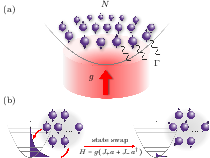
Figure 1: Schematic of the spin–motion coupling arrangement. (a) An arbitrary mode couples globally to the effective spins. (b) At large N, a collective red-sideband pulse swaps the mode and spin quantum states.
Analytical derivations and Holstein–Primakoff approximations establish that after a single swap pulse, the residual mean phonon number scales quadratically with the inverse of the ion number, $1/2$0. This constitutes a significant collective enhancement compared to single-ion protocols. The robustness of the mechanism is proven for arbitrary motional modes with sufficiently large crystals, and sensitivity to the initial phonon statistics is substantially reduced.
Experimental Demonstration of Collective Cooling Dynamics
The experimental system comprises planar crystals of up to $1/2$1 $1/2$2Ca$1/2$3 ions in a monolithic Paul trap, enabling global and addressed laser drives as well as EIT cooling of spectator modes. Sideband heating prepares the targeted non-COM drumhead modes in thermal states, and collective red-sideband pulses are applied for cooling measurements.
Transient phonon population dynamics under varying dissipation regimes are recorded, showing that for large $1/2$4 the system approaches the analytic large-$1/2$5 behavior predicted by the theory. Third-order cumulant expansion methods are adopted to circumvent numerical limitations in solving the full master equation for large, inhomogeneous crystals.
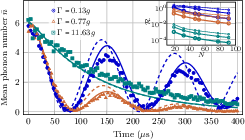
Figure 2: Observed cooling transients in a $1/2$6 crystal. Experimental and theoretical dynamics converge to the analytic large-$1/2$7 limit. Inset: Convergence analysis for increasing crystal size.
The experimental cooling factors, defined as the ratio of final to initial mean phonon occupation, were systematically measured for $1/2$8. The results closely track theoretical predictions, exhibiting the $1/2$9 scaling and confirming the collective enhancement even for inhomogeneous non-COM modes.
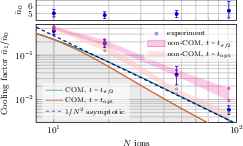
Figure 3: Cooling efficiency and initial mode occupation for varying ν0. Measured cooling factor aligns with theoretical predictions and demonstrates quadratic scaling in ν1.
State-Swap Thermometry and Pulsed Cooling Iteration
The spin–motion state-swap mechanism enables indirect thermometry: the distribution of motional excitations is mapped onto spin states, accessible via global spin readout. This allows direct reconstruction of the phonon number statistics, including for highly non-thermal states with sub-Poissonian distributions.
Iterated pulsed collective cooling, whereby repeated swap-and-repump cycles are applied, achieves exceptionally low residual phonon occupancies, reaching stable values below ν2. The reported minimum occupation for a 19-ion crystal is ν3, establishing a new benchmark for mechanical oscillator cooling.
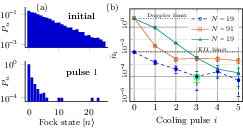
Figure 4: (a) Phonon occupation statistics mapped from spins pre/post pulse for ν4. (b) Iterated collective cooling drives mean phonon numbers to record-low levels.
Anomalous Heating and Mode Statistics
Examination of anomalous heating rates reveals nonlinear behavior in non-COM modes, with ν5 rising exponentially in contrast to linear heating for the COM mode. State mapping reveals highly non-thermal statistics after extended evolution, indicating possible parametric excitation mechanisms, likely affected by trap electrode modulation or background gas collisions. The accessibility of motional state statistics via spin-mapping provides a powerful diagnostic tool for characterizing and mitigating such phenomena.
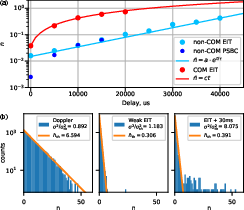
Figure 5: Nonlinear heating and statistical characterization for ν6 ion crystal. Deviations from thermal statistics are evident after extended evolution.
Computational Methods: Cumulant Expansion and DTWA
For large, inhomogeneous ion crystals, cumulant expansion up to third order offers stable and efficient evaluation of quantum dynamics. Discrete Truncated Wigner Approximation (DTWA) is also examined for comparison: DTWA performs well for higher initial phonon occupation but is outperformed by cumulant expansion near ground-state cooling. The chosen cumulant approach demonstrates both computational tractability and high accuracy for realistic experimental settings.
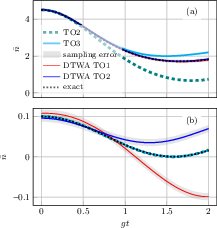
Figure 6: Comparative analysis of exact, cumulant, and DTWA approaches for ν7 crystal. Cumulant expansion delivers robust results in ground-state regime.
Implications and Prospects
The demonstrated collective enhancement in sideband cooling is practically significant for quantum information processing, quantum simulations, and high-precision metrology with large ion registers. The ν8 efficiency scaling and robustness to non-thermal motional statistics directly enable faster cooling protocols, improved time budget management, and new avenues for motional state thermometry and diagnostics. The indirect measurement of heating and excitation processes in large crystals, and the possibility of dark-state cooling extensions, suggest fruitful directions for both practical deployment and fundamental studies in quantum many-body systems.
Future developments include comprehensive analysis of the multi-mode regime (critical for larger and more complex crystals), exploration of pulsed cooling in conjunction with dark states, and refinements in the diagnostic and mitigation of anomalous heating processes.
Conclusion
This work provides a rigorous theoretical and experimental characterization of collective enhancement in sideband cooling for large ion Coulomb crystals, showing that coherent pulsed cooling enables quadratic scaling of efficiency with system size. The experimental validation across multiple ion numbers and motional modes, as well as the ability to probe motional statistics via spin measurements, constitutes a substantial advance in the management of entropy and motional states in many-body quantum systems. These results are expected to influence both the practical implementation of advanced quantum technologies and the theoretical understanding of collective phenomena in engineered quantum materials.