- The paper introduces a novel FLM framework that recasts occupancy prediction as a global maximum likelihood estimation problem.
- It employs a feed-forward network with learnable superquadrics to extract scene geometry, achieving up to 64.0% mIoU with far fewer primitives.
- Ablation studies reveal that global FLM loss enables significant primitive relocation and spatial sparsity improvements over local methods.
FLM-Occ: Feed-forward Likelihood Maximization for Efficient Indoor Occupancy Prediction
Indoor occupancy prediction demands an efficient and accurate mapping of scene geometry and semantics from monocular RGB images to a voxel grid, crucial in contexts ranging from robotics to embodied AI. Traditional voxel-based approaches incur prohibitive cubic complexity, motivating sparse parametric representations via mixture models (e.g., Gaussians, superquadrics). However, extant mixture model-based methods overwhelmingly rely on voxel-wise classification losses, which impose only local constraints. This locality results in sub-optimal primitive distributions, with redundant primitives persisting in empty regions and degraded representational and computational efficiency.
Feed-forward Likelihood Maximization (FLM): Theoretical Framework
FLM-Occ introduces a fundamentally different training paradigm, recasting occupancy prediction as voxel distribution estimation via global maximum likelihood estimation (MLE). The core FLM objective maximizes the joint likelihood of all ground-truth occupied voxels, training a feed-forward network to predict a mixture model that aligns primitives with the observed scene structure. Crucially, mixture weights are reparameterized as normalized primitive volumes, which both enforce simplex constraints and ensure that spatial extents are respected, obviating degenerate solutions with vanishing mixture weights for large primitives.
FLM Loss: Gradient Analysis and Global Supervision
Prior cross-entropy objectives induce vanishing gradients for primitives distant from occupied voxels, restricting training signals to local refinement. In contrast, the FLM loss (negative log-likelihood with volume normalization and density contribution) provides global relocation signals, enabling substantial movement of primitives in a feed-forward architecture. Explicit gradient analysis demonstrates that every ground-truth occupied voxel provides relocation signals to all primitives, circumventing the local limitation.

Figure 1: The information propagation graphs for voxel classification vs. MLE demonstrate the superiority of global supervision with FLM loss.

Figure 2: The role of the volume and density terms in FLM loss; volume compresses primitives to match voxels, density aligns them with actual occupancy.
Model Architecture: FLM-Occ
FLM-Occ—built upon the FLM framework—comprises a single image encoder (Depth Anything v2 ViT) and a set of learnable geometric primitives (typically superquadrics, subsuming Gaussians). Unlike existing pipelines that depend on depth maps for initialization, FLM-Occ initializes primitives randomly and leverages FLM loss for substantial, unconstrained relocation. Four refinement blocks, equipped with MLPs and deformable feature sampling, iteratively update primitive parameters based on extracted image features.
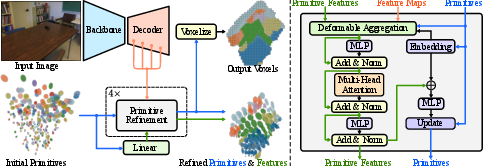
Figure 3: FLM-Occ architecture and refinement block structure.
Voxelization and Post-processing
The FLM mixture model is voxelized by aggregating density and semantic logits, classifying voxels as occupied if their density exceeds a global threshold (empirically validated to $0.5$). Density regularization further encourages densities to reside in [0,1], enhancing segmentation accuracy and minimizing primitive overlap.
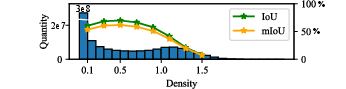
Figure 4: Density distribution and IoU under thresholding demonstrate optimal performance at threshold $0.5$.
Empirical Results and Ablation Analysis
FLM-Occ achieves strong numerical results on Occ-ScanNet, outperforming prior state-of-the-art with fewer primitives and higher inference speed. With only 32 superquadrics (2.7% of prior SoTA’s primitive count), FLM-Occ achieves 55.9% mIoU—surpassing SplatSSC (1200 Gaussians, 51.8% mIoU) and EmbodiedOcc (16200 Gaussians, 45.2% mIoU). Scaling to 1024 superquadrics yields 64.0% mIoU, a +12.2% margin relative to previous bests. Importantly, efficiency saturates with increasing primitive counts, indicating that only a few hundred primitives are required for maximal fidelity.
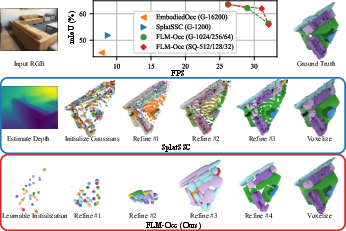
Figure 5: Accuracy-efficiency tradeoff comparison on Occ-ScanNet, FLM-Occ establishes dominance at reduced primitive counts.
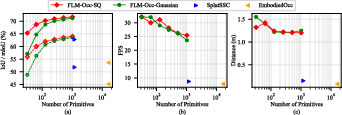
Figure 6: Performance curves vs. representation size (primitive count), confirming early saturation and scalability.
Ablation studies reveal that superquadrics consistently outperform Gaussians, especially at lower primitive counts. Furthermore, FLM-Occ’s primitives exhibit substantial average displacement during optimization (≈1.2m), demonstrating the efficacy of global FLM-guided relocation—far exceeding the limited movement observed in previous methods.
Qualitative Comparisons
Qualitative evaluation confirms that FLM-Occ produces sparse, object-centric representations with minimal overlap, while SplatSSC and EmbodiedOcc generate redundant, locally-adjusted primitives with substantial overlap. FLM-Occ’s global supervision yields efficient occupancy grids, even under coarse annotation.
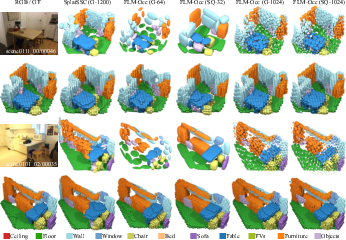
Figure 7: Qualitative results comparing SplatSSC and FLM-Occ with varied primitive counts—FLM-Occ consistently delivers more efficient spatial representation.
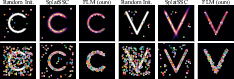
Figure 8: Toy experiments isolate the effect of FLM loss in primitive relocation, revealing robust convergence from random initialization.
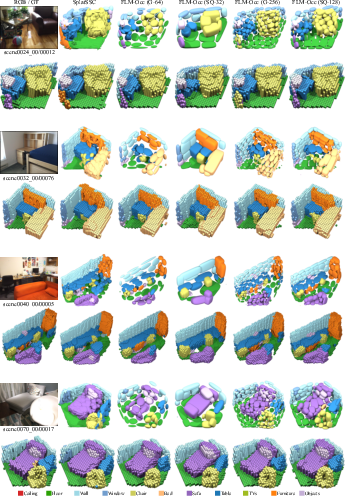
Figure 9: Primitives and voxel predictions from SplatSSC and FLM-Occ demonstrate FLM-Occ’s superior spatial sparsity.
Limitations and Future Directions
While FLM-Occ achieves substantial advances, several limitations persist: (1) bilinear complexity of FLM loss requires innovation in aggregation for large scenes; (2) fixed primitive count necessitates retraining networks for varying granularity; (3) current datasets offer limited annotation quality and scope. Extensions to hierarchical primitive structures, learnable pruning/splitting, and higher-fidelity annotation are recommended. FLM’s general formulation is applicable beyond indoor occupancy, including outdoor applications and general feed-forward 3D primitive prediction.
Conclusion
FLM-Occ introduces feed-forward likelihood maximization for monocular indoor occupancy prediction, leveraging MLE-based global supervision and probabilistic voxelization. It substantially reduces the required primitive count, accelerates inference, and boosts representational efficiency while achieving superior quantitative and qualitative performance. FLM-Occ’s formulation and empirical validation establish a new benchmark in sparse mixture-model occupancy prediction, laying groundwork for broader applications in scene understanding and parametric 3D modeling.