- The paper introduces a weakly supervised ML framework for dark vessel detection along subsea cables using DAS data, achieving a 97.8% detection rate.
- It employs multi-band preprocessing and a hierarchical spatio-temporal encoder with dual-head architecture to attain refined localization of vessel crossings.
- The system demonstrates real-time operational potential by flagging AIS-silent events with a false-trigger rate of 1.98% and a median localization error of 239.9 m.
Sea-Scan: Weakly Supervised DAS Monitoring for High-Accuracy Dark Vessel Detection
Introduction
The proliferation of dark vessels—those operating with disabled or absent AIS transponders—poses significant risks to subsea infrastructure, notably the global fiber-optic cable network. Traditional detection paradigms reliant on cooperative AIS reporting are insufficient for operational security, necessitating non-intrusive, large-scale sensing. Distributed Acoustic Sensing (DAS) enables existing subsea fibers to function as kilometer-scale acoustic sensor arrays, capturing vessel-generated noise with meter-resolution. Prior works leveraging DAS have either relied on array-processing, demanding precise environmental calibration, or have used deep learning methods bounded by limited geographic scale and unreliable AIS-based ground truth.
System Architecture and Pipeline
Sea-Scan introduces an ML-driven framework for end-to-end vessel detection and localization, designed for operational deployment across extensive cable routes. The end-to-end pipeline integrates multi-band preprocessing, weak label alignment, hierarchical encoder design, and robust event triggering.
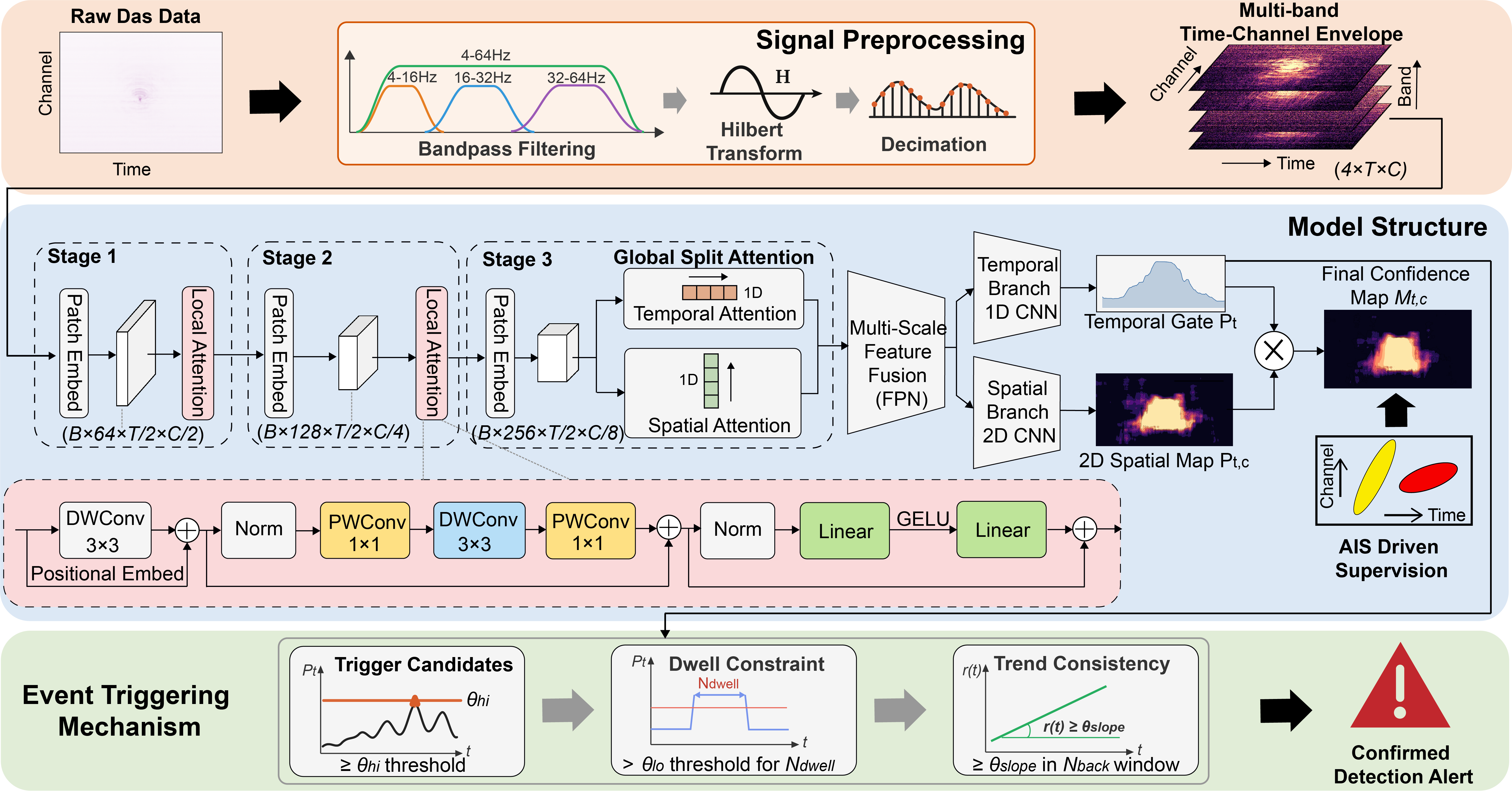
Figure 1: End-to-end pipeline of the proposed DAS vessel detection and localization framework.
Raw DAS strain-rate signals are bandpass filtered into three sub-bands (4–16, 16–32, 32–64 Hz) and one broadband channel (4–64 Hz), followed by envelope extraction with Hilbert transform and z-score normalization. This spectral decomposition is motivated by vessel-class dependent energy distribution and mitigates gauge-length-induced spatial averaging. AIS labels are projected onto the cable with a ±2 km corridor to accommodate spatial uncertainty inherent in mapping ship positions to fiber tracks.
A hierarchical, three-stage spatio-temporal encoder—adopted from UniFormer (Li et al., 2022)—integrates local and split attention mechanisms, producing fused multi-scale representations. Detection utilizes a dual-head architecture with factorized temporal and spatial branches: a global temporal aggregator generates per-timestep activity scores, while a spatial branch outputs segment-level confidence maps. The multiplicative gating mechanism ensures spatio-temporal coupling, suppressing spatial false positives absent sustained temporal evidence.
Learning Paradigm and Event Triggering
Sea-Scan employs a weakly supervised loss function tailored to noisy AIS ground truth. The top-K MIL loss operates over positive intervals, penalizing only the salient 10% of timesteps, while Huber smoothing reduces sensitivity to isolated label noise. Pixel-wise BCE and Dice losses further calibrate spatial localization.
Triggering is realized via hysteresis thresholding combined with trend consistency filtering—only temporally coherent events reflecting characteristic vessel transits are flagged, suppressing impulsive, non-vessel acoustic interference.
Experimental Setup
The framework was assessed on the Emerald Fibre Bridge Link (EFBL), a 120 km UK–Ireland subsea cable, with continuous DAS data acquisition over 35 days. The OptoDAS interrogator was configured at 625 Hz, 61.28 m gauge length, 30.64 m channel spacing, producing ∼14 TB of data. 1,518 AIS-aligned vessel crossings and 4,343 noise samples were cataloged, split 70/30 for train/test, with balanced sampling during optimization. All computations were performed on commodity GPU (NVIDIA RTX 4090) and CPU hardware.
Results
Sea-Scan achieved a detection rate of 97.8% and a false-trigger rate of 1.98% over the balanced test set. Median localization error relative to AIS crossing positions was 239.9 m; Dice and IoU scores for spatial matching were 0.612 and 0.579, respectively. Missed detections (FN=10) predominantly occurred beyond 85 km cable distance, aligning with increased ambient noise and attenuated signal fidelity.
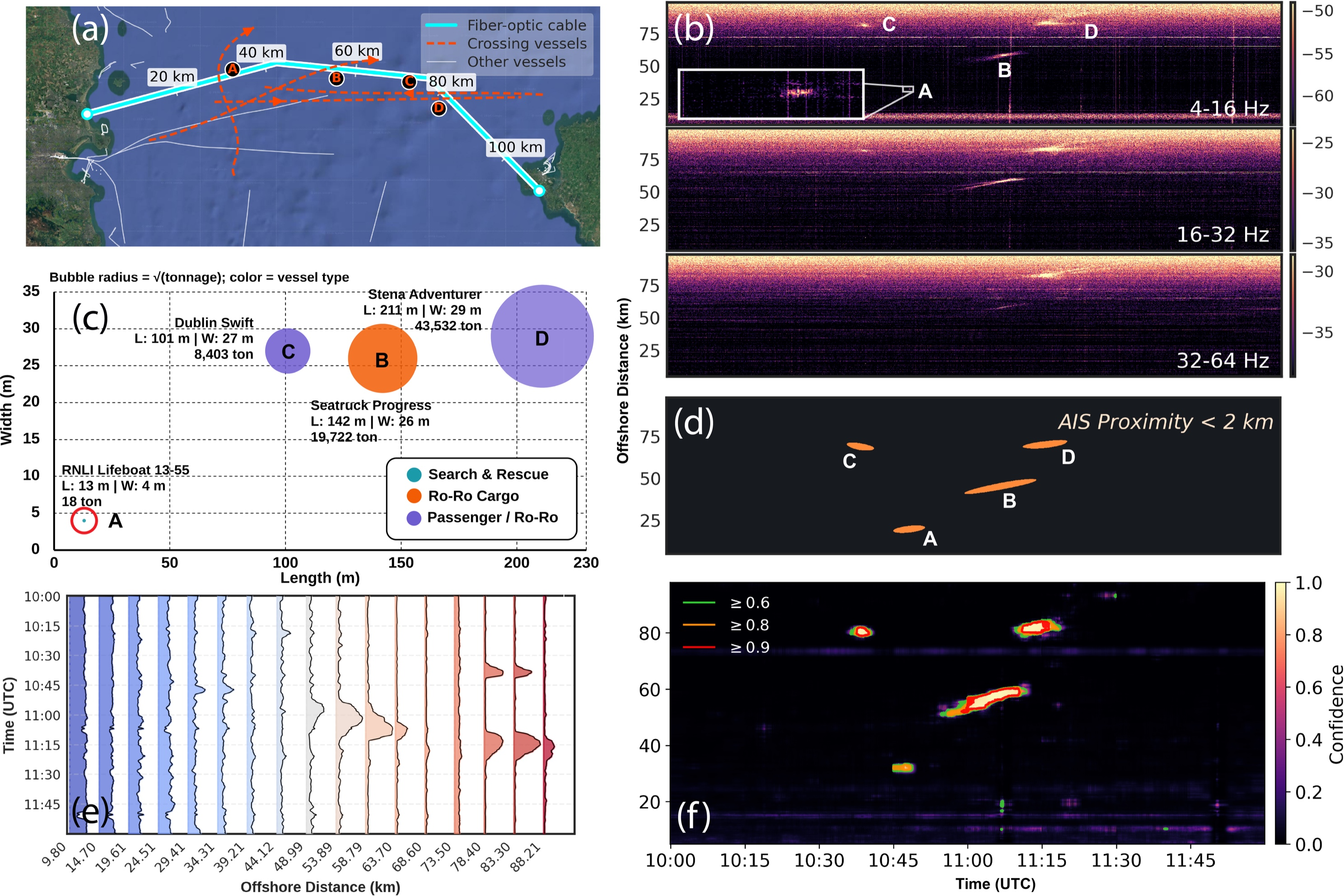
Figure 2: Detection example across 120 km of cable over a 2-hour interval, showing route, DAS envelope intensity, vessel characteristics, and spatio-temporal prediction outputs.
A representative two-hour interval encompassing four vessel crossings (ranging from small lifeboat to large Ro-Ro carrier) demonstrated spatially coherent detection outputs, including successful identification of low-amplitude small-vessel signatures. The pipeline's computational efficiency allows 10s time slot processing for the entire 120 km cable in 9.3 s, enabling real-time operation.
Critically, in segments absent any AIS-reported activity, Sea-Scan flagged 42 events (of 4,343), which manual review confirmed as potential dark-vessel transits based on their spectral profiles. This capacity is pivotal for broad-scale continuous infrastructure monitoring where AIS silence is common.
Implications and Future Directions
Sea-Scan provides an operational blueprint for scalable, real-time dark vessel detection leveraging weakly supervised ML on DAS data. The weak supervision paradigm robustly addresses systematic label noise, operationalizing DAS for security-critical use cases. Practically, this enables persistent surveillance over long subsea links without reliance on cooperative vessel reporting or bespoke environmental calibration, with deployment on commodity hardware.
Theoretically, Sea-Scan advances top-K MIL and spatio-temporal factorization, offering a template for robust anomaly detection in weak-label acoustic sensing. Its successful identification of dark vessels signals the transformative potential for maritime situational awareness and cable security.
Future research may extend to unsupervised anomaly detection for further generalization, domain adaptation under variable seabed conditions, and integration with multi-modal remote sensing for comprehensive maritime activity mapping.
Conclusion
Sea-Scan demonstrates high-accuracy, weakly supervised DAS-based vessel detection and localization across 120 km of subsea cable, attaining 97.8% detection, 1.98% false-trigger, and 239.9 m median localization error. The system is validated against AIS ground truth and identifies candidate dark vessel events in AIS-silent intervals, establishing DAS as a viable modality for continuous, infrastructure-scale vessel monitoring.