- The paper establishes that oxygen p-orbital Coulomb interactions, captured via Wannierization and cRPA, significantly modulate T₍c₎ in cuprates.
- The authors employ ab initio downfolding into single-band Hubbard and three-band Emery models to quantitatively correlate bandstructure features with T₍c₎ variations.
- Statistical regression reveals that both next-nearest neighbor hopping and Holstein-type retardation effects are crucial predictors for superconducting behavior.
Summary of "Importance of effective Coulomb interactions for Tc in cuprates" (2606.21323)
Motivation and Scope
The paper presents a systematic, ab initio investigation into the determinants of the superconducting critical temperature (Tc) in cuprate materials, aiming to quantitatively correlate experimental Tc with low-energy lattice model parameters downfolded from first-principles calculations. The focus is on capturing the impact of effective Coulomb interactions, especially those involving oxygen p-orbitals, via Wannierization and cRPA, in both single-band Hubbard and three-band Emery models. Robust statistical analysis is employed to link material-specific parameters with maximal observed Tc values, providing a basis for future theoretical and computational studies.
Dataset Construction and Bandstructure Classification
The dataset encompasses approximately 40 stoichiometric parent cuprate compounds with documented maximal Tc, spanning different families and structural variants. For each, DFT calculations yield bandstructures, further downfolded to minimal lattice models via MLWFs and cRPA for interaction parametrization. Bandstructure analysis exposes several categorical distinctions, notably the presence or absence of additional bands near the Fermi level arising from buffer-layer atoms or chain structures.
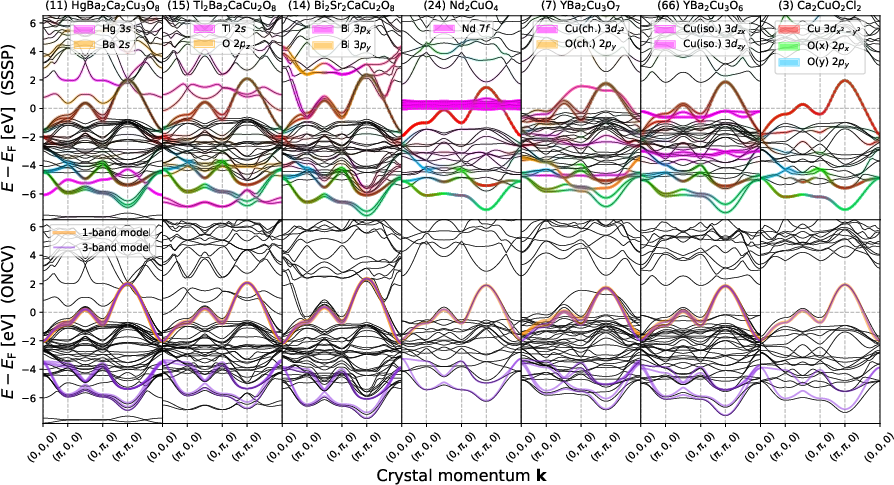
Figure 1: DFT and downfolded bandstructures for representative cuprate categories, indicating orbital contributions to bands near the Fermi level.
Maximal Tc is strongly modulated by such bandstructure categories; highest Tc values are associated with compounds displaying additional bands proximate to the Fermi energy and multiple CuO2 layers per unit cell.
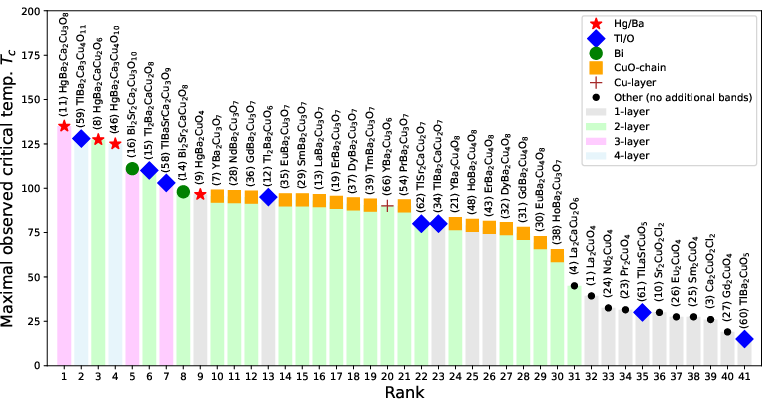
Figure 2: Distribution of maximal observed Tc by compound category and number of CuOTc0 layers.
Downfolding and Effective Interaction Parametrization
Wannierization (via Wannier90 and RESPACK) yields tight-binding parameters (Tc1, Tc2, Tc3 for Hubbard; Tc4, Tc5 for Emery) alongside orbital spreads, with cRPA supplying frequency-dependent effective interactions Tc6. Notably, significant frequency dependence is observed, and the quantitative amplitude of coupling constants varies between models and compounds. The spatial spread of Wannier orbitals anticorrelates with on-site interaction strength.
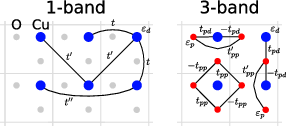
Figure 3: Hopping amplitude illustration for single-band and three-band models, central to tight-binding parametrization.

Figure 4: MLWF spreads versus corresponding on-site Coulomb interactions; anti-correlation indicates increased delocalization decreases bare interactions.


Figure 5: Representative cRPA results showing frequency dependence of effective Coulomb interactions for 1-band and 3-band models; occasional inversion of Tc7 and Tc8 observed.
Statistical Correlation Analysis
Regression analysis seeks single-parameter and low-dimensional multivariate predictors of Tc9 from computed model parameters. Across the full dataset, Tc0 and ratios such as Tc1 in the single-band model display moderate correlation, corroborating previous claims that next-nearest-neighbor hopping is significant for superconductivity. In three-band models, the strongest correlations consistently involve local Coulomb interactions on oxygen Tc2-orbitals (Tc3, Tc4), along with ratios to oxygen-oxygen hopping (Tc5).

Figure 6: Correlation plots of model parameters versus Tc6, highlighting significance of Tc7 in single-band and Tc8/Tc9 in three-band models.
Importantly, this correlation is highly robust across different subsets—compounds with additional bands, Cu-O chains, ternary p0-element compounds—suggesting a universal role for oxygen-site interactions.
Figure 7: Restriction to CuO-chain-containing compounds, further evidencing the preeminence of oxygen-site interactions in predicting p1.
Figure 8: Restriction to ternary p2-element compounds; p3 remains dominant predictor for p4.
Interaction Retardation and Holstein Modeling
Analysis of model-parameter correlations at different Matsubara frequencies suggests that instantaneous interaction assignments are insufficient; strong predictors often involve couplings evaluated at finite frequency, motivating a Hubbard-Holstein or Emery-Holstein model description. Coupling constants for Holstein bosons derived from cRPA (especially p5 for oxygen sites) yield the best fits to p6 across the entire dataset, implicating retardation effects as crucial for accurate modeling.

Figure 9: Regression by Holstein parameters (p7, p8) in Emery-Holstein model, surpassing instantaneous interaction predictors in statistical robustness.
Parameter Space, Phase Diagram, and Trends
Visualization of model parameter-space population reveals clustering by structural category and confirms that high and low p9 compounds often occupy overlapping regions—a counterintuitive result suggesting that subtle changes in interaction parameters, especially on oxygen sites, critically modulate Tc0.
Figure 10: Single-band model parameter-space, showing overlap of high/low Tc1 compounds; Tc2 threshold for superconductivity evident.

Figure 11: Three-band model parameter-space; strong correlation between bare Coulomb interactions on Cu and O sites, but maximal variation in charge-transfer gap.
Practical and Theoretical Implications
The findings emphasize the necessity of incorporating oxygen-site interactions and their retardation in minimal models for cuprate superconductivity. The regime of Tc3 required for nonzero Tc4 in square-lattice Hubbard models is confirmed quantitatively, consistent with recent ground-state studies. The statistical dominance of Holstein-type couplings for oxygens motivates direct many-body solutions of augmented Emery-Holstein models, combined with cRPA-derived parameter sets, to assess their predictive power for material-specific Tc5.
The methodology enables future materials design efforts to focus on maximizing oxygen-site coupling strengths and optimizing parameter regimes identified as robust across compound families. The evidence against Tc6 being determined solely by 1-2 model parameters underscores the complexity of the pairing mechanism and the important role of crystallographic and electronic structure nuances.
Conclusion
The paper delivers a comprehensive mapping from first-principles electronic structure to effective lattice models, robustly correlating oxygen-site Coulomb interactions (including their retardation) with experimental superconducting critical temperatures in cuprates. This work motivates further exploration of Holstein-type models and reinforces the indispensability of oxygen orbitals in accurate theoretical treatments of high-Tc7 superconductivity.
Figure 1: DFT and model bandstructure examples for key compound categories.
Figure 2: Maximal Tc8 per compound category and CuOTc9 layer count.
Figure 3: Hopping matrices for single-band and three-band models.
Figure 6: Parameter-Tc0 correlations in full dataset for Hubbard and Emery models.
Figure 7: Parameter-Tc1 correlations restricted to CuO chain compounds.
Figure 8: Parameter-Tc2 correlations for ternary Tc3-element compounds.
Figure 9: Holstein parameter regression in Emery-Holstein model.
Figure 4: Wannier spread vs. Coulomb interaction (anti-correlation).
Figure 5: cRPA frequency dependence; comparison of Tc4 and Tc5.
Figure 10: Parameter-space region population for single-band model.
Figure 11: Parameter-space region population for three-band model.
Conclusion
The robust correlation between oxygen-site Coulomb interaction parameters and superconducting Tc6 demands theoretical models for cuprates that honor this physics. The work provides practical parameter sets for future theoretical exploration and establishes statistical foundations for materials optimization. Incorporating interaction retardation, particularly via Holstein coupling on oxygen orbitals, is posited as the most promising avenue for accurate and predictive modeling of high-Tc7 superconductivity in cuprates.