- The paper introduces a dual-chip photonic integrated QKD system leveraging InP for active modulation and SiN for low-loss passive circuitry in a time-bin BB84 protocol.
- It details an experimental configuration that achieves sub-4% QBER and kbps secret key rates, optimized for varying channel losses and block sizes.
- The work points toward scalable, compact QKD modules with tunable basis ratios and potential for further integration and detector miniaturization.
Introduction
The paper presents a discrete-variable quantum key distribution (DV-QKD) implementation using a dual-chip photonic architecture based on Indium Phosphide (InP) and Silicon Nitride (SiN) photonic integrated circuits (PICs), targeting the time-bin variant of the BB84 protocol. The motivation for hybrid PICs arises from the disparate strengths of individual platforms: InP enables active functionalities (laser generation, modulation), whereas SiN provides low-loss passive circuitry and scalable access to integrated delay lines. The system leverages an on-chip, actively modulated InP transmitter (Alice) and a reconfigurable SiN decoder (Bob), obviating the transmitter-side delay line typically required in time-bin QKD protocols and offering a tunable measurement basis ratio for protocol optimization.
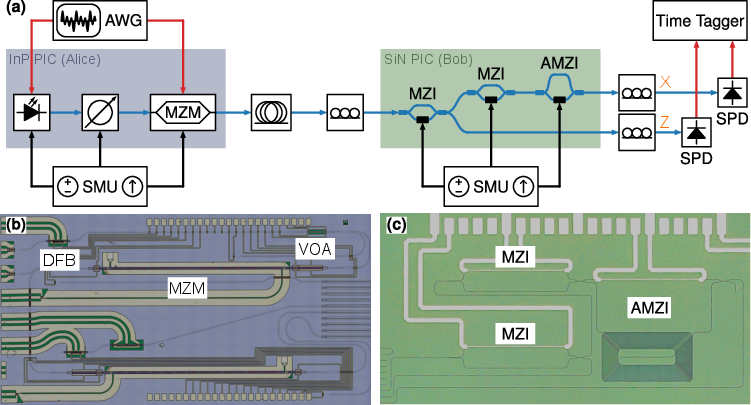
Figure 1: (a) Schematic of the InP-SiN QKD setup with Alice and Bob PICs. (b) Microscope image of Alice's InP PIC. (c) Microscope image of Bob's SiN PIC.
System Architecture and Experimental Implementation
The experimental configuration consists of an InP transmitter PIC with a directly modulated DFB laser, MZM for pulse carving and amplitude control, and VOA for on-chip attenuation. Electronic modulation at 1.065 GHz produces time-bin encoded quantum states at 1550 nm, with intensity levels suitable for decoy state protocols.
At the receiver side, a polarization controller aligns input states for the SiN receiver PIC, which incorporates two MZI-based tunable couplers, an AMZI with a 940 ps delay line for time-bin interference, and on-chip thermo-optic phase shifters (TOPS) for basis selection and phase tuning. This topology enables precise control of the Z/X basis split, adapts for loss imbalances, and facilitates high extinction-ratio interference in the X basis. Detection is carried out using twin channels of SNSPDs with 80% efficiency and 21 ps timing jitter, supporting robust photon arrival time discrimination.
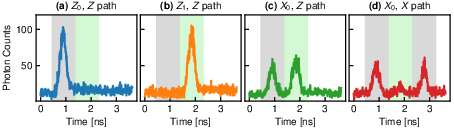
Figure 2: Time-bin histograms at Bob's output for Z and X basis states, showing destructive interference in the X channel and active detection slots.
Protocol and Security Analysis
The QKD protocol deployed is a three-state time-bin BB84 variant with one decoy intensity. Alice probabilistically selects Z basis states (Z0, Z1) (early/late bins) or the X basis state (X0) (coherent superposition of both bins), with corresponding modulation to set signal and decoy intensities. Basis selection probability (PZ/PX) at Bob can be continuously tuned from the SiN PIC to maximize secret key rate (SKR) given channel conditions and finite sample statistics.
Security against collective and coherent attacks is analyzed using finite-key bounds, relying on decoy-state estimation for single-photon contributions, phase error rate assessment from X basis projections, and classical error correction leakage. The key extraction formula incorporates Serfling corrections for finite sample estimation and employs statistical tightness parameters consistent with state-of-the-art composable security models.
Protocol parameters were globally optimized with respect to channel loss and block size, revealing substantial Z basis bias characteristic of efficient-BB84 operation. With increasing block sizes (sifted Z detections), statistical penalties wane, extending feasible secure transmission distances. The mean photon numbers for signal and decoy states, as well as basis selection probabilities, are explicitly optimized for each scenario.
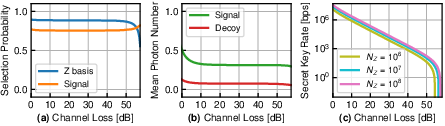
Figure 3: (a) Optimized Z basis and signal selection probabilities vs. channel loss. (b) Signal and decoy mean photon numbers under loss. (c) SKR (kbps) for three sifted block sizes (NZ) versus channel loss.
Empirical results validate stable secret key rates over metropolitan and intercity distances: for losses of 30, 40, and 50 dB (corresponding to 150, 200, and 250 km SSMF respectively), QBER remains below 4%, and estimated SKRs are 16, 1.5, and 0.13 kbps with block sizes NZ=107. The QBER floor arises from preparation defects, finite AMZI extinction, and detector jitter. The finite-key penalty dominates at short block sizes, shrinking as the number of sifted bits increases.
Implications and Future Directions
Hybrid photonic integration combining InP and SiN addresses key pain points in DV-QKD hardware: it eliminates transmitter-side delay lines, reduces passive losses, and provides fine-grained protocol adaptability. Sustaining SKRs over hundreds of km with QBER under the 4% threshold demonstrates the practical relevance of this approach for metropolitan and long-haul fiber QKD infrastructures.
Practical implications include scalable chip-level QKD modules suitable for field deployment, tunable basis ratios for optimal operation, and compatibility with existing fiber networks. Theoretical directions include side-channel evaluation (e.g., pattern-dependent leakage, residual pulse correlations), integrated detector development to replace cryogenic SNSPDs, and the consolidation of active, modulation, and passive photonic functionalities on a single platform. The adoption of more sophisticated finite-key security models and higher-rate operation could further elevate SKRs or extend distances.
Integration of on-chip single-photon detectors, enhanced thermal/polarization stabilization, and compact co-packaging for the transmitter/receiver are recognized as key steps toward miniaturized, robust QKD transceiver modules. The chip-scale approach promises to align with the demands of cost, scalability, and operational reliability required for future quantum-secure communication deployments.
Conclusion
This work demonstrates an InP-SiN dual-chip photonic QKD system for time-bin BB84 with decoy states, maintaining sub-4% QBER and kbps key rates over up to 250 km of fiber. The hybrid strategy leverages active modulation in InP and passive high-performance delay/interference in SiN, pointing toward scalable, cost-effective photonic QKD solutions. Future technical advances in integration, detector miniaturization, side-channel certification, and operational robustness will further push practical chip-scale QKD into widespread deployment scenarios.