- The paper presents the STIR Hand, a minimalistic, two-digit robotic hand that integrates foil strain gauges in soft joints for high-resolution proprioception.
- It employs underactuated tendon-driven mechanics and real-time motor feedback, with classification models achieving over 98% accuracy in object discrimination.
- The integrated joint sensor approach enhances haptic feedback and reliably distinguishes material and stiffness variations, setting new benchmarks for adaptive grasping.
Human-Inspired Thumb-Index Robotic Hand with Embedded Strain Gauges
Introduction
The paper "A Human-Inspired Thumb-Index Robotic Hand with Strain Gauges Embedded in Soft Joints" (2606.21245) presents the Safe Thumb-Index Robotic (STIR) Hand, a minimalistic, compliant, two-digit robotic hand inspired by human thumb-index biomechanics. The architecture combines underactuated tendon-driven mechanics and foil strain gauges embedded within silicone-encapsulated soft joints. This configuration yields passive, adaptive grasping and high-resolution proprioception, offering both internal kinesthetic feedback and enhanced haptic perception. The design is motivated by the challenge of maintaining accurate proprioceptive sense in soft robotics, which often rely on indirect or noisy sensing modalities.
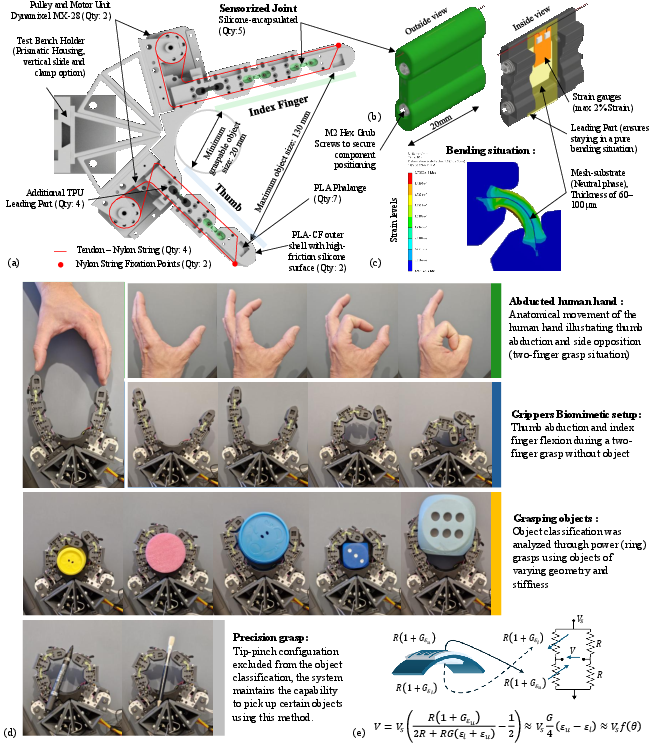
Figure 1: STIR-Hand design assembly showcasing the thumb and index finger hardware, embedded sensors, grasping dimensions, and neutral axis visualization under bending.
Hardware Architecture & Sensorization
The STIR Hand utilizes rigid PLA/PLA-CF segments for structural stability and soft joints (silicone, nylon, TPU) to mediate safe, adaptive interactions. The tendon routing is managed by dual nylon tendons per finger, actuated via independent servo motors with precise torque estimation. A critical innovation is the strategic placement of foil strain gauges (BF350-3AA) on a robust nylon mesh substrate, positioned near the neutral bending axis within the joint. This maximizes the sensor’s operational range while preserving linear response within strain tolerances, circumventing issues common in elastomeric or nanocomposite sensors such as nonlinearity, signal noise, and poor durability.
STIR-Hand’s sensing and actuator electronics are modularized for synchronization and deterministic feedback processing. Strain signals pass through a custom half-bridge PCB and are sampled at 500Hz, while motor-current feedback is acquired via INA240 amplifiers, allowing compensation during quasi-static grasps and decoupling torque estimation from mechanical deformation.
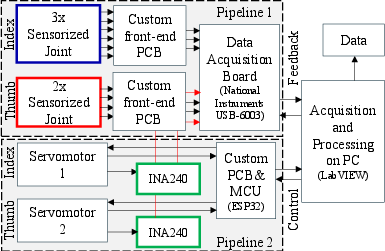
Figure 2: Block diagram of the electronics and data acquisition pipeline highlighting feedback paths for joint and motor channels.
Proprioception and Feedback Integration
Joint calibration yields robust linear voltage-to-angle mapping for strain gauges. Combined with real-time motor-current monitoring, the architecture realizes closed-loop proprioception: as the hand makes contact and increases grasp force, motor current is used to compensate strain gauge values, ensuring joint angle estimation reflects genuine deformation rather than actuator load-induced artifacts.
The integration of embedded joint sensors, in addition to motor feedback, offers a dual-channel proprioceptive framework, transmitting nuanced state data during grasping and manipulation events.
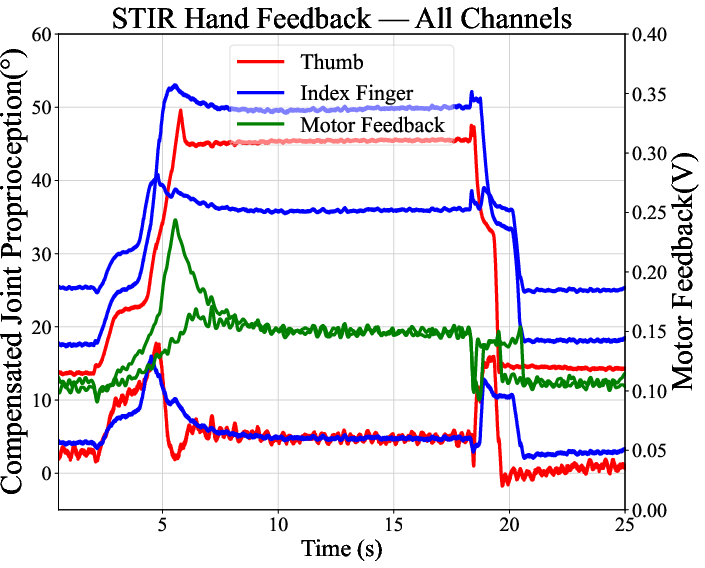
Figure 3: Example feedback signals from thumb and index finger joints and associated motors during typical grasp operations.
Experimental Framework
To empirically evaluate the STIR Hand, two curated object sets were used: cylinders (systematic variation in size and material) and irregular cubes/cuboids (variation in geometry and stiffness), enabling rigorous assessment of shape, size, and material discrimination.
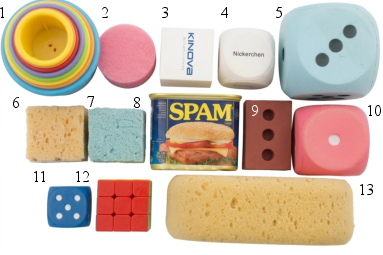
Figure 4: Object sets employed for recognition experiments—systematic cylinders (1,2) and complex, deformable cubes/cuboids (3-13).
Each grasping action is parameterized by motor load and PI gain configurations, spanning both aggressive and compliant modes. Data acquisition consisted of 7-channel time series (5 joint, 2 motor channels), processed into 105-dimensional feature embeddings comprising statistical and temporal characteristics.
Unsupervised Embedding Analysis
Principal Component Analysis (PCA) is leveraged for initial, unsupervised inspection of grasp event embeddings. Results demonstrate that load settings and type of grasp (transient vs. stable) exert primary influence on clustering, followed by object properties.
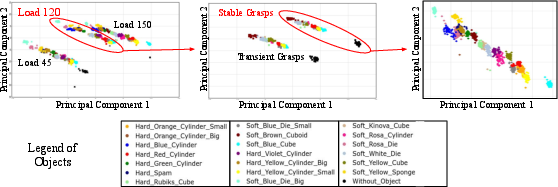
Figure 5: PCA visualization of embedding clusters—distinct separation by action parameters, transient vs. stable grasps, and detail by object identity.
For the cylinder set, PCA projections reveal diameter and material distinctions are cleanly encoded in the sensor signals, with further separation along stiffness dimensions when including all proprioceptive channels. Ablation studies confirm that motor feedback alone is insufficient for fine-grained material discrimination; embedded joint sensors are essential for robustness and granularity.
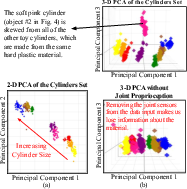
Figure 6: Dimensionality reduction highlights object size and material discrimination driven by bending sensor signals.
Classification and Ablation Results
Object classification was tested across four model types: k-NN, SVM, XGBoost, and MLP. Using the full sensor suite, XGBoost and MLP achieved accuracies exceeding 98% on the full 20-object set, a substantial improvement over baseline.
Ablation analyses illustrate that removing embedded joint signals results in a marked drop in classification performance, especially for material and stiffness discrimination. Conversely, joint sensors alone (excluding motor feedback) retain high classification accuracy, reaffirming the centrality of the embedded sensors to tactile perception.
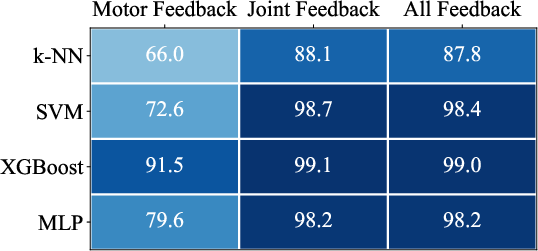
Figure 7: Ablation study results—classification accuracy decrease without joint sensors across all model types and data subsets.
Comparative Analysis with Other Grippers
Assessment against established grippers (qb SoftHand, Robotiq 2F-85, OnRobot RG6, Barrett Hand) using the same nine-object subset demonstrates that the STIR Hand outperforms the qb SoftHand (which lacks joint proprioception) across all classification paradigms, including LSTM models. While rigid grippers remain superior on raw accuracy, the STIR Hand establishes a new benchmark for compliant devices in proprioceptive-driven classification, validating the embedded sensor approach.
Implications and Future Directions
The STIR Hand validates that embedded strain gauges in soft joints achieve robust, linear proprioception within the mechanical limits of passive joint compliance, effectively supporting real-time tactile feedback for both state estimation and object discrimination. Practical implications include enhanced safety and adaptability for assistive robotics, prosthetics, and delicate industrial manipulation where external vision or tactile fingertip sensors may be undesirable or impractical.
Further miniaturization and integration efforts could enable smaller, more dexterous hands suitable for complex manipulation tasks. Additional embedding of fingertip tactile sensors may augment slip detection and friction measurement, allowing dynamic closed-loop control. Algorithmic progression from static object classification to real-time property estimation and interaction-aware force modulation is plausible, enabling advanced manipulation behaviors in unstructured environments.
Conclusion
The STIR Hand introduces a robust, low-complexity approach to compliant, sensorized grasping via embedded joint strain gauges, overcoming the limitations of conventional proprioception in soft robotic hands. Experimental results substantiate strong object discrimination capabilities, especially for material properties, with comparative analyses highlighting the advantages of joint sensor hardware. This platform demonstrates significant potential for real-time, adaptive manipulation and provides a foundation for continued progress in proprioceptive-enabled soft robotics.