- The paper employs DMRG with high bond dimensions to compute entanglement entropy and map six distinct quantum phases.
- It demonstrates that bipartite entanglement measures effectively distinguish gapped, gapless, and topologically ordered states.
- Finite-size scaling yields central charges (c≈1 and c≈0.5), confirming Tomonaga–Luttinger liquid and Ising universality in phase transitions.
Entanglement Diagnostics of Quantum Phases in a Frustrated Spin-1/2 Heisenberg Ladder
Model Specification and Computational Framework
The paper "Entanglement-entropy analysis of critical and topological quantum phases in a frustrated spin-1/2 Heisenberg ladder" (2606.21242) investigates a two-leg spin-1/2 Heisenberg ladder subjected to transverse magnetic field and bond-anisotropic exchange interactions parameterized by α. The α parameter allows continuous interpolation from the Ising-like regime (α=0), through the isotropic Heisenberg point (α=1), to the XY-dominated regime (α≫1). The system exhibits frustration due to the inclusion of diagonal inter-rung interactions of the XXZ type. Ground states are computed using DMRG within an MPS framework, leveraging high bond dimensions (χ up to 2000) to minimize truncation errors.
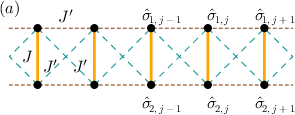
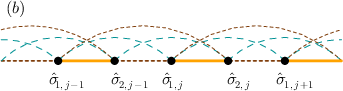
Figure 1: Schematic of the spin-1/2 two-leg ladder with Heisenberg vertical bonds and XXZ-like horizontal and diagonal inter-rung couplings governed by anisotropy parameter α.
The model Hamiltonian includes intra-rung Heisenberg interactions, bond-dependent anisotropic inter-rung couplings, and an external transverse field. Open boundary conditions are used, aiding the analysis of edge states and entanglement scaling.
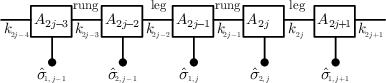
Figure 2: MPS graphical depiction showing alternating rung and leg bonds in the one-dimensional mapping of the ladder’s Hilbert space.
Phase Structure and Characterization
An extensive phase diagram is established by varying α and hx. Six distinct phases are identified: rung-singlet, ordered ferromagnetic, Haldane-like, Tomonaga–Luttinger liquid, canted Ising-ordered, and XY-polarized. Phase identification is achieved by combining magnetic observables, nearest-neighbor correlation functions, and entanglement entropy diagnostics. Notably, bipartite entanglement measures enable differentiation between gapped and gapless regimes and distinguish phases where local magnetization signatures are qualitatively similar.
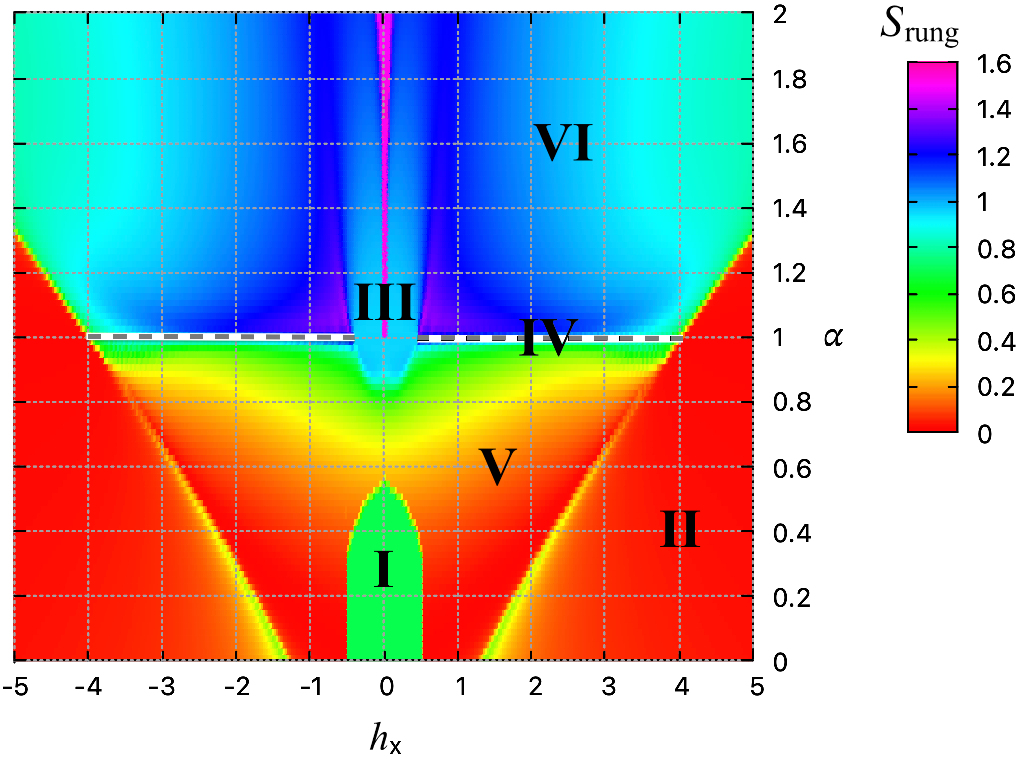
Figure 3: Phase diagram of Srung versus α0 and α1 highlighting the six ground-state phases.
Magnetic Response and Criticality
Magnetization plateaus and their evolution with α2 reveal strong sensitivity to exchange anisotropy. For α3, field-induced transitions match Tomonaga–Luttinger liquid behavior, with plateaus vanishing continuously and critical intervals evident for moderate fields. Deviations from α4 immediately suppress gapless behavior and induce discontinuous (first-order) transitions characteristic of Ising universality.
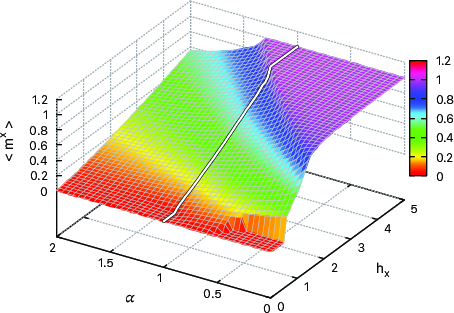
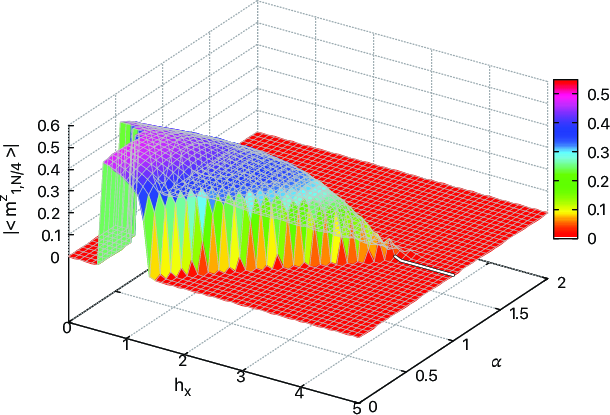
Figure 4: 3D plot of net magnetization per dimer α5 and onsite magnetization α6 as functions of α7 and α8.
The local α9-magnetization is finite for α=00 and vanishes at α=01 in the thermodynamic limit, confirming Ising-like order away from isotropy.
Quantum Entanglement Structure
Entanglement entropy serves as a highly sensitive probe of quantum phase boundaries. Rung entanglement entropy α=02 reveals plateaus corresponding to maximally entangled dimers (α=03), transitions to multipartite entangled critical phases (α=04), and vanishing entanglement in trivially ordered states.
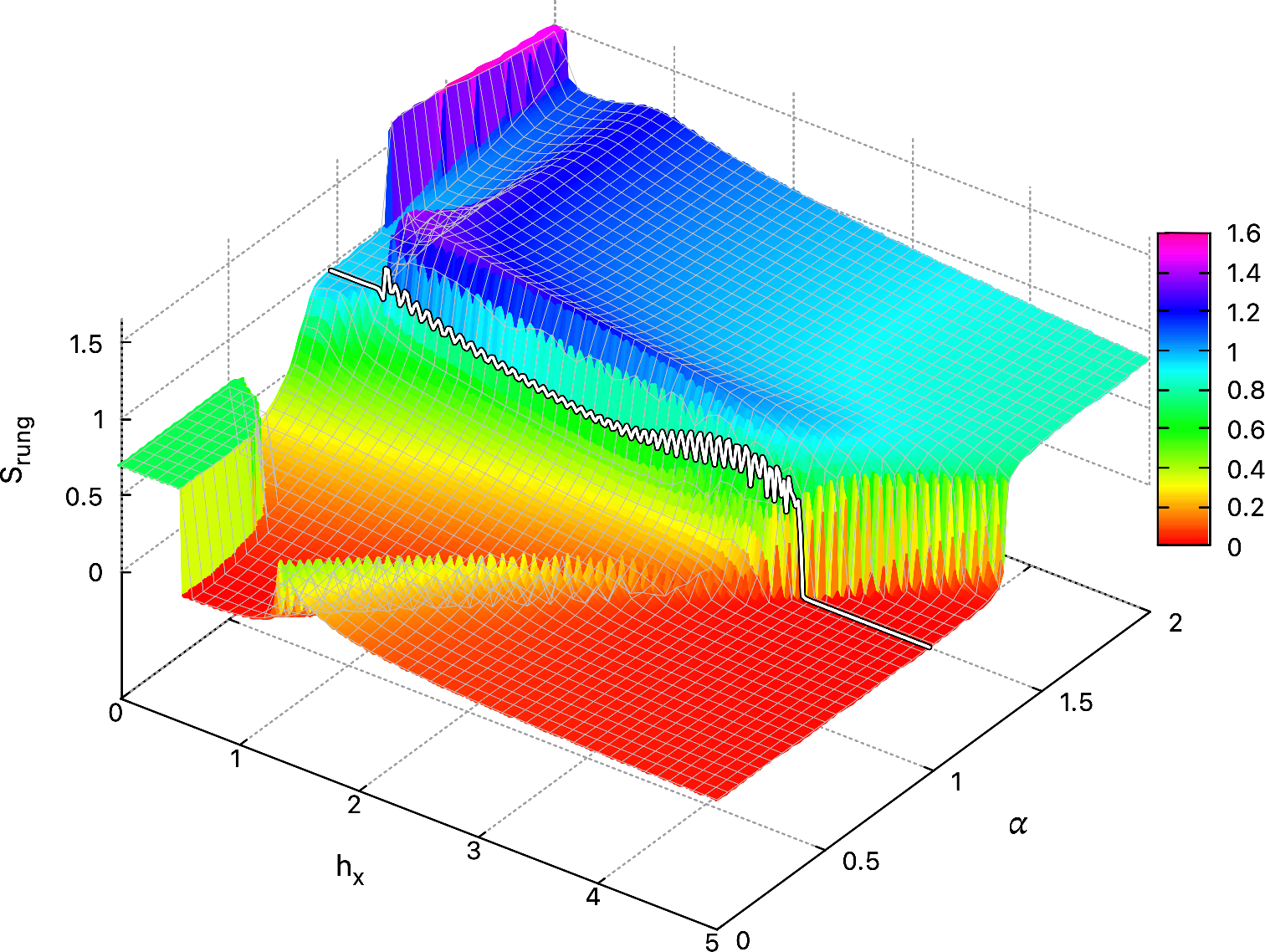
Figure 5: 3D plot of α=05 vs α=06 and α=07, showing the enhanced entropy near critical points and saturation in gapped phases.
Distinct regimes are observed: for α=08 and α=09, the ground state is a direct product of rung singlets. For α=10, α=11 exceeds α=12 and it displays a uniform bulk profile with boundary suppression, indicative of a gapped Haldane-like regime and effective spin-1 chain physics.
Correlation Functions and Universality
Nearest-neighbor spin-spin correlations differentiate phases with short-range order from critical regimes. The rung correlation α=13 only attains two sharply separated values (α=14, α=15), marking singlet and triplet configurations, and leg correlation α=16 varies continuously around critical boundaries.
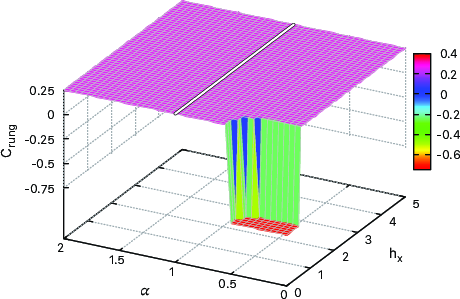
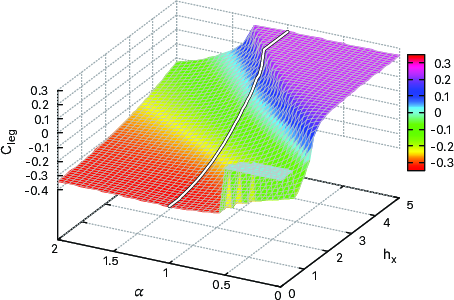
Figure 6: 3D plots of α=17 and α=18 as functions of α=19 and α≫10, marking clear phase switches.
Finite-Size Scaling and Central Charge Extraction
Finite-size scaling of entanglement entropy is employed to extract the central charge α≫11 at critical points. Within the Tomonaga–Luttinger liquid regime (α≫12), scaling yields α≫13, confirming gapless Gaussian criticality. At the canted Ising–ferromagnetic transition (α≫14, α≫15 at criticality), α≫16, in accordance with Ising universality.
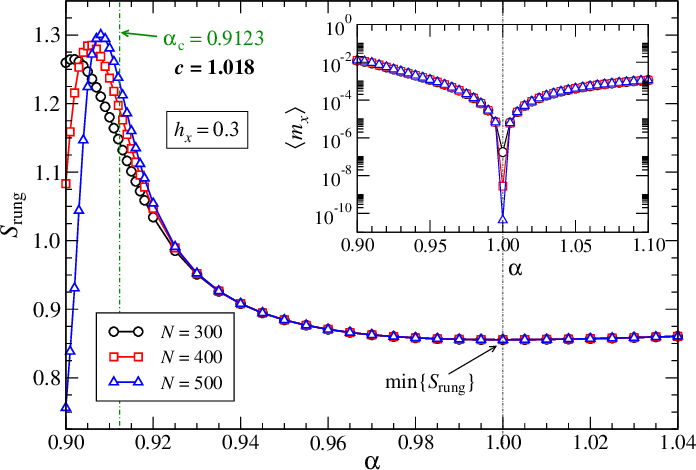
Figure 7: Finite-size scaling of α≫17 vs α≫18 for α≫19, showing the critical point and extracted central charge χ0.
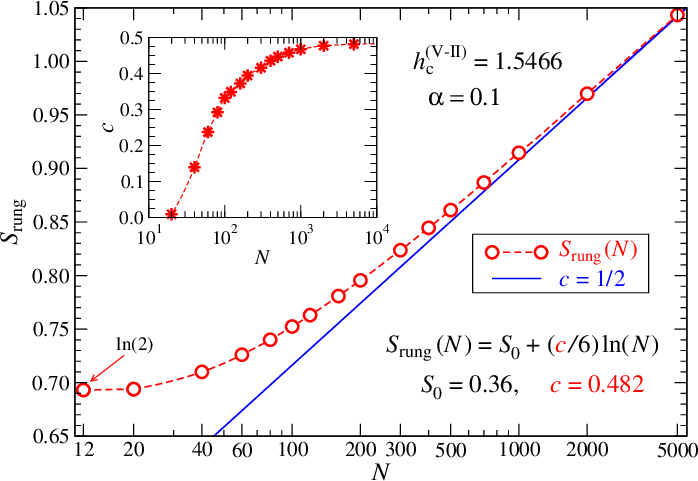
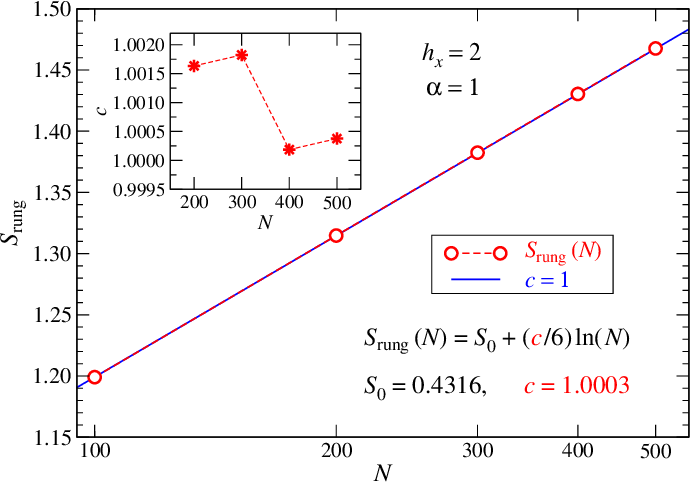
Figure 8: Central-charge analysis from χ1 scaling with system size, validating χ2 at the Luttinger liquid phase and χ3 at the canted Ising–ferromagnetic transition.
Edge States and Bulk-Edge Correspondence
Magnetization profiles and entanglement entropy reveal edge excitations in finite ladders for the Haldane-like regime. The bulk exhibits high, nearly uniform entropy, while boundary suppression confirms area-law behavior and edge-state localization.
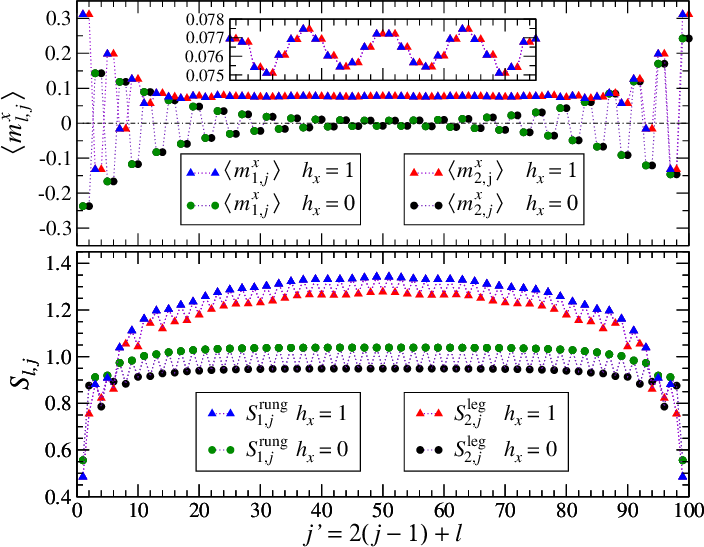
Figure 9: Position dependence of onsite magnetization and entanglement entropy, revealing edge-localized states in the Haldane-like and Luttinger liquid regimes.
Gapless and Gapped Regimes under Exchange Anisotropy
Within the narrow window near χ4, the Tomonaga–Luttinger liquid and Haldane-like phases are stabilized, but both are highly fragile to exchange anisotropy. Even small departures from isotropy (χ5) cause rapid suppression of criticality in favor of gapped or field-polarized states. The critical region shrinks with increasing system size, with phase boundaries converging sharply.
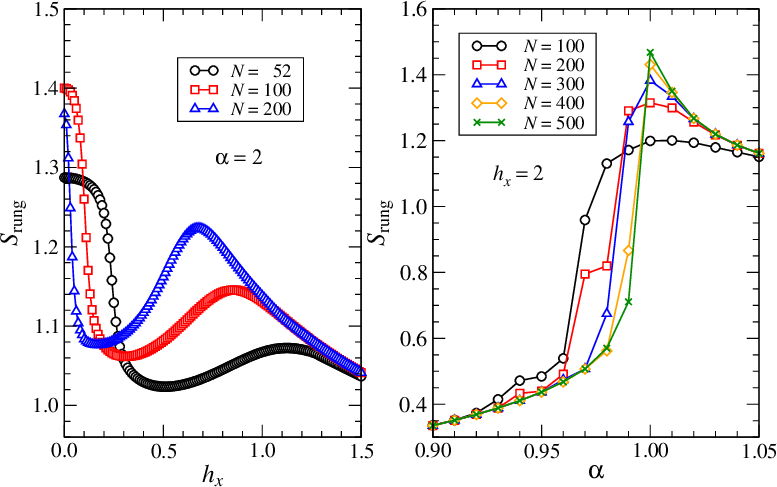
Figure 10: Size dependence of χ6 at χ7 and near χ8, showing entropy suppression away from the critical regime.
Implications and Future Directions
The study establishes bipartite entanglement and its finite-size scaling as an essential diagnostic tool for low-dimensional frustrated quantum magnets. Entanglement entropy enables phase-resolved identification even in cases where magnetization and local correlations fail to differentiate competing phases. The extracted central charge directly links phase transitions to underlying universality classes. The pronounced sensitivity of critical and topological behaviors to exchange anisotropy highlights the need for precision in experimental realizations and motivates further studies into engineered frustration and field-induced transitions.
Future research may focus on:
- Extending the analysis to multi-leg ladders, exploring richer even–odd dichotomies.
- Investigating robustness of topological edge modes under disorder or longer-range interactions.
- Incorporating time-dependent and thermal effects to probe phase dynamics and entropy scaling beyond the ground state.
- Exploiting entanglement diagnostics for quantum simulation benchmarking of strongly correlated systems.
- Exploring quench protocols and entanglement growth to probe real-time phase transitions in low-dimensional quantum magnets.
Conclusion
This paper elucidates the rich phase structure of a frustrated spin-1/2 Heisenberg ladder with bond-dependent anisotropy, demonstrating the utility of entanglement entropy and central charge as universal diagnostics for critical and topological quantum phases. The approach provides a unified characterization of gapped, gapless, and symmetry-protected regimes, resolving competing quantum states with high sensitivity. The finding that quantum criticality is tightly bound to the isotropic limit, and the remarkable fragility of critical states to anisotropy, have significant implications for theoretical modeling and experimental realization of quantum magnets. Entanglement-based analysis is established as an indispensable methodology for future studies of frustrated quantum systems.