- The paper presents an iterative algorithm that constructs arc-length parameterized splines, ensuring accurate interpolation of all original data points.
- It utilizes numerical integration and iterative corrections to rapidly converge to a true arc-length parameterization across multi-dimensional data.
- Empirical results confirm robustness on non-uniform, noisy datasets, making it valuable for applications like handwriting recognition and precise path planning.
Arc-Length Parameterized Interpolating Splines: An Iterative Framework
Overview
The paper "Arc-Length Parameterized Interpolating Splines" (2606.21209) introduces an iterative algorithm for constructing arc-length parameterized interpolating splines through a fixed sequence of points in RD. Unlike previous approaches, this method prioritizes interpolation accuracy—ensuring the curve passes through the original data points—while achieving an arc-length parameterization. This enables more intrinsic geometric analysis and has downstream benefits for applications such as handwriting recognition and path planning.
Background and Motivation
Spline interpolation is fundamental in geometric modeling, CAD, and data-driven curve analysis, particularly where smooth transitions and accurate feature preservation are required. Conventional splines are typically parameterized by arbitrary monotonic variables, which can distort subsequent geometric or analytic computations due to non-uniform progression along the curve. Arc-length parameterization addresses these issues by ensuring that the progression along the curve reflects true distance, thereby simplifying the evaluation of geometric invariants like curvature, and aligning computations with the intrinsic geometry of the curve.
Existing methods can be grouped into four primary categories:
- Resampling and refitting: Generates splines through points sampled at equidistant arc-lengths on an initial curve, but these splines do not generally interpolate the original data.
- Inverse-mapping composition: Uses numerical inversion to express the parameter variable as a function of arc-length, followed by spline composition, resulting in geometric fidelity but with potential degree proliferation and high preprocessing cost.
- Closed-form approximation: Employs analytic approximations to the arc-length map, improving efficiency but at the cost of precision.
- Iterative schemes: Iteratively adjust parameter values or spline control points to better approximate arc-length parameterization; these typically require explicit curve representations and cannot enforce strict interpolation at sample points.
The presented method fills a gap by delivering a practical, fast, and data-respecting algorithm for the arc-length parameterized interpolation problem in arbitrary dimensions.
Iterative Algorithm
The method starts with cumulative chord length between sequential points as the initial parameter assignment. At each iteration, a spline (cubic by default, but generalizable to higher degrees) is fit through the points, assigned to the current parameter values. The arc-lengths along each spline segment are then recomputed using accurate numerical integration, and the resulting cumulative values replace the previous parameterization. This process is repeated until the parameter values converge, as measured by the maximum relative change in arc-length assignments dropping below a user-specified tolerance.
Key technical features include:
- Generic applicability to data in RD.
- Ability to preserve the original points exactly, circumventing the need for smoothing or control point adjustment.
- Straightforward extension to arbitrary spline degrees and dimensions, with most experiments focusing on cubic splines for computational efficiency and C2 continuity.
The algorithm is robust to non-uniform sample point distributions, a typical scenario for measured data such as handwriting input. The paper observes that denser sampling naturally occurs near high-curvature or corner-like regions, reflecting slower input device movement in those regions. By construction, the method always yields a C1 or C2-continuous spline, smoothing over any sharp corners.
Near geometric corners, the method produces smooth approximations rather than true discontinuities; arc length is calculated on the smoothed curve, not an idealized polygon with exact corners.
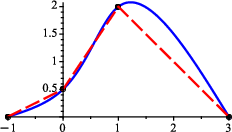
Figure 1: Spline behaviour near a geometric corner; the method produces a smooth interpolation, not a sharp vertex.
Numerical Evaluation
The algorithm is empirically validated across various parametric curves (ellipse, rose, heart, infinity, hypotrochoid, lissajous, astroid) and for different sample sizes and convergence tolerances. Experimental evidence demonstrates that typically only two to three iterations are needed to reach a maximal relative change below 10−3 for most shapes of reasonable complexity—an operationally efficient result.
Notably:
- For smooth and symmetric shapes (e.g., ellipses), rapid convergence is observed regardless of sample count.
- For high-curvature or clustered regions, convergence requires more iterations, but typically fewer than ten even for tight error tolerances.
- The chord-length initialization systematically underestimates the true arc length, but the iterative correction eliminates this bias with minimal computation.
Application to Real Data
The method was applied to a digitized handwriting trace of the word “ICMS.” The algorithm accurately reproduces the hand-drawn path, including regions with multiple curvature extrema and clustered data points. This demonstrates its robustness to real-world, noise-afflicted, and multiply featured input.
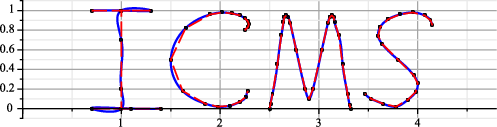
Figure 2: Spline representation (blue) of a handwritten term ‘ICMS’, demonstrating the method’s ability to resolve complex, non-uniform input data.
Practical and Theoretical Implications
Practically, the method enables more faithful modeling and downstream analysis in applications where the geometry of interpolated curves must reflect underlying measured data, not artifacts of ad hoc parameterizations. This is essential for domains such as:
- Handwriting recognition: Intrinsic representations improve classification accuracy and robustness, especially for mathematical notations sensitive to fine geometric detail.
- Path planning: Ensures uniform traversal speeds and accurate length-based computations.
- Computer-aided design: Simplifies subsequent computations and transformations of geometric entities.
Theoretically, the algorithm highlights the role of arc-length as a canonical geometric parameter and establishes an efficient, data-respecting route to its practical computation. Open questions remain regarding convergence and uniqueness of arc-length parameterized interpolants for arbitrary data sets and spline degrees.
Future Directions
While the current framework is evaluated in Maple, cross-platform implementations (TypeScript, C++, etc.) would enable broad deployment, including in-browser real-time applications. Direct comparisons with existing piecewise linear and smoothing-based preprocessing pipelines, particularly in complex environments and under noise, remain as promising avenues for further investigation. Analytical results on the existence and uniqueness of arc-length parameterized interpolating splines would also deepen theoretical understanding.
Conclusion
This work presents a systematic, efficient algorithm for constructing arc-length parameterized interpolating splines in any finite dimension, preserving all sampled data points as interpolation constraints. The method achieves rapid empirical convergence and can flexibly accommodate non-uniform, noisy, or high-curvature data. Its adoption carries immediate practical benefits and opens new lines of research at the intersection of computational geometry, data-driven modeling, and geometric data analysis.