- The paper introduces Asymptotic Cubic Galileon (ACG) models that enable phantom crossing in dark energy by modifying kinetic and braiding terms.
- The paper employs a custom sampler with combined CMB, BAO, SNe, and ISW data to constrain model parameters and assess consistency with observations.
- The paper discusses impacts on structure growth and potential void pathologies, while comparing ACG performance against ΛCDM and dynamical dark energy models.
Constraints on Horndeski Gravity with Phantom Crossing
Introduction and Motivation
This paper provides a comprehensive analysis of Horndeski scalar-tensor gravity models exhibiting dynamical dark energy (DE) with phantom crossing, in response to recent cosmological datasets which indicate an evolving DE equation-of-state (EoS) that transitions across the w=−1 threshold ("phantom divide"). The authors introduce a class of minimally coupled Horndeski models, termed Asymptotic Cubic Galileon (ACG), designed to capture early-time phantom behavior with subsequent phantom crossing at redshift z≈0.5, as preferred by observations. Crucially, these models are constructed within a Lagrangian framework, enabling predictions for both background and perturbative observables.
Model Construction: Modification of Horndeski Theory
Horndeski gravity is the most general 4D scalar-tensor theory with second-order field equations. For this analysis, only the luminal subset (consistent with GW170817 [GW_170817]) is retained, i.e., gravitational wave speed matches the speed of light. The paper restricts attention to minimally coupled models (G4(ϕ)=1/2), avoiding non-minimal couplings that are disfavored by ISW/large-scale structure (LSS) constraints.
The baseline Cubic Galileon (CG) model is shift-symmetric, and therefore cannot account for phantom crossing, as its EoS remains strictly below −1. The authors break shift symmetry via multiplicative ϕ-dependencies in the kinetic or braiding terms:
- Growing G(ϕ) Model: G3(ϕ,X)=g31(1+cg3ϕ)X (kinetic braiding grows with ϕ)
- Decaying K(ϕ) Model: K(ϕ,X)=k1exp(−ckϕ)X (kinetic term decays with z≈0.50)
Both variants are parameterized to recover standard CG at early times (z≈0.51) and allow for phantom crossing at late times.
Observational Constraints and Parameter Inference
The analysis employs a custom sampler combining compressed Planck CMB likelihoods, DESI DR2 BAO, DES-Dovekie SNe, and an ISW prior requiring positive cross-correlation. Model parameters and posteriors are constrained using nested (DYNESTY) and affine-invariant (emcee) sampling. The critical additional parameters in ACG are z≈0.52 (relative scalar field fraction at high redshift), z≈0.53, and z≈0.54.
The posterior constraints for both the growing and decaying models are depicted below.
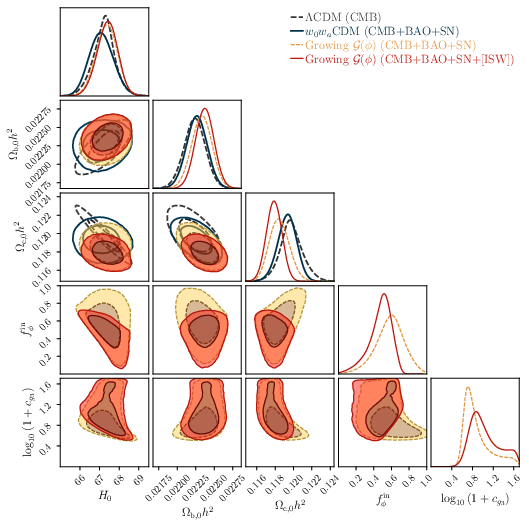
Figure 1: Posterior constraints on the Growing z≈0.55 model, with ISW prior imposing moderate z≈0.56 and broad, elevated z≈0.57.
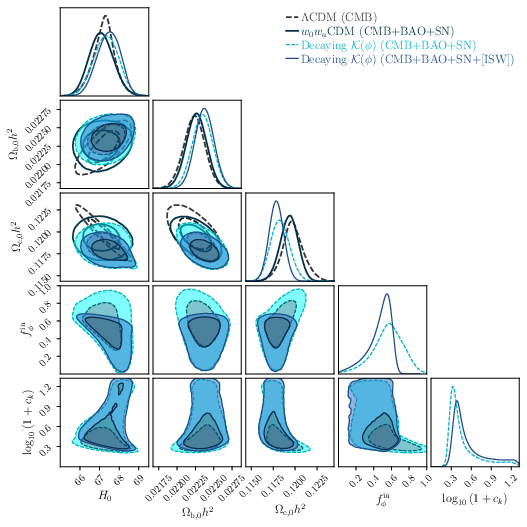
Figure 2: Posterior constraints on the Decaying z≈0.58 model, showing similar behavior to the Growing z≈0.59 due to parameter degeneracy.
Phantom Crossing and ISW Constraints
The crucial phenomenological feature is the phantom crossing behavior of the DE EoS, achieved by tuning G4(ϕ)=1/20 or G4(ϕ)=1/21. This crossing is observed in reconstructed EoS profiles:
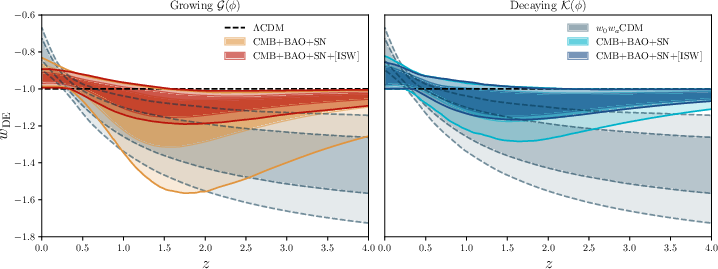
Figure 3: EoS for DE from joint CMB, BAO, and SNe constraints: ACG models exhibit phantom crossing at G4(ϕ)=1/22–G4(ϕ)=1/23, earlier than the G4(ϕ)=1/24CDM model’s G4(ϕ)=1/25.
Imposition of the ISW prior constrains the allowed shape of the EoS, selecting solutions with more gradual phantom crossing and limiting deep phantom excursions. The ISW integral thus acts as a stringent filter on G4(ϕ)=1/26-dependent modifications:
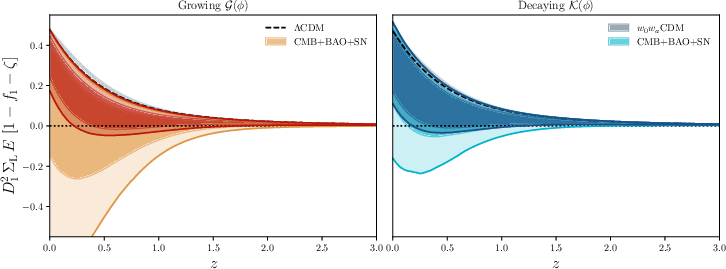
Figure 4: Constraints on the ISW strength integral; both ACG models yield weaker ISW than G4(ϕ)=1/27CDM or G4(ϕ)=1/28CDM, consistent with positive ISW cross-correlation.
Fits to Cosmological Observables
Comparison with BAO and SNe measurements indicates that both ACG models and dynamical DE outperform G4(ϕ)=1/29CDM in fitting low-redshift expansion observables, particularly the observed suppression in −10 and low-−11 SNe distance modulus:
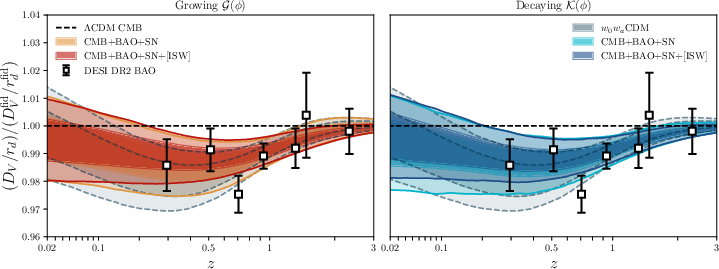
Figure 5: Volume average BAO measurements: ACG and dynamical DE models accommodate the observed BAO dip better than −12CDM.
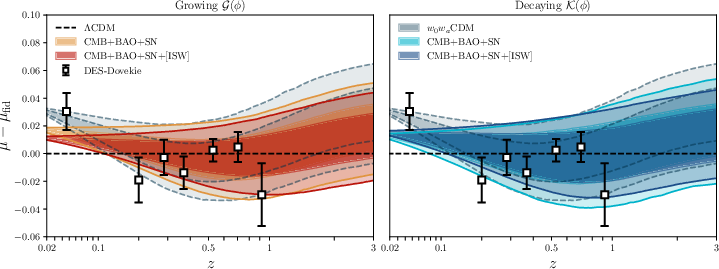
Figure 6: SNe distance modulus constraints; ACG models favor smaller values at low −13, but not as strongly as dynamical DE.
Perturbative and Nonlinear Structure Growth
The modification of the Poisson equation and lensing potential is captured by −14 and −15, which are equal in the analyzed ACG models:
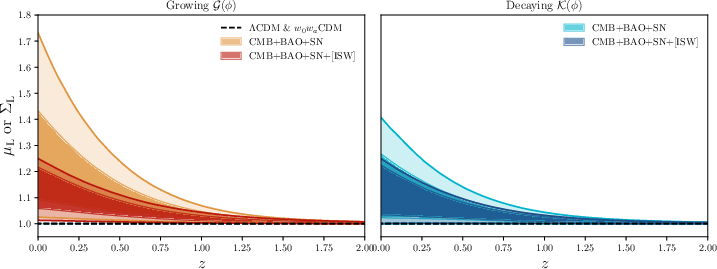
Figure 7: Linear modification to the Poisson and lensing potentials; positive ISW prior ensures profiles are shallow, thus compatible with structure formation and ISW constraints.
Matter fluctuation growth predictions (−16) are broadly consistent with −17CDM and dynamical DE at −18, although ACG models exhibit a mild preference for increased growth at late times:
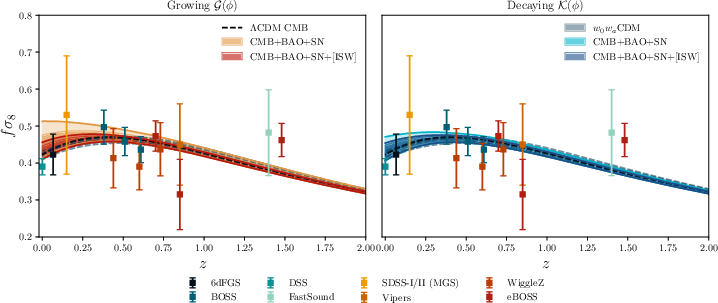
Figure 8: Growth of structure (−19) for various models: ACG variants are consistent at low redshift but favor moderate enhancement.
Theoretical Pathologies and Voids
Analysis of the Vainshtein screening factor reveals that both ACG models violate the requirement ϕ0 at low redshift in voids, indicating potential theory pathologies if pure Vainshtein screening is assumed. Pathology avoidance is possible with more gradual functional forms, illustrated by rational decay modifications:
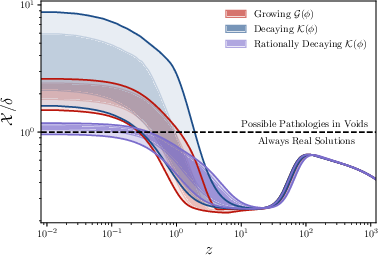
Figure 9: Vainshtein screening factor for ACG models; both exhibit possible pathologies in voids at ϕ1, remediable with modified ϕ2.
Negative Neutrino Mass and Model Comparison
The ACG framework does not resolve the negative effective neutrino mass preference in current cosmological fits, as early DE phantom behavior is suppressed (ϕ3), unlike dynamical DE models which shift the posterior to ϕ4:
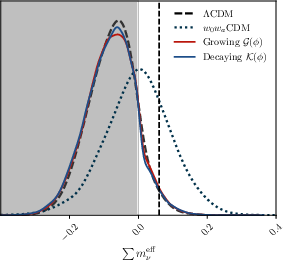
Figure 10: Marginalised posteriors for effective neutrino mass: ACG matches ϕ5CDM's preference for negative mass, dynamical DE peaks near zero.
Bayesian evidence and ϕ6 metrics consistently favor both dynamical DE and ACG models over ϕ7CDM, but ACG achieves slightly superior evidence ratios due to greater theoretical restrictiveness and reduced parameter volume penalization.
Braiding Strength and EFT Comparison
The predictions for the Horndeski braiding parameter ϕ8 in ACG models are consistently lower than best-fit EFT values from DESI full shape + BAO + SN + CMB measurements, especially with the ISW prior imposed:
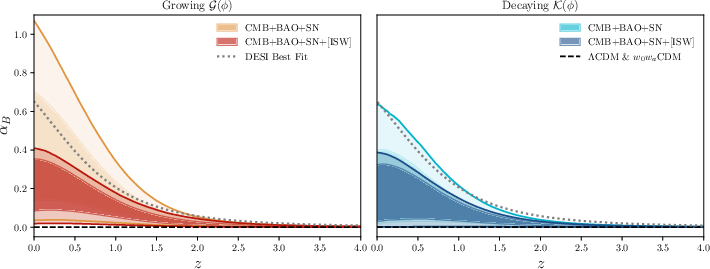
Figure 11: Constraints on the ACG ϕ9 parameter: ACG models yield shallower and less flexible profiles, especially under ISW prior.
Conclusion
The ACG class of minimally coupled Horndeski gravity models provides a robust theoretical framework for dynamical DE with phantom crossing, aligning with current cosmological observational preferences for evolution beyond a cosmological constant. These models ground phenomenological G(ϕ)0CDM fits in scalar-tensor Lagrangian physics, enabling predictive analysis for both background and perturbative observables, including ISW, BAO, SNe, and structure growth. Model comparison metrics indicate moderate preference over G(ϕ)1CDM, especially when ISW constraints are imposed. The imposed ISW prior significantly restricts allowed solution space, favoring gradual phantom crossing and limiting pathologies in voids.
While ACG models do not resolve the negative neutrino mass tension, they remain cosmologically viable and highly predictive, offering a structured avenue for future analyses of nonlinear structure formation and CMB perturbations via full Boltzmann solvers. Their compatibility with forthcoming Stage IV cosmological survey data and potential resolution of theoretical pathologies will be pivotal for the continued exploration of the landscape of modified gravity models with dynamical dark energy (2606.20794).

