- The paper establishes a rigorous extension of the average gate fidelity formula to accommodate time-dependent dissipation, enabling accurate error budgeting in dynamically modulated quantum operations.
- It employs perturbative methods, including a Schrieffer–Wolff transformation, to derive explicit expressions for fidelity reduction and leakage in adiabatic CZ gate implementations.
- Numerical validations confirm the analytical model’s accuracy in realistic superconducting circuits, guiding optimal gate design and noise suppression strategies.
Fidelity Bounds for Adiabatic Gates under Time-Dependent Dissipation
The paper establishes a rigorous extension of the analytical average gate fidelity formula for quantum operations to the regime of time-dependent dissipation, addressing a gap left by previous formulas limited to static Markovian noise (2606.20501). The authors derive first-order expressions for the fidelity reduction, Fˉ, under a general Lindblad master equation with time-dependent rates, applicable to scenarios where dissipative decoherence channels and system parameters are dynamically modulated during gate operations. This enables evaluation of error budgets for architectures leveraging tunable elements for implementing adiabatic two-qubit gates, such as baseband flux gates in superconducting circuits.
A central advancement is the formulation of fidelity reduction for adiabatic quantum operations, where the system Hamiltonian evolves slowly in time. The time-evolution operator is decomposed into a product of operators responsible for phase accumulation and eigenbasis transformation. The fidelity-reduction integrand is shown to be independent of the phase operator when gate initial states coincide with the instantaneous eigenstates, streamlining the tracing of dissipative contributions in the dressed eigenbasis.
Analytical but perturbative evaluation of the frame transformation is performed, using a Schrieffer–Wolff-type transformation to expand dressed operators in terms of bare states and system parameters (coupling strengths g, detunings Δ, anharmonicities α). This enables explicit expressions for fidelity reduction and leakage to be derived, clarifying quantitative relationships between decoherence rates, control parameters, and gate duration.
Concrete Example: Adiabatic CZ Gate via Tunable Coupler
The framework is applied to a representative superconducting circuit architecture: two fixed-frequency qubits coupled by a tunable coupler, with the latter’s frequency swept by external flux to induce an adiabatic controlled-Z gate. The gate protocol induces strong time-dependence in mode hybridization and dissipation rates—particularly pure dephasing rates sensitive to flux derivatives—necessitating the full time-dependent treatment developed in this work.
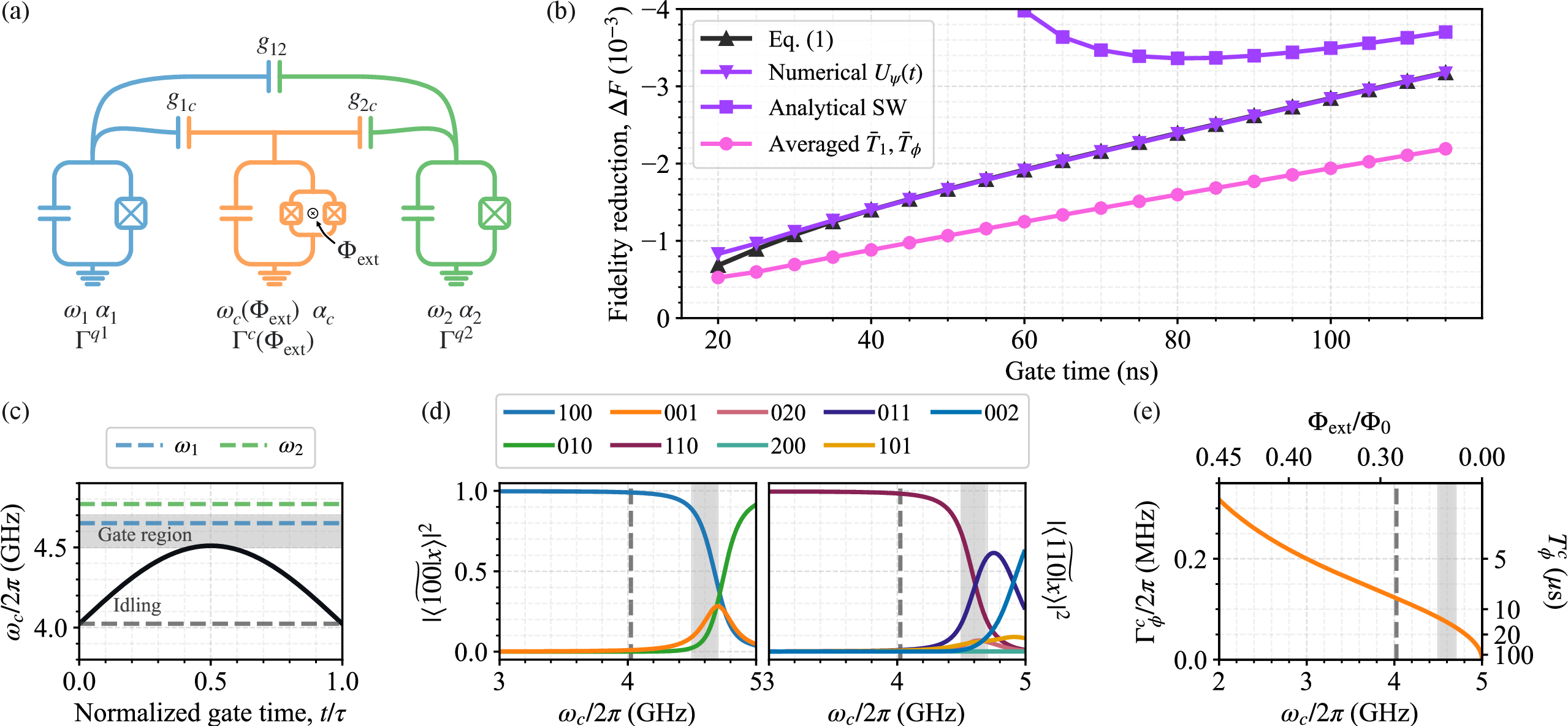
Figure 1: Fidelity reduction ΔF=Fˉ−1 for an adiabatic CZ gate, illustrated in a two-qubit-coupler system with time-dependent coupler frequency and flux noise sensitivity.
The authors derive explicit expressions for the fidelity-reduction rate due to relaxation and dephasing, showing that the rate scales with hybridization weights (∼gic2/Δic2) and coupler noise sensitivity, while the total error is governed by the product of this rate and the gate duration. Notably, they demonstrate the trade-off between increasing coupling strength—which accelerates gate execution and reduces overall error—and the resulting increase in instantaneous fidelity-reduction rates, supporting practical gate optimization strategies.
Numerical validation is provided by direct evaluation of the average gate fidelity with time-dependent dressed jump operators, benchmarking against full master-equation integration and heuristic time-averaged error formulas. Strong agreement is observed except in nonadiabatic regimes (very fast gates or near avoided crossings) where the perturbative SW expansion breaks down, confirming the practical utility of the framework for realistic gate design.
Quantitative Results and Leakage Analysis
Explicit formulas for state-specific and total leakage rates are presented, showing that population loss outside the computational subspace arises solely due to pure dephasing and is quantitatively captured by traces over dressed jump operators. Analytical expressions are derived using the first-order Dyson expansion and frame transformation, allowing transition rates to specific leakage states to be computed in closed form.
Additionally, the paper provides fourth-order analytical expressions for fidelity reduction including weak anharmonicity effects, offering high accuracy in regimes relevant for superconducting qubits and tunable couplers.
Implications and Outlook
This work supplies essential theoretical tools for evaluating performance limits and error budgets in tunable quantum processors, supporting the practical optimization of gate parameters (coupling strengths, detuning trajectories, flux pulse shaping) and hardware design (noise suppression at flux sweet spots, hybridization management). The analytic framework is directly applicable to dynamically modulated gates in superconducting qubits, trapped ions, neutral atoms, and other platforms where dissipation is time-dependent.
The results clarify the interplay between mode hybridization and time-dependent noise channels, highlighting that fast, strongly coupled gates are favorable when coherent errors are subdominant, and that optimization must also account for increased sensitivity to environmental noise. The analytical approach greatly reduces computational overhead compared to full master-equation simulation, facilitating rapid evaluation of gate performance across parameter spaces.
Extending this framework to non-Markovian noise sources, higher-order correlated dissipation, and other dynamical control protocols remains a promising direction. The methodology may also inform error analysis in quantum sensing and communication protocols where dynamic dissipation is pertinent.
Conclusion
The paper "Fidelity bounds for adiabatic gates and other quantum operations with time-dependent dissipation" (2606.20501) provides a rigorous mathematical and practical toolkit for quantifying decoherence-induced gate errors in quantum operations with dynamically varying dissipation rates. Its application to adiabatic gates elucidates key trade-offs between gate speed, hybridization, and noise sensitivity, with explicit formulas and numerical benchmarks validating previous heuristic models and extending their predictive power. The results are of immediate relevance for optimization and error-budgeting in advanced quantum processor architectures, and pave the way for further developments addressing more complex noise environments and correlated dissipation.

