- The paper demonstrates that core composition (rock, water, soot ratios) directly controls observable atmospheric properties in sub-Neptunes, including C/O, MMW, and heavy element fractions.
- It employs a global chemical equilibrium framework combined with radiative-convective and photochemical modeling to simulate atmospheric structure and evolution.
- Findings indicate that only water-rich, soot-bearing interiors produce methane-rich, high-MMW atmospheres, offering empirical diagnostics to distinguish formation scenarios.
Introduction
The "Atmospheric diversity of sub-Neptunes from formation with rock, water, and soot" (2606.20464) addresses the fundamental question of how the nature and proportions of planetary building blocks—specifically, rock, water, and refractory carbon ("soot")—affect the observable atmospheric compositions of sub-Neptunes. Motivated by recent JWST detections of methane and carbon dioxide in a subset of these exoplanets, the authors systematically quantify the links between formation environment, interior thermochemistry, and atmospheric signatures. This work extends prior studies by explicitly modeling global chemical equilibrium between interior and atmosphere, particularly incorporating volatile and refractory carbon partitioning across phases and tracking the subsequent propagation of deep atmospheric signatures to the observable layers. The study provides a robust physical framework to discriminate among distinct origin scenarios, leveraging a suite of high-precision atmospheric model predictions that are directly comparable to JWST spectra.
The authors consider four canonical bulk core compositions corresponding to distinct formation environments relative to condensation fronts (soot line and water ice line) in the protoplanetary disk:
- (1) Pure rock core (inside the soot line)
- (2) Soot-rock core (intermediate, 24% soot by mass)
- (3) Soot-water-rock core (beyond the soot line, with substantial soot and water)
- (4) Water-rock core (beyond the water ice line, soot-free)
This compositional taxonomy systematizes the possible diversity of sub-Neptune interiors as a function of formation location, yielding end-members for global chemical equilibrium calculations.
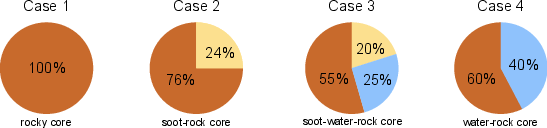
Figure 1: Schematic of considered bulk core compositions, highlighting the diversity of planet-building materials accreted as condensed solids.
Methods: Interior-Atmosphere Equilibration and Atmospheric Modeling
A global chemical equilibrium (GCE) framework is employed, allowing hydrogen, oxygen, and carbon partitioning across metallic, silicate, and gas phases at high pressure and temperature. This model rigorously enforces mass and elemental conservation using a reaction network that incorporates new parameterizations for H, C, and O solubility and partitioning informed by recent experimental and ab initio constraints. Primordial H/He atmospheres of varying mass fraction (1–9%) are included, with their degree of dissolution into the interior controlled by a pressure-dependent solubility law.
For the atmospheric structure, the chemical equilibrium abundances at the atmosphere–magma ocean interface (AMOI) are used as lower boundary conditions in coupled 1D radiative-convective, photochemical, and kinetic modeling. The suite—FastChem, HELIOS, VULCAN, and HELIOS-K—iteratively solves the vertical P-T and compositional structure up to observable altitudes, for different eddy diffusion coefficients (vertical mixing).
Results: Atmospheric Properties Emerging from Bulk Composition
The primary numerical result is that the atmospheric C/O ratio, mean molecular weight (MMW), total atmospheric mass fraction, and heavy element mass fraction (Z) are highly sensitive to core composition for a given primordial envelope fraction, but only weakly sensitive to the latter within the studied range.
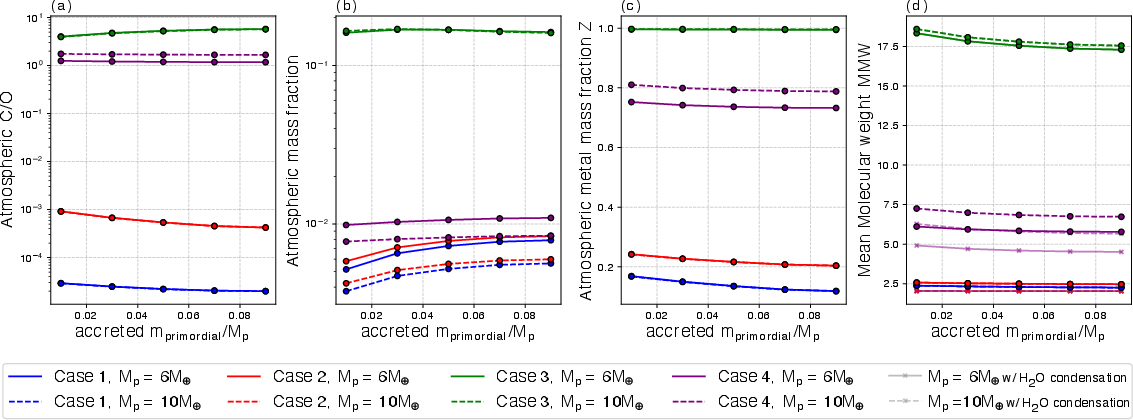
Figure 2: Atmospheric C/O ratio, mass fraction, metallicity, and mean molecular weight as a function of formation scenario and primordial gas accretion.
Key trends include:
- Volatile-poor interiors (cases 1 and 2) yield atmospheres with very low C/O (<10−2), MMW near H2-dominated regimes (2–4 g/mol), and heavily depleted abundances of both CH4 and CO2 (log abundances <−5).
- Water-rich scenarios (cases 3 and 4) result in super-solar atmospheric C/O, large MMW (> 7 up to >17 for case 3), and atmospheric metal mass fractions approaching unity. Soot inclusion (case 3) dramatically enhances atmospheric CH4, yielding methane-rich atmospheres with high MMW; case 4 (water, rock only) achieves a combination of H2, H2O, CH20, and CO.
Crucially, the atmospheric mass fraction in the methane-rich soot-water-rock case is about an order of magnitude larger than in the other end-members, enabling a discriminant based on atmospheric mass and MMW if 21 is well constrained.
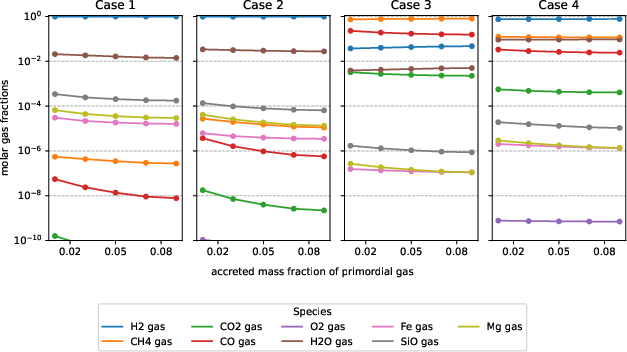
Figure 3: Molar mixing ratios of dominant atmospheric species at the AMOI for the four bulk compositions, showing transitions from H22-dominated to methane-dominated states with increasing volatile content.
Vertical Structure and Observability
The study traces how the deep, equilibrium chemical composition propagates into the upper observable atmosphere, explicitly accounting for mixing and photochemistry. The signature of formation remains diagnostically robust against atmospheric mass loss and vertical transport except in extreme regimes.
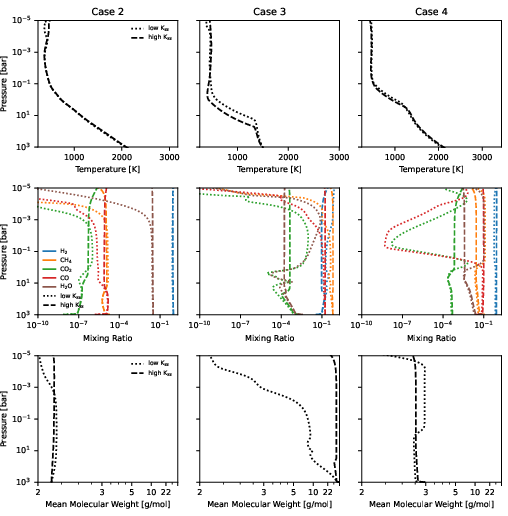
Figure 4: Pressure-temperature, mixing ratio, and vertical MMW profiles for representative soot-bearing and water-rich formation cases under different mixing strengths, illustrating the chemical imprint across atmospheric depths.
- Strong vertical mixing maintains deep chemical signatures aloft.
- In methane-dominated (soot-water-rock) regimes, upper atmospheric MMW remains elevated, while weaker mixing allows photochemical depletion of heavy species in the observable layers, potentially mimicking water-rock chemistry at low vertical mixing.
Application to JWST-Characterized Sub-Neptunes
Comparisons to the ensemble of JWST-characterized sub-Neptunes reveal:
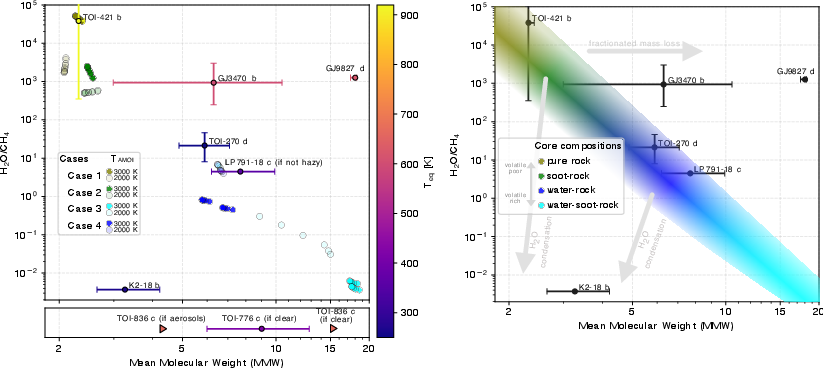
Notably, the H40O/CH41 ratio and MMW together provide a strong two-dimensional diagnostic for distinguishing formation environments, modulated by water condensation (in temperate climates) and mass loss/fractionation effects.
Model Sensitivities and Limitations
The model is anchored at end-member assumptions: full global chemical equilibrium between interior and gas, and fixed (high) magma–atmosphere interface temperatures. Real planets may be intermediate between this scenario and fully chemically decoupled interiors, depending on convection, mean molecular weight gradients, and thermal stratification. The discriminating power of diagnostics based on MMW and CH42 can be diminished at 43 K or in mixing-limited atmospheres. Improved structural constraints on 44 and evolutionary modeling including layered convection and time-dependent exchange will further sharpen interpretation.
Theoretical and Observational Implications
The results underpin several important theoretical implications:
- Atmospheric C/O and heavy element abundance are not simple mappings of bulk planetary composition. Interior sequestration and equilibrium processes can drive atmospheric depletion of carbon and oxygen even for super-solar bulk values, contrasting simpler assumptions adopted in some planet formation frameworks.
- Carbon partitioning between metal and silicate phases is essential to reproduce observed CO45 abundances—in volatile-poor interiors, carbon is sequestered into metal, quenching atmospheric CH46 and CO47 even if the planetary bulk is carbon-rich.
- Formation beyond the water ice line is necessary but not sufficient for CH48-rich, MMW-elevated atmospheres—soot is required for methane dominance.
- A high H49O/CH20 ratio without corresponding atmospheric water detection is not a robust indicator of water-poor formation when condensation and photochemical processing are considered.
On the observational front, atmospheric mean molecular weight and robust detections of both H21O and CH22 at the few percent level are particularly diagnostic for distinguishing formation models, especially if enhanced by CO23 measurements. Future high-S/N JWST datasets with precise constraints on vertical mixing, photochemical products, and atmospheric structure will further refine the mapping between planetary atmospheres and formation reservoirs.
Conclusion
This study delivers a physically rigorous, observationally relevant mapping between sub-Neptune formation environments and the diversity of atmospheric composition, leveraging global chemical equilibrium and vertical atmospheric modeling frameworks. A key numerical finding is that only water-rich building blocks can yield atmospheres with log(CH24) and log(CO25) above 26; volatile-poor cases are strongly depleted in these species, independent of primordial envelope mass within the plausible range. The H27O/CH28 vs. MMW plane offers an efficient empirical discriminant for sub-Neptunes, explaining the diversity of current JWST observations and providing a guide for future surveys.
Interpretation of formation history from atmospheric spectra demands explicit modeling of interior-atmosphere connection and compositional partitioning—not simply inheritance of disk chemistry. As the suite of well-characterized sub-Neptunes grows, the formalism and case taxonomy advanced here will be central to exoplanet population studies, atmospheric retrieval, and theoretical investigation of protoplanetary disk chemistry and migration. Further improvements in constraints on magma ocean boundary conditions, time-dependent mixing, and escape physics will refine the diagnostic power of atmospheric measurements for inferring planetary origin and composition.