- The paper's main contribution is proving that every graph admits a rooted, linked, componental tree-cut decomposition of finite adhesion that displays all undominated edge-ends.
- It employs a recursive construction with cutting and successor families to leverage submodularity and ensure Menger-type connectivity along adhesion sets.
- Implications include unified combinatorial proofs for classical infinite graph theory results and new avenues for algorithmic analysis of edge-connectivity.
Tree-cut Decompositions for Displaying Undominated Edge-ends
Introduction and Context
This paper establishes that every (possibly infinite, multigraph) admits a linked, componental, rooted tree-cut decomposition of finite adhesion that displays all undominated edge-ends. Tree-cut decompositions, originally introduced by Wollan as an edge-analog to Robertson and Seymour’s classical vertex-based tree-decomposition, offer a combinatorial framework for understanding edge-connectivity in infinite graphs. The notion of “displaying” end-structures, especially undominated edge-ends, is central to structural infinite graph theory as it enables rigorous analysis of ends, end-degrees, and topological cycles within the context of partitioned connectivity.
The linked property, adapted from Thomas’s criterion for tree-decompositions, ensures Menger-type duality: along any finite path in the decomposition tree, the minimal adhesion bounds the number of edge-disjoint paths between corresponding adhesion sets. Componentality guarantees connectedness and non-triviality of each region indexed by the decomposition, and finite adhesion secures manageable, local separation properties. The main theorem’s combination of these properties enables the resolution of several classical open problems concerning edge-end degrees and Eulerian conditions, as well as unified derivations of deep results from infinite graph theory.
Main Theorem and Structural Construction
The principal result asserts:
Every graph admits a rooted, linked, componental tree-cut decomposition of finite adhesion that displays all undominated edge-ends.
The decomposition is constructed recursively using cutting families and successor families, which ensure that every undominated edge-end is localized to a unique end in the index tree (Figure 1). The interaction between submodularity of edge-boundaries and boundary-linkedness is leveraged to partition edge-ends efficiently and guarantee Menger-type connectivity along rays in the decomposition.
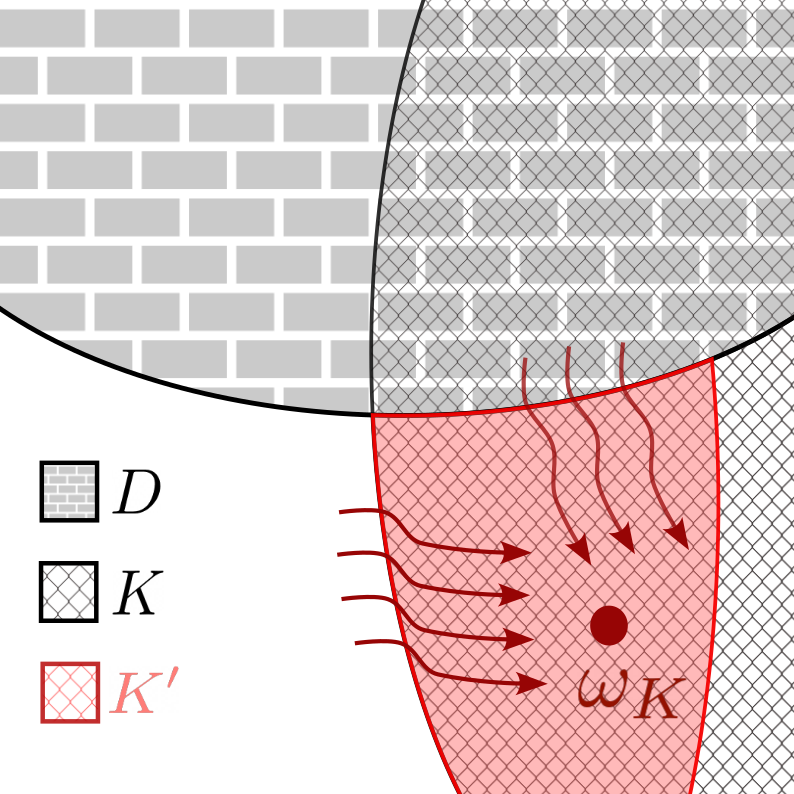
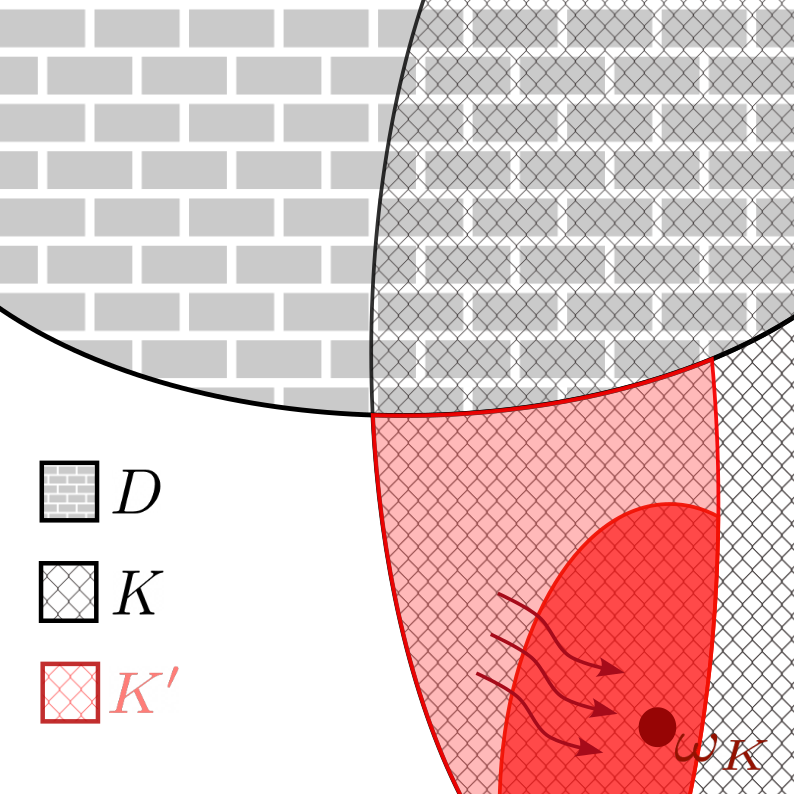
Figure 1: Case in which the connected component K′ of K∖D is boundary-linked to ωK.
At each stage, regions are refined to maximize boundary-linkedness and minimize boundary size, using uncrossing and chain arguments. This builds up a decomposition in which every undominated edge-end is displayed, with strong connectivity properties inherited from the linkedness criterion.
Displaying Edge-degrees
A central application is the resolution of Halin's edge-analog question: finding a tree-cut decomposition that displays both ends and their edge-degrees simultaneously. The construction ensures that:
The edge-degree of any displayed undominated edge-end equals the liminf of the boundary sizes along its decomposition ray.
This duality is powered by linkedness: at each step, minimal adhesion sets force the ray degree—i.e., the supremum of edge-disjoint ray families contained in the edge-end class—to match the minimum boundary size encountered along the ray in the decomposition tree.
For locally finite graphs, where every end is undominated, the decomposition gives a locally finite tree into finite parts, displaying all ends and their edge-degrees via finite combinatorial invariants, thus producing concise combinatorial characterizations of end degrees.
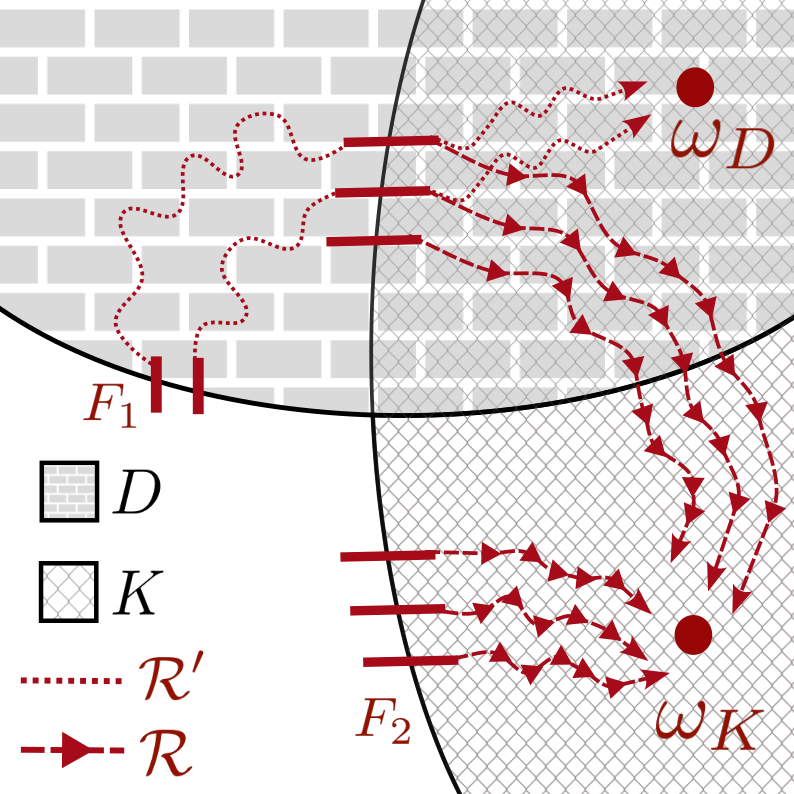
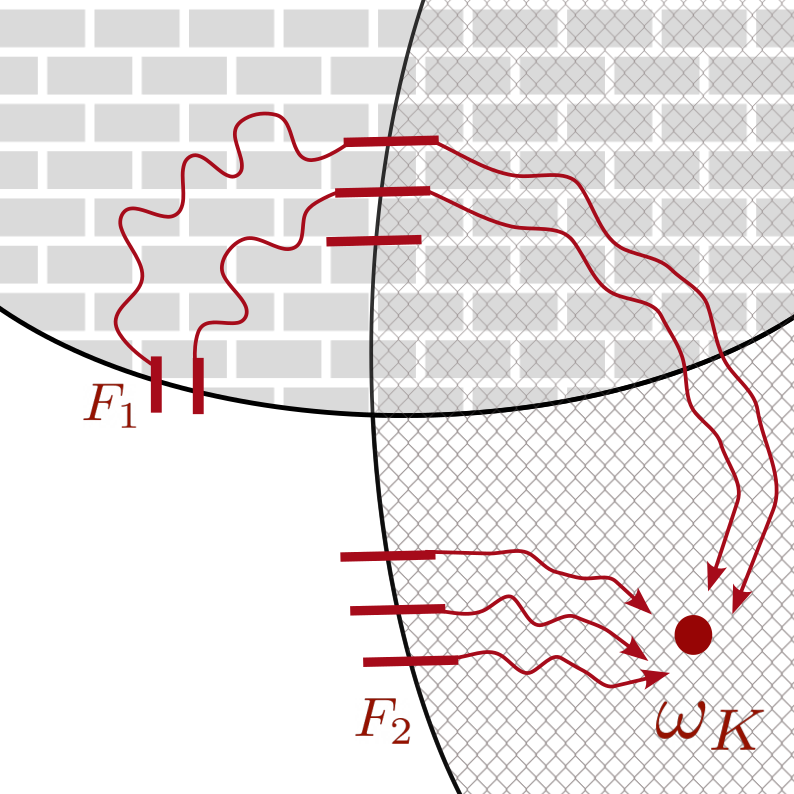
Figure 2: Depiction of the ray families R and R′ used in boundary-linked constructions for successor regions.
Unified Deductions of Classical Results
The decomposition yields short, unified proofs for two significant results:
Thomassen's Theorem on Boundary-linked Finite Partitions: The tree-cut decomposition immediately constructs finite partitions into boundary-linked regions displaying strong separation properties, directly addressing the combinatorial partitioning of locally finite graphs for infinite connectivity results.
Bruhn–Stein's Eulerian Characterization: The decomposition facilitates a direct combinatorial proof that a locally finite graph is Eulerian iff all vertices have even degree and all ends are even, aligning topological cycle existence with finite cut parity and edge-end structure.
These derivations underscore the utility of the linked componental decomposition in infinite graph theory, consolidating results previously accessible only via intricate topological or analytic techniques.
Submodularity, Algorithmic Refinement, and Strong Linked Counterexamples
The paper develops technical machinery for submodular boundary uncrossing (Lemma SubmodularityCuts), showing that regions can be refined or expanded to preserve boundary-linkedness and maintain minimal adhesion, a key for assembling the decomposition. Additionally, algorithmic recursive schemes for partitioning and refining regions are given, ensuring maximal coverage and disjointness.
A counterexample (Appendix) demonstrates that strongly-linked decompositions (unrooted version) cannot exist for all infinite graphs, paralleling known limitations in vertex-based decompositions. This sharpens the constraints and characterizes the precise reach of the linked rooted construction.
Implications and Future Directions
Practically, the existence of such decompositions means all undominated edge-ends and their degrees can be analyzed combinatorially via finite partitions, enabling both algorithmic and structural analysis of infinite graphs, including applications to immersion, topological cycles, and infinite flows.
Theoretically, the result positions tree-cut decompositions as a central tool for infinite edge-connectivity, opening avenues for further generalizations:
- Investigating Gδ sets of edge-ends that can be displayed (cf. topological end spaces).
- Connections to end-faithful spanning trees, normal spanning structures, and the topological compactification of infinite graphs.
- Algorithmic decomposition for infinite edge-disjoint path packings and flows.
There are open questions regarding finer invariants for edge-dominated ends, parallels to lean decompositions, and extensions to broader classes of infinite graphs with prescribed end-structure.
Conclusion
The paper delivers a comprehensive structural theorem: every graph admits a linked, componental, rooted tree-cut decomposition of finite adhesion displaying all undominated edge-ends, encompassing their edge-degrees, and affording unified combinatorial proofs of deep results in infinite graph theory. This sets a new combinatorial standard for the analysis of infinite edge-connectivity and its applications.