- The paper presents experimental evidence suggesting a 17 MeV vector boson through anomalous e+e– pair emissions with significance above 6σ.
- It employs nuclear transition data and precision atomic measurements to impose strict constraints on bosonic couplings, emphasizing protophobicity and necessary sign-tuning.
- The study integrates insights from g-2, Lamb shift, and electroweak precision tests, underlining the need for novel symmetry principles in light mediator models.
Phenomenological Analysis of the X17 Anomaly: Experimental Status and Model Constraints
Introduction
The longstanding paradigm of the Standard Model (SM) leaves a wide array of open questions in particle physics and cosmology, among which are the nature of dark matter, the generation of neutrino masses, and the baryon asymmetry of the Universe. In this context, low-energy anomalies in nuclear transitions provide potential portals to physics beyond the SM that are complementary to high-energy collider searches. The so-called X17 anomaly, first reported by the ATOMKI group in angular correlations of e+e− pairs emerging from 8Be and later 4He nuclear transitions, constitutes one such candidate. This essay systematically reviews the experimental evidence for X17, the theoretical frameworks constructed to accommodate it, and the stringent phenomenological constraints these scenarios face, as articulated in "The X17 Anomaly: Experimental Evidence and Theoretical Interpretations" (2606.20423).
Experimental Evidence and Status
The ATOMKI measurements center on the 7Li(p,γ)8Be reaction, specifically exciting the 18.15 MeV 1+ isoscalar state of 8Be. The observed IPC (Internal Pair Creation) events yield e+e− pairs exhibiting an angular correlation excess at large opening angles, which is not predicted by QED or standard nuclear models. This manifests as a bump in the invariant mass spectrum corresponding to mX≈16.7 MeV/c2 with a significance reported above 80. Corroborating results appeared in 81He transitions, reinforcing the interest in a new bosonic state.
Subsequent independent searches have yielded inconclusive outcomes. The MEG II collaboration found no significant deviations in similar 82 correlation studies, thereby neither confirming nor decisively excluding the ATOMKI region. A positive but yet-to-be-confirmed observation was reported by VNU, with a compatible excess and significance above 83.
Furthermore, fixed-target and beam dump experiments such as NA64 have established upper limits on couplings of light vector bosons to electrons, significantly constraining parameter space and challenging simple new physics explanations. Thus, the present situation is sharply characterized by the tension between the ATOMKI (and partially VNU) signals and null results from high-sensitivity probes.
Theoretical Interpretations
The existence of an approximately 17 MeV boson with visible leptonic decay modes requires models that evade a suite of experimental and astrophysical constraints. The primary viable candidate is a protophobic vector boson: a light vector mediator with suppressed (ideally vanishing) coupling to protons and dominant interactions with neutrons and (to a lesser extent) electrons and muons. The Lagrangian for such an 84-boson, with general couplings to SM fermions, is given by
85
with 86 at the fundamental fermion level, and similarly incorporated at the nucleon level.
Alternative explanations have involved light scalar or pseudoscalar bosons (axion-like or pseudo-Nambu-Goldstone bosons) and dark sector portals, but all such cases face much tighter experimental and astrophysical bounds, especially from meson decays, beam dump limits, and stellar cooling arguments. Phenomenologically, the vector scenario is further favored by the nuclear transition selection rules, which are inconsistent with scalar emission.
Precision Constraints on 87 Parameter Space
Muon Anomalous Magnetic Moment
A light weakly-coupled vector with mass 88 MeV produces a calculable one-loop contribution to the lepton anomalous magnetic moments (89, 40). For the muon, the deviation is
41
where 42 is an integral function of 43. Accounting for the observed 44 tension, this yields an upper bound 45. The electron case provides a much stronger but less relevant constraint, given the suppression by 46.
Lamb Shift in Muonic Atoms
Precision measurements of the Lamb shift in muonic hydrogen and deuterium offer a direct probe of light boson-induced corrections to atomic energy levels via a Yukawa-type potential. Given the observed deviations from SM expectations, the couplings are subject to tight bounds. For muonic hydrogen, the correction satisfies
47
where the sign of the energy shift imposes that 48. This is shown by the contour plot mapping the lower bound for 49 (Figure 1).
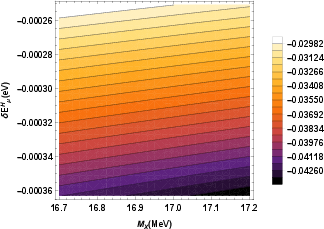
Figure 1: Contour plot of the lower bound for the coupling 70 as a function of mediator mass 71 and observed Lamb shift 72, fixing 73.
A parallel analysis for muonic deuterium places related constraints on the neutron coupling 74, again for fixed 75 (Figure 2).

Figure 2: Constraints on 76 from muonic hydrogen and deuterium measurements, assuming 77 and 78.
These analyses crucially rule out lepton-universal models and further specify the necessary sign relations between leptonic and nucleonic couplings.
Electroweak Precision and Kinetic Mixing
Generic extensions with 79 gauge symmetry entail kinetic mixing with SM hypercharge. Even loop-induced kinetic mixing alters oblique parameters ((p,γ)80, (p,γ)81, (p,γ)82), leading to shifts in the (p,γ)83 mass. The induced corrections
(p,γ)84
impose an upper limit (p,γ)85 on the kinetic mixing parameter, derived from current (p,γ)86 mass measurements.
Implications and Outlook
The conjunction of low-energy nuclear anomalies, high-precision atomic and leptonic observables, and electroweak precision data yields the following points:
- Only non-universal, sign-tuned coupling structures remain permissible; lepton-universality or scalar explanations are disfavored by several orders of magnitude.
- The necessary combination of (p,γ)87 and Lamb shift data requires not only the suppression of proton couplings (protophobicity) but also sign-tuning between muon and nucleon interactions.
- Kinetic mixing, unavoidable in gauge scenarios, must be stringently constrained but does not by itself salvage excluded regions of parameter space.
Practically, any experimental effort intending to clarify the X17 anomaly must prioritize both independent confirmation of the (p,γ)88 pair anomalies and expanded/optimized coverage in precision atomic physics. Theoretically, further model-building efforts must confront the challenge of radiatively stable protophobicity and strong sign hierarchies, likely requiring new symmetry principles or ultraviolet completions.
Conclusion
A confluence of nuclear, atomic, and particle physics precision measurements continues to probe light, weakly-coupled new physics in the MeV regime. The X17 anomaly remains viable only within tightly circumscribed parameter regions, predominantly as a protophobic vector boson with non-universal fermion couplings and carefully selected signs. The current suite of experimental and theoretical analyses underscores the critical importance of multi-channel constraints for any future light mediator scenarios and motivates additional high-sensitivity searches in both nuclear and atomic systems. The resolution of the X17 anomaly, either as an experimental artifact or as a harbinger of new physics, will have significant consequences for the strategic direction of sub-GeV BSM searches.