- The paper introduces a geometry-driven framework that links tunable sparse interaction graphs to distinctive ground-state phenomena in quantum lattice models.
- It employs analytical and numerical techniques including exact diagonalization, Monte Carlo simulations, and Krylov methods to reveal phase transitions and gap closures.
- The study highlights potential applications in quantum simulation platforms and p-adic mapping for controlling non-local interactions in many-body systems.
Interaction Geometry and Ground-State Phenomena in Sparse Quantum Lattice Models
Sparse Long-Range Graphs: Structural Foundations
The study initiates with a generalized approach to tunable sparse long-range graphs, particularly focusing on families with logarithmic degree growth: power-of-p and Fibonacci graphs. Each site in a system of N nodes couples to O(logN) partners, yielding sparse, yet non-local, interaction structures. The power-of-p graphs possess discrete scale self-similarity; bonds exist at distances pl, enforcing recursive connectivity. In contrast, Fibonacci graphs break this symmetry, defining bonds at Fibonacci-separated distances, generating a less regular but equally sparse structure.
The geometric perspective is central: as the distance exponent s is varied, the effective connectivity of these graphs morphs continuously, yielding distinct physical regimes and determining many-body ground-state structure. For power-of-p graphs, s deformation interpolates between local ring-like and “tambourine”-style connectivity, sparse all-to-all structures, and ultimately decoupled clusters.
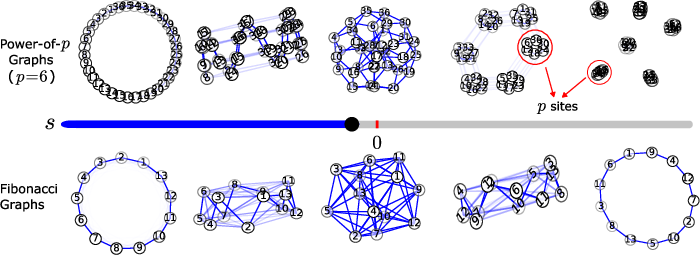
Figure 1: Continuous deformation of interaction geometry for power-of-p and Fibonacci graphs as the exponent s is tuned.
Many-Body Hamiltonian Models and Analytical Approaches
Sparse graphs serve as the backbone for two quantum lattice models: antiferromagnetic transverse-field Ising (TFIM) and spinless fermion hopping models. Both exhibit interactions scaling as N0, with N1 modulating the dominance of short vs. long-range bonds. Analytical, exact diagonalization (ED), Monte-Carlo (MCMC) simulations, and Krylov/SQKD diagonalization techniques are employed for spectrum and ground-state analysis.
The TFIM Hamiltonian, N2 for spin-N3, fundamentally links classical frustration and quantum fluctuation. The fermionic Hamiltonian, N4, is quadratic and solved exactly via Fourier-Bogoliubov transformations.
Classical and Quantum Phase Structure on Sparse Graphs
Power-of-N5 Graphs
The classical ground-state phase structure for even N6 is dominated by recursive antiferromagnetic configurations. As N7 increases, criticality shifts: N8, the classical gap closing, approaches N9 as O(logN)0 grows. This is verified numerically for O(logN)1 via MCMC, and analytically by geometric recursion arguments (see Fig. 2, Fig. 8).
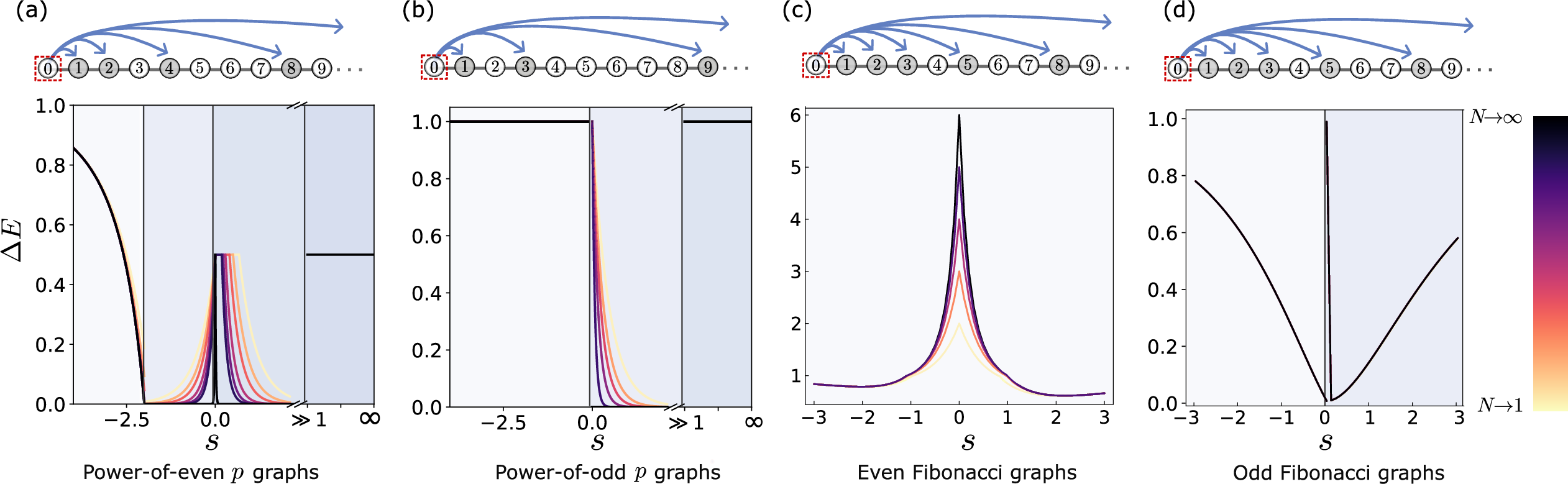
Figure 2: Classical phase diagrams for power-of-two, power-of-three, and Fibonacci graphs; critical transitions and gapless regimes are resolved with energy gap analysis.
Even-O(logN)2 ground-states are constructed by iteratively doubling the system and concatenating globally flipped blocks (Fig. 3).
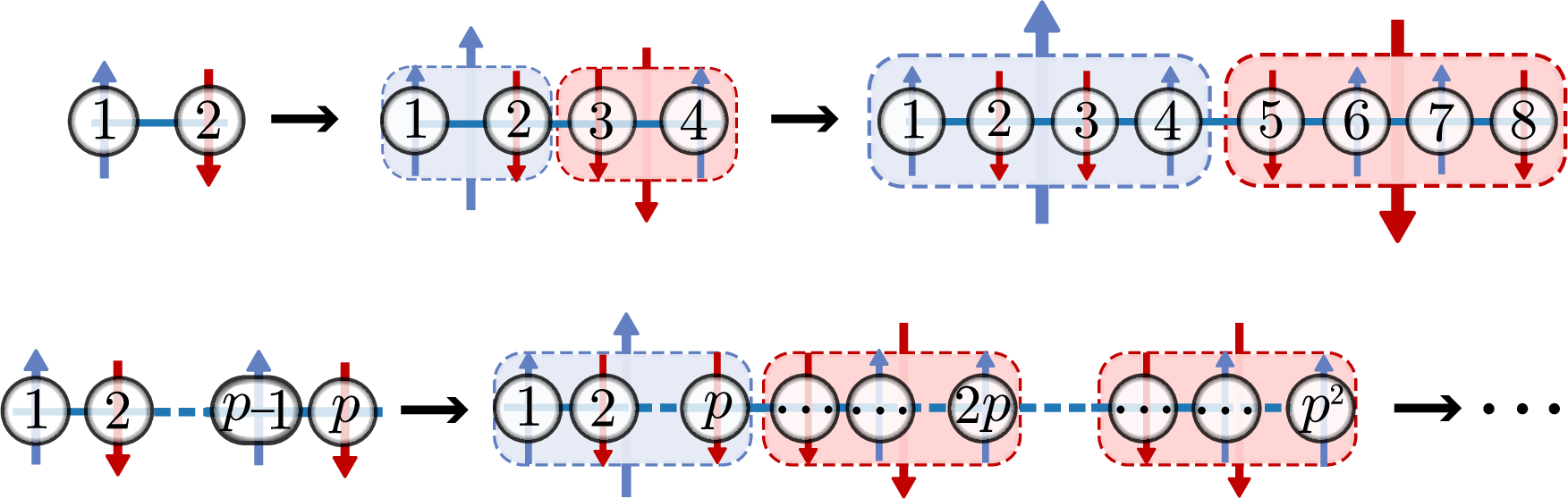
Figure 3: Recursive AFM construction for power-of-O(logN)3 graphs: block concatenations yield ground-state patterns as system size is scaled.
Odd O(logN)4 introduces geometric frustration: each shell (O(logN)5) decomposes the ring into odd-length cycles, which prohibit full AFM satisfaction (Fig. 4). The AFM state frustrates exactly one bond per cycle, yielding a minimal frustration configuration that is proven to be globally optimal. For large positive O(logN)6, degeneracies emerge as short-range costs vanish, leading to a gapless extensive manifold.
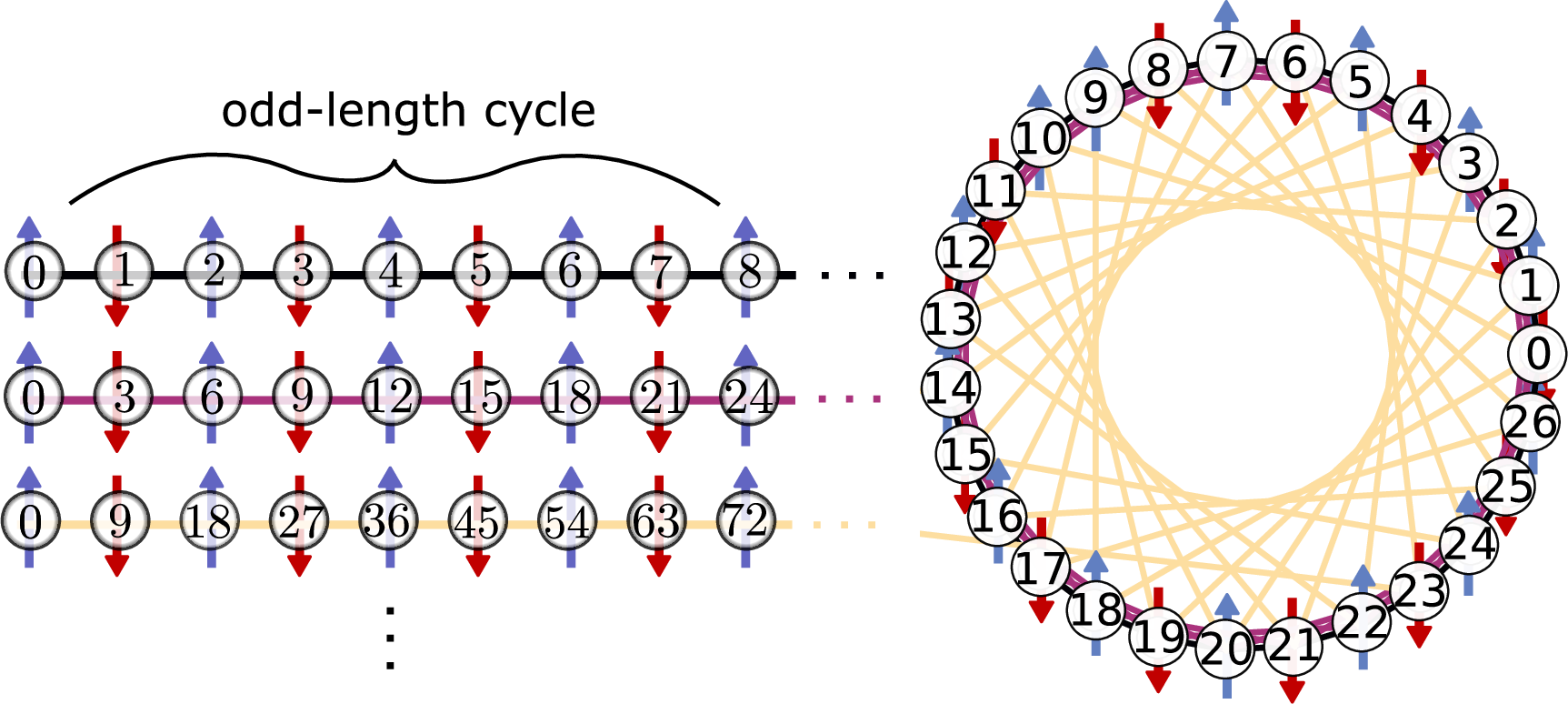
Figure 4: Minimal frustration for AFM patterns on power-of-three graphs; every odd cycle is frustrated exactly once.
Quantum phase diagrams retain the primary features of the classical landscape, but quantum fluctuations mix states and reshape transitions. For even O(logN)7, rich universality classes emerge, including 2D Ising behavior at critical points. Odd O(logN)8 (exemplified by O(logN)9) remains robustly AFM for p0, transitioning to volume-law scaling as p1 increases (Fig. 5).
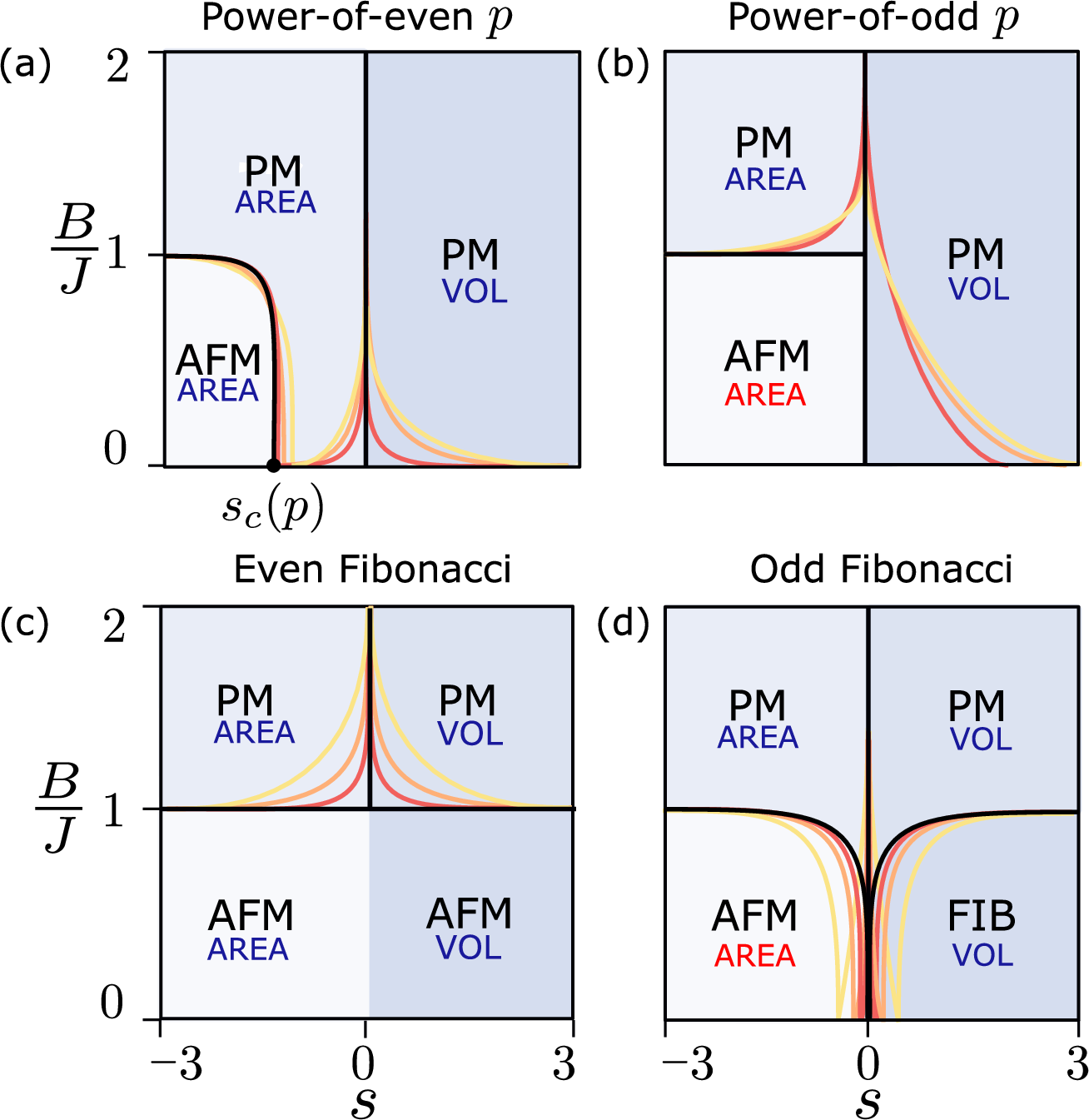
Figure 5: Quantum phase diagrams for sparse graphs show the interplay of AFM, paramagnetic, and Fibonacci AFM phases; entanglement scaling is annotated.
Fibonacci Graphs
Fibonacci graphs lack self-similarity, resulting in fundamentally mirrored geometric transitions across p2. For even Fibonacci p3, both nearest-neighbor and furthest-neighbor cycles are odd, ensuring unique AFM ground states and absence of classical phase transitions. Odd p4 instead exhibit a p5 transition between nearest-neighbor AFM and Fibonacci AFM phases, with gapless regimes at the transition point.
Effective interaction geometry remains ring-like for all limits, as verified through correlation analysis and geometric mapping (Fig. 7).
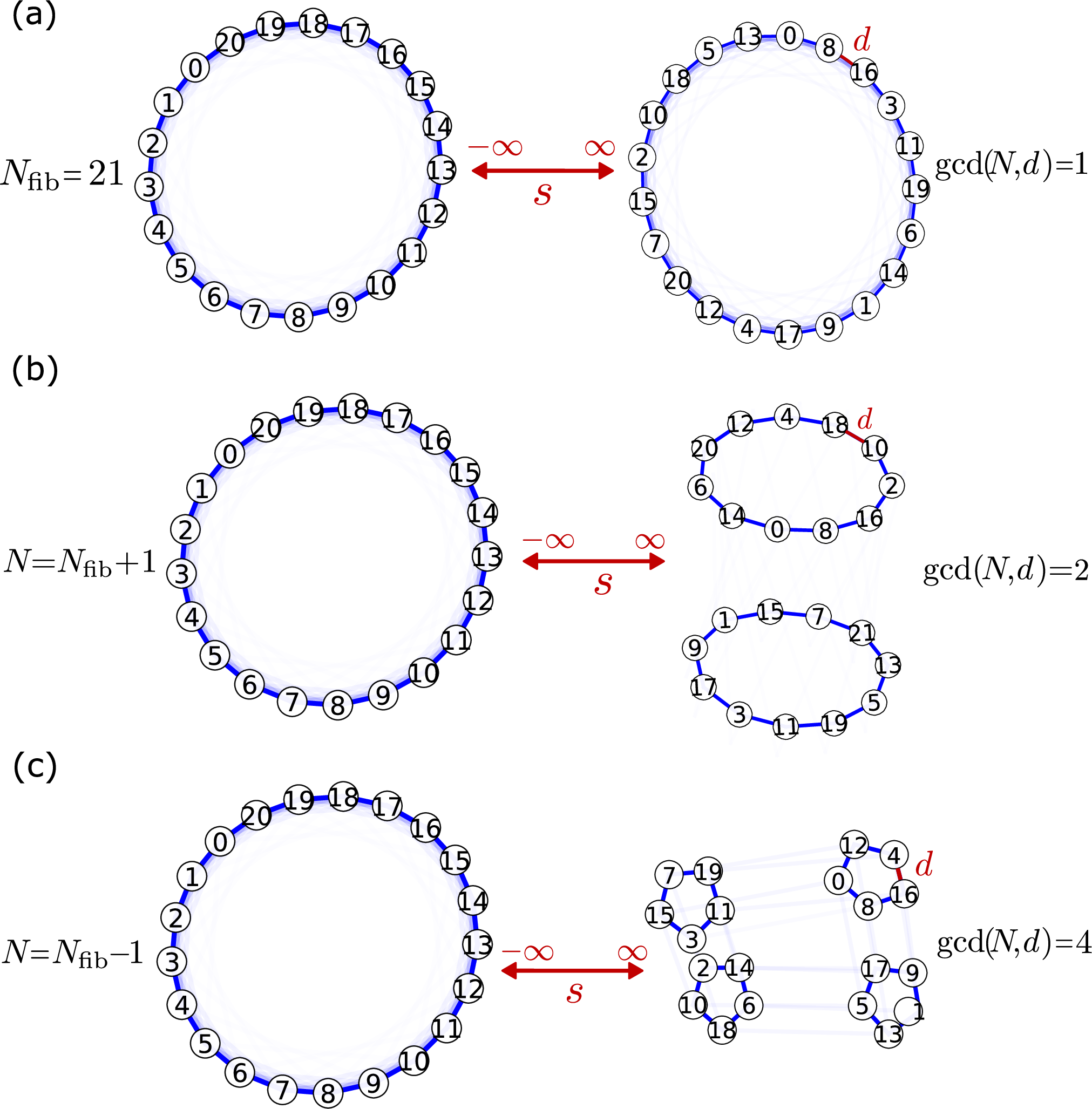
Figure 6: Effective geometry of Fibonacci graphs with variation in system size; dominant interaction bonds change the loop structure according to p6.
Exactly Solvable Fermionic Regime and Gap Scaling
The fermionic hopping model is solved for power-of-p7 graphs. Analytic gap closing is observed at p8, confirmed by numerical spectrum convergence for large p9 (Fig. 6). For positive pl0, a second gapless regime emerges between pl1 and pl2, with gap scaling algebraically toward zero with increasing pl3. Odd pl4 never show analytic mode closing at pl5, but numerical dispersion computation reveals gapless behavior for pl6.
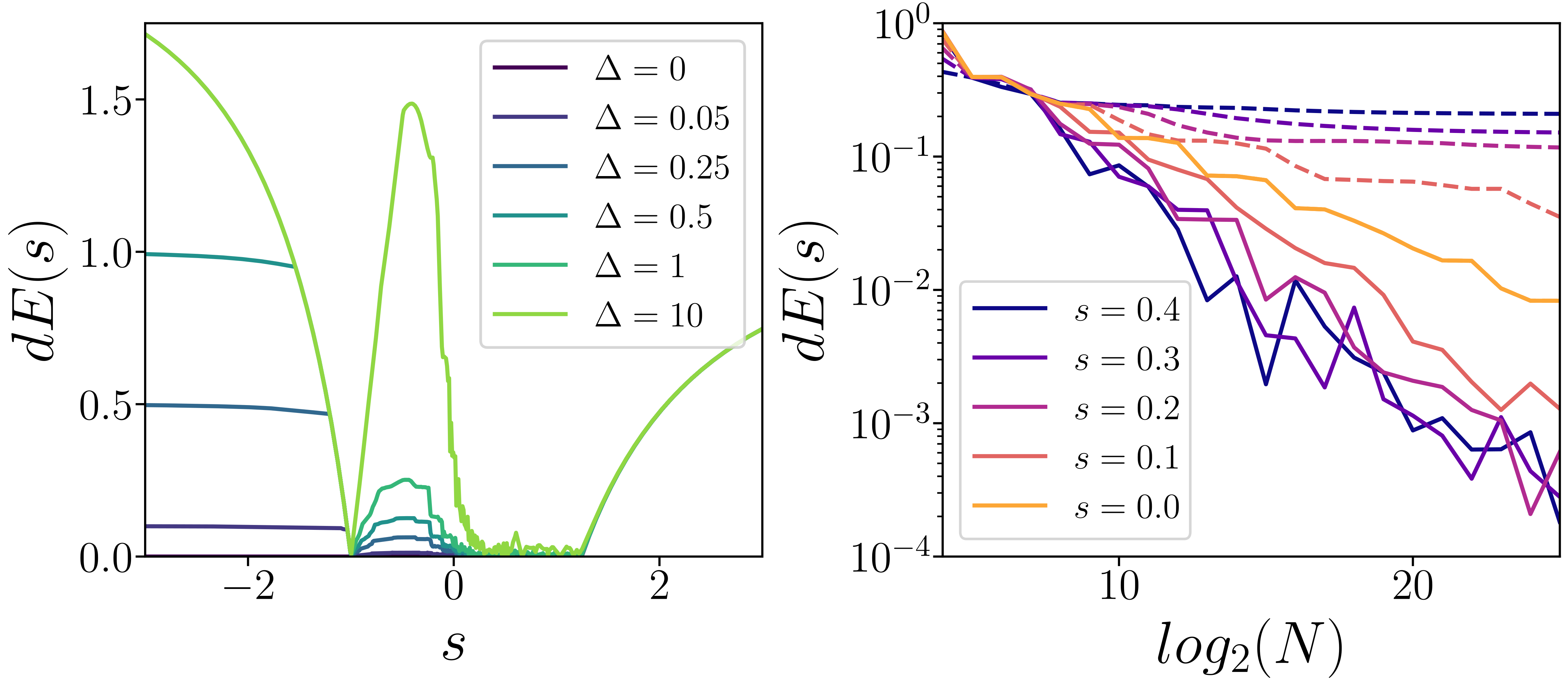
Figure 7: Spectral gap and coupling-function for PWR2 models: analytic gap closing at pl7 and numerical gapless regime for pl8.
Robustness and Sensitivity to System Size
Ground-state and spectral properties are highly sensitive to system size, particularly for pl9 where dominant interaction cycles depend on s0. For Fibonacci graphs, varying s1 fragments the graph into disconnected loops or preserves ring structure, qualitatively impacting ground-state degeneracies (Fig. 7). For fermionic models, density-density correlators reveal pronounced peaks at graph-connected distances for positive s2, mirroring changes in loop connectivity and corroborating the geometric framework.
Conclusion
This work systematically demonstrates that sparse long-range quantum graphs exhibit ground-state phase behavior governed by their effective geometry. Recursive or frustrated connectivity in power-of-s3 graphs leads to two major qualitative classes, with power-of-two models showing maximal structural complexity. Fibonacci graphs, lacking self-similarity, manifest mirrored phase diagrams and transitions, providing a symmetric case for geometry-first analysis. Robust numerical and analytical treatment reveals strong sensitivity to system size, particularly for long-range regimes, where even a single-site shift can transform phase structure via changes in s4.
The implications for quantum simulation architectures are substantial: neutral-atom arrays and cavity-QED platforms can engineer these sparse geometries, enabling controlled exploration of distinct universality classes, degeneracies, and integrability properties. The s5-adic connection suggests future prospects for holographic mapping and tensor network investigations. Extending the geometry-driven framework beyond equilibrium, including dynamical phases and quantum information spreading, remains a promising research direction (2606.20387).

