Published 18 Jun 2026 in cond-mat.mes-hall | (2606.20378v1)
Abstract: We investigate the realization of a time-reversal-broken Weyl semimetal in Floquet synthetic dimensions generated by two incommensurate drives, in the spirit of topological frequency conversion in driven synthetic lattices PRX 7, 041008 (2017). The system is described by a one-dimensional lattice model in a mixed $(1~\mathrm{real}+2~\mathrm{synthetic})$-dimensional setting, where the driving phases act as synthetic momenta and generate Weyl points in the mixed Floquet band structure. Using the topology associated with these band degeneracies, we analyze the energy transfer between the two drives. We find that the mixed Floquet lattice captures the Weyl-semimetal topology only in a momentum-resolved sense: for fixed real momentum $k_x$, the power transfer measures the $k_x$-resolved Chern number and detects the separation of the Weyl nodes. However, the full real-space response is qualitatively different. The total power transfer does not reproduce the static Weyl-semimetal phase diagram, but instead follows an effective Rice-Mele-type pumping structure. Thus, in contrast to fully gapped topological insulators, gapless semimetallic phases do not straightforwardly translate to Floquet synthetic dimensions. Our results reveal a distinct dynamical phase structure of driven Weyl systems and establish mixed Floquet lattices as a platform for exploring non-equilibrium gapless topology.
The paper presents a mixed Floquet lattice model that achieves momentum-resolved quantized energy pumping, revealing Weyl node separation.
It employs incommensurate periodic drives to create synthetic dimensions and extract kₓ-dependent Chern numbers through energy transfer.
Numerical and analytical results confirm that while momentum-resolved responses capture gapless topology, real-space pumping reflects only 1D winding invariants.
Mixed Floquet Lattice Model for Gapless Topology
Conceptual Framework and Motivation
The paper "Mixed Floquet Lattice model for gapless topology" (2606.20378) develops a rigorous analysis of time-reversal symmetry-broken Weyl semimetals in systems with mixed real and synthetic dimensionality. It specifically considers a one-dimensional real lattice coupled to two incommensurate periodic drives, thereby constructing a (1real+2synthetic)-dimensional Floquet lattice. The synthetic dimensions arise from the independent phases of the drives, generalizing Floquet theory to a quasi-periodic setting. This model targets realization of Weyl band topology by dynamic engineering rather than via direct material synthesis, leveraging synthetic dimensions as a platform for simulating higher-dimensional topological phenomena, including those inaccessible in static solid-state systems.
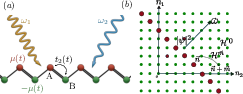
Figure 1: Panel (a) depicts the Rice-Mele model coupled to two oscillating magnetic fields; panel (b) displays the mixed Floquet lattice with localization parallel to the effective electric field ω and dispersive behavior perpendicular to it.
Mixed Floquet Lattice Model and Synthetic Weyl Topology
The system is described by a quantum chain of two-level systems, each subjected to two oscillating magnetic fields. The Hamiltonian is formulated such that the drive phases substitute for crystalline momenta in the transverse dimensions, yielding a synthetic momentum-space Bloch Hamiltonian. The mixed Floquet lattice thus forms a tight-binding representation in photon-number space (n1,n2), with drive frequencies ω1,ω2 acting as electric field components on this lattice.
For each fixed real momentum kx, the remaining (θ1,θ2) phases lead to a two-dimensional synthetic Brillouin zone supporting Weyl points. The authors demonstrate that the mixed Floquet band structure manifests Weyl topology only in a momentum-resolved fashion, i.e., the Chern number C(kx) can be extracted via power transfer between the drives as a function of kx, capturing the separation of Weyl nodes.
Dynamical Response and Topological Quantization
The dynamical observable central to this work is the rate of energy pumping between the two drives, which reflects the Berry curvature of the synthetic bands through anomalous velocity transverse to the synthetic electric field. In the adiabatic regime, this harvesting of topology is quantified by dεˉ1/dt=−dεˉ2/dt=ω1ω2C/(2π), where C is the synthetic band Chern number.
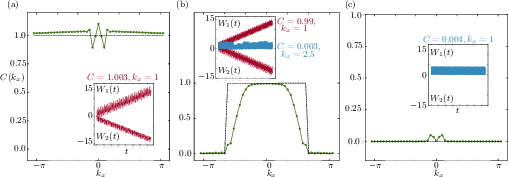
Evaluating the work operator for each drive, the authors establish that for fixed ω0—and under appropriate parameter regimes corresponding to LCI (gapped), ω1 (Weyl), and trivial phases—the power transfer alludes directly to topological invariants of the synthetic bands. The momentum-resolved pumping response, ω2, exhibits quantized values that sharply transition in the presence of Weyl nodes, in excellent agreement with the Fukui–Hatsugai–Suzuki numerical computation of Chern numbers.
Figure 2: Chern number ω3 extracted from energy pumping (green) versus the synthetic band calculation (black), demonstrating step-function behavior across phase boundaries and encoding Weyl node positions.
Real-Space Versus Momentum-Resolved Responses
The key insight is the qualitative divergence between momentum-resolved and total real-space responses. While the momentum-resolved pumping quantifies the topological structure associated with Weyl nodes, the spatially integrated power transfer aligns instead with Rice–Mele-type pumping. The total response does not reconstruct the full static Weyl phase diagram but follows the winding structure of an effective 1D pump dictated by the time-evolving onsite potential and hopping.
This distinction is attributed to a topological obstruction: There is no single integer-valued invariant in the total pump that can encode the continuous Weyl node position. Only the piecewise function ω4 retains this information, with discontinuities marking Weyl nodes. The total pump performs a projection that inherently discards the Weyl node separation information.
Numerical Results and Analytical Claims
Strong numerical evidence is presented that:
Momentum-resolved power transfer directly measures the ω5-dependent Chern number and Weyl node separation.
Total real-space power transfer reflects only the Rice–Mele winding and is insensitive to the detailed Weyl structure.
The length of the ω6 interval for nonzero Chern numbers corresponds to the Fermi arc length, but the total pump is unable to distinguish between Weyl phases with different node separations.
Contrary to the intuition from gapped topological insulators, gapless semimetallic phases do not map straightforwardly onto synthetic Floquet dimensions; fully gapped systems exhibit pump quantization, but gapless Weyl phases require momentum resolution.
Experimental Implications and Future Directions
Experimental platforms in cold atoms, driven spin systems (e.g., nitrogen-vacancy centers), and superconducting qubits are amenable to realization of this mixed Floquet lattice and its associated dynamical responses. Recent experiments demonstrate quantized Hall drifts and energy pumping, supporting the feasibility of observing these momentum-resolved responses.
The analysis suggests that future explorations of synthetic dimensional embedding and higher Weyl node multiplicity (ω7, ω8, ω9) in complex Hamiltonians will reveal further distinctive dynamical topology not present in static models. Mixed Floquet lattices thus provide a versatile toolkit for simulating, probing, and discovering gapless topological phenomena in non-equilibrium settings.
Conclusion
This work establishes that momentum-resolved quantized pumping in Floquet synthetic dimensions admits a rigorous correspondence with Weyl semimetal topology, while total real-space pump responses are limited to 1D winding invariants. Synthetic dimensions engineered via incommensurate drives form a viable pathway for studying dynamical, gapless topology, and open new routes for experimental and theoretical exploration of topological matter beyond static band structure paradigms.
“Emergent Mind helps me see which AI papers have caught fire online.”
Philip
Creator, AI Explained on YouTube
Sign up for free to explore the frontiers of research
Discover trending papers, chat with arXiv, and track the latest research shaping the future of science and technology.Discover trending papers, chat with arXiv, and more.