- The paper introduces a framework that models attosecond path qubits by mapping short and long quantum trajectories in high-harmonic generation.
- It employs a trajectory-resolved density matrix and Bloch sphere mapping to quantify coherence, purity, and phase dynamics with attosecond resolution.
- The study distinguishes reversible classical dephasing from irreversible quantum decoherence, providing insights for state engineering and ultrafast metrology.
Attosecond Path Qubits in High-Harmonic Generation: Classical Dephasing and Trace-Out Decoherence
Introduction and Motivation
High-harmonic generation (HHG) under intense laser fields is characterized by interference between distinct quantum electron trajectories, predominantly the so-called "short" and "long" paths. This paper establishes a formalism wherein these two quantum trajectories constitute an experimentally addressable two-level subsystem, termed the attosecond path qubit (APQ). The work advances a trajectory-resolved density matrix approach, enabling explicit distinction between classical dephasing effects (from ensemble averages over fluctuations) and quantum decoherence channels (from trace-out over unobserved degrees of freedom). By mapping the HHG process onto a quantum-information framework, the authors provide rigorous quantification of path coherence, purity, and information loss, unlocking operational routes for state engineering and diagnosis in attosecond interferometry (2606.20372).
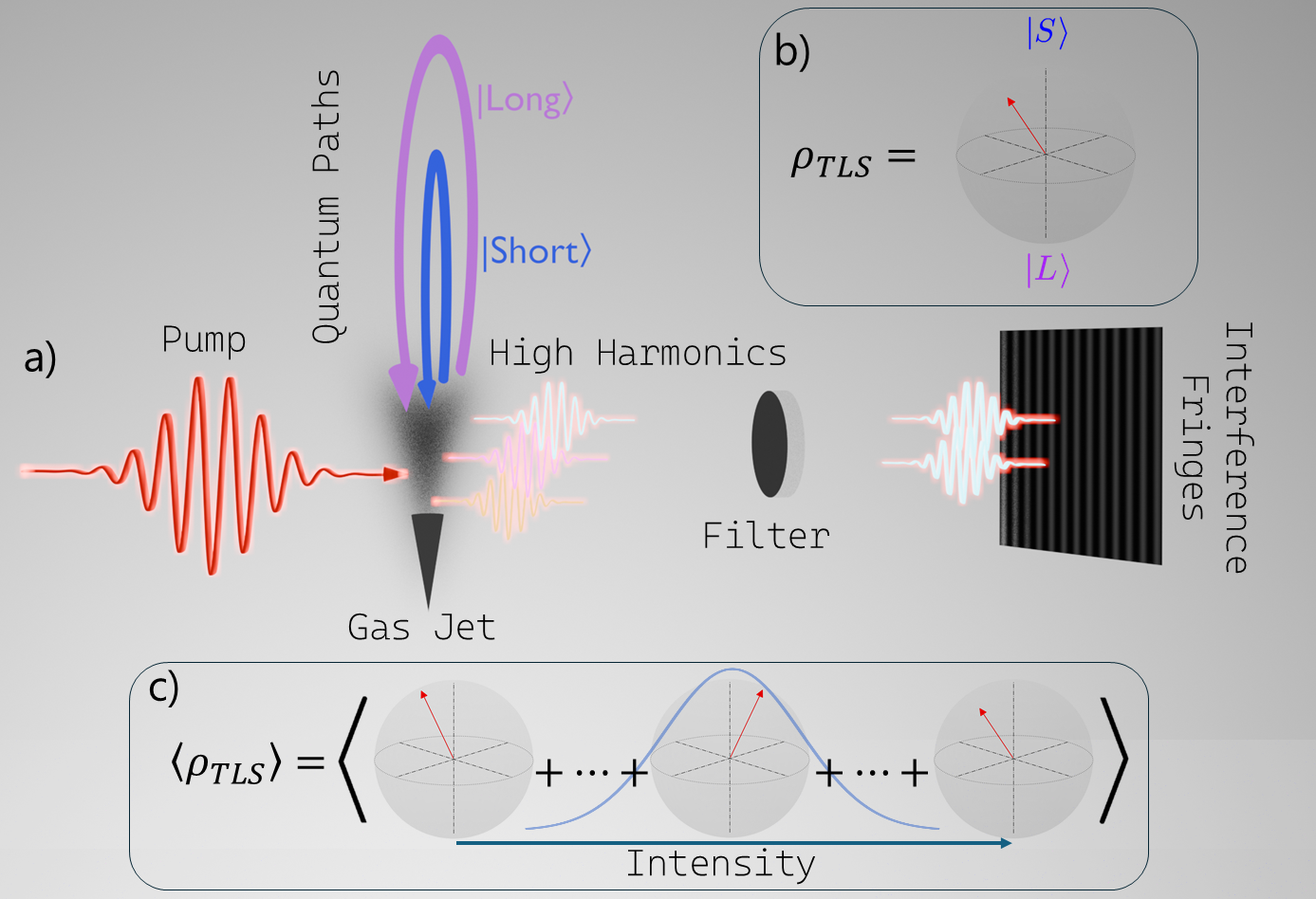
Figure 1: Schematic representation of attosecond-path qubits in HHG; (a) experimental setup with short/long quantum orbits, (b) Bloch-sphere for APQ density matrix, (c) ensemble-averaged Bloch vector due to shot-by-shot fluctuations.
The APQ is defined by the coherent superposition of short and long quantum trajectories, which can be written as a two-level spinor in a Hilbert space HTLS. The population imbalance and coherence between these states are intimately linked to experimentally measurable observables: spatial and spectral modulations in HHG. The trajectory-resolved density matrix for APQ enables mapping onto the Bloch sphere, providing geometric visualization of path populations, coherence amplitude, and phase. The diagonal density matrix elements correspond to path populations, while off-diagonal terms encode coherence, directly measurable via interferometric visibility and predictability.
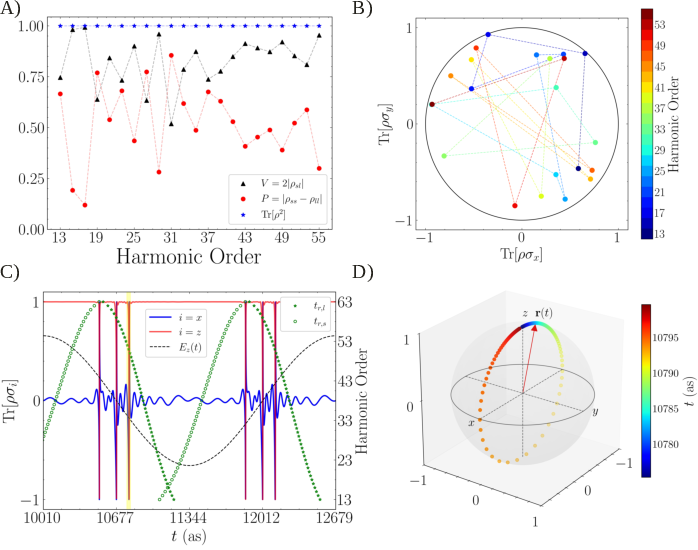
Figure 2: Pure-state APQ Bloch vector dynamics: visibility, predictability, and purity as functions of harmonic order; complex coherence map and attosecond-scale time domain trajectories.
Tomographic Reconstruction and Experimental Relevance
APQ tomography leverages established attosecond measurement techniques, such as phase matching, intensity/phase scans, and spatial filtering, to reconstruct the path-specific density matrix via attosecond interferometry. The protocol utilizes spectral and spatial signatures to extract populations and coherence, allowing operational quantification of the state purity and coherence loss. Deviations from pure-state coherence are interpreted as signatures of decoherence, traceable to environmental entanglement or uncontrolled fluctuations.
Classical Dephasing Channel: Ensemble Averaging
Classical dephasing emerges from averaging over stochastic fluctuations in parameters such as laser intensity or emission volume, leading to suppression of coherence without fundamentally mixed single-shot states. The ensemble-averaged density matrix maintains diagonal populations but contracts the Bloch vector, reducing off-diagonal coherence terms. Importantly, dephasing-induced purity loss is operationally reversible via conditioning or post-selection.
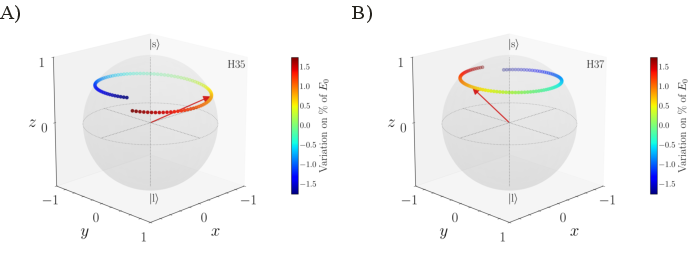
Figure 3: APQ Bloch vector rotation for representative harmonics as a function of laser intensity fluctuations, illustrating dephasing-driven phase dispersion.
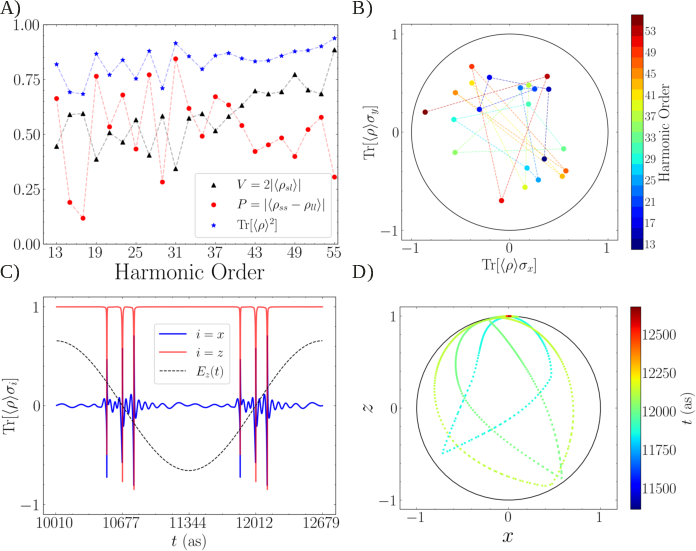
Figure 4: Dephasing channel effects—mean purity, visibility, predictability, and coherence contraction versus harmonic order and time, demonstrating operational reversibility.
Decoherence Channel: Trace-Out of Unresolved Degrees of Freedom
Genuine quantum decoherence arises from entanglement between the APQ and unobserved environmental degrees of freedom, such as transverse electron momentum. This process fundamentally reduces purity even for single, perfectly controlled shots, distinguishing it from classical dephasing. The partial trace over transverse momentum results in intrinsic loss of both visibility and purity, with the Bloch vector contracting toward the sphere center, reflecting irreversible information loss.
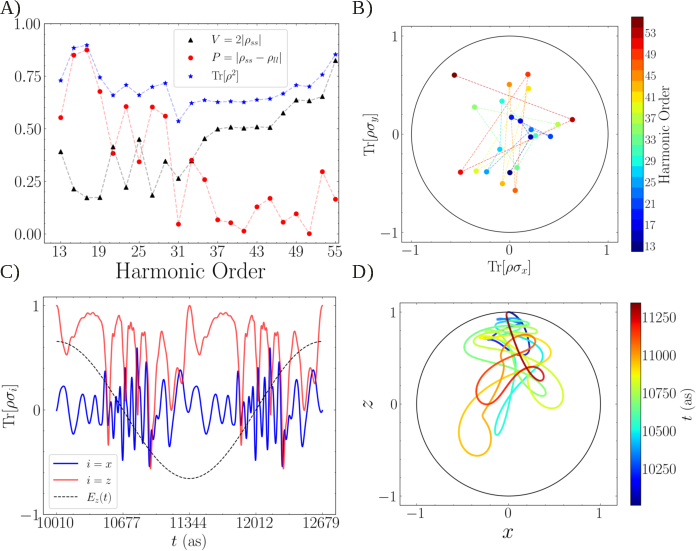
Figure 5: APQ and TLS Bloch vector dynamics after trace-out of transverse momentum—permanent reduction in purity and coherence across harmonic spectrum and time evolution.
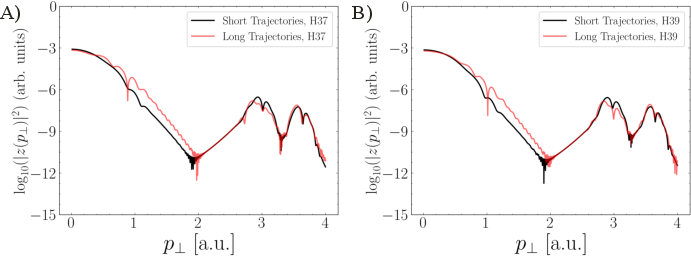
Figure 6: p⊥-resolved dipole moment for short and long trajectories, showing destructive interference and suppression of long-path weight upon integration.
Numerical Analysis and Results
The authors deploy strong-field approximation (SFA) calculations for hydrogen atoms driven by mid-IR fields, resolving HHG emission to the spectral plateau where short/long trajectory separation is robust. In pure-state regime, APQ dynamics show Bloch vector evolution consistent with coherent unitary rotation, with sub-cycle modulations at the attosecond timescale and full state purity. Analysis of dephasing from intensity fluctuations yields reduced visibility but unchanged path populations, with ensemble-average purity dropping below unity. Decoherence from transverse momentum trace-out results in more severe purity degradation and altered path weights, dominating the HHG emission signature and quantum-state properties.
The APQ formalism reframes HHG as a quantum-information process, making trajectory-defined path qubits operational for quantum state engineering and diagnosis at the attosecond scale. This approach provides direct protocols for APQ tomography, robust to current experimental methods. The work delineates classical dephasing (reversible) and quantum decoherence (irreversible), enabling rigorous tracking of information flow and purity loss. The APQ serves as a microscopic sensor for decoherence, opening novel routes for metrology of many-body correlations, environmental influences, and entanglement in strong-field regimes.
The trajectory-based formalism is inherently scalable: extension to qutrit systems (including ground state dynamics), multi-qubit architectures via multicolor driving, and quantum driving fields (e.g., squeezed vacuum) will enable exploration of higher-dimensional state spaces, entangled clusters, and fundamental tests of quantum speed limits, entropy production, and Leggett-Garg macrorealism at sub-femtosecond timescales.
Conclusion
This paper rigorously defines the attosecond path qubit (APQ) in HHG, providing a quantum-information framework to characterize coherence, purity, and information loss via classical dephasing and genuine decoherence channels (2606.20372). The explicit density matrix formalism, Bloch sphere mapping, and tomographic protocols establish HHG as a platform for quantum information science at ultrafast timescales. The theoretical and operational separation of dephasing and decoherence channels has deep implications for state engineering, quantum metrology, and fundamental explorations in strongly driven quantum systems. Future directions include multi-path, multi-qubit extensions, environmental sensing, and tests of quantum limits in attosecond science, with potential impact in ultrafast quantum control, spectroscopy, and quantum technologies.