- The paper demonstrates that stationary spin-bath entanglement can be mapped to reveal a dome-shaped entropy landscape that correlates with traditional dynamical phase boundaries.
- It employs TTN-TDVP-PS methods to resolve the full spin-environment wavefunction, providing clear insights into coherent, incoherent, and pseudo-coherent regimes.
- The study highlights the dominance of low-frequency bath modes in driving entanglement dynamics and offers a Bloch-sphere interpretation of decoherence transitions.
Entanglement Structure of Dynamical Phases in the Sub-Ohmic Spin-Boson Model
Introduction
This paper investigates the entanglement structure underlying the dynamical phases of the sub-Ohmic spin-boson model (SBM). The SBM, which describes a two-level quantum system linearly coupled to a bosonic environment characterized by a sub-Ohmic spectral density (J(ω)∼ωs, $0dissipative quantum dynamics and is relevant to phenomena such as electron transfer, quantum coherence, and decoherence in quantum information processing. While previous studies have classified spin dynamics into coherent, incoherent, and pseudo-coherent regimes based on population dynamics, the correspondence between these regimes and the underlying entanglement structure remained unresolved.
This work employs large-scale tree tensor network (TTN) simulations with projector-splitting time-dependent variational principle (TDVP-PS) to resolve the full spin-environment wavefunction. Using this framework, the authors systematically characterize the stationary spin-bath entanglement entropy over a broad grid in the (s,α) parameter space and relate its features to the traditional population-based phase diagram.
Methodology
The model considered is the unbiased sub-Ohmic SBM with Hamiltonian
H^SB=−21ℏΔσx+j∑[21mjωjx^j2+2mjp^j2]+σzj∑(cjx^j)/2
The continuous spectral density is discretized into Nb=1000 bosonic modes, with greater weight at low frequencies to resolve non-Markovian effects. The initial state is a product of spin-up and boson vacua. The TTN framework, with a bipartite-graph approach to automatic TTN operator construction, enables efficient and unbiased access to all entanglement measures.
Key observables are the time-resolved spin expectation ⟨σz(t)⟩, the reduced-spin entanglement entropy Sspin(t), its stationary (time-averaged) plateau Sstable, and the mode-resolved environmental and mutual information entropies. Bloch-vector representations and frequency-resolved analyses provide additional geometric and dynamical insight.
Dynamical Phase Diagram and Spin Entanglement Landscape
The population-based classification demonstrates three dynamical regimes as a function of α (coupling) and s (spectral exponent): coherent (damped oscillatory), incoherent (monotonic decay), and pseudo-coherent (overdamped with a single minimum and relocalization). The TTN-TDVP-PS simulations, using long-time propagation, yield a phase diagram consistent with previous QUAPI results and recent matrix-product based studies.
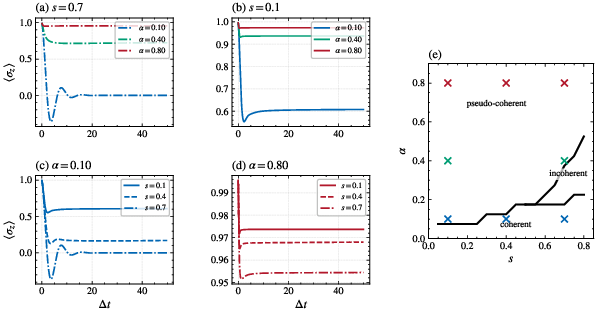
Figure 1: Spin polarization dynamics and resulting population-based phase diagram, demarcating coherent, incoherent, and pseudo-coherent regimes in the $0
Analysis of the spin entanglement entropy $0
Figure 2: Spin entanglement entropy dynamics for representative parameter sets and the resulting stationary entropy landscape. The entropy ridge (dashed), extracted from cut-wise maxima, largely tracks the population-based boundary at small $0
Notably, the entropy landscape is dome-shaped, with a single ridge of maximal stationary spin-bath entanglement. At small $0
The Bloch-sphere analysis makes this correspondence explicit: the entanglement plateau corresponds to the spin subsystem relaxing to a fixed-radius shell, with radius given by (s,α)0. The stationary entropy is strictly determined by this radius. Tracking full three-dimensional and projected Bloch trajectories, the transition from coherent to pseudo-coherent behavior is evident as a passage from spiral to single-excursion (hook-shaped) trajectories, with minimal stationary radius attained within the incoherent (high-entanglement) regime.
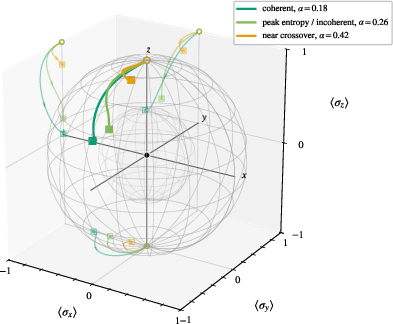
Figure 3: Three-dimensional representative Bloch trajectories at (s,α)1, colored by dynamical regime and terminating at different radii corresponding to the entropy plateau.
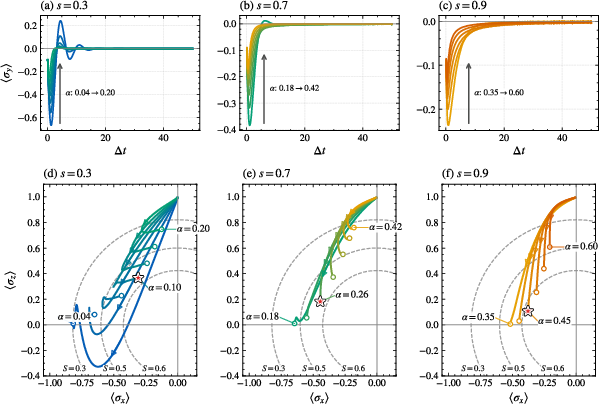
Figure 4: Tunneling current (s,α)2 and corresponding projected Bloch-sphere trajectories for varying (s,α)3, with constant-entropy contours shown. Trajectories terminating closer to the origin denote greater stationary entanglement.
Mode-Resolved Environmental Entanglement
To dissect the role of different environmental modes, the time-resolved one-mode entanglement entropy (s,α)4 and the spin-mode mutual information (s,α)5 were computed for low- and high-frequency modes. In pseudo-coherent and incoherent regimes, (s,α)6, indicating that these bath modes entangle largely through their direct correlation with the spin. In contrast, in the coherent regime, (s,α)7, signaling pronounced bath-mode correlations mediated by coherent spin dynamics.
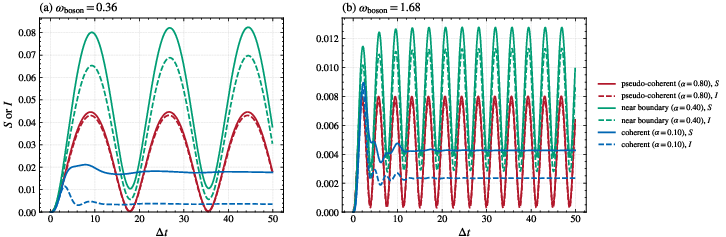
Figure 5: Mode-resolved environmental entanglement for selected low- and high-frequency bath modes across dynamical regimes. Oscillation amplitude and the relative size of (s,α)8 and (s,α)9 reveal the entanglement structure.
Spectral analysis of H^SB=−21ℏΔσx+j∑[21mjωjx^j2+2mjp^j2]+σzj∑(cjx^j)/20 shows that its oscillation frequency H^SB=−21ℏΔσx+j∑[21mjωjx^j2+2mjp^j2]+σzj∑(cjx^j)/21 is linearly proportional to the bare boson frequency H^SB=−21ℏΔσx+j∑[21mjωjx^j2+2mjp^j2]+σzj∑(cjx^j)/22 (slope H^SB=−21ℏΔσx+j∑[21mjωjx^j2+2mjp^j2]+σzj∑(cjx^j)/23), and the amplitude H^SB=−21ℏΔσx+j∑[21mjωjx^j2+2mjp^j2]+σzj∑(cjx^j)/24 decays rapidly for higher H^SB=−21ℏΔσx+j∑[21mjωjx^j2+2mjp^j2]+σzj∑(cjx^j)/25. Thus, entanglement and non-Markovian effects are dominated by low-frequency environmental modes.
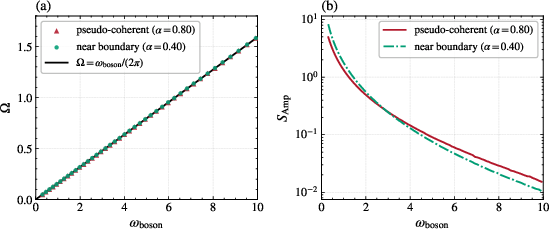
Figure 6: Entanglement oscillation frequency scaling linearly with H^SB=−21ℏΔσx+j∑[21mjωjx^j2+2mjp^j2]+σzj∑(cjx^j)/26 and rapidly decaying amplitude, indicating dominance of low-frequency bath modes for entanglement dynamics.
Implications and Future Directions
The study establishes that the stationary spin-bath entanglement entropy is a sensitive, physically meaningful observable that complements, but does not entirely mirror, traditional population-based classifications of open system dynamics. While the dynamical phase diagram sharply distinguishes coherent, incoherent, and pseudo-coherent regimes, the stationary entanglement landscape only resolves the maximal entanglement region and a single nonsplitting ridge. This signals that spin-bath correlation structure may encode different physical information than population behavior alone, particularly in regimes where slow bath modes and non-Markovian memory are pronounced.
Practically, this work demonstrates that TTN-based tensor network time-propagation methods can reliably extract both population and entanglement observables for high-dimensional open-system models. Given that the entanglement structure is largely set by low-frequency bath modes, future improvements in tensor network environmental truncation or mode selection could exploit this for further efficiency in open quantum system simulation. On a more conceptual level, the geometry of the stationary reduced state (Bloch-sphere interpretation) provides direct insight into the connection between observables and underlying quantum correlations.
Potential extensions include (i) inclusion of finite bias, (ii) finite-temperature initial conditions, (iii) multimode and structured spectral densities for modeling molecular environments, and (iv) extending the entanglement analysis to multipartite and bipartite bath correlations, which may illuminate more complex quantum phase behavior or decoherence processes relevant in condensed matter and quantum information settings.
Conclusion
This paper provides a comprehensive, high-precision elucidation of the entanglement structure underlying dynamical phase transitions in the sub-Ohmic spin-boson model. Stationary spin-bath entanglement, revealed via TTN-TDVP-PS simulation, offers a complementary view to population-based phase diagrams, tracing a distinct entanglement landscape that reflects but does not necessarily map one-to-one onto dynamical transitions. Low-frequency bath modes are shown to dominate entanglement formation and entropy oscillations, with the Bloch-sphere viewpoint offering clear geometric understanding of regime transitions. These results clarify the relationship between dissipative dynamics and open-system entanglement, setting the stage for future applications in quantum simulation, quantum thermodynamics, and entanglement characterization of complex quantum environments.

