Three-particle di-light-cone distribution amplitudes of the B-meson in heavy-quark effective theory
Published 18 Jun 2026 in hep-ph | (2606.20267v1)
Abstract: We present a systematic study of the three-particle di-light-cone distribution amplitudes (DLCDAs) of the B-meson. They are defined through B-meson--to--vacuum matrix elements of trilocal HQET operators, in which the light antiquark and the gluon field-strength tensor are located on two back-to-back light rays. In this sense, the DLCDAs generalise the conventional B-meson light-cone distribution amplitudes to configurations where soft fields couple to collinear degrees of freedom in two distinct directions. As such, they parametrise the non-perturbative dynamics associated with non-factorisable soft-gluon contributions in rare and non-leptonic exclusive B-meson decays. We derive the complete Lorentz decomposition of the matrix elements of generic trilocal operators, identify eight independent DLCDAs, and organise them in a basis of definite twist. Using local operator identities and equations-of-motion constraints, we obtain tree-level relations for their normalisation integrals and first moments in terms of a minimal set of hadronic parameters. These relations allow us to construct simple momentum-space models for all independent DLCDAs. For the leading-twist distribution, we further incorporate the perturbative radiative tail at order αs and discuss its impact on the resulting parametrisation.
The paper presents a systematic classification of eight independent three-particle DLCDAs for the B-meson using Lorentz decomposition and EOM constraints.
It introduces a factorized ansatz for momentum-space models and incorporates one-loop radiative corrections that generate complex phases and power-like tails.
The analysis clarifies exclusive B-decay observables, offering a rigorous framework for future phenomenological studies and lattice QCD validations.
Three-Particle Di-Light-Cone Distribution Amplitudes of the B-Meson in HQET
Introduction and Motivation
This work systematically investigates the three-particle di-light-cone distribution amplitudes (DLCDAs) for the B-meson within the framework of heavy-quark effective theory (HQET). DLCDAs generalize the standard light-cone distribution amplitudes (LCDAs) by considering correlations where soft fields couple to collinear degrees of freedom in two distinct, back-to-back light-cone directions. These amplitudes are indispensable for parametrizing non-factorizable soft-gluon dynamics in rare and non-leptonic exclusive B-meson decays, especially in processes with hadronic recoil in multiple directions or non-eikonal soft-gluon couplings.
Lorentz Structure and Classification of DLCDAs
The authors perform a complete Lorentz decomposition of trilocal HQET matrix elements related to DLCDAs by considering heavy-quark, light-antiquark, and gluon field-strength tensors located on two separate light cones. Through detailed analysis and constraints derived from equations of motion (EOM) and Dirac matrix identities, they identify eight independent DLCDAs. These are organized into a basis of definite twist, reflecting SCET power counting and conformal spin assignments.
DLCDAs are divided into:
Leading-twist: Φ3(nnˉ), governing dominant contributions to large-recoil exclusive decays.
To enable practical applications, the normalization integrals and first moments of DLCDAs are linked to a minimal set of hadronic parameters (B1, B2, B3) via local operator identities and EOM constraints. The systematic elimination and reduction of parameters ensure that, for phenomenological modeling, only four independent first moments need to be specified, with all others obtained from analytic relations. The local normalization constants for the various DLCDAs are provided in terms of the chromoelectric and chromomagnetic parameters, which are accessible via QCD sum rules.
A factorized ansatz for momentum-space models is adopted:
B4
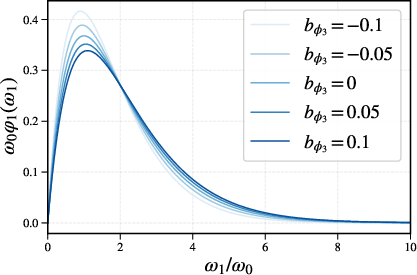
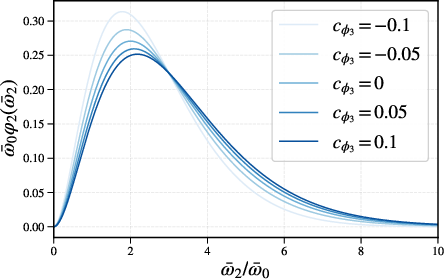
with exponential suppression at large momenta, polynomial prefactors set by conformal spin, and Heaviside functions enforcing positive support in B5. Reference scales for quark and gluon momenta (B6, B7) are distinct, accommodating differing renormalization-group behavior.
Figure 1: Illustration of the B8 and B9 dependence of the leading-twist DLCDA B0; rescaled to manifest variations in shape parameters.
One-Loop Radiative Tail and Complex Structure
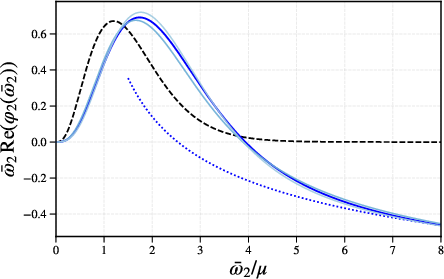
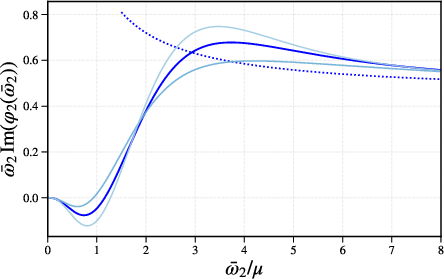
The paper incorporates the perturbative radiative tail for the leading-twist DLCDA B1, using one-loop renormalization group equations in position space. Unlike conventional LCDAs, radiative corrections here generate nontrivial complex-valued functions due to rescattering involving the two light-cone directions. The analytic structure permits negative light-cone momenta, but practical factorization restricts integration to positive values.
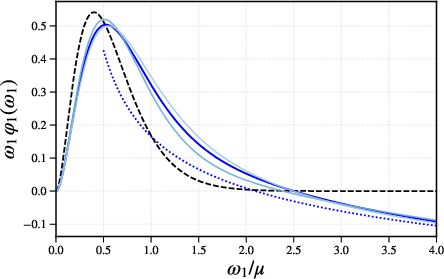
The implementation proceeds by interpolating between the hadronic model at large separation and the perturbative tail at short distances, controlled by an auxiliary scale B2. The radiative tail modifies the short-distance expansion, inducing power-like behavior at large momenta and complex phases related to B3 color factors:
Figure 2: Effect of the radiative tail in the function B4: Comparison between tree-level parametrization and one-loop improved model, highlighting the shift and zero crossing.
Numerically, radiative tails enhance the distribution at large B5, produce zero-crossings, and, for the gluon momentum direction, induce significant imaginary parts. This intricately affects the moments and model parameters, such that the tail is proportional to the characteristic scale and color factors, with B6 enhancements relative to B7.
Implications for Factorization and Exclusive Decay Observables
The DLCDAs provide a refined tool for accounting for non-factorizable soft-gluon effects in many exclusive B8-decay scenarios:
Long-distance penguin contributions, e.g., in B9 [Qin:2022rlk].
Non-leptonic two-body Φ3(nnˉ)0 decays with significant hadronic recoil in multiple directions.
Weak-annihilation amplitudes involving four- and five-particle DLCDAs [Boeer:CKM2025].
The complex-valued nature and strong phases generated suggest these amplitudes may contribute previously neglected sources to observables, including CP asymmetries and flavor anomalies. The analysis provides a rigorous foundation for incorporating DLCDAs into LCSR and QCDF as hadronic input for precision phenomenology.
Future Directions
The modeling framework established here, and the analytic control of moments and radiative corrections, facilitate further developments:
Numerical determination of DLCDAs from lattice QCD and improved sum rule techniques.
Precise implementation in LCSR for non-leptonic decays and weak-annihilation processes.
Exploration of impact on the interpretation of flavor anomalies and searches for new sources of CP violation.
Extension to baryonic and multi-particle light-cone amplitude scenarios.
Investigation of two-loop and higher-order renormalization effects, especially on nontrivial analytic structure and complex phases [Huang:2023jdu].
Conclusion
The study presents a comprehensive classification, parametrization, and modeling of three-particle di-light-cone distribution amplitudes for the Φ3(nnˉ)2-meson in HQET. By combining rigorous Lorentz analysis, local EOM constraints, and systematic treatment of radiative corrections, the DLCDAs are rendered for immediate use in exclusive Φ3(nnˉ)3-decay calculations. The emergence of complex-valued functions and distinctive large-momentum radiative tails underscore the qualitative distinction from conventional LCDAs. The framework sets the stage for improved theoretical predictions in the flavor sector, with clear routes to leveraging these amplitudes in ongoing and future experimental analyses of rare and non-leptonic Φ3(nnˉ)4-decays.