- The paper derives a systematic higher-loop expansion linking quantum Krylov complexity to wormhole length in sine-dilaton gravity.
- It employs an operator-based Liouville framework with explicit five-loop perturbative corrections to overcome previous computational barriers.
- Findings reveal analytic and numerical confirmation of both short-time diffusive and long-time ballistic regimes, including nonperturbative effects.
Higher-Loop Krylov Complexity and Wormhole Length in Sine-Dilaton Gravity via DSSYK
Introduction and Theoretical Context
This work rigorously addresses the connection between quantum complexity measures and geometric observables in two-dimensional gravity, focusing on the identification of the quantum wormhole length in sine-dilaton gravity with the Krylov spread complexity in the double-scaled Sachdev-Ye-Kitaev (DSSYK) model. The relevance stems from the holographic framework, wherein observables in boundary quantum systems map to geometric quantities in a bulk gravitational dual. Recent advances have equated the Krylov complexity—rooted in operator growth and information spreading under chaotic dynamics—to the length of an Einstein-Rosen bridge (wormhole) in JT or sine-dilaton gravity, thereby providing a quantum-complexity perspective on bulk spacetime geometry.
On the field-theoretic side, the SYK model and its double-scaling (DS) limit have become pivotal in understanding quantum chaos, random matrix universality, and the emergence of black hole physics. In the DS limit, boundary correlators and spectra are tractable via chord diagrammatics and admit precise connections to bulk gravity theories, notably sine-dilaton gravity, which extends the JT paradigm beyond the strictly AdS regime.
Krylov Complexity and Operator Dynamics in DSSYK
The authors exploit the operator-based definition of Krylov spread complexity, utilizing the Lanczos algorithm to recursively define the Krylov basis through repeated applications of the Hamiltonian on a reference state. In DSSYK, this basis is identified with the chord basis, where the Hamiltonian takes a tridiagonal form with q-oscillator algebra. Krylov complexity is then given by
C(t)=ℓ=1∑∞ℓ∣⟨ℓ∣e−iHt∣0⟩∣2
where ∣ℓ⟩ are chord states. The time-evolved amplitudes satisfy a chain of coupled ODEs, making the model amenable to both analytic and efficient numerical treatments.
Higher-Loop Semiclassical Expansion via Operator Liouville Equation
A central technical innovation is the use of the Heisenberg equations of motion for the Krylov number operator in the DSSYK q-algebra, yielding an operator-valued Liouville equation:
ℓ^′′(μ)=−2qℓ^(μ),
with initial conditions set by the q-oscillator algebra, where μ is related to real time t. This formalism enables a controlled perturbative (semiclassical) expansion in the 't Hooft-like parameter λ, which in the gravity dual corresponds to the semiclassical limit of small coupling.
The methodology is algorithmic: the authors provide an explicit expansion for ℓ^(μ) in powers of C(t)=ℓ=1∑∞ℓ∣⟨ℓ∣e−iHt∣0⟩∣20, up to five loops for complexity (i.e., terms up to C(t)=ℓ=1∑∞ℓ∣⟨ℓ∣e−iHt∣0⟩∣21), and to lower but nontrivial orders for the variance and higher cumulants. Crucially, this operator approach overcomes the technical barriers encountered in direct saddle-point or C(t)=ℓ=1∑∞ℓ∣⟨ℓ∣e−iHt∣0⟩∣22-formalism-based path integral expansions, which become intractable beyond one-loop.
The leading order recovers known results:
C(t)=ℓ=1∑∞ℓ∣⟨ℓ∣e−iHt∣0⟩∣23
corresponding to the classical wormhole length.
The five-loop expression for Krylov complexity is given as:
C(t)=ℓ=1∑∞ℓ∣⟨ℓ∣e−iHt∣0⟩∣24
where the C(t)=ℓ=1∑∞ℓ∣⟨ℓ∣e−iHt∣0⟩∣25 are explicit polynomials in C(t)=ℓ=1∑∞ℓ∣⟨ℓ∣e−iHt∣0⟩∣26 with time-dependent coefficients. For example, up to the third order:
- C(t)=ℓ=1∑∞ℓ∣⟨ℓ∣e−iHt∣0⟩∣27
- C(t)=ℓ=1∑∞ℓ∣⟨ℓ∣e−iHt∣0⟩∣28
- C(t)=ℓ=1∑∞ℓ∣⟨ℓ∣e−iHt∣0⟩∣29 contain higher polynomial and transcendental terms, detailed explicitly in the main text.
This expansion constitutes a significant analytic extension beyond prior one-loop (leading ∣ℓ⟩0) results. The higher-loop corrections encode the quantum and ∣ℓ⟩1-like effects, crucial for understanding the quantum structure of complexity-growth and the dual geometry beyond the semiclassical limit.
Krylov Variance, Higher Cumulants, and Fluctuations
The same expansion procedure yields closed expressions for the Krylov variance (second cumulant) and third-order cumulant, both interpreted as quantifiers of quantum fluctuations of the wormhole length observable. The variance reads
∣ℓ⟩2
where notably,
- ∣ℓ⟩3
with further terms given in the text.
These cumulants generalize the approach from mean values to fluctuation diagnostics—enabling a probe not just of the average geometric dual, but of the quantum spread and higher moments.
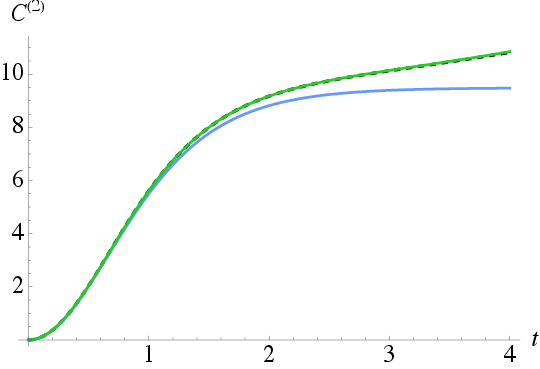
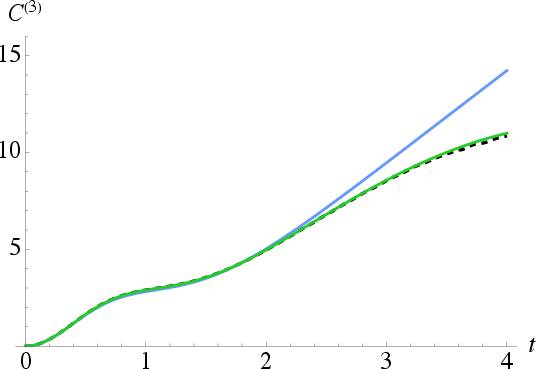
Figure 1: Comparison between the numerical evaluation of the Krylov variance and third-order cumulant at ∣ℓ⟩4, ∣ℓ⟩5, and analytic expansion results.
Asymptotics: Small-Time and Late-Time Linear Growth
The expansion recovers the universal short-time diffusive behavior, with leading terms
∣ℓ⟩6
and for the variance,
∣ℓ⟩7
These results align with preceding estimates, but the exact ∣ℓ⟩8 corrections presented allow precise matching to numerics.
At late times, the complexity displays ballistic (linear) growth characteristic of operator spreading in maximally chaotic systems:
∣ℓ⟩9
with the slope q0 given by a perturbative series up to q1, conjectured to resum as
q2
and with nonperturbative corrections q3 detected numerically.
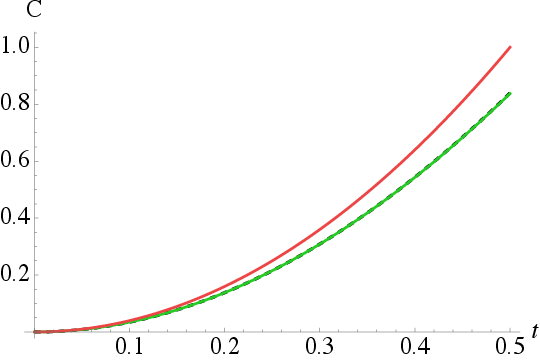
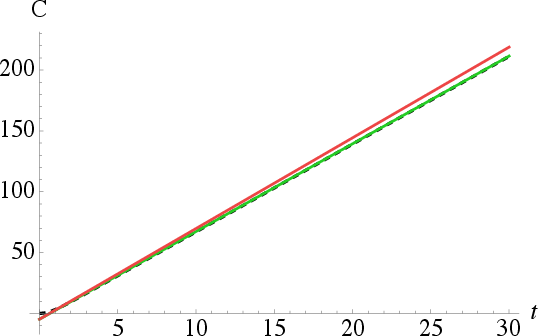
Figure 2: Left—small time behavior of the Krylov complexity at q4, q5, demonstrating analytic-numeric matching; Right—large-time, linear growth with analytic and numeric slopes.
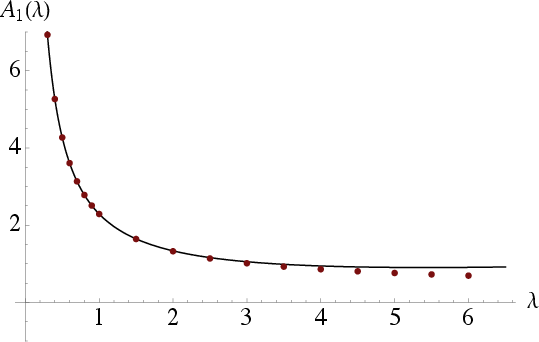
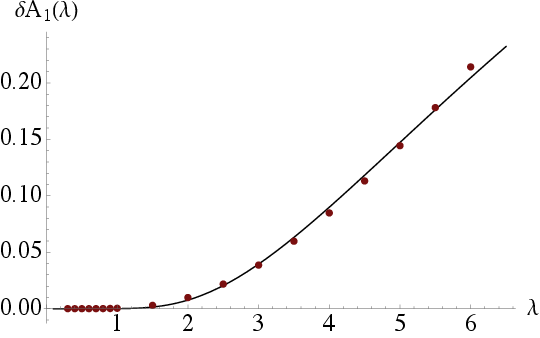
Figure 3: Comparison between the numerically estimated slope q6 and the perturbative generating function q7, with residuals fitted by q8 indicating nonperturbative effects.
Implications, Open Problems, and Future Directions
This analysis cements the semiclassical and quantum correspondence between Krylov complexity and geometric wormhole length in the sine-dilaton gravity/DSSYK correspondence, robustly extending the holographic complexity-volume paradigm to higher-loop order. The ability to compute systematic corrections places the operator Liouville approach as a powerful technical tool for both quantum gravity and quantum information perspectives.
From a practical standpoint, the results facilitate precision tests of holographic dualities using quantum complexity. The numerical confirmation and analytic resummation conjectures for the late-time slope, as well as the explicit nonperturbative corrections, suggest that quantum gravity observables even in low-dimensional gravity have rich non-perturbative structure accessible via controlled boundary computations.
On the theoretical side, an important open direction is the analytic determination of q9 across all coupling, possibly via exact spectral methods for the DSSYK chord Hamiltonian, which could further resolve the physical origin of observed nonperturbative corrections. Extending these techniques to finite temperature and capturing the full periodicity structure in ℓ^′′(μ)=−2qℓ^(μ),0 remains highly non-trivial but is, in principle, algorithmically tractable as discussed.
Additionally, the extension to higher cumulants in this operator framework paves the way for refined complexity-fluctuation-bulk geometry correspondences, deepening the understanding of the quantum structure of wormhole geometry.
Conclusion
The work provides an explicit and systematic higher-loop expansion of Krylov complexity and its fluctuations in the double-scaled SYK model, mapping directly to the quantum wormhole length in sine-dilaton gravity. The operator-based Liouville equation and its perturbative solution represent a significant technical advancement, enabling controlled computations inaccessible to earlier methods. The expansions accurately interpolate between short and long-time regimes and precisely capture both perturbative and leading nonperturbative effects on complexity growth. These results contribute essentially to the quantum gravity and holographic complexity literature, offering a template for the analysis of operator growth and geometry in chaotic quantum many-body systems.
Reference:
"Higher-loop wormhole length in sine-dilaton gravity from DSSYK Krylov complexity" (2606.20220)