- The paper introduces a variational framework that leverages backpropagation to learn quantum circuits encoding both unitary and non-unitary operators within hardware constraints.
- It demonstrates significant improvements, achieving up to three orders of magnitude error reduction in quantum simulation and a 20% improvement in quantum chemistry tasks.
- The approach minimizes resource requirements by using a single ancilla qubit for block-encoding, paving the way for efficient quantum hardware-software co-design.
Operator Learning for Efficient Quantum Computation
Introduction
“Operator Learning for efficient Quantum Computation” (2606.20184) presents a hardware-agnostic, variational framework for synthesizing quantum circuits that encode general linear operators—both unitary and non-unitary—with explicit flexibility for hardware constraints such as qubit connectivity and interaction range. The framework leverages backpropagation and a regularized cost function, enabling direct circuit learning for arbitrary operators while utilizing only a single ancilla qubit for non-unitary block encoding. This general approach is demonstrated across quantum simulation, quantum chemistry, and engineering applications, with quantifiable advantages over standard Suzuki-Trotter decompositions and existing tensor network-based quantum circuit synthesis strategies.
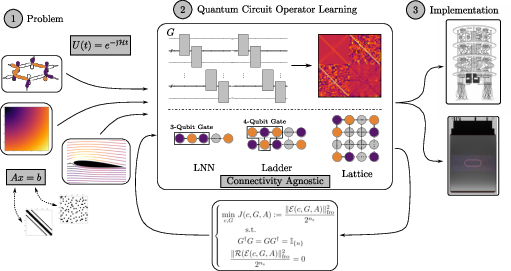
Figure 1: Illustration of the entire quantum operator learning approach.
Methodological Framework
The protocol formalizes operator learning as a variational optimization problem over an (optionally hardware-constrained) circuit ansatz. Arbitrary operators, including non-square and non-unitary matrices, are embedded—via zero-padding and block-encoding, respectively—onto an n-qubit register. Block-encoding of non-unitaries is realized with a single ancilla qubit, with the operator implemented as the principal sub-block of a larger unitary acting on the extended register.
The circuit ansatz is a product of parameterized r-qubit gates, arranged in l layers. Each gate acts on a chosen subset of qubits Gij, typically corresponding to hardware connectivity (e.g., LNN, lattice, or all-to-all).
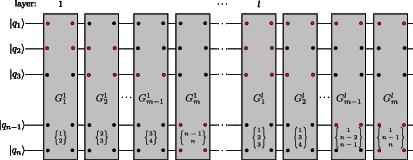
Figure 2: Illustration of an l-layer trainable quantum circuit ansatz G detailing the placement and support of local gates.
Optimization proceeds by automatic differentiation (backpropagation) on the local gate parameters, with SVD-based projections enforcing unitarity after each gradient step. The cost function combines operator reconstruction error (Frobenius norm) and an ℓ2-regularization term, the latter incentivizing smooth, homogeneous error profiles. For non-unitary operators, the normalization factor c and ancilla postselection success probability are computed analytically within the loop.
The protocol supports hierarchical optimization, training gates in order of their impact (determined through amplitude encoding or classical relevance) before a final global refinement, improving convergence and minimizing barren plateau effects.
Computational Complexity
The classical optimization cost scales as O(klm(23r+22n2r)), dependent on system size n, gate size r0, number of layers r1, and number of gates per layer r2. The dominant term is from contracting full Hilbert space operators; this is ameliorated by using local gates and can be mitigated further with tensor network extensions for operators of limited entanglement entropy, or where hardware constraints permit more efficient representations.
Gate counts and depths scale favorably for moderate r3 and r4, enabling resource-efficient circuits surpassing the gate complexity of Trotter expansions for comparable accuracy.
Quantum Applications
Quantum Simulation
For the 1D transverse-field Ising model with longitudinal field, the learned propagator circuits r5 (with 2-local and 3-local gates, LNN topology, and initializations from first-order Suzuki-Trotter) achieve dramatically improved error scaling compared to standard r6 and r7. Notably, the learned circuits display algebraic error scalings r8, with improvements of up to three orders of magnitude in the small time-step regime.
For fixed time-step r9, circuit errors remain nearly independent of system size up to l0 qubits, consistent with Lieb-Robinson information propagation bounds and confirming the transferability of learned gate parameters with increasing l1.
Strong result: The variational circuits not only outperform Trotterizations of equivalent quantum resources but also match or surpass the best-known results for local gate-based circuit learning approaches.
Quantum Chemistry
A PPP model of butadiene mapped to l2 qubits via Jordan-Wigner transformation is used as a testbed. The variational protocol, using a hardware-inspired circuit layout matching the 3-local and 2-local interaction structure, realizes a consistent l3 reduction in error compared to the first-order Trotter expansion across a range of time steps, without increase in quantum resources.
While not as large as in spin models, this improvement is robust. The limitations in gain are attributed to the more delocalized structure of the Trotterized generators in quantum chemistry, suggesting that initialization and ansatz engineering may become bottlenecks for highly nonlocal operators.
Engineering Applications
Discrete Laplace Operator
The framework is applied to the amplitude-encoded implementation of the second-derivative (Laplace) operator with Dirichlet boundary conditions on quantum registers (l4 to l5 qubits). Both LNN and lattice-inspired topologies are considered.
For l6, machine-precision operator reconstruction is achieved, with success probabilities matching theoretical limits for normalized encodings. For larger l7, approximation error is nearly constant, suggesting limitation due to the fixed gate size l8 and emphasizing the importance of layout/topology in expressiveness. Lattice-inspired ansatz consistently outperforms LNN for the same resource count, due to more efficient realization of long-range correlations.
Numerical result: For small l9, success probabilities Gij0 (matching operator norms), and relative errors drop below Gij1. For increasing Gij2, errors rise to Gij3, but remain invariant with further system size increases.
Fluid Dynamics Panel Method Operator
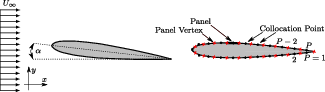
Figure 3: Illustration of the flow around a NACA 0012 airfoil subjected to an approach flow Gij4.
A dense, non-unitary operator from a classical panel method for airfoil flow is encoded using block-encoding with a single ancilla. The regularization term in the cost function is critical for homogeneous error profiles and practical performance in such dense operator settings. Detailed numerical data confirm high-fidelity encodings and practical postselection probabilities within the feasibility range for near-term QPUs.
Regularization and Optimization Strategy
Empirical comparisons between global (non-hierarchical) optimization, hierarchical optimization, and hierarchical optimization with Gij5-regularization show that the latter strategy achieves smallest and most uniformly distributed reconstruction error. In demanding cases (e.g., Gij6 Laplace operator), final relative errors with regularization and hierarchical optimization approach those observed for smaller, more tractable systems.
Implications and Outlook
The presented operator learning framework demonstrates that variational synthesis of compact, hardware-conforming circuits is possible for a broad spectrum of operators—unitary, non-unitary, sparse, or dense—with improved resource scaling and error rates compared to standard operator decompositions and tensor network-based schemes. The reduction in ancilla qubit requirements (single ancilla for block-encoding) and directly learned gate sequences ameliorate key practical hurdles for both NISQ and early fault-tolerant devices. The approach generalizes across quantum simulation, quantum chemistry, and classical engineering domains.
Theoretically, the capacity to variationally adapt to hardware constraints opens avenues for quantum hardware-software co-design and quantum device specialization. Practically, the ability to compress arbitrary operators to circuits efficiently portends enhanced expressivity for quantum simulation, quantum linear algebra, and quantum optimization, with feasible extensions to high-dimensional tensor network representations when classical resources limit system size.
Future developments include scaling to larger system sizes via approximate tensor network methods, further reduction of optimization-induced barren plateau effects, and integration with quantum hardware through hybrid quantum-classical workflows. Incorporating improved initialization protocols and exploiting classical surrogates may enable routine operator learning for problem sizes relevant to industrial and scientific applications.
Conclusion
This work establishes a flexible, resource-efficient, and highly generalizable method for operator learning and quantum circuit synthesis, with demonstrated advantages in accuracy, success probability, and hardware compatibility across diverse application domains. The methodology provides a foundation for future advances in variational quantum algorithms, hardware-adaptive compiler toolchains, and cross-domain quantum operator encodings.
References
(2606.20184): Operator Learning for efficient Quantum Computation.

