- The paper introduces a measurement-domain formulation that uses raw detector hit data to enhance material discrimination in cosmic-ray muon imaging.
- It employs robust statistical models, including Student‑t and Huber loss functions, to adjust for momentum uncertainties and cosmic-ray fluctuations.
- Benchmark results show that the method outperforms classical algorithms, notably improving ROC-AUC in low‐contrast scenarios such as aluminum detection.
Measurement-Domain Formulation for Muon Tomography: Raw-Hit Likelihoods and Material Discrimination
Introduction and Motivation
The paper "Raw-Hit Muon Tomography: A Measurement-Domain Formulation for Cosmic-Ray Muon Imaging" (2606.20180) addresses the computational inverse problem intrinsic to cosmic-ray muon tomography (MT), formulating it directly at the level of raw detector hit coordinates. Cosmic-ray muons serve as penetrating probes for imaging concealed or voluminous structures, leveraging their multiple Coulomb scattering (X0) and ionization energy loss (ρZ/A) to extract material-specific contrast. Traditionally, MT pipelines reduce raw hits to derived per-muon summaries—scattering angles, displacements, or momentum estimates—prior to inversion, thereby discarding hit-level correlations and momentum-dependent nuances that fundamentally impact contrast and algorithmic robustness.
RHMT rejects this conventional reductionist paradigm, instead integrating the stochastic particle-transport model within the reconstruction pipeline. The approach preserves detector-hit granularity and marginalizes nuisance parameters using blank scans; consequently, it admits robust likelihoods for both scattering and energy-loss channels, each extracting orthogonal material properties.
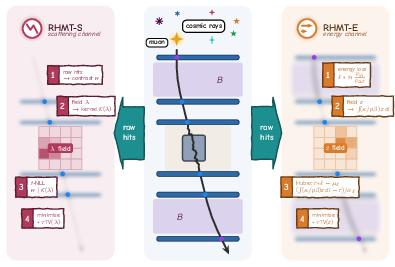
Figure 1: Measurement-domain view of RHMT illustrating raw-hit acquisition (a), scattering contrast extraction (b), and energy-loss estimation (c).
Methodology: RHMT-S and RHMT-E Measurement-Domain Likelihoods
Raw-Hit Scattering (RHMT-S)
RHMT-S constructs a penalized likelihood over the joint covariance of hit coordinates after analytically projecting out the nuisance straight-track component. The Fermi–Eyges covariance captures the cumulative effect of scattering kicks, parameterized by radiation-length density λ=1/X0 and scaled by a per-muon momentum-dependent factor. Since per-muon momentum is unmeasured in practical tracking setups, the momentum scale is marginalized using an inverse-gamma prior, yielding a Student-t robust likelihood. This statistical formulation confers bounded influence to outlier events and corrects for cosmic spectrum variability, enhancing discrimination sensitivity especially in low-contrast regimes such as aluminium against silicate/concrete backgrounds.
The inversion proceeds via Adam gradient descent, minimizing a penalized negative log-likelihood with anisotropic total-variation (TV) regularization on a voxel grid. Calibration of nuisance parameters is achieved exclusively through blank scan optimization, with operating constants held fixed across all scenes.
Energy-Loss Channel (RHMT-E)
RHMT-E operates in a six-plane spectrometer configuration, utilizing the magnetic bend measurements to obtain log momentum loss (ℓ=ln(pin/pout)). The log-loss is treated as a Bethe–Bloch line integral of electron-density-related contrast (s=ρZ/A) and is favored for its near-homoscedasticity. The likelihood for RHMT-E is specified via a matched Huber loss, providing resilience against non-Gaussian straggling and radiative loss fluctuations. Blank scan calibration matches the residual core and tail, ensuring precise offset removal and robust estimation.
Both RHMT-S and RHMT-E use the same coarse voxel grid, trilinearly sampled per muon. Strong regularization is placed on the depth axis to counteract limited-angle acquisition effects typical in vertical-stack detector geometries.
Benchmark and Experimental Design
A rigorous Geant4 simulation is conducted, employing an RPC-based MT instrument with magnet-free and spectrometer tiers. Scenes consist of U-shaped blocks (lead, water, aluminium) embedded in two backgrounds (SiO2, concrete), each scenario paired with matching blank scans. The U-block is chosen for its spatial complexity and material diversity, intentionally probing both strong and weak contrast domains.
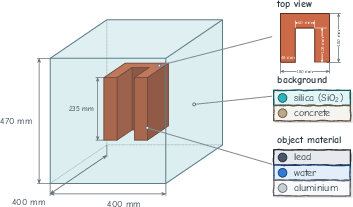
Figure 2: Benchmark geometry: U-shaped object configuration in 400×400×470 mm backgrounds, with full specification of object dimensions and materials.
Exposure is swept across full, 50k, and 15k surviving muons; hit-position resolution is varied from 0.05 mm to 2 mm. Scattering-only, momentum-measured, and energy-loss reconstructions are benchmarked via Mann–Whitney ROC-AUC on a common $6$ mm grid, providing a threshold-free metric for material detectability.
Numerical Results and Analysis
RHMT-S demonstrates a clear improvement over classical scattering baselines (MLS-EM, PoCA, ASR), notably in aluminium scenarios where standard methods approach chance-level discrimination (ρZ/A0–ρZ/A1 ROC-AUC). RHMT-S elevates aluminium AUCs to ρZ/A2–ρZ/A3, raising the six-scene mean to ρZ/A4–ρZ/A5 (ASR: ρZ/A6). Momentum-measured variants further enhance baseline performance, but RHMT-E, leveraging energy-loss contrast, achieves near-perfect AUCs for aluminium (ρZ/A7) and other materials, with mean ρZ/A8.
Robustness analysis under decreasing exposure and increasing position error validates RHMT-E's stability (ρZ/A9 at minimal exposure; λ=1/X00 at maximal error), outperforming all baselines in both axes. RHMT-S retains significant performance advantage under moderate noise, degrading gracefully.
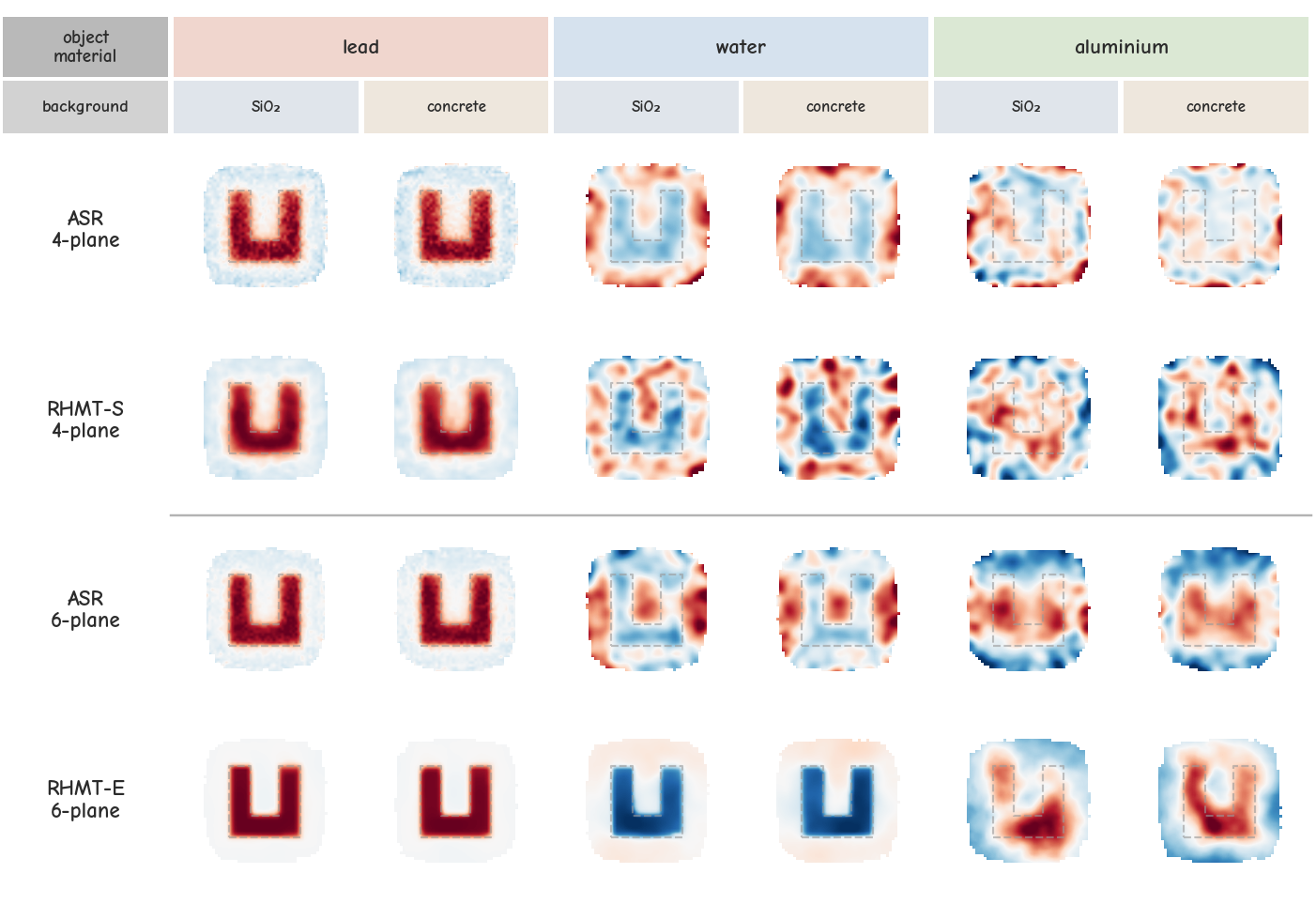
Figure 3: Representative reconstructions at full exposure, λ=1/X01 mm, contrasting RHMT with classical and momentum-measured baselines across all scenes.
Practical and Theoretical Implications
RHMT's measurement-domain paradigm offers substantial practical benefits: by operating directly on detector hits and systematically calibrating nuisance parameters, it circumvents momentum-assignment ambiguities and achieves robust, unbiased inversion. The separation of scattering and energy-loss channels enables material discrimination even when traditional contrast mechanisms fail, exemplified by aluminium scenarios. The model-based calibration via blank scans ensures reproducibility, avoids overfitting, and aligns with cosmic-ray field instrument operational procedures.
Theoretically, RHMT adapts a computable likelihood framework consonant with differentiable imaging pipelines, preserving physical transport models throughout inversion. Its Student-λ=1/X02 and Huber robust functionals accommodate non-Gaussian cosmic-ray fluctuations, exemplifying statistical optimality under constrained detector information.
Future Directions
Future developments should consider integration with learned post-processing (e.g., deep reconstruction flows), dynamic calibration for detector drift, and adaptive grid resolution contingent on event density. Instrumental upgrades, such as angular diversity or hybrid detector configurations, may further improve λ=1/X03-localization and field-of-view completeness. Extension to multi-modal imaging—combining MT with neutron, λ=1/X04-ray, or other passive probes—will augment contrast specificity and broaden applicability.
Conclusion
RHMT presents a comprehensive framework for cosmic-ray muon tomography, formulating the inverse problem directly on raw detector hits and marginalizing all nuisance parameters via blank scans. This approach outperforms classical baselines in both scattering and energy-loss domains, providing robust material discrimination and stability under practical instrument constraints. Detector hits are treated as informative inverse-problem data rather than mere intermediates, establishing RHMT as an effective measurement-domain solution for computational MT.