- The paper introduces DASH, a method that leverages continuous relaxation and Frank-Wolfe filtering to reduce dimensionality in large-scale convex MIQPs for portfolio optimization.
- It systematically prunes assets based on gradient scores, drastically reducing the search space and enhancing computational efficiency.
- Empirical results show that DASH significantly outperforms standard solvers like Gurobi, especially under ill-conditioned covariance and loose box constraints.
DASH: Dimensionality Reduction for Large-Scale Convex MIQPs in Subset Portfolio Optimization
The paper introduces DASH (Decreasing Active Set Hierarchy), a method designed to expedite mixed-integer quadratic programming (MIQP) solvers for large-scale subset selection problems, with emphasis on convex portfolio selection. Such problems, e.g. sparse portfolio construction and feature selection in regression, are NP-hard due to the exponential growth in feasible subsets ((kp) for p assets and k sparsity), rendering typical branch-and-bound (B&B) approaches computationally infeasible for large p.
In practical Markowitz-type portfolio optimization, additional constraints such as box constraints on asset weights and explicit sparsity are critical for real-world deployment. The introduction of a sparsity constraint transforms the quadratic program (QP) into an MIQP, severely increasing computational complexity. Standard solvers (e.g. Gurobi) cannot guarantee global optimality within reasonable time frames as p grows; thus, practitioners seek high-quality incumbents often far from optimality.
DASH aims to alleviate this curse of dimensionality via systematic dimensionality reduction, focusing solver effort on promising subsets while preserving solution quality.
Theoretical Foundations
DASH operates by leveraging continuous relaxations of discrete MIQPs. The sparsity constraint is handled by introducing binary (s∈{0,1}p) and continuous (t∈[0,1]p) variables, enabling formulation of the relaxed feasible set T as a polytope: T={t∈[0,1]p:∥t∥1=k}.
The relaxed objective admits optimization via Frank-Wolfe (FW) constrained gradient descent. The key insight: as FW iterates, asset selection scores (ti) naturally partition into reserved (high p0) and discarded (low p1) groups. The selection process is theoretically justified by properties of the value function and its gradient (see Theorem 3 and 4), which tie financial desirability (high mean, low variance, favorable covariance) to negative gradient components—assets with negative gradients preferentially improve the objective when their participation increases.
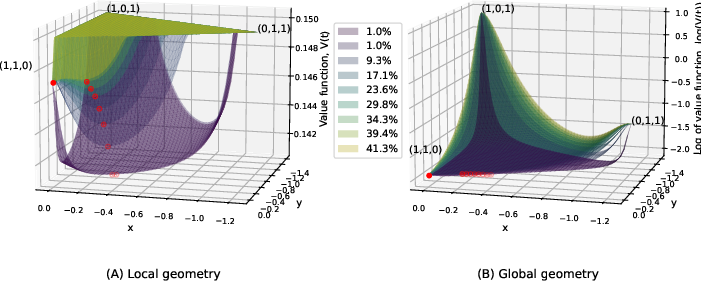
Figure 1: Evolution of the value function landscape and minimizer location as the regularization parameter p2 varies, highlighting sensitivity to the penalization of inactive coordinates.
Gradient elements are decomposed into idiosyncratic risk, box sensitivity, aggregate weight sensitivity, return, and diversification attributes; the sign and magnitude of each term determine asset selection. Assets with gradient components converging to zero are systematically pruned.
Algorithmic Construction
DASH is composed of two stages:
- Frank-Wolfe Filter (FWF): Iteratively solves continuous relaxations via FW steps. At each step, the p3 assets with most negative gradients are selected, updating p4 towards the corresponding binary vertex in p5 (the discrete subset space). Attention scores for discarded assets decay exponentially, enabling early and accurate filtering.
- Application of MIP Solver: The reduced asset universe yields a much smaller MIQP, which is then solved by Gurobi or similar B&B solvers. This restriction reduces feasible subset count from p6 to p7 for filtered subset size p8.
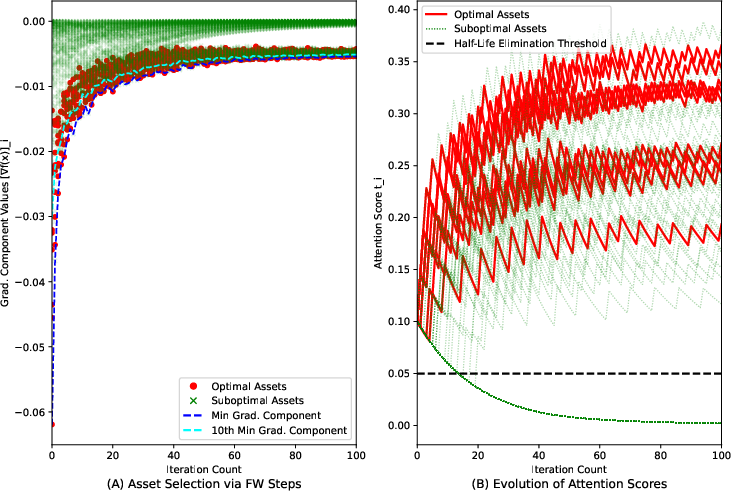
Figure 2: FW attention evolution highlights clear partitioning between assets selected for retention and those discarded across FW steps.
FWF enables substantial computational acceleration via closed-form gradients (when box constraints are loose), as validated in efficiency benchmarks.
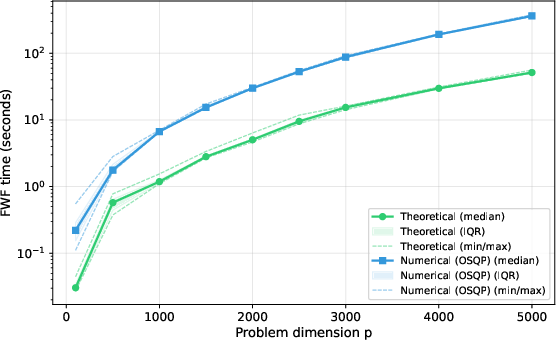
Figure 3: Benchmark demonstrating speed improvements of closed-form gradient evaluation in FWF relative to envelope-gradient approaches.
Empirical Results
Synthetic data generated via factor models allows precise control of covariance matrix condition number (p9), box constraints, and sparsity levels. Experiments reveal:
- Gurobi solve times scale exponentially in k0; problem difficulty is heightened for ill-conditioned k1, loose box constraints, and intermediate sparsity levels.
- For large-scale, ill-conditioned scenarios, DASH consistently achieves significant improvement in incumbent solution quality under time constraints (sometimes exceeding 100% improvement relative to Gurobi). The advantage is most pronounced when the covariance matrix is ill-conditioned, box constraints are loose, and k2 is large.
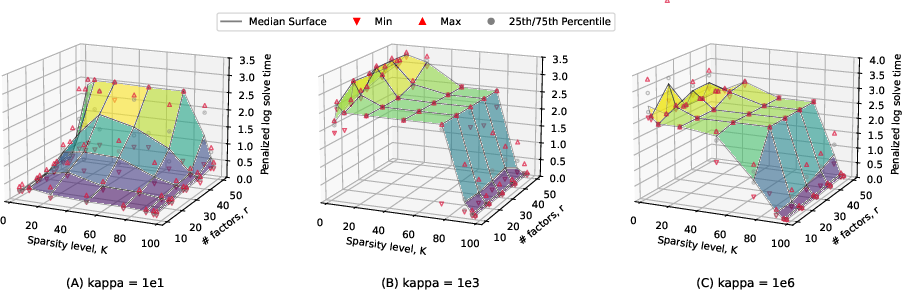
Figure 4: Problem difficulty increases sharply with higher condition number and less restrictive box constraints.
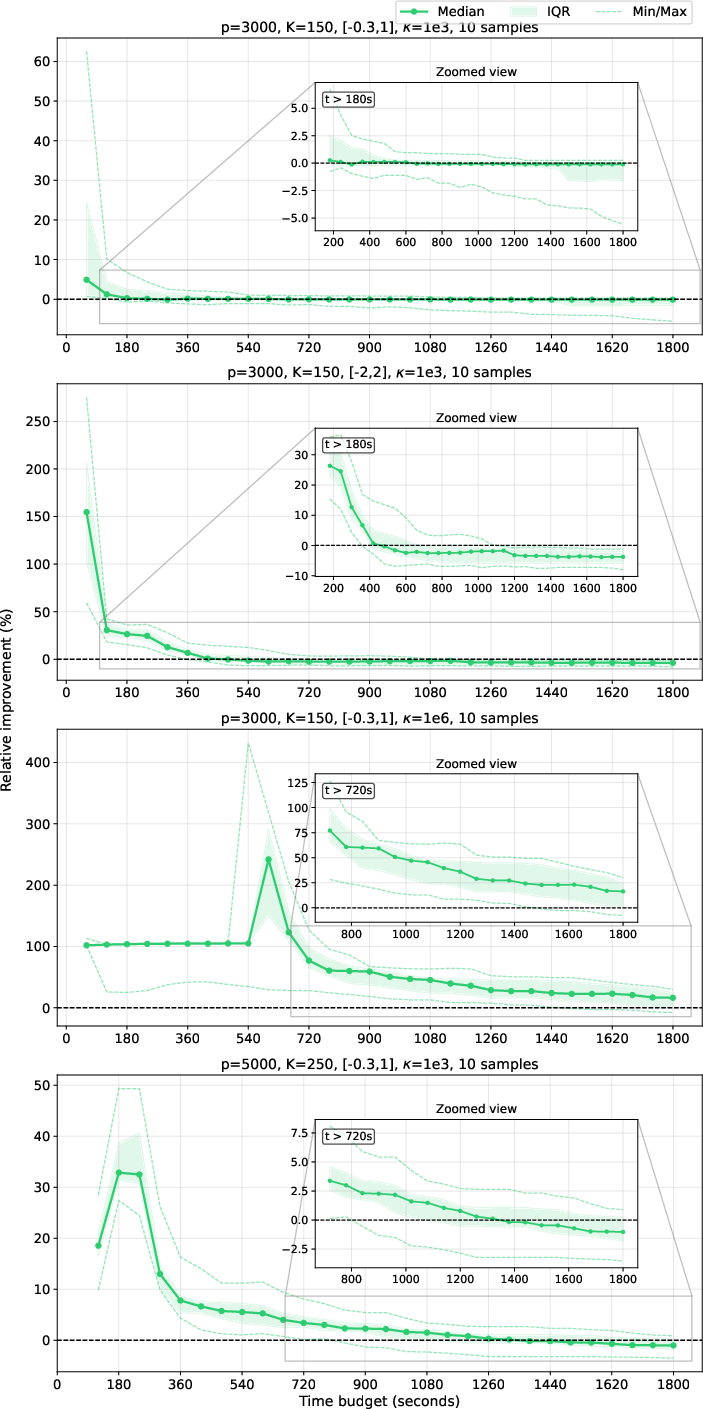
Figure 5: The relative gap in incumbent solution quality between DASH and Gurobi across varying problem configurations demonstrates both the magnitude and persistence of DASH's improvement as complexity increases.
Performance tables display robust win rates for DASH over Gurobi as problem difficulty rises and time budgets are constrained.
Generalization and Extensions
DASH applies to a broad class of subset selection problems where:
- The objective is convex and can be decomposed into a QP for fixed subsets.
- Linear constraints (box, equality) ensure regularity and allow application of FW.
- The continuous relaxation admits differentiability and tractable gradient computation.
Canonical extensions include k3-constrained regression, sparse feature selection, and other cardinality-constrained combinatorial QPs. In all cases, DASH's filtering yields dramatic reductions in the search space without significant impairment to solution quality.
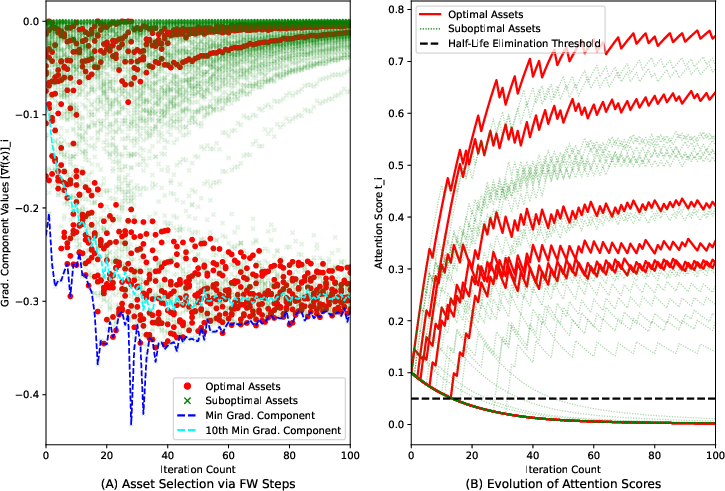
Figure 6: Attention evolution for moderately ill-conditioned covariance, demonstrating partial effectiveness of filtering under increased noise.
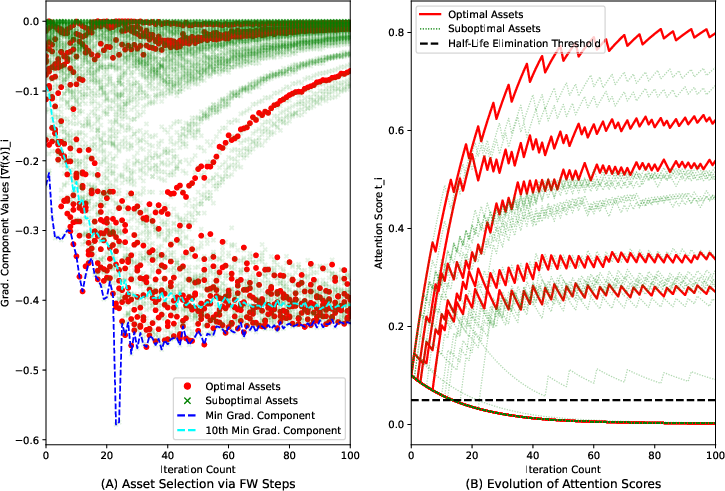
Figure 7: Severe ill-conditioning—FW steps still enable substantial subset partitioning, albeit with risk of sub-optimal pruning.
Practical and Theoretical Implications
DASH provides a metaheuristic framework that complements existing MIP solvers. Its main utility lies in improving the practical quality of feasible solutions within fixed computational budgets. The dimensionality reduction serves both to improve the early stage incumbent and to facilitate more efficient pruning within commercial B&B solvers. For large-scale, difficult instances (e.g. finance, large feature sets), DASH is especially effective.
From a theoretical perspective, the filtering process relies on geometric properties of continuous relaxations and algorithmic structures of FW, opening avenues for analysis of combinatorial QPs via continuous optimization techniques. The abstraction of subset selection spaces provides a foundation for future work in generalized cardinality constraints.
Future Directions
Potential research directions include adaptive tuning of elimination thresholds, combination with other metaheuristics (local branching), and extension to non-convex or nonlinear MIQPs. Integration with statistical approaches (e.g. structured regularization, robust covariance estimation) would enable unified treatment of modeling and computational complexity in high-dimensional selection problems.
Conclusion
DASH presents a principled method for dimensionality reduction in large-scale convex MIQPs. By leveraging continuous relaxations and FW descent, subsets with high marginal impact are identified, and solver resources are concentrated. Empirical evidence demonstrates consistent and significant improvement in incumbent solution quality over commercial solvers in difficult settings, with theoretical guarantees in gradient-driven selection. DASH is generalizable to a broader class of subset selection MIQPs, offering a practical complement to existing exact optimization algorithms.

