- The paper presents a novel self-adaptive scale handling module that dynamically learns calibration coefficients for heterogeneous time series forecasting.
- It integrates a scale calibrating component with a selection policy based on Gumbel-Softmax to mitigate over-calibration and preserve semantic fidelity.
- Empirical evaluations demonstrate improved WMAPE and robust performance across multiple TSF architectures, highlighting its industrial applicability.
Self-Adaptive Scale Handling for Forecasting Time Series with Scale Heterogeneity
Introduction
Joint modeling for time series forecasting (TSF) in scale-heterogeneous contexts remains a persistent challenge, especially for industrial applications such as sales or financial forecasting, where individual series commonly span substantially different orders of magnitude. Traditional normalization strategies induce either signal compression in low-scale series or semantic indistinguishability, while window-based scaling amplifies reconstruction errors on high-scale series. This paper presents a self-Adaptive Scale-handling (AS) module that integrates with contemporary TSF backbones, learning input-adaptive scale coefficients and an explicit selection policy to dynamically calibrate or retain scale factors per instance. Theoretically and empirically, this approach mitigates both over-calibration and semantic obfuscation, resulting in improved forecast accuracy and robustness.
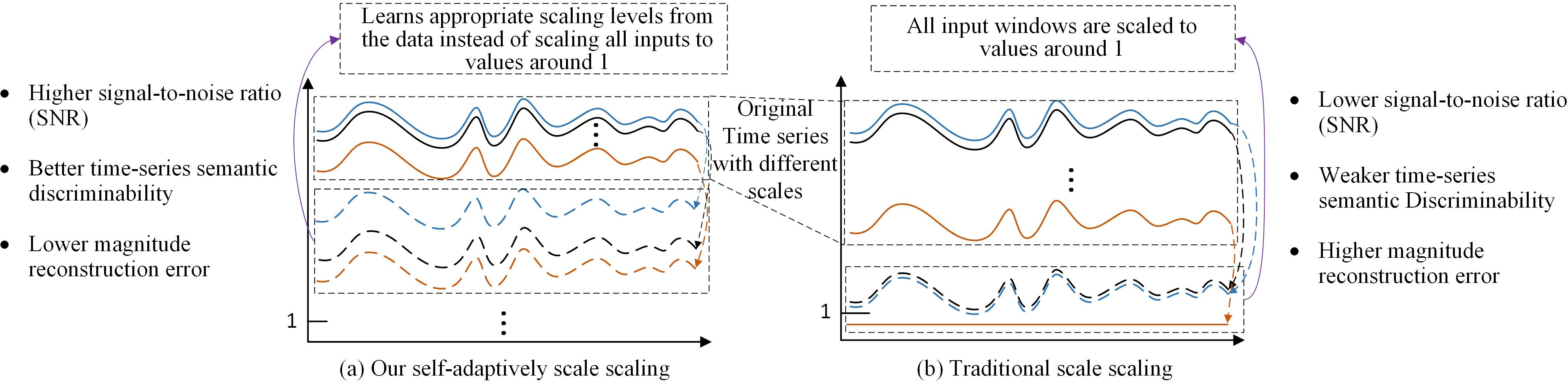
Figure 1: Comparison between adaptive scale handling (left) and traditional scale scaling (right), illustrating superior restoration of signal-to-noise ratio and discrimination under adaptive scaling.
Challenges of Scale Heterogeneity in TSF
Scale heterogeneity in multivariate TS forecloses the conventional practice of applying models trained under scale homogeneity. Joint modeling ideally leverages common latent dynamics, but large discrepancies in magnitude result in underutilization of minor components or inflated errors in reconstruction. This semantic misalignment is exacerbated by uniform transformations, which overly compress informative variations in small-scale series and induce large restoration errors in high-scale windows (Figure 1). Window-based and global scaling approaches fundamentally fail to preserve cross-variable discriminability and propagate error imbalances during inverse transformations.
Self-Adaptive Scale Handling Module
Architecture and Core Components
The proposed AS module operates as a pluggable, architecture-agnostic layer, introducing two major components: Scale Calibrating (SC) and Scaling Selection (SS). The pipeline is summarized below (Figure 2):
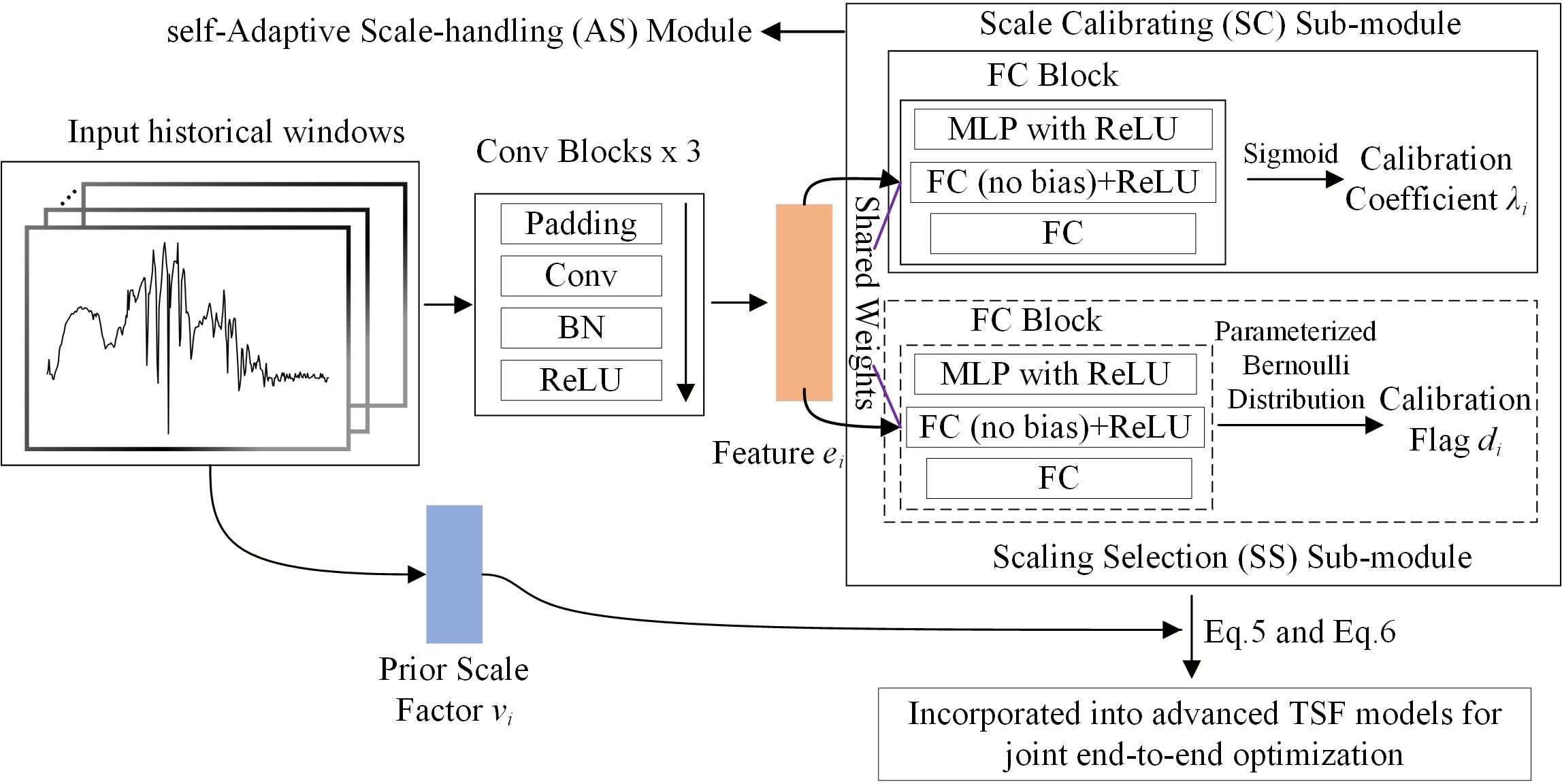
Figure 2: The AS-enabled framework: feature extraction, computation of calibration coefficient λ^ and binary calibration flag di, and adaptive application of scale correction per window.
- Scale Calibrating: The SC module first computes a prior mean scaling factor vi for each sample, following the logic in DeepAR, ensuring numerical stability via offsetting by 1. Temporal features are extracted from input sequences using consecutive convolution blocks. These features are processed through deep, bias-free fully connected layers, culminating in a sigmoid for normalized calibration coefficient λi. To facilitate training stability, batch-level averaging yields λ^, producing the calibrated factor vi=λ^vi.
- Scaling Selection: Unconditional application of calibration can degrade performance when priors are already well-suited. The SS sub-module solves this by parameterizing a binary Bernoulli over a Gumbel-Softmax, where a parallel feature extractor Φ independently predicts per-instance calibration needs. The resulting indicator di determines whether to use the calibrated or original scale factor for each input window.
- End-to-End Integration: During both training and inference, input Xih is scaled by v^i, and the TSF backbone operates in normalized space. Predicted values are upscaled using the same instance-specific di0. The process is fully differentiable and supports seamless integration with any deep TSF model.
Experimental Evaluation
Datasets and Baselines
Experiments utilize real-world fund sales datasets (Ant Fortune, Alipay), with stark scale heterogeneity observed across product series (up to di1 fold differences). Canonical TSF architectures (Informer, Transformer, Performer, Autoformer) serve as backbones. Variants include baseline vanilla scaling, no preprocessing, and (for ablation) SC-only or combined SC+SS instantiations.
Metrics and Loss Functions
Evaluation metrics focus on scale-invariant measures: weighted MAPE (WMAPE), Root Squared Error (RSE), and PMAE. All training employs WMAPE loss, corroborating its superior stability in heterogeneous contexts compared to MSE, which disproportionately penalizes high-scale series and destabilizes convergence.
Results
Across all backbone models and datasets, the AS module establishes a clear hierarchy: AS di2 vanilla scaling di3 no preprocessing. Notably, both global normalization and standardization are contraindicated, performing worse than simple no-scaling, which accentuates their unsuitability in scale-heterogeneous TSF. SC-only configurations characterize an improvement in some cases; however, without SS, over-calibration emerges, especially in models like Transformer and Informer on data with well-aligned priors. Critically, the joint SC+SS design consistently avoids these pitfalls.
Numerically, Autoformerdi4 achieves WMAPE improvements (e.g., di5 vs.\ di6 for vanilla scaling and di7 for no preprocessing), with similar trends manifesting across all major architectures. Ablation confirms that SS is essential in moderate-to-large variable scenarios, providing at least parity with vanilla scaling in the worst case and clear improvement otherwise.
Implications and Theoretical Significance
The AS module's main theoretical contribution is the formalization and operationalization of selective, neural scale calibration at the instance level in TSF. By introducing both data-adaptive recalibration via deep networks and a differentiable decision boundary (SS via Gumbel-Softmax), it directly counteracts both gradient dilution for small-scale series and error explosion for large-scale series following inverse transformation. This represents a shift from static or rule-based data preprocessing to fully trainable, architecture-integrated normalization, enhancing semantic fidelity and controllability in joint modeling.
The approach generalizes across Transformer-like and lightweight linear models, illustrating that its benefits are orthogonal to the specific backbone. For practical industrial deployments—where new products regularly appear and training data for low-volume items is sparse—this enables effective transfer learning and boosting of series with marginalized signals.
Limitations and Open Problems
While robust to large cross-series scale differences, several open issues persist. The paper notes that when expanding beyond two variables per product, particularly with increased intra-product scale diversity, calibration factors become less stable; cross-variable coordination is a necessary future extension. Moreover, per-sample calibration factors introduce additional sources of stochasticity during early training, only partially mitigated by batch-mean strategies. Thus, further research is warranted on more stable, perhaps structured, adaptive factor estimation and on integrating scale-coordination mechanisms within the AS framework.
Conclusion
This work introduces a self-Adaptive Scale-handling module as a differentiable, adaptive, and selective approach to TSF under scale heterogeneity. By dynamically learning to calibrate or retain scale factors per instance within an end-to-end framework, it surpasses traditional preprocessing, ensuring both error minimization and inter-series discriminability. The architecture-agnostic design, strong empirical gains, and theoretical underpinning make it a principled advancement for TSF in heterogeneous industrial environments. Future directions include enhancing calibration stability for high-dimensional settings and extending adaptive scaling to broader classes of neural models.