- The paper demonstrates a novel 3D passive ring gyroscope design that leverages a tetrahedral configuration to overcome limitations of traditional active gyroscopes.
- It outlines a robust methodology using PDH locking, FPGA control, and beat frequency extraction for precise Sagnac-based rotational measurements.
- Experimental validation against a MEMS gyroscope confirmed μrad/s sensitivity and effective full-vector reconstruction of seismic ground rotations.
Three-Dimensional Passive Ring Gyroscope for Rotational Seismology
Introduction and Motivation
Precise observation of rotational ground motions is essential in seismology, geodesy, inertial navigation, and fundamental physics. Sagnac interferometer-based ring laser gyroscopes (RLGs) represent the state-of-the-art in measuring rotation rates, with sensitivity sufficient for resolving both seismic phenomena and geodynamic signals including Earth's rotation and its variations. Traditional active RLGs achieve high stability and sensitivity but suffer from gain medium degradation, multi-mode operation, and backscatter-induced coupling. Passive ring gyroscopes (PRGs), which rely on externally injected probe lasers, circumvent many of these limitations. The work presents a prototype of a compact, transportable three-dimensional free-space passive ring gyroscope, specifically targeting seismic applications and local full-vector reconstruction of ground rotation.
Tetrahedral Gyroscope Design
The core of the system is a tetrahedral array comprising four highly stabilized triangular optical cavities interconnected via stainless-steel rods. Each cavity consists of three high-finesse plano-concave mirrors forming a 0.5 m-side triangle, yielding a perimeter of 1.5 m and a free spectral range (FSR) of 200 MHz. The tetrahedral topology ensures full three-dimensional rotation measurement capability and allows system-level consistency checks.
The optical architecture integrates a fiber-coupled, single-frequency laser operating at 1550 nm and below 100 Hz linewidth. Light is split into clockwise (CW) and counter-clockwise (CCW) directions for each cavity, modulated by electro-optic and acousto-optic modulators for independent frequency locking via the Pound-Drever-Hall (PDH) method, and coupled into free-space via precision collimators. The control system employs a field-programmable gate array (FPGA) for feedback loop execution, locking the laser to cavity resonance and synchronizing the radio-frequency drives. Slow feedback employing piezoelectric actuators on one mirror per cavity enables compensation for mechanical and environmental perimeter drifts.
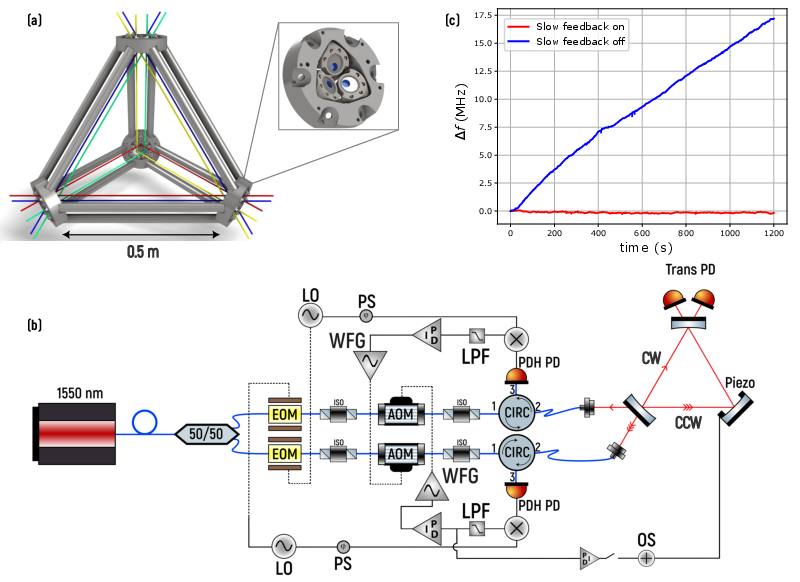
Figure 1: Mechanical and optical schematic of the tetrahedral passive ring gyroscope, with details of the electronic and fiber connections, mirror holders, and long-term frequency drift stabilization.
The rotation signal is extracted as the difference between the RF drives applied to the AOMs for CW and CCW directions, with the resulting beat frequency directly proportional to the Sagnac effect-induced rotation rate. This electronic acquisition approach eliminates reliance on optical beat detection and improves immunity against ambient noise.
Three-Dimensional Rotational Reconstruction
The tetrahedral system defines a Cartesian coordinate frame relative to the optical table. Each cavity measures the projection of ground rotation onto its surface normal ni, sensitive to rotations perpendicular to the cavity plane. A non-coplanar triplet of cavities suffices to reconstruct the full 3D rotation vector via inversion of the normal matrix. The overcomplete system with four cavities allows further statistical uncertainty reduction, but this was not exploited due to performance differentiation among the cavities.
System validation included mounting a commercial MEMS gyroscope aligned to the table axes. Controlled excitation sequences (axis tilt, translation) simulated seismic rotations and translations. Sagnac frequency shifts were converted to rotation rates and compared against MEMS readouts, demonstrating accurate and consistent reconstruction for all axes and dynamic motion sequences.
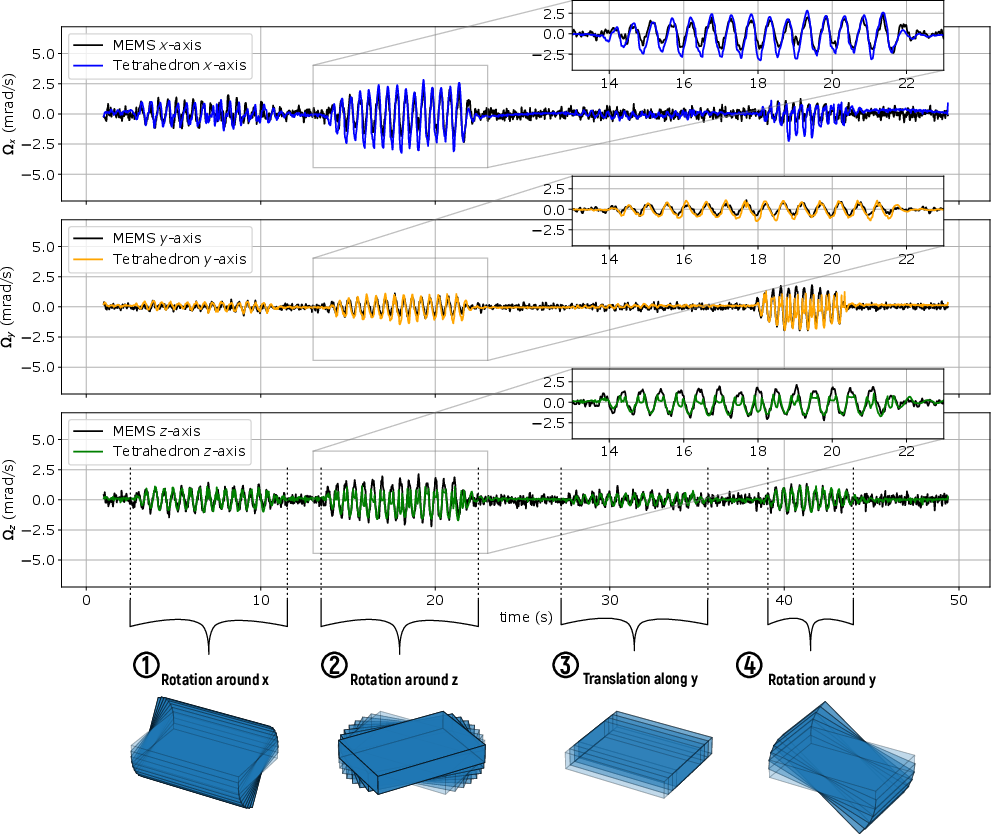
Figure 2: Reconstructed Ωx, Ωy, and Ωz rotation rates during simulated seismic excitation, compared to a MEMS gyroscope reference.
Cross-coupling between rotational signals was observed due to excitation mechanics, but the PRG reliably resolved principal axis rotations and temporal dynamics, highlighting its fidelity for complex ground motion observation.
Self-Noise Characterization and Sensitivity Analysis
Noise analysis was performed with the optical table static. The Welch amplitude spectral density revealed axis-dependent noise characteristics: flicker noise ($1/f$) dominated at low frequencies for the z and y axes, while Brownian (1/f2) noise was prominent on the x axis, particularly below 1 Hz. The transition frequencies between noise regimes varied by axis, correlating with the number of cavities used in the reconstruction and their respective optical finesses. Acoustic and electronic interference peaks were identified at 15 Hz (piezo), 50 Hz (electronics), 64 Hz (HEPA filter), and 77 Hz (FPGA).
The Allan deviation quantified short-term sensitivity: minima of 6, 7, and 29 μrad/s for Ωx0, Ωx1, and Ωx2 axes, respectively, were achieved at integration times between 0.1 and 0.4 s. White-noise-limited sensitivities reached Ωx3 = 7, Ωx4 = 2, Ωx5 = 3 Ωx6rad/s/Ωx7. The Ωx8 axis was consistently inferior due to lower cavity finesse and reconstruction complexity.
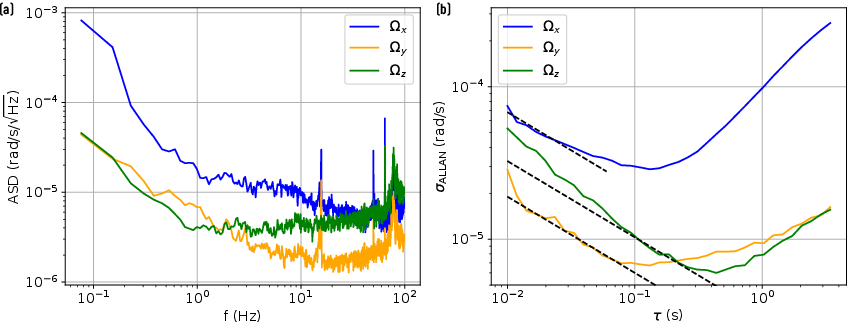
Figure 3: Amplitude spectral density and Allan deviation of reconstructed rotations for all three axes, showing axis-dependent noise floors and integration-time sensitivities.
The observed noise is attributed mainly to air movement and thermal fluctuations. With vacuum enclosure and enhanced thermal isolation, sensitivity could improve by orders of magnitude, approaching the shot-noise limit at Ωx9nanoradian/s/Ωy0 [U. Schreiber 2013]. Mirror surface quality and symmetric cavity optimization are further avenues for performance enhancement.
Practical and Theoretical Implications
The prototype demonstrates practical feasibility for compact, transportable 3D PRG systems in rotational seismology and geodesy. Sensitivities in the Ωy1rad/s/Ωy2 regime—without extensive optimization—validate its utility for full-vector seismic wavefield reconstruction and distributed sensor arrays. Such instruments enable six-degree-of-freedom ground motion measurements, advancing earthquake source characterization and spatial resolution. Portable deployment facilitates targeted campaigns post-seismic event and in sparsely instrumented regions.
Theoretically, combining RLG-level sensitivity with fiber-optic gyroscope portability addresses a longstanding gap in rotational seismology. PRGs provide Sagnac-based rotation measurement decoupled from laser gain instability and lock-in effects, broadening operational bandwidth for millisecond-to-hour timescales critical in seismology. Further advances in cavity vacuum engineering and super-polished mirrors are projected to push sensitivities to the nanoradian/s/Ωy3 sphere, potentially surpassing the Rotational Low Noise Model (RLNM) [Brotzer 2023].
Conclusion
The study presents a transportable, high-finesse, three-dimensional passive ring gyroscope for seismological applications, enabling full-vector ground rotation measurement at Ωy4rad/s/Ωy5 sensitivities. The device demonstrates robust 3D reconstruction, validated against commercial MEMS gyroscope benchmarks, and offers a pathway for distributed rotational sensing networks. Current noise floors are dominated by environmental and optical imperfections, but systematic improvements in vacuum isolation and mirror technology promise near-theoretical performance. The design constitutes a significant advance toward comprehensive, deployable rotational seismology instrumentation.