- The paper reveals that robust compositional circuits emerge only within a narrow depth-connectivity regime in MLPs.
- The study introduces similarity-based pruning to collapse entangled representations, outperforming traditional pruning strategies.
- The research establishes that optimal depth and sparse connectivity are critical for achieving monosemantic and generalizable features.
Compositionality Emerges in a Narrow Depth–Connectivity Regime: Architectural Constraints and Solution Manifolds
Motivation and Problem Statement
Despite the broad success of foundation models (LLMs, VLMs, diffusion models) in challenging generative and reasoning tasks, their generalization remains brittle when subjected to distributional shift, particularly in compositional understanding. These models often fail to bind attributes, maintain object relations, or preserve semantic content under minor prompt or visual perturbations. Prior mechanistic analyses attribute this fragility to polysemanticity—neurons encoding multiple unrelated concepts—leading to fractured entangled representations (FER), rather than monosemantic and compositional circuits. The central question addressed is: under which architectural and training conditions can monosemanticity and compositionality emerge from gradient-based optimization?
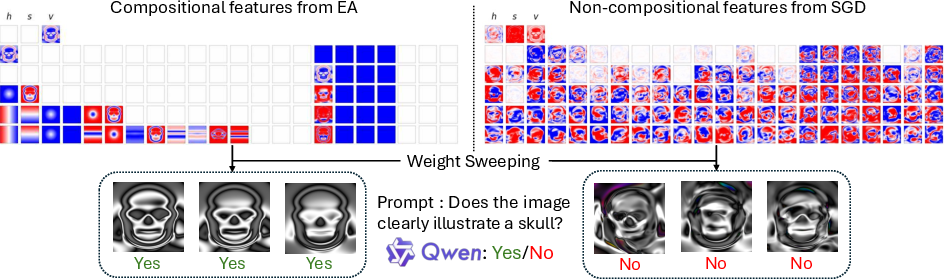
Figure 1: Comparing internal structure (Red=-1, White=0, Blue=1): an evolutionary algorithm produces factorized intermediate features, whereas SGD-trained networks typically exhibit fragmented, entangled ones.
Architectural Bias and Compositional Emergence
The paper empirically demonstrates that compositional circuits only reliably emerge in multilayer perceptrons (MLPs) within a narrow regime defined jointly by depth and connectivity. Specifically, networks exhibiting sparse and specialized wiring—such as those discovered by NEAT in Picbreeder—permit strong compositionality and monosemantic intermediate features (cf. Figure 1). Dense MLPs trained by SGD, even when allowed equivalent computational scaling, seldom reach such solutions; optimal architectural bias must preserve specific wiring patterns rather than mere weight sparsity.
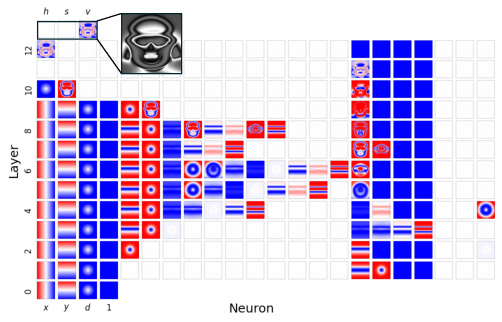
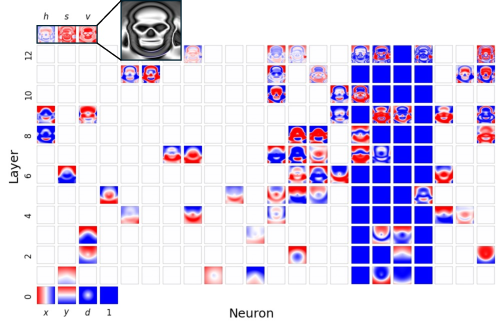
Figure 2: Architectural bias shapes compositionality; similarity-based pruning collapses a dense solution into a sparse, structured subnetwork, yielding clear spatial motifs and symmetry.
Similarity-based pruning (SP), introduced by the authors, prunes neurons with redundant activations, preserving those with disjoint semantics. This method collapses entangled circuits and recovers compositional solutions, outperforming classical pruning strategies such as Lottery Ticket, LLM-Pruner, and Wanda.
Depth-Connectivity Interaction and Structural Reachability
Compositionality is not monotonic with network depth or width. Empirical results show a pronounced peak in compositionality at target-dependent depths; moving shallower or deeper destroys monosemantic structure, even with optimal connectivity.
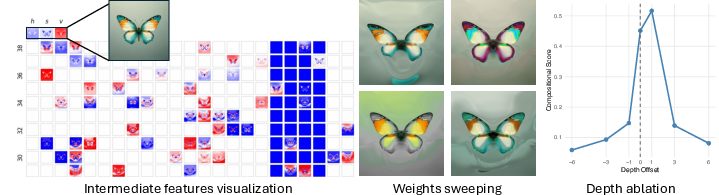
Figure 3: Qualitative results on out-of-domain targets; SP and depth search yield monosemantic features and meaningful semantic invariance under weight perturbations, including a compositionality peak at predicted depth.
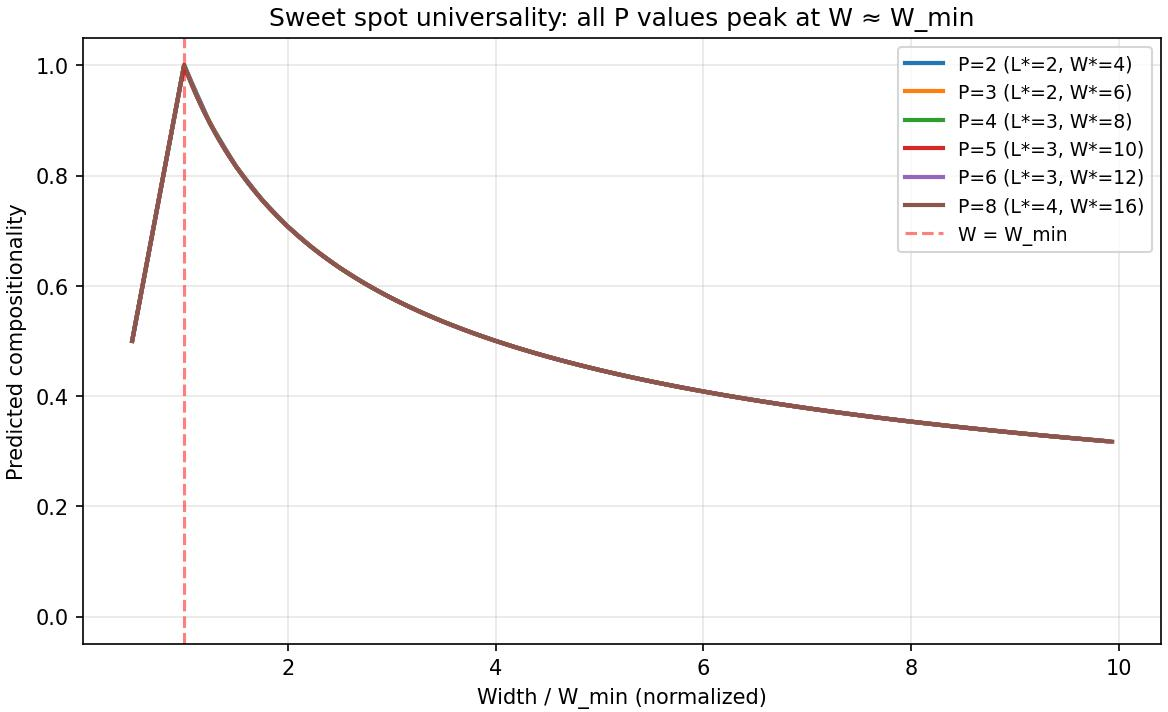
Figure 4: Sensitivity analysis: predicted compositional score versus normalized width, validating universal concentration of compositionality at the architectural sweet spot.
A theoretical framework based on compositional sparsity and volume-ratio arguments is developed. The compositional volume ratio ρ(W,L) formalizes the prior probability of landing in a compositional basin given width and depth. The analytic bounds predict that ρ is sharply localized at (Wmin,L⋆), where Wmin scales with the number of primitives and L⋆ is the minimal depth required for a balanced compositional tree. As task complexity increases (P grows), ρ becomes exponentially rare, emphasizing the necessity for precise architectural design.
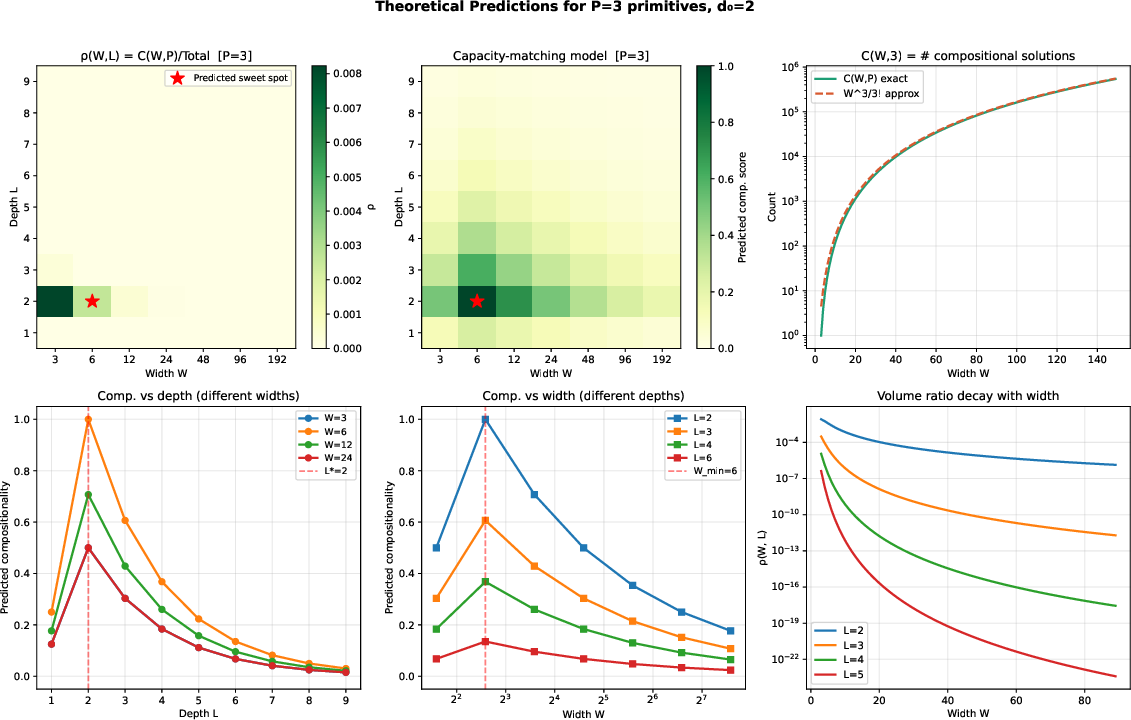
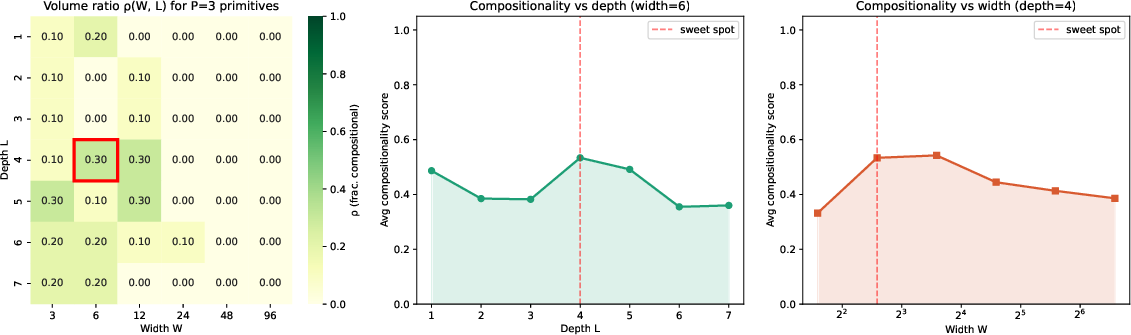
Figure 5: Theoretical versus empirical volume ratio ρ(W,L) highlights concentration of compositionality at predicted architectural sweet spots.
Methodologies and Benchmarking
The authors introduce EMC2-Bench—a suite that quantitatively measures compositionality by semantic invariance under weight sweeping. Perturbed weights are evaluated by VLMs for retained semantic content, and compositional circuits are scored. Only similarity-based pruning (SP) yields non-zero compositionality scores; baseline methods fail to produce semantically invariant circuits at comparable sparsity.
Further, a heuristic depth predictor correlates optimal compositional depth with input image complexity (measured via PNG compression ratio), enabling efficient depth search when ground-truth compositional solutions are unknown.
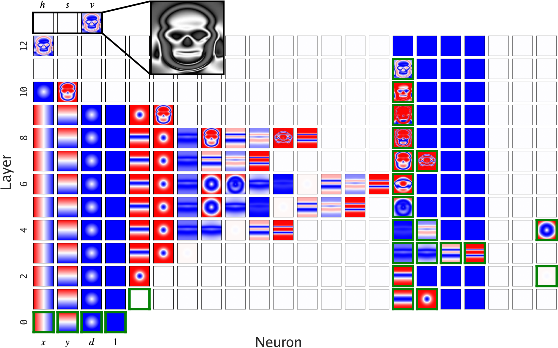
Figure 6: Internal representation of the Picbreeder skull CPPN benchmark for compositionality.
Quantitative and Qualitative Results
SP combined with advanced optimization (Muon) reliably uncovers compositional structure across both reference (Picbreeder) and out-of-domain targets. Results indicate that:
- SP is the only pruning strategy with nonzero compositionality scores.
- Increasing optimizer quality (e.g., Muon with additional Newton-Schultz iterations) further enhances compositional emergence.
- Depth sweeps expose sharp compositionality peaks, aligning with theoretical predictions.
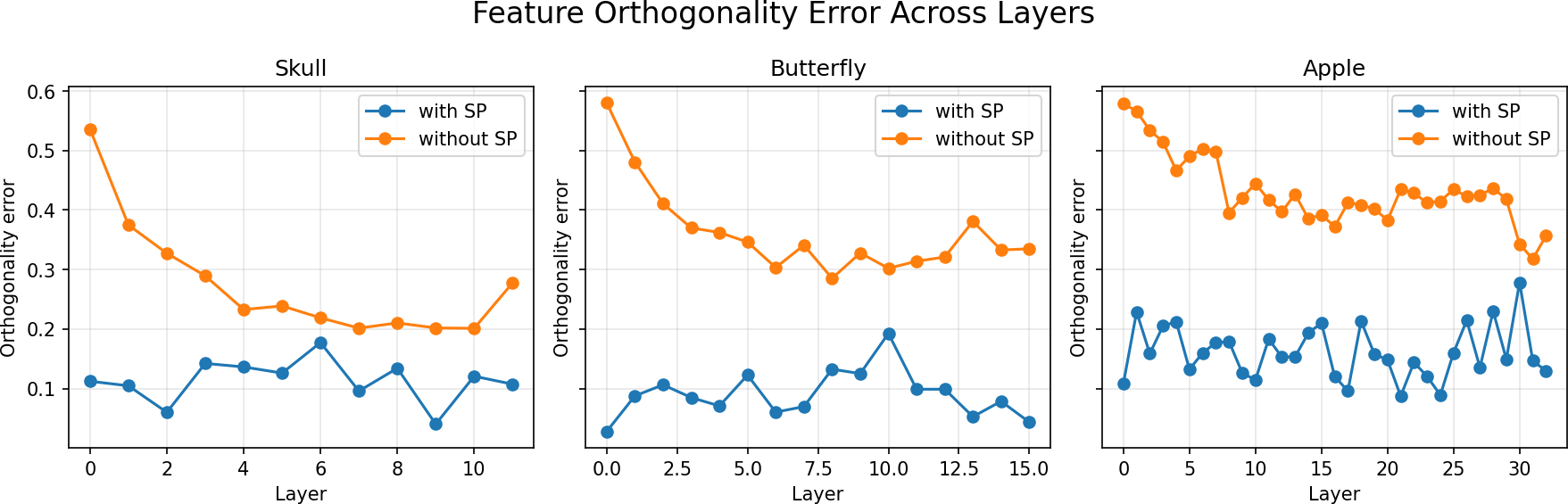
Figure 7: Feature orthogonality comparison: SP lowers orthogonality error and enhances monosemanticity relative to baseline dense networks.
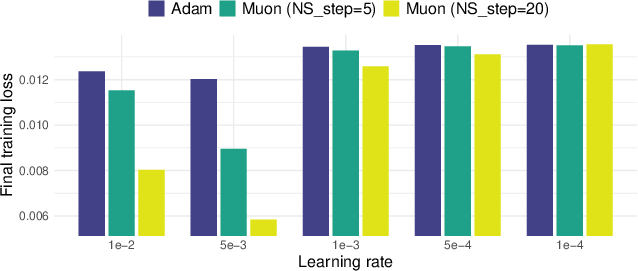
Figure 8: Final training loss on Picbreeder’s skull: Muon optimizer achieves lower minima, supporting improved compositionality.
Theoretical Framework and SGD Dynamics
The theoretical analysis connects compositional sparsity to monosemanticity via the Welch bound: compositional circuits minimize destructive interference, thus enabling orthogonal (monosemantic) features. Three mechanisms bias SGD toward compositional basins:
- Forced uniqueness: At the sweet spot, only the compositional basin exists.
- Basin flatness: Compositional solutions are flatter; SGD prefers flat minima.
- Gradient signal clarity: Sparse, minimal networks allocate gradients unambiguously to unique primitives.
These mechanisms are mutually reinforcing and explain empirical emergence in appropriately constrained architectures.
Implications and Future Directions
Architectural choices—not scale, sparsity, or low training loss alone—drive compositional generalization. The narrow depth-connectivity sweet spot predicts a precise locus for emergent compositionality, and outside this regime, gradient descent converges to fractured, entangled solutions lacking reusable subcircuits.
Practical implications include:
- Model design: Sparser, carefully pruned architectures are essential for robust compositionality and generalization.
- Benchmarking and interpretability: EMC2-Bench provides a reproducible metric for compositional emergence.
- Optimization: Advanced optimizers, such as Muon, are effective in discovering compositional minima.
Theoretically, as task complexity increases (more primitives), compositional solutions become exponentially rare, necessitating stronger structural and inductive biases.
Conclusion
Monosemanticity and compositionality are structurally contingent properties, emerging only within a narrow, target-dependent regime of depth and connectivity. The combination of similarity-based pruning, heuristic depth prediction, and compositional sparsity offers a pathway to recover these circuits via gradient-based training. Both empirical and theoretical results clarify why compositional solutions are rare and suggest that generalization in foundation models is fundamentally tied to architectural constraints making compositional manifolds accessible to optimization (2606.19941).

