- The paper establishes the concept of a twist soliton as a localized 2π helicity modulation along a magnetic skyrmion tube.
- It combines large-scale Landau-Lifshitz-Gilbert simulations with analytical modeling to reveal quadratic current-dependence and chirality effects on soliton dynamics.
- Results suggest practical spintronic applications by enabling electrical detection and magnetic control of complex 3D topological solitons.
Creation and Manipulation of Twist Solitons in Magnetic Skyrmion Tubes
Introduction
This study systematically explores the formation, dynamics, and electrical detection of twist solitons in three-dimensional (3D) magnetic skyrmion tubes (2606.19900). Magnetic skyrmion tubes constitute topological solitons in 3D chiral magnets, formed by stacking two-dimensional (2D) skyrmions along the out-of-plane direction. Recent advances in magnetic imaging have enabled direct observation of skyrmion tubes and stimulated investigations into their topological deformation modes, including bending and twisting. While the dynamics of bent skyrmion tubes have been extensively examined, the implications of twist degrees of freedom, and their soliton excitations, are largely unexplored.
The paper establishes the concept of a "twist soliton" as a localized modulation of skyrmion helicity along the tube direction and thoroughly characterizes its nonlinear current-driven dynamics, chirality dependence, and emergent electromagnetic responses. The research combines large-scale micromagnetic Landau-Lifshitz-Gilbert (LLG) simulations and analytical modeling, revealing novel physical mechanisms and proposing measurable protocols relevant for spintronic device functionalities.
Twist solitons are realized via a localized variation of helicity η along the tube axis, producing a 2π modulation over the length of the tube, and characterized by their chirality χ. The helicity profile is fixed by spin interactions, with Dzyaloshinskii-Moriya interaction (DMI) playing a crucial role in determining the energetically favored state. Previous reports mostly considered uniformly helicity skyrmion tubes or surface-induced twists, but the present study demonstrates the intrinsic stabilization of twist solitons, even in bulk systems without surface effects.
The authors invoke the Kibble-Zurek mechanism to explain defect formation during thermal quench dynamics. By quenching from a random high-temperature spin state, formation of 2π-twist solitons on skyrmion tubes can be observed probabilistically. The twist is spatially localized due to the specific DM vector configuration, analogous to soliton formation in helimagnets under magnetic fields.
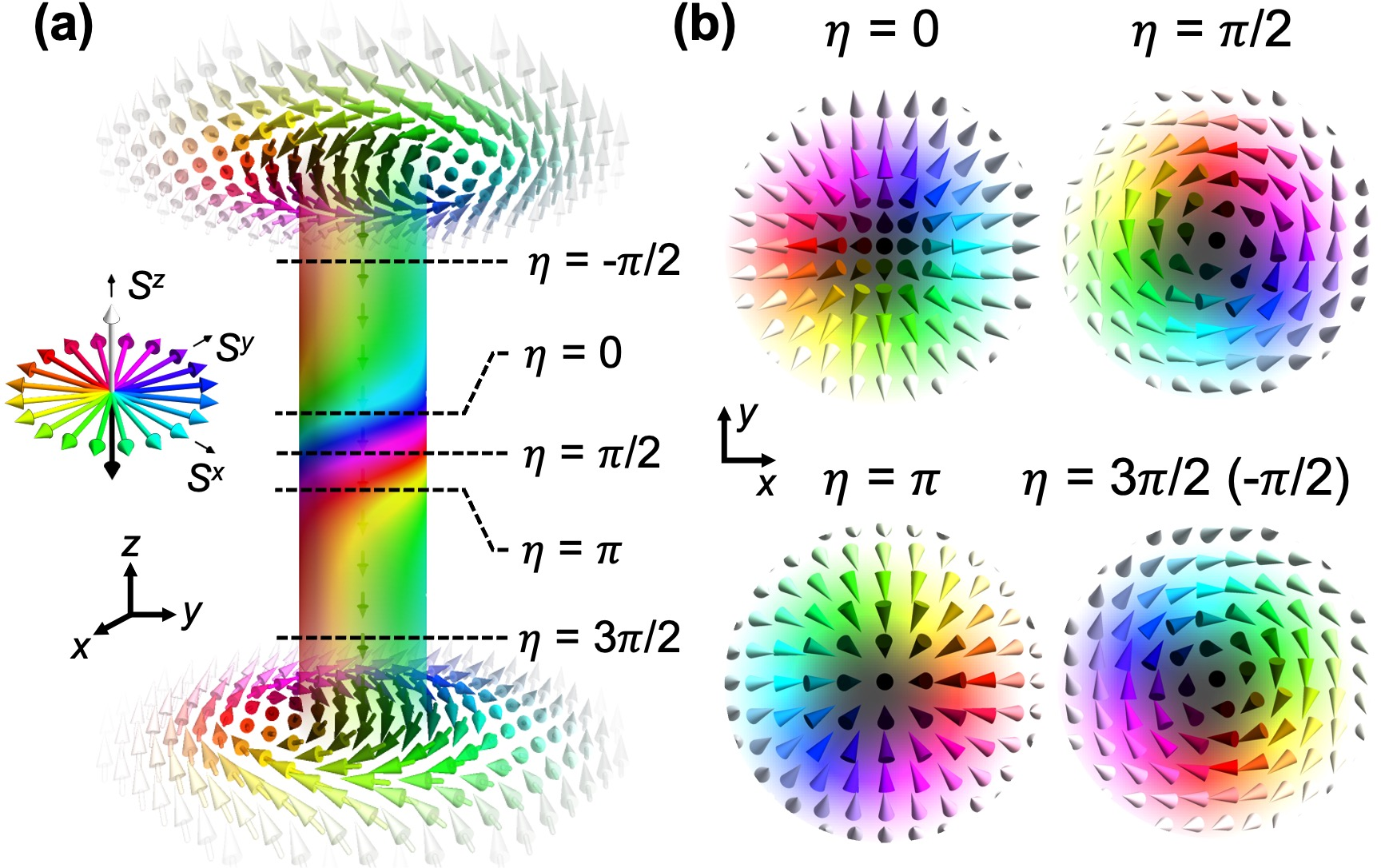
Figure 1: Schematic illustration of a locally twisted skyrmion tube, depicting continuous z-dependent helicity modulation and cross-section spin configurations for various η values.
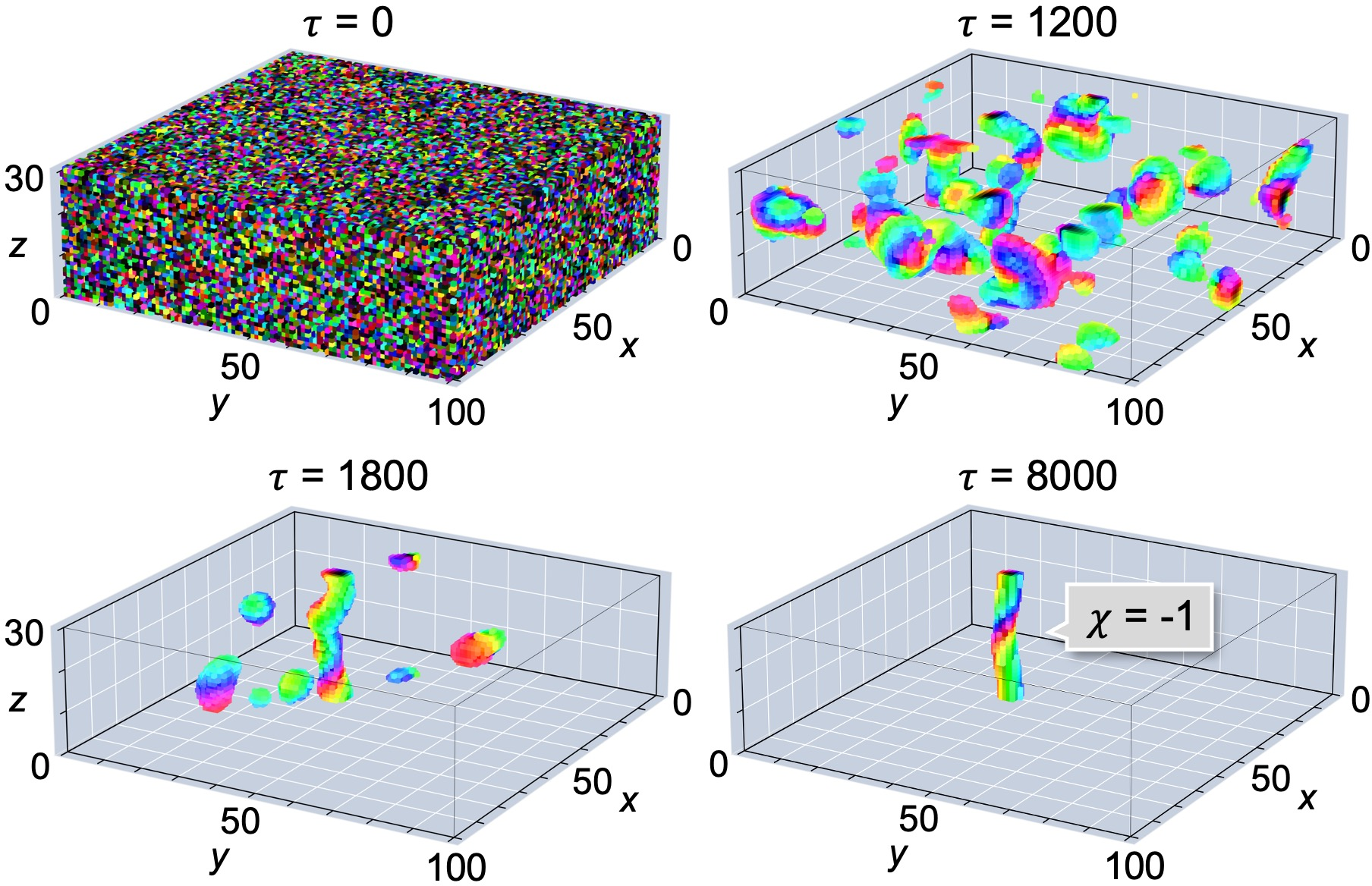
Figure 2: Sequential snapshots of the stochastic creation process for a twisted skyrmion tube under thermal quench dynamics.
Statistical analysis of numerous independent quenching runs confirms the preference for chiralities determined by the DM vector and supports the applicability of the protocol to materials such as MnSi and FeGe.
Current-Driven Dynamics and Chirality Dependence
The research investigates dynamics induced by spin-transfer torque (STT) from an applied in-plane electric current perpendicular to the tube axis. Numerical experiments, performed for both χ=±1 twist solitons, reveal that in-plane currents generate conventional longitudinal and transverse skyrmion tube motion (Hall effect) and also induce pronounced out-of-plane (tube-direction) propagation of the twist soliton. The tube motion is linear in current amplitude, while the soliton velocity exhibits a strong quadratic dependence and reverses direction with chirality.
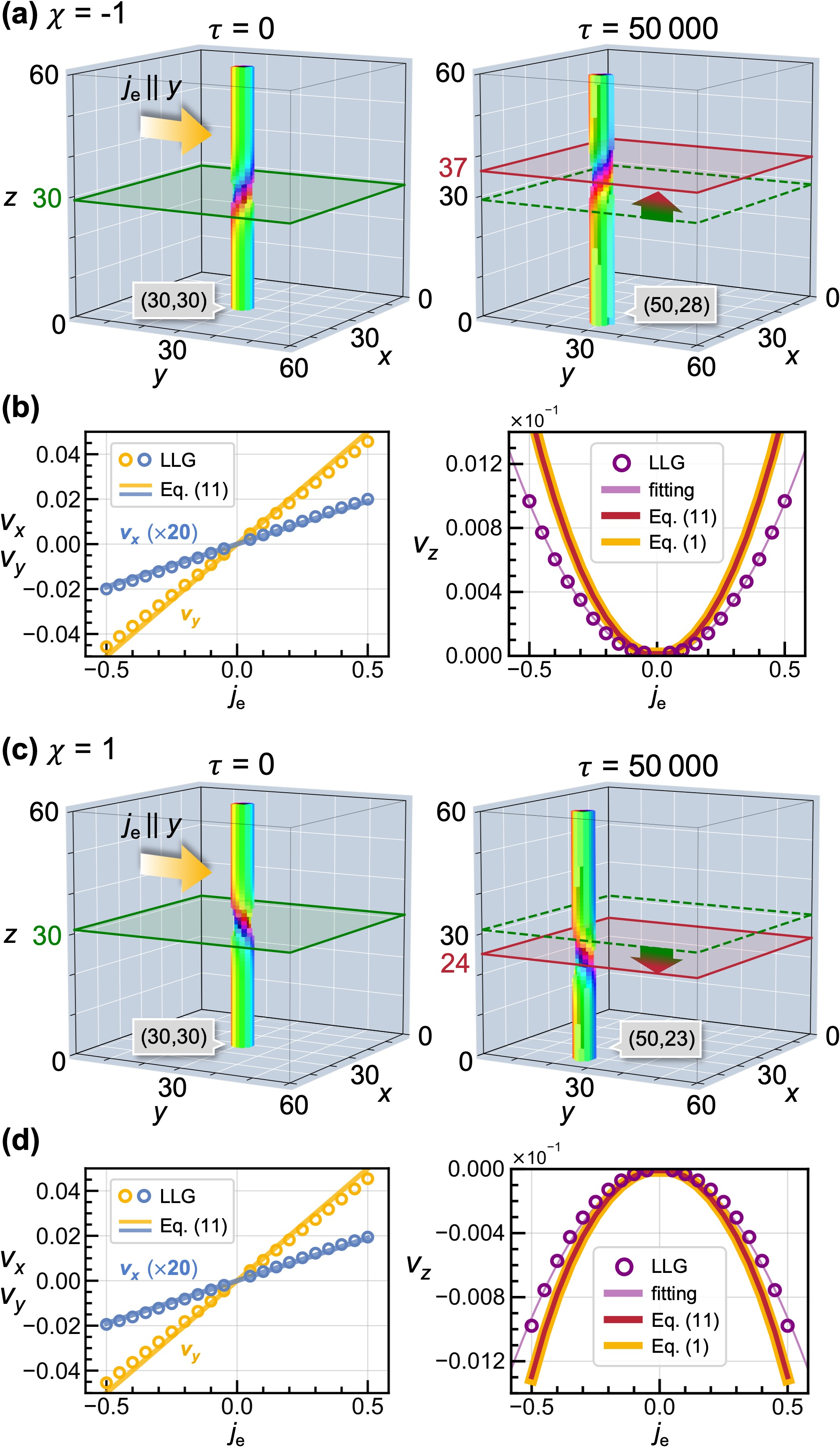
Figure 3: Current-driven motion of twisted skyrmion tubes, showing chirality-dependent out-of-plane propagation and velocity scaling with current amplitude.
Analytical modeling via the Thiele approach clarifies the mechanism: off-diagonal dissipative tensor components (DYZ) mediate the coupling between in-plane current and out-of-plane soliton motion. The sign and amplitude of vz depend on both twist chirality and the current, with the analytical formulas capturing the essential quadratic trend but showing quantitative deviation due to rigid-body and lattice effects.
Control via Magnetic Fields and Magnetization Response
The out-of-plane soliton velocity is highly sensitive to the orientation of the applied magnetic field. Even a slight in-plane component By (relative to the dominant 2π0) produces linear enhancement and nonreciprocal control of 2π1 through first-harmonic corrections to the dissipative tensor. Simulations explicitly demonstrate several-fold increases in soliton velocity for small tilt angles and gain/loss in velocity for opposite chirality or current direction.
The mechanism is further confirmed by measuring the STT-induced magnetization 2π2 as a function of 2π3: dips in 2π4 correlate with twist-soliton positions and differentiate the directionality of soliton motion by chirality.
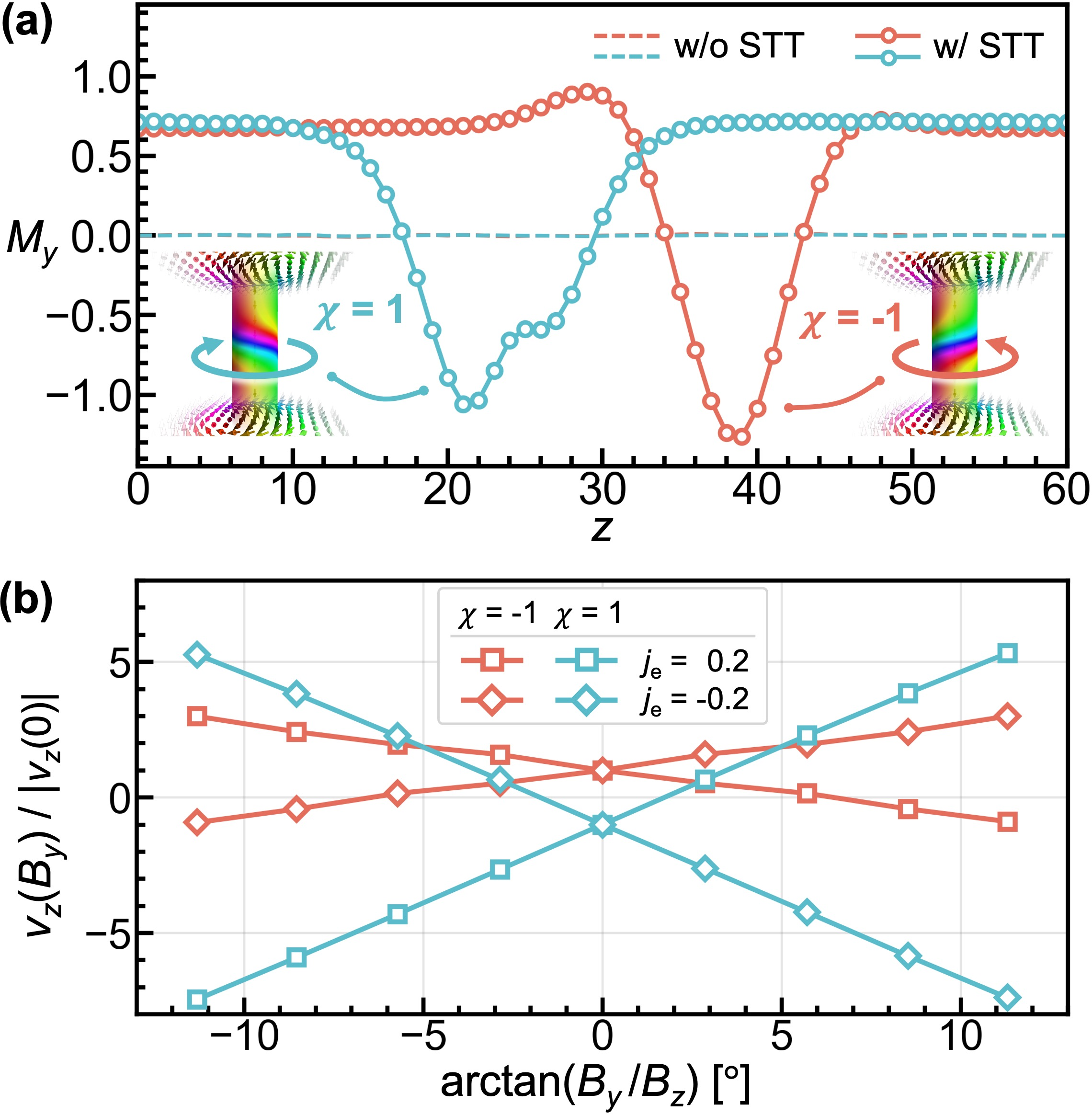
Figure 4: Chirality-dependent STT-induced magnetization and soliton velocity enhancement under applied tilted magnetic fields.
Emergent Electric Field and Electrical Detection
Twist soliton motion generates an emergent electric field (EEF), equivalent to the spin-motive force, along the tube direction. The EEF, defined via time-derivative and spatial-gradient cross products of the spin texture, is dominated by dissipative contributions proportional to 2π5 and the dissipative tensor. Importantly, the EEF is quadratic in current and chirality, permitting electrical detection and discrimination of twist soliton presence, direction, and chirality via out-of-plane Hall measurements.
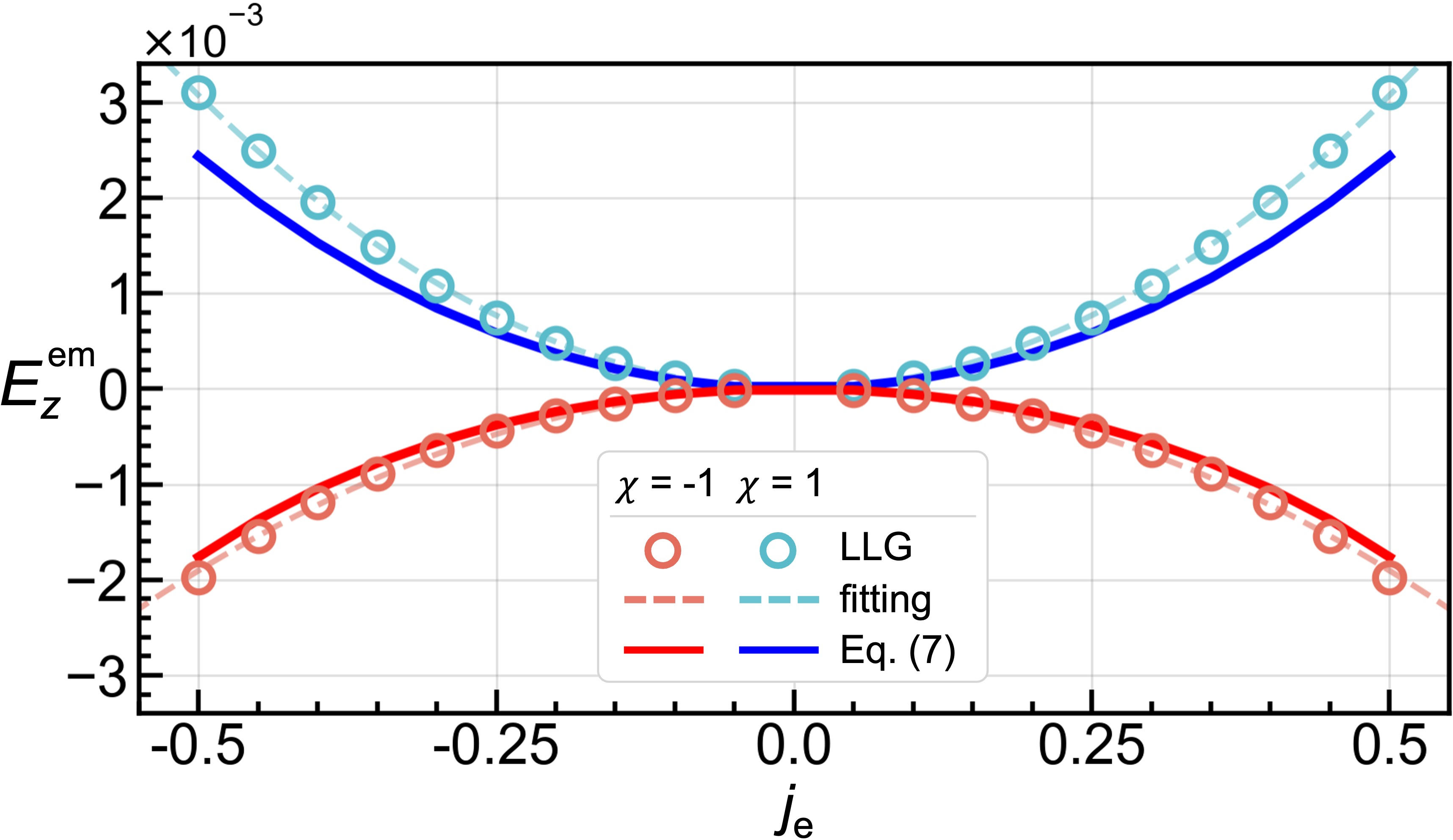
Figure 5: Dependence of the nonadiabatic contribution to the emergent electric field on twist chirality and current amplitude, evidencing quadratic scaling and sign reversal.
Implications and Future Directions
The primary theoretical implication is the establishment of the twist degree of freedom as a crucial dynamical parameter for skyrmion tube physics. The results pave the way for manipulating and detecting topological solitons in 3D magnetic systems, with immediate practical relevance for spintronic architectures leveraging nontrivial magnetic texture dynamics (e.g., information carriers, soliton-based logic). The electric-field detection protocol offers a foundation for device design and experimental verification.
Further avenues include deterministic creation methods for twist solitons (e.g., edge injection using tailored fields or vortex beams), crystalline states of multiple twist tubes, effects on magnon transport, and direct extensions to hopfion and mixed-topology soliton systems. The analogy to twisted magnetic flux tubes in astrophysical contexts (e.g., solar flares) hints at cross-disciplinary applications. Rigorous modeling, advanced imaging, and collective transport studies are necessary to fully harness the topological and dynamical richness of twist solitons.
Conclusion
This work comprehensively elucidates the intrinsic formation, nonlinear dynamics, magnetic-field control, and electrical detection of twist solitons in magnetic skyrmion tubes (2606.19900). The twist degree of freedom emerges as an indispensable aspect of 3D topological magnetic physics, promising novel device concepts and fundamental insights into soliton behavior in condensed matter and beyond.